Grumpy opinions about everything.

Category: Art

Grumpy opinions about art.

The Death of Vincent Van Gogh: A Controversy That Won’t Die

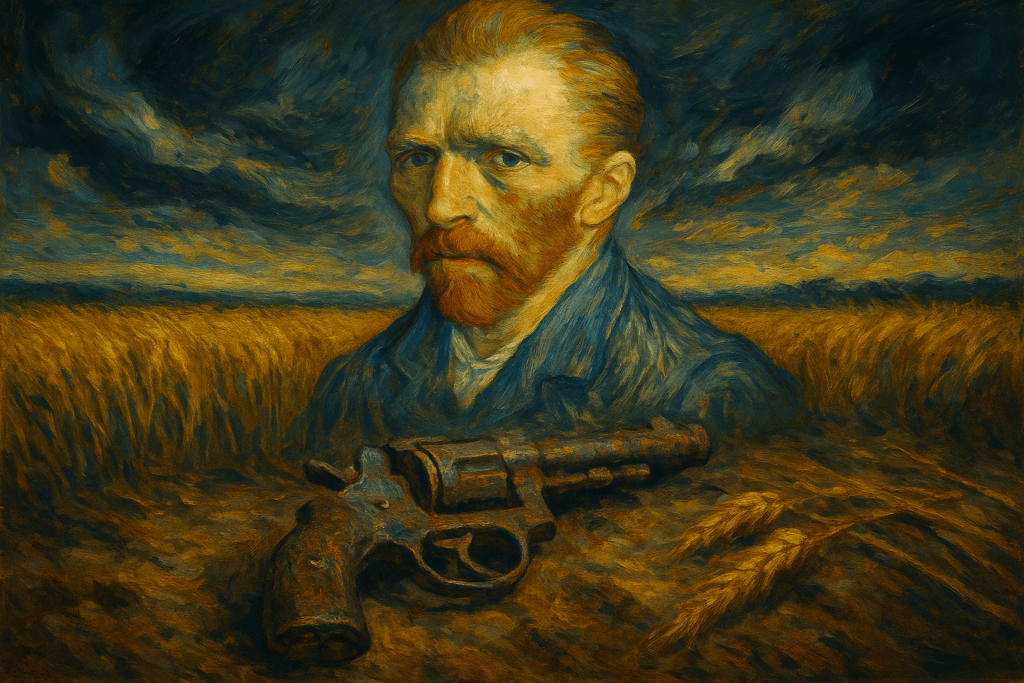
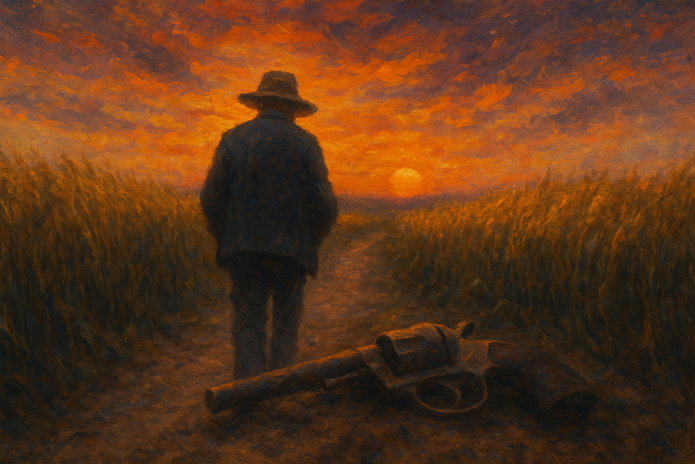
The wheat fields outside Auvers-sur-Oise have become one of art history’s most debated crime scenes. On the evening of July 27, 1890, Vincent van Gogh returned to his small inn, badly wounded and clutching his chest. What happened in those fields remains unsettled: did he shoot himself, as generations believed, or was he caught in some kind of accident—or even an intentional shooting by someone else?

When I first got interested in art, van Gogh grabbed me right away. His paintings felt urgent, almost breathless, as if he couldn’t get his vision out fast enough. The more I learned about his short, turbulent life, the more I wondered what forces drove that energy—and what cut it short.

How we interpret his death matters. If we see it as suicide, we reinforce the familiar trope of the “tortured genius,” a man undone by the same demons that fueled his creativity. If it wasn’t suicide, then that myth fractures, and we’re left with someone whose life ended not by fate or torment, but by chance and circumstance.

The Traditional Story: A Troubled Artist’s Final Day
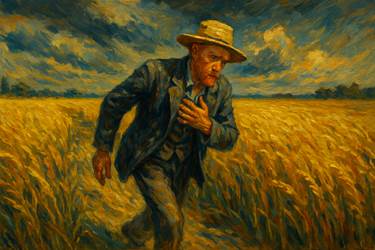
For more than a century, the standard version has been simple: van Gogh, struggling with depression and recurring psychiatric crises, walked into a wheat field and shot himself. He had been living in Auvers-sur-Oise and painting furiously—roughly 70 works in 70 days. Some saw that productivity as a sign of mounting instability.

According to Adeline Ravoux, the innkeeper’s daughter, he left after breakfast and didn’t return until after dark. When police asked what happened, he reportedly said, “Do not accuse anyone. It is I who wanted to kill myself.”

Van Gogh had a long history of mental-health struggles—severe depression, psychotic breaks, even earlier suicidal behavior. His letters often carried a tone of exhaustion; in one to his brother Theo, he wrote, “The sadness will last forever.”

Theo, who died just six months later, recalled his brother saying, “I wish I could have gone away like this.”
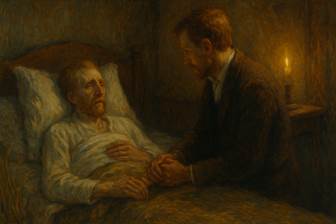
Doctors, friends, and family at the time took all this as confirmation of suicide. The narrative of a gifted but tormented artist ending his own life fit neatly into late-19th-century ideas about genius and madness—and it has persisted ever since. The Van Gogh Museum still supports this interpretation:

The Murder Theory: A Challenge to the Old Story

The debate shifted dramatically in 2011 when Steven Naifeh and Gregory White Smith published Van Gogh: The Life. They argued the suicide story didn’t fully line up with the evidence.

Their alternative theory centers on René Secrétan, a 16-year-old local who liked to tease van Gogh and who reportedly had access to a faulty pistol. The authors note several problems with the suicide explanation:

  • Van Gogh rarely had access to weapons and had a stated dislike for them.
  • His final paintings were calm, not despairing.
  • He had described suicide as sinful.
  • He somehow walked more than a mile back to the inn after being shot.
  • His painting gear from that day was never found.

They speculate that Secrétan may have accidentally shot him—and that van Gogh, not wanting to ruin the boy’s life, claimed it was suicide. This remains speculation, but it’s one reason the theory caught fire.

The Forensic Debate

A 2020 study added fuel to the controversy. Researchers tested the same model of revolver and reported that a self-inflicted shot at that angle and range likely would have left powder burns—burns that weren’t noted in van Gogh’s case.

Their conclusion: the injury was “in all medical probability” inconsistent with suicide.

Critics push back, noting that van Gogh’s clothing could have blocked powder residue or that details simply weren’t recorded well in 1890. With no autopsy and no preserved clothing, much of this is still guesswork.

The Counterargument: Why Many Experts Still Reject The Murder Theory

Van Gogh scholar Martin Bailey—among others—finds the murder theory unconvincing.  Key points include:

  • Secrétan denied shooting van Gogh when interviewed later in life.
  • He claimed he had left town before the incident.
  • It’s extremely rare for a homicide victim to insist it was suicide.
  • Theo, Dr. Paul Gachet, and others closest to the situation all believed it was self-inflicted.
  • Van Gogh’s burial outside the Catholic cemetery was itself a sign the community accepted suicide—something they would likely have resisted if foul play had been suspected.

What We Actually Know

Despite a mountain of theories, only a handful of facts are certain:

  • Van Gogh was shot in the chest on July 27, 1890.
  • He survived for about 30 hours and died on July 29.
  • No autopsy was performed.
  • The weapon was never recovered.
  • His art supplies from that day disappeared.
  • He left no suicide note.

Everything else rests on testimony, conjecture, and the limits of 19th-century medical documentation.

Why This Debate Matters

The dispute has moved far beyond academia. Films like Loving Vincent (2017) and At Eternity’s Gate (2018) lean into the accident/murder theory. The discussion reflects a broader cultural question: why do we romanticize suffering when we talk about creativity?

If we assume suicide, we risk locking van Gogh into the stereotype that great art comes only from great pain. If we assume an accident, we open the door to imagining a different future—one where he kept painting, evolving, maybe even recovering.

Could Modern Forensics Solve It?

Some researchers want to exhume van Gogh’s remains to analyze the wound using modern techniques. Proponents argue that even degraded bone might show clues about firing distance or angle. That said:

  • It would require major legal and ethical approval.
  • There’s no guarantee the remains would provide answers after 130+ years.

At this point, it remains an academic long shot.

The Bottom Line

Most major institutions still support the traditional suicide explanation. But alternative theories—especially the forensic questions—have made the old story less airtight than it once seemed.

The most honest conclusion is also the least satisfying—we may never know exactly what happened in that wheat field. Too much evidence is missing, and too much time has passed. What remains is a mystery as layered and emotional as the brushstrokes he left behind.
Frédéric Bazille: The Impressionist Who Never Saw Impressionism

I like to think of my research and my writing as being eclectic, although sometimes I have to admit they may be better described as unfocused. This post may be an example of one of those episodes.  Recently I was looking through a magazine and saw an ad with an illustration that was obviously based on Monet’s Garden in Giverny. It sent me thinking about a series of lectures I had watched on French Impressionists and that got me thinking about Frédéric Bazille, an artist I have always found fascinating. I decided to spend a little time looking into him. So, I completely forgot about the project I was working on and started on this one. That may be why I have so many unfinished articles and random files of unrelated research.

In French Impressionism there are names that stand in the forefront— Monet, Renoir, Degas, Manet — and then there are names that hover just behind them. Frédéric Bazille is one of those in the shadows. He was part of the same circle, painted with the same daring brush, and showed the same fascination with light and color. Yet his life ended before Impressionism even had a name. Bazille was killed in the Franco-Prussian War in 1870, at just twenty-eight years old. His death robbed the movement of both a gifted painter and a generous friend who helped shape its history.

A Wealthy Outsider

Bazille was born in Montpellier in 1841, the son of a prosperous Protestant family. Unlike Monet and Renoir, who often lived in dire poverty, Bazille never worried about how to pay for paints or rent. That freedom made him unusual in Parisian art circles.

Bazille became interested in painting after seeing works by Eugène Delacroix, but his family insisted he also study medicine to ensure financial independence. By 1859, he had begun taking drawing and painting classes at the Musée Fabre in Montpellier with local sculptors Joseph and Auguste Baussa.

In 1862, Bazille moved to Paris ostensibly to continue his medical studies, but he also enrolled as a painting student in Charles Gleyre’s studio. There he met three fellow students who would become close friends and collaborators: Claude Monet, Pierre-Auguste Renoir, and Alfred Sisley. He soon became part of a group of artists and writers that also included Édouard Manet, and Émile Zola.  After failing his medical exam (perhaps intentionally) in 1864, Bazille began painting full-time.

Bazille used his money to help everyone in his circle. He rented large studios in Paris, where friends who couldn’t afford space of their own painted and slept. He bought their finished canvases when no one else would. To Manet, Renoir, Monet, and Sisley, Bazille was not just a colleague but a lifeline. Without him, some of the paintings we now consider cornerstones of Impressionism might never have been finished.

Experiments With Light

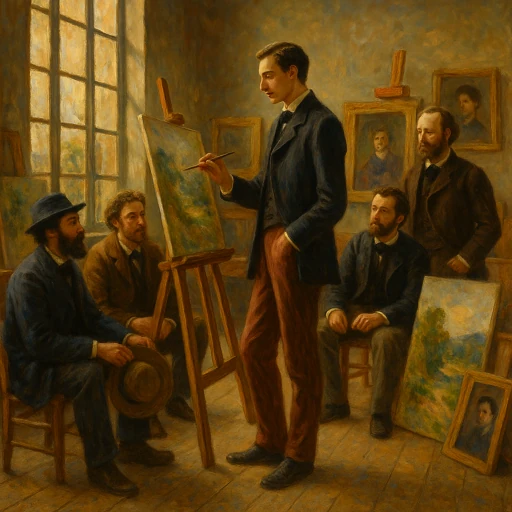
What makes Bazille more than a wealthy patron is his own work as an artist. He was fascinated by how sunlight transformed color and how outdoor settings could frame the human figure. Long before the Impressionists formally broke with mainstream French art, Bazille was exploring these themes.  In The Pink Dress (1864), he painted his cousin on a terrace overlooking the countryside, her figure half-lost in shadow, half-caught by light.  In Family Reunion (1867), he executed a technically difficult group portrait outside, with natural sunlight revealing the folds of dresses and the textures of grass. In The Studio on the Rue de la Condamine (1870), Bazille turned his brush on his own circle, capturing Manet, Monet, Renoir, and Zola in a collective portrait of the avant-garde.

His style was less free than Monet’s and more deliberate than Renoir’s, but the suggestion of Impressionism is unmistakable. He was bridging the academic precision of his training with the looser brushwork of the new school.

Bazille exhibited at the Salon in Paris in 1866 and 1868.  The Salon was the most prestigious and conservative art exhibition in France. These official exhibitions became increasingly controversial as they repeatedly rejected innovative artists like the Impressionists, leading to the creation of alternative exhibitions such as the famous Salon des Refusés in 1863 and independent Impressionist exhibitions starting in 1874.

A Call to War

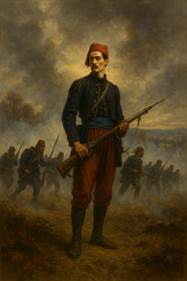
When France declared war on Prussia in 1870, Bazille enlisted in the army. He could easily have avoided service — his family connections, his money, and his medical background all gave him options. But he joined the Zouave, an elite infantry regiment known for its colorful uniforms and reckless bravery.

On November 28, 1870, at the Battle of Beaune-la-Rolande, Bazille’s commanding officer was struck down. Bazille stepped forward to lead the attack. Within minutes, he too was hit and killed. He never saw the armistice. He never saw the first Impressionist exhibition in 1874. He never saw his friends vindicated by history.

The Spirit of Impressionism

Bazille left fewer than sixty known canvases. That small number alone ensures his reputation will never match Monet’s or Renoir’s. Yet the works he did leave offer glimpses of a painter who might have been one of the movement’s greats. He had both vision and means — a rare combination in the avant-garde world.

Without him, the Impressionists lost not only a friend but also a stabilizing force. Bazille’s studios had been safe havens, his purchases financial lifelines, his company a source of encouragement. Monet and Renoir were devastated by his death, and for years afterward, they spoke of him with unslacking grief.

Art historians often speculate about what role he might have played had he lived. Perhaps he would have anchored Impressionism more firmly in the Paris art establishment, or perhaps his money and position would have shielded his friends from years of ridicule. We can only guess.

Remembering Bazille

Today, Bazille’s paintings hang in the Musée d’Orsay in Paris and the Musée Fabre in Montpellier and in the United States at The National Gallery of Art, the Metropolitan Museum of Art, and the Art Institute of Chicago.  To see them is to feel both promise and loss. His canvases are alive with sunlight and color, and they hint at the career that never was.

Bazille reminds us that history is shaped not just by the titans who endure but also by the voices cut short. Impressionism survived and flourished without him, but it was poorer for his absence. In a way, every bright patch of sunlight in Monet’s gardens or flashing dress in Renoir’s dance halls carries a trace of the young man who painted light before the movement even had a name — and who never lived to see it shine.

Even More Fun With AI

Since I’m easily amused, I’m still playing with the AI image generator DALL-E. I wanted to take some time to show you just how easy this is to use. All these images were generated on the requests shown below. The only ones I’ve modified or edited are the ones in the series to demonstrate an edit. You will usually get two versions with each request. You can save either one or both. You can generate up to 50 images a day. I’ve hit my limit more than once.

I generated the image above using the following command. In a cartoon style, generate images of a man dressed as an artist, wearing a beret and a smock, and holding an artist palette and brush. On the easel, have a computer screen with a picture of the same man.

It only takes a little bit of change to get a completely different feel to your pictures. I created the image below basically by saying in a realistic style as opposed to in a cartoon style.

Generate an image in a realistic style of a man dressed as an artist with a smock and beret, holding a palette and a paintbrush and standing in front of an easel with a computer screen in a messy studio.

Now, let your imagination soar and see what you can come up with. I’m going to make up a few commands now and see what develops.

In a surrealistic style generate images of a young boy with pale green skin and feathers on his arms soaring with fantastical eagles over a fantasy landscape of canyons and forests.

In a realistic style, generate images of an African American woman in a sophisticated business suit and carrying a briefcase. Place her in a whimsical background with fantasy creatures, such as elves, fairies, and unicorns.

In a steampunk style, generate images of a doctor examining a patient with a stethoscope. Have the patient have a third eye in the middle of his forehead.

In an abstract style, generate images of a man and a woman sitting in chairs facing each other. Have the man smoking a cigar and have the woman with purple hair.

In a style reminiscent of the French impressionists, generate images of young people in colorful outfits, dancing on an outside patio.

In a cubist style generate images of baseball players.

DALL-E offers the capability to edit your pictures. However, as you’ll see from the series below it actually generates new pictures with slight variations based on your requests for edit.

In a cartoon style generate images of a young man walking down a sidewalk on a sunny day. Have him in a suburban neighborhood with trees and flowers and well tended lawns and houses.

Change the neighborhood to urban with cars parked on the street and the sky overcast.

So far, the changes seem to be fairly consistent and go along with the general style we requested. Let’s make a couple of big changes and see what happens.

Have him look disheveled and scruffy. Make the neighborhood run down with trash in the streets. Have him carry a whiskey bottle and a cigarette.

I think it’s right on with this one.  It got the feel I was looking for.

Now for my last picture, I’m going to let my imagination run wild and try to come up with these strangest and most bizarre images I can imagine and see if DALL-E matches or exceeds my ideas.

In a dystopian style with a post-apocalyptic background, generate images of an emaciated Santa Claus jumping rope while talking to an Easter Bunny with vampire fangs and a leprechaun with claws. Add any other menacing characters you think may be appropriate.

I couldn’t decide which one I liked best, so I decided to use them both.  I’m not sure what it says about me that I like these images.

I couldn’t resist trying one more edit.  I asked DALL-E to generate the above image in cartoon style.  It sent me this response: I encountered some issues while trying to generate the cartoon-style images. Please let me know if you would like to try a different request or if there’s anything else I can assist you with.  Perhaps it thought cartoon style would attract children and the subject matter was a little too ghoulish for kids.  After tweaking the prompt a couple of times, I got the following image:

Maybe they were right the first time.

Give it a try.  I think you’ll have as much fun as I do.

Doctor’s orders!

Learning to Love Abstract Art

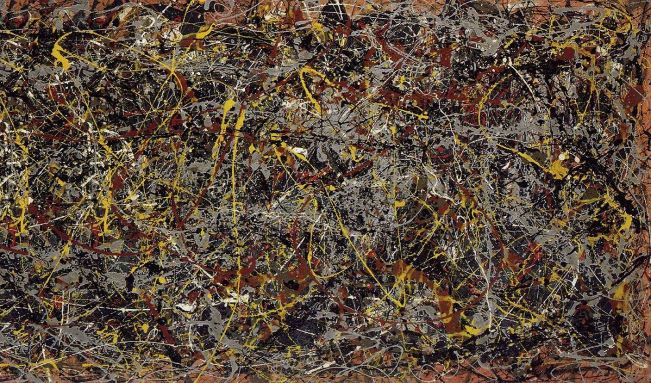
No. 5 Jackson Pollock, 1948

I have to admit that I came late in life to appreciating abstract art. Early on, I thought it was the type of art done by people who had no artistic ability. My general impression was that it was probably done better by a 12 year old.

I was in my late 50s before my wife, who was extremely interested in art, got me involved in an art appreciation group called The Collectors Club at the Clay Center in Charleston. At that time, I still wasn’t convinced that abstract art was really art. I was more inclined to art such as the great masters like Rembrandt and Caravaggio, or the French impressionists like Renoir and Monet or the post impressionists like Cezanne and Van Gogh. While I still think that Van Gogh was one of the world’s greatest artistic geniuses, I have learned to appreciate other styles as well.

For a long time, I thought abstract art could be done by anyone with a can of paint and a brush.  I’m ashamed to say I was not shy about expressing my opinions about abstract art. While this included such recognized masters as Picasso and Miro from the early 20th century; my specific scorn was held for the mid-century artists known as abstract expressionists.

I will now admit that I was completely wrong about this. And for those of you who know me, you know how hard it is for someone as opinionated as I am to admit to being wrong. But my wife, as she most frequently is, was right about this. It just took me awhile to recognize it.

We began going to art exhibits and museums and saw a lot of mid-century art. Initially I was resistant to it. My thought was that if I can do it, then it certainly can’t be art. And I really thought that I could do it.

The specific target of my scorn was Jackson Pollock and his drip paintings. At the time, I didn’t realize that he was a formally trained artist who had even studied under the famed muralist Thomas Hart Benton.  He was adept at sculpture and ceramics in addition to representational works in oil.

 When I finally took the time to truly examine his drip paintings, I recognized that there was something there. I just couldn’t quite put my finger on what it was.

I thought, just to satisfy myself, I would give it a try. I bought some canvases and put them on the garage floor. Since many of the abstract expressionists worked with house paint, I bought several different colors of enamel house paint. I also bought a stylus similar to what Jackson Pollock used. I laid out my canvas and began to drip the paint.

I was really surprised, but his paintings had a coherence and a uniformity and a visual impact that I could not achieve. No matter how many times I tried I could not get my paintings to look like anything other than a drip cloth.

I spent a lot of time thinking about this. I decided this form of abstract art required a talent I didn’t understand. It was more than just paint poured on the canvas. It was paint poured on a canvas with a purpose. It created an effect that I could feel but couldn’t duplicate.

My initial thought was if I can do it, it is not art. Since I couldn’t, maybe it was art.  The more I reviewed it, the more I realized that there was a plan, a vision, and a feeling that produced an overall sensory experience. This was not something that occurred by chance. It was something created by a person with an artistic vision I didn’t have.

I may not have convinced you, but I have convinced myself.  This is art. Look at it with an unprejudiced view and you may come to recognize it as well.  It is never too late to learn about something new, even if that something is 70 years old.  Try it, you just might like.  Call me; we can talk about it.

Powered by WordPress & Theme by Anders Norén