
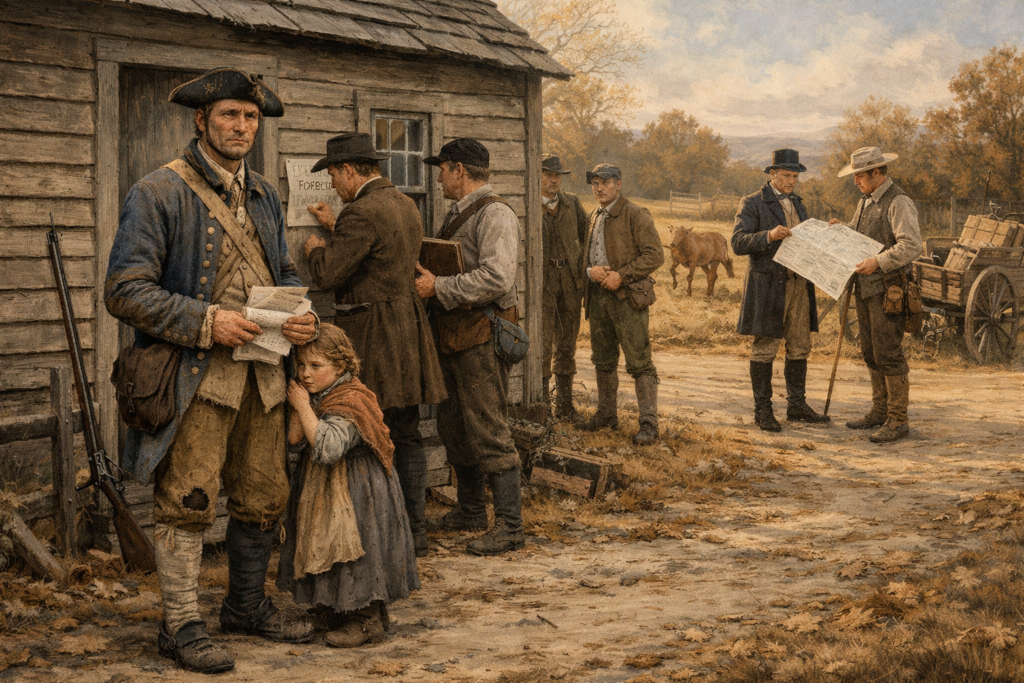
The story of how the Continental Army’s veterans were treated after winning independence reads like a betrayal. These men had endured Valley Forge, fought without pay — — often without food or clothing — risking everything for a revolution that promised liberty and opportunity. What many received instead was financial ruin, confiscated land, and a harsh lesson in how political power and economic class determined who really benefited from their shared sacrifice.
The Pay That Never Came
Let me start with the most basic broken promise — pay. Continental soldiers were supposed to receive regular wages, but the Continental Congress lacked the power to tax and relied on increasingly worthless paper money. By war’s end, many soldiers hadn’t been paid in months or even years. When they finally returned home, they carried IOUs called “certificates of indebtedness” rather than actual money.
The wealthy and well-connected quickly figured out how to profit from this situation. Speculators traveled through rural areas buying up these certificates from desperate veterans at pennies on the dollar. The soldiers, facing immediate debts and no income, often had no choice but to sell. When the federal government eventually redeemed these certificates at full value under Alexander Hamilton’s financial plan in the 1790s, it was the speculators who made fortunes, not the men who’d earned the money, suffered and won the revolution.
Pensions: Promised to Officers, Denied to Enlisted Men
The pension situation revealed the class divisions even more starkly. In 1780, Congress promised officers who served until the war’s end a pension of half-pay for life. Common soldiers received no such promise. When the officers’ pensions proved controversial and expensive, Congress “commuted” them in 1783 to a one-time payment of five years’ full pay — still nothing for the enlisted men who’d done most of the fighting and dying.
It wasn’t until 1818 that Congress finally created a pension for Continental Army privates, and even then, only for those in “reduced circumstances” — meaning you had to prove you were poor to get it. The maximum annual pension was $96, hardly generous compensation for years of service. Soldiers who had served in militia units were generally excluded. By contrast, officers had already received their commutations decades earlier and often held positions of economic and political power.
Land Bounties: Another Empty Promise
Land bounties represented another avenue where common soldiers got shortchanged. Various colonies and Congress promised land grants to encourage enlistment — typically 100 acres for privates, scaling up to 500+ acres for officers and thousands of acres for generals. But there were problems from the start.
First, much of the promised land was in frontier territories like the Ohio Country, which remained dangerous and largely unsurveyed for years after the war. Second, the process of claiming your land required navigating bureaucratic systems, paying surveying fees, and sometimes traveling hundreds of miles. Third, the land often turned out to be of poor quality or in disputed areas. The average veteran with little education, almost no money and absolutely no political influence was seldom ever able to take advantage of the land bounty.
Predictably, speculators moved in. They bought up land bounty warrants from soldiers who lacked the resources or knowledge to claim them directly. One study found that in Virginia, which promised the most generous bounties, speculators ultimately controlled vast tracts while many veterans received little or nothing.
The Tax Collector Cometh
Here’s where the story gets particularly cruel. While veterans struggled with unpaid wages and unredeemed promises, the new state governments faced their own financial crises. They’d accumulated massive war debts and needed revenue. Their solution? Property taxes.
In Massachusetts, the legislature imposed heavy taxes payable in hard currency — gold or silver — which almost nobody in rural areas possessed. The same certificates of indebtedness that soldiers were given by the government weren’t accepted for tax payments, even though the state owed them that money. Veterans who’d sold their certificates for a fraction of their value to pay immediate debts now faced tax bills they couldn’t pay. These policies were not accidental side effects; they reflected the priorities of creditor classes concentrated in coastal towns, who preferred regressive property taxes over inflation or debt relief for veterans.
When farmers and veterans couldn’t pay these taxes, local sheriffs seized and auctioned their property. In many cases, the buyers at these auctions were the same merchant elites and speculators who’d bought up the certificates. This wasn’t accidental — it was a systematic transfer of wealth and property from those who’d fought the war to those who’d financed it, avoided personal risk and now controlled state governments. Elites did not overtly confiscate veterans’ land through direct political targeting; instead, they relied on neutral-looking fiscal policy — strict tax collection, aggressive debt enforcement, and courts unsympathetic to insolvency — to transfer property legally. The effect was unmistakable; veterans who fought for independence lost their farms to satisfy debts incurred during or immediately after their service, while wealthier investors accumulated land and made financial gains.
The Massachusetts situation became particularly egregious. Between 1784 and 1786, thousands of foreclosure proceedings were filed. Veterans who’d survived the war returned to find themselves losing their farms and, in some cases, being thrown into debtors’ prison.
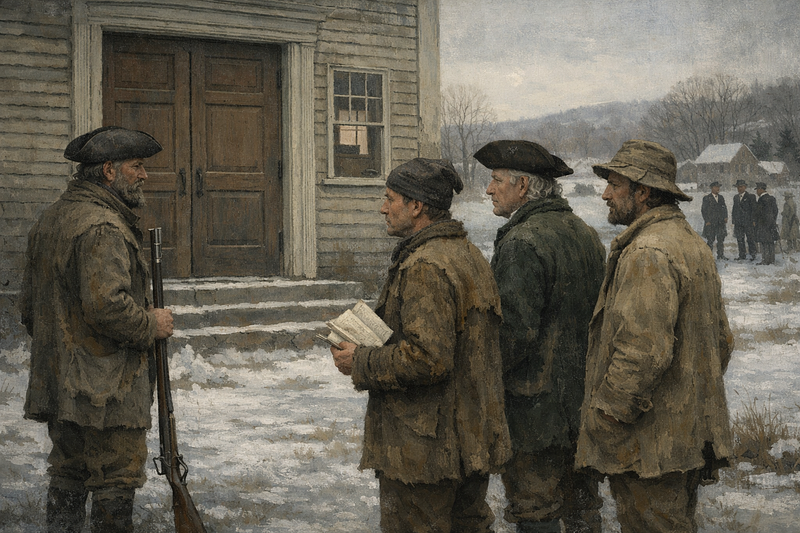
Shays’ Rebellion: When Veterans Fought Back
The breaking point came in 1786 with Shays’ Rebellion in Massachusetts. Daniel Shays, a former Continental Army captain, led hundreds of veterans and farmers in an armed uprising against foreclosures and debt courts. They physically prevented courts from sitting, trying to halt the cascade of farm seizures. They represented the soldiers who’d won independence and felt the new government had betrayed them.
The rebellion was suppressed by a militia funded by wealthy Boston merchants and creditors as the state treasury lacked ready cash to pay troops. This was a clear demonstration of how thoroughly economic power had concentrated among elites and sent shockwaves through the political establishment. To many rural farmers the suppression looked like creditors hiring an army to enforce unjust laws against impoverished veterans.
Interestingly, most of the rebels received pardons, and Massachusetts did eventually reduce some taxes and reform debtor laws. But the damage was done, and the pattern had been established.
The Class Divide in Revolutionary Benefits
The broader pattern is unmistakable. Officers, who were generally drawn from propertied classes, received pensions and larger land bounties, had the education and connections to navigate bureaucratic systems, and often held the political power to protect their interests. Common soldiers, usually farmers or laborers, received certificates they had to sell at a loss, faced tax collectors seizing their property, and had little political voice. They disproportionately bore the costs of the new fiscal order through unpaid or depreciated wages, lack of early pension support, and vulnerability to foreclosure, while many of the tangible financial benefits of their service migrated to wealthier elites.
Some historians argue this wasn’t conspiracy but circumstance — that the new nation genuinely lacked resources and that markets naturally concentrated certificates in wealthier hands. There’s some truth to this. The Continental Congress was genuinely broke, and state governments faced real fiscal crises.
But the specific policy choices — redeeming certificates from speculators at full value while rejecting them for tax payments, creating pensions for officers but not enlisted men, setting tax policies that required hard currency that poor farmers didn’t have — these weren’t inevitable, they were a choice. They reflected the interests of those who held power in state legislatures and the Continental Congress.
The Long Echo
The treatment of Continental Army veterans established patterns that would echo through American history: promises made during wartime, broken during peace; benefits flowing more generously to officers than enlisted men. Economic and political elites using legal mechanisms to transfer wealth from those who fought the revolution to those who financed it.
The first genuinely “service‑based” pension law that broadly covered surviving Continental soldiers — regardless of disability — did not arrive until 1818, three decades after the war, and it initially required proof of indigence, effectively screening out better‑off veterans and stigmatizing poorer ones. Not until the 1832 act did Congress move toward full pay for life for many surviving officers and enlisted men — including militia — based on length of service alone. But large numbers of veterans had already lost their farms, spent years in poverty, or died. The benefits came too late and too meagerly to undo decades of hardship. They were owed better.
Illustrations generated by author using ChatGPT.
Sources:
Mount Vernon Digital Encyclopedia — Veterans of the Revolutionary War https://www.mountvernon.org/library/digitalhistory/digital-encyclopedia/article/veterans-of-the-revolutionary-war/
This George Washington Presidential Library resource provides an overview of how Continental Army veterans were treated, including details on certificate speculation, payment issues, and the general economic struggles veterans faced after the war.
National Archives — Revolutionary War Pension Files https://www.archives.gov/research/military/war-of-1812/pension-files
While this link references War of 1812 pensions, the National Archives maintains extensive documentation on Revolutionary War pensions as well. The site explains the evolution of pension systems and eligibility requirements, including the 1818 act that finally provided pensions to enlisted men who could prove poverty.
Encyclopedia Virginia — Military Bounty Lands https://www.encyclopediavirginia.org/entries/military-bounty-lands/
This scholarly resource details Virginia’s land bounty system, which was among the most extensive. It documents how these bounties were promised, the challenges veterans faced in claiming them, and how speculators ultimately acquired much of the promised land.
American Battlefield Trust — Shays’ Rebellion https://www.battlefields.org/learn/articles/shays-rebellion
This article provides context on the 1786–1787 uprising in Massachusetts, explaining the economic conditions that drove veterans to armed resistance, the foreclosure crisis, and the rebellion’s impact on constitutional debates.
Massachusetts Historical Society — Shays’ Rebellion https://www.masshist.org/features/shays/