
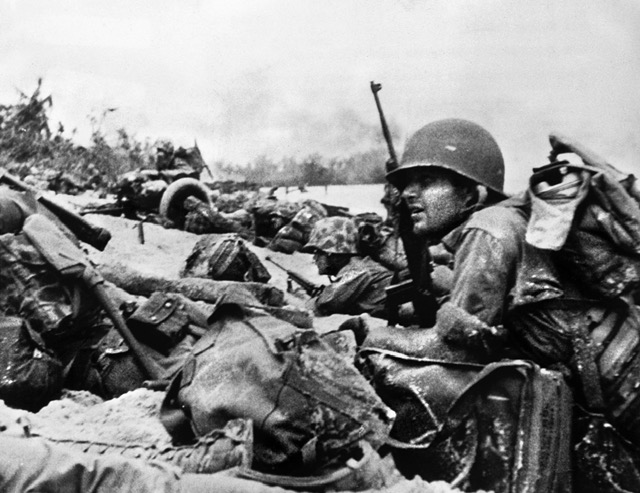
Anyone with even a passing familiarity of the history of World War II knows about the major island campaigns in the Pacific: Guadalcanal, Tarawa, Iwo Jima and Okinawa. But unless you are a student of military history or perhaps a former Marine, you’ve probably never heard of the Battle of Peleliu
The Battle of Peleliu, fought from September 15 to November 27, 1944, stands as one of the most controversial and costly operations in the Pacific Theater. This assault on the small coral island in the Palau chain reveals much about the complexities of strategic decision-making during wartime.
Objectives and Strategic Rationale
The primary objective was to capture Peleliu’s airfield to prevent Japanese aircraft from interfering with General MacArthur’s upcoming invasion of the Philippines. American planners believed that Japanese forces based on Peleliu could attack the right flank of the Philippine invasion force. Additionally, the island was seen as a potential base for supporting further operations against Japan in the western Pacific.
Military planners, especially Admiral Chester Nimitz and his staff, believed neutralizing Japanese air power on Peleliu was critical to protecting the Philippineinvasion. The airfield on the island, if left in Japanese hands, could theoretically pose a threat to operations in the southern Philippines or even to the fleet.
However, this concern was based on a misreading of Japan’s actual capacity to project power from the island. By late 1944, Japan’s air forces were significantly degraded, and their capacity to use the Peleliu airfield was minimal, if it existed at all.
The operation was planned as part of a broader strategy to neutralize Japanese strongholds and establish forward bases for the final push toward Japan. Admiral Nimitz initially supported the invasion, viewing it as necessary to protect MacArthur’s Philippine campaign and to continue the island-hopping strategy that had proven successful elsewhere in the Pacific.
Admiral William Halsey argued the operation was unnecessary, as American bombardment had already isolated Japanese forces and rendered the airfield unusable. However, Admiral Nimitz approved the invasion, believing cancellation logistically impractical because preparations were too far advanced. Marine commanders initially predicted a swift victory, with Major General William Rupertus claiming the island would fall in four days.
The Strategic Reality
In retrospect, Peleliu’s strategic value was far more limited than initially assessed. The island’s airfield, while operationally useful, was not critical to the success of the Philippine invasion. The Japanese garrison of approximately 11,000 troops under Colonel Kunio Nakagawa had transformed the island into a fortress, utilizing the coral caves and ridges to create an intricate defensive system that would exact a terrible price from the attackers.
The 1st Marine Division, supported by the 81st Infantry Division, ultimately secured the island, but at enormous cost. American casualties totaled over 9,000, with nearly 1,800 killed in action. Japanese losses were almost total, with fewer than 200 prisoners taken from the original garrison.
Post-Battle Assessment
After the battle’s conclusion, many military leaders questioned whether the operation had been worth its tremendous cost in human lives. The strategic benefits gained were minimal compared to the losses sustained. The airfield was not essential to subsequent operations, and the island’s location proved less critical than originally believed.
Military historians increasingly view Peleliu as an example of how the initial strategic and tactical assessments proved flawed when planners failed to recognize the evolution of Japanese defensive tactics, which emphasized fighting from prepared positions rather than the banzai charges that had characterized earlier encounters.
Historical Significance
Peleliu is overshadowed in World War II histories by larger, more decisive battles like Iwo Jima and Okinawa. However, it served as a crucial learning experience for American forces, providing insights into Japanese defensive innovations that would prove valuable in later operations. The battle highlighted the importance of accurate intelligence and realistic strategic assessment.
The intense fighting on Peleliu also demonstrated the resilience and adaptability of American forces under extremely challenging conditions. The prolonged nature of the battle, lasting over two months instead of the predicted few days, tested logistics, medical support, and command structures in ways that informed future operations.
The Aftermath
While the immediate strategic gains from Peleliu were limited, the battle did provide several important advantages. It eliminated a potential threat to Allied shipping lanes in the region and provided valuable experience in assaulting heavily fortified positions. The lessons learned about Japanese defensive tactics, the importance of coordinated air and ground support, and the challenges of fighting in coral terrain all contributed to improved performance in subsequent operations.
Perhaps most significantly, Peleliu demonstrated the need for more careful strategic evaluation of objectives relative to costs. This lesson influenced planning for later operations and contributed to discussions about alternative strategies for ending the war in the Pacific. In specific, the battle demonstrated Japan’s willingness to fight to the death and perhaps may have indirectly influenced the decision to use atomic bombs to avoid similar carnage in a main island invasion.
The Battle of Peleliu remains a sobering reminder of the complexities of wartime strategy and the human cost of military operations. While its immediate strategic value was questionable, its role in the broader context of Pacific War operations and its lessons for military planning ensured its place in the historical record of World War II.