
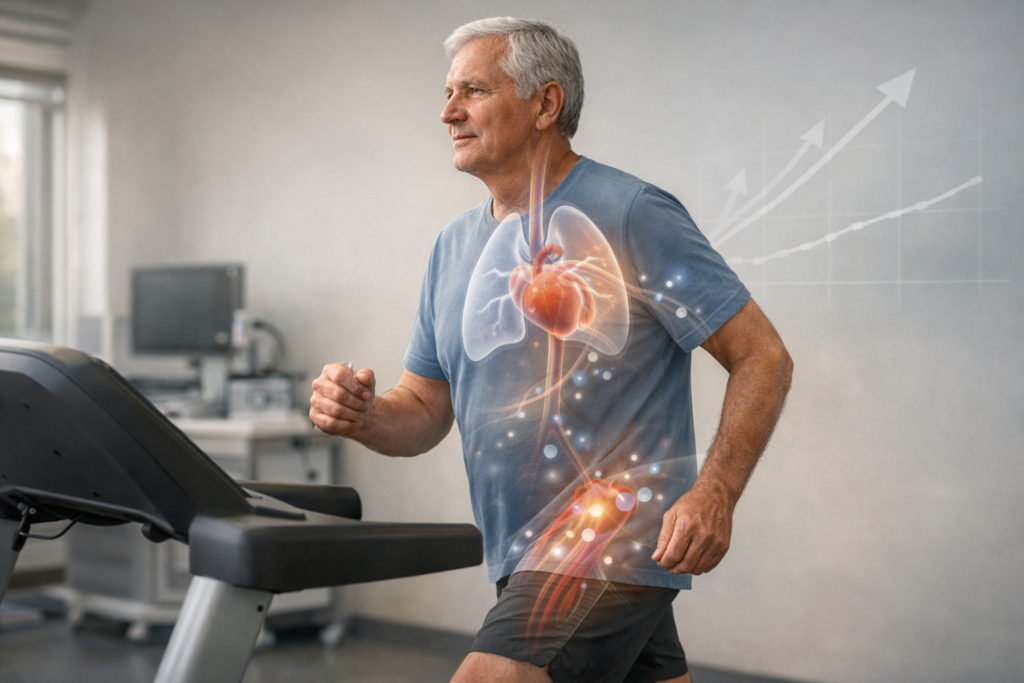
If you’ve ever wondered what separates elite endurance athletes from weekend warriors—or why your friend can cruise up hills while you’re gasping for air—the answer often comes down to a vital sign you’ve probably never heard of — VO2 max. Think of it as your cardiovascular system’s horsepower rating, a number that tells you how efficiently your body can use oxygen during intense exercise.
What VO2 Max Actually Means
VO2 max stands for maximal oxygen consumption; it measures the maximum amount of oxygen your body can take in, transport, and use during exercise. Scientists express it in milliliters of oxygen per kilogram of body weight per minute (ml/kg/min). When you’re working out at your absolute limit—say, sprinting up a hill until you simply can’t go any faster—your muscles are burning through oxygen to produce energy. VO2 max represents the ceiling of that process, the point where your body has maxed out its oxygen delivery system and can’t use any more oxygen even if you try to push harder.
An average sedentary man might have a VO2 max around 30-40 ml/kg/min, while an average woman might measure 25-30 ml/kg/min. Elite endurance athletes, however, occupy an entirely different universe. Cross-country skiers and distance runners can reach values of 70-85 ml/kg/min or even higher. The legendary Norwegian cyclist Oskar Svendsen reportedly recorded a VO2 max of 97.5 ml/kg/min, which is probably the upper reaches of human cardiovascular capacity.
The rest of us are also affected by VO2 Max. In later life, it is closely tied to our everyday activities. There’s a minimum aerobic capacity required for independent living—walking briskly, climbing stairs, carrying groceries. As VO2 max declines to that functional threshold, small losses can translate into disproportionate declines in independence. Conversely, modest improvements can produce meaningful gains in stamina, balance, and confidence.
The Gold Standard of Measurement
The most accurate way to measure VO2 max involves what’s called a graded exercise test, typically performed in a lab or clinical setting. You’ll hop on a treadmill or stationary bike while wearing a mask connected to a metabolic cart—essentially a sophisticated machine that analyzes every breath you take. The test starts easy but gets progressively harder every few minutes. The technician increases either the speed, incline, or resistance while the equipment measures exactly how much oxygen you’re consuming and how much carbon dioxide you’re producing.
You keep going until you reach exhaustion—the point where you literally cannot continue despite maximum effort. The highest oxygen consumption rate recorded during this test is your VO2 max. It’s not a particularly pleasant experience, but it’s incredibly accurate. The test also provides valuable data about your anaerobic threshold, the point where your body starts relying more heavily on systems that don’t require oxygen and where lactic acid begins accumulating in your muscles.
For those of us without access to exercise labs, there are several field tests we can use to estimate VO2 max reasonably well. The Cooper test, developed by Dr. Kenneth Cooper in the 1960s, involves running as far as you can in 12 minutes on a track (that wouldn’t be too far for me). The distance you cover correlates with your VO2 max through established formulas [VO2max: (distance covered in meters – 504.9) / 44.73 = VO2 max in ml/kg/min]. Age and gender normed values can be found on a number of fitness websites. Many fitness watches and apps now offer VO2 max estimates based on heart rate data during runs, though these are less precise than laboratory testing.
Why This Number Matters
VO2 max serves as one of our strongest predictors of cardiovascular health and longevity. Research published in major medical journals has consistently shown that higher VO2 max values correlate with lower risks of heart disease, diabetes, and all-cause mortality. A 2018 study in the Journal of the American Medical Association (JAMA) that followed over 122,000 patients found that cardiorespiratory fitness (measured by VO2 max) was a better predictor of mortality than traditional risk factors like hypertension, diabetes, or even smoking.
The relationship is striking, for every 3.5 ml/kg/min increase in VO2 max, mortality risk drops by about 13 percent. People in the lowest fitness category (those with the poorest VO2 max scores) have death rates two to three times higher than those in the highest fitness category, even when controlling for other health factors.
Beyond mortality statistics, VO2 max influences your daily quality of life. A higher VO2 max means your heart doesn’t have to work as hard during routine activities. Climbing stairs, carrying groceries, playing with kids or grandkids—all these activities demand less relative effort when your cardiovascular system operates efficiently. Your body becomes better at delivering oxygen-rich blood to working muscles and clearing away metabolic waste products, which means you fatigue less easily and recover more quickly.
The Path to Improvement
The encouraging news is that VO2 max responds remarkably well to training, especially if you’re starting from a sedentary baseline. You can’t completely escape genetics—some people are simply born with larger hearts, more efficient lungs, or a higher percentage of slow-twitch muscle fibers—but training can typically improve VO2 max by 15-30 percent in previously untrained people.
The most effective approach combines several training methods. High-intensity interval training (HIIT) has emerged as particularly powerful tool for boosting VO2 max. These workouts involve short bursts of near-maximal effort followed by recovery periods. A classic protocol might involve running hard for four minutes at about 90-95 percent of your maximum heart rate, then recovering with light jogging for three minutes, repeated four or five times. Studies show that just two or three HIIT sessions per week can produce significant improvements in VO2 max within eight to twelve weeks.
Longer, steady-state aerobic exercise also plays a crucial role. These sessions—think longer runs at a conversational pace—improve your cardiovascular system’s efficiency and build the capillary networks that deliver oxygen to muscles. The optimal training program typically includes both high-intensity intervals and longer moderate-intensity sessions, along with adequate recovery time.
Interestingly, resistance training can indirectly support VO2 max improvements as well. While lifting weights won’t directly boost your oxygen consumption capacity the way running does, it helps maintain lean muscle mass, improves movement efficiency, and can enhance your ability to perform high-intensity cardiovascular work.
This high intensity training is all well and good for young, relatively healthy people. But what about older folks, particularly those with underlying medical problems?
The encouraging news: VO2 max responds to training well into our 70s, 80s, and beyond. Key approaches involve the same elements but tailored to age and medical history.
Moderate-intensity aerobic exercise (brisk walking, cycling, swimming) performed most days of the week is the primary element. Individually adjusted interval training, including carefully supervised higher intensity intervals, have shown impressive VO2 max gains even in older populations. Strength training is beneficial for older folks as well, and as an added benefit, it helps maintain and even improve bone density. A personal trainer can help design your fitness program to maximize improvement while minimizing the likelihood of injury.
Stop any exercise immediately if you experience chest pain, dizziness, or extreme shortness of breath. Remember consistency matters more than intensity alone and, most importantly, never start any exercise program without checking with your doctor first.
The Inevitable Decline
Here’s the less cheerful part: VO2 max naturally declines with age, typically dropping about 10 percent per decade after age 30 in sedentary people. This decline accelerates after age 70. However—and this is crucial—regular exercise dramatically slows this process. Senior athletes who maintain consistent training can preserve VO2 max values that rival or exceed those of sedentary people decades younger. A fit 60-year-old can easily have a higher VO2 max than an inactive 40-year-old.
The decline happens for several reasons: maximum heart rate decreases, cardiac output drops, muscle mass decreases, and the body becomes less efficient at extracting oxygen from blood. But none of these changes are inevitable consequences of aging alone—they’re heavily influenced by activity levels.
Putting It in Perspective
While VO2 max provides valuable information about cardiovascular fitness, it’s worth remembering that it’s just one metric among many. You don’t need the VO2 max of an Olympic athlete to be healthy and enjoy an active life (thankfully). A moderate VO2 max maintained consistently into your later years will serve you far better than a high value in your twenties followed by decades of inactivity.
The real value of understanding VO2 max lies in what it represents: your body’s fundamental capacity to generate energy and support movement. When you work to improve this capacity through regular cardiovascular exercise, you’re investing in both your current quality of life and your long-term health prospects. Every little bit helps—so put down the remote, get up off the couch and start walking. You’ll be glad you did.
Sources:
- American College of Sports Medicine on VO2 max testing: https://www.acsm.org/
- Mayo Clinic on cardiorespiratory fitness: https://www.mayoclinic.org/
- National Institutes of Health research on fitness and mortality: https://www.nih.gov/
- JAMA Network 2018 study on cardiorespiratory fitness and mortality: https://jamanetwork.com/journals/jamanetworkopen/fullarticle/2707428
Image generated by author using ChatGPT