
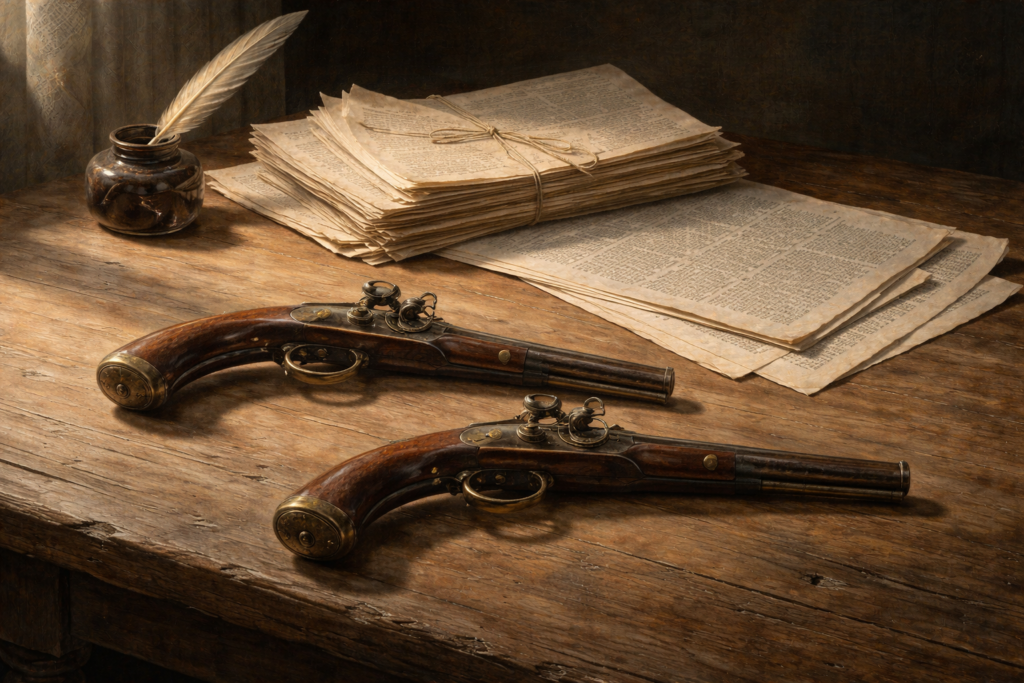
The story of the Hamilton-Burr duel has all the elements of a Greek tragedy: brilliant men, political ambition, an unforgiving honor culture, and an ending that destroyed both victor and vanquished alike. When Aaron Burr shot Alexander Hamilton on the morning of July 11, 1804, he didn’t just kill one of America’s founding architects—he also ended his own political career and helped doom the entire Federalist Party to irrelevance. Let’s rewind the clock more than a decade to try and understand how these two gifted lawyers and Revolutionary War veterans ended up facing each other with loaded pistols.
The Long Road to Weehawken
Hamilton and Burr moved in the same elite New York political circles from the 1790s onward, but they had remarkably different temperaments and political beliefs. Hamilton was ideological, prolific, and combative—often too much so for his own good. Burr was pragmatic, opaque, self-serving, and famously hard to pin down on principle. They distrusted each other deeply.
Their rivalry stretched back to 1791, when Burr defeated Philip Schuyler for a U.S. Senate seat representing New York. This wasn’t just any political defeat for Hamilton—Schuyler was his father-in-law and a crucial Federalist ally on whom Hamilton had counted to support his ambitious financial programs. Hamilton, who was serving in George Washington’s cabinet as Treasury Secretary, never forgave Burr for this loss. In correspondence from June 1804, Hamilton himself referenced “a course of fifteen years competition” between the two men.
Their philosophical differences ran deep. Hamilton was an ideological Federalist who dreamed of transforming the United States into a modern economic power rivaling European empires through strong central government, industrial development, and military strength. Burr, by contrast, approached politics more pragmatically—he saw it as a vehicle for advancing his own interests and those of his allies rather than as a way to implement sweeping political visions. As Burr himself allegedly said, politics were nothing more than “fun and honor and profit”. Hamilton viewed Burr as fundamentally dangerous due to his lack of fixed ideological principles. Hamilton wrote in 1792 that he considered it his “religious duty to keep this man from office”
The election of 1800 brought their animosity to a boiling point. Due to a quirk in the original Constitution’s electoral system, Thomas Jefferson and his running mate Aaron Burr tied in the Electoral College with 73 votes each, allowing the Federalists to briefly consider elevating Burr to the presidency. The decision went to the House of Representatives, and Hamilton—despite despising Jefferson’s Democratic-Republican politics—campaigned hard to ensure Jefferson won the presidency rather than Burr. Hamilton argued that Jefferson, however wrong in policy, had convictions, whereas Burr had none. In the end, Jefferson gained the presidency and Burr became Vice President, but their relationship was never collegial and Burr was excluded from any meaningful participation in Jefferson’s administration.
By 1804, it was clear Jefferson would not consider Burr for a second term as Vice President. Desperate to salvage his political career, Burr made a surprising move: he sought the Federalist nomination for governor of New York, switching from his Democratic-Republican affiliation. It was a strange gambit—essentially betting that his political enemies might support him if it served their interests. Hamilton, predictably, worked vigorously to block Burr’s ambitions yet again. Although Hamilton’s opposition wasn’t the only factor, Burr lost badly to Morgan Lewis, the Democratic-Republican candidate, in April 1804.
The Cooper Letter and the Challenge
The immediate trigger for the duel came from a relatively minor slight in the context of their long feud. In February 1804, Dr. Charles Cooper attended a dinner party where Hamilton spoke forcefully against Burr’s candidacy. Cooper later wrote to Philip Schuyler describing Hamilton’s comments, noting that Hamilton had called Burr “a dangerous man” and referenced an even “more despicable opinion” of him. This letter was published in the Albany Register in April, after Burr’s electoral defeat.
When the newspaper reached Burr, he was already politically ruined—still Vice President of the United States, but with no prospects for future office. He demanded that Hamilton acknowledge or deny the statements attributed to him. What followed was a formal exchange of letters between the two men and their representatives that lasted through June. Hamilton refused to give Burr the straightforward denial he sought, explaining that he couldn’t reasonably be expected to account for everything he might have said about a political opponent during fifteen years of competition. Burr, seeing his honor impugned and his options exhausted, invoked the code of honor and issued a formal challenge to duel.
Hamilton found himself in an impossible position. If he admitted to the insults, which were substantially true, he would lose his honor. If he refused to duel, the result would be the same—his political career would effectively end. Hamilton had personal and moral objections to dueling. His eldest son Philip had died in a duel just three years earlier, at the same Weehawken location where Hamilton and Burr would meet. Hamilton calculated that his ability to maintain his political influence required him to conform to the codes of honor that governed gentlemen’s behavior in early America.
Dawn at Weehawken
At 5:00 AM on the morning of July 11, 1804, the men departed Manhattan from separate docks. They were each rowed across the Hudson River to the Heights of Weehawken, New Jersey—a popular dueling ground where at least 18 known duels took place between 1700 and 1845. They chose New Jersey because while dueling had been outlawed in both New York and New Jersey, the New Jersey penalties were less severe.
Burr arrived first around 6:30 AM, with Hamilton landing about thirty minutes later. Each man was accompanied by his “second”—an assistant responsible for ensuring the duel followed proper protocols. Hamilton brought Nathaniel Pendleton, a Revolutionary War veteran and Georgia district court judge, while Burr’s second was William Van Ness, a New York federal judge. Hamilton also brought Dr. David Hosack, a Columbia College professor of medicine and botany, in case medical attention proved necessary.
Shortly after 7 a.m., the seconds measured out ten paces, loaded the .56‑caliber pistols, and explained the firing rules before Hamilton and Burr took their positions. What exactly happened next remains one of history’s enduring mysteries. The seconds gave conflicting accounts, and historians still debate the sequence and meaning of events.
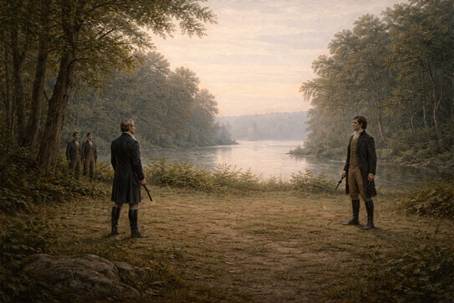
In a written statement before the duel, Hamilton expressed religious and moral objections to dueling, worry for his family and creditors, and professed no personal hatred of Burr, yet concluded that honor and future public usefulness compelled him to accept. By some accounts, Hamilton had also written to confidants indicating his intention to “throw away my shot”—essentially to deliberately miss Burr, satisfying the requirements of honor without attempting to kill his opponent. Burr, by contrast, appears to have aimed directly at Hamilton.
Some accounts suggest Hamilton fired first, with his shot hitting a tree branch above and behind Burr’s head. Other versions claim Burr shot first. There’s even a theory that Hamilton’s pistol had a hair trigger that caused an accidental discharge after Burr wounded him.
What’s undisputed is the outcome: Burr’s shot struck Hamilton in the lower abdomen, with the bullet lodging near his spine. Hamilton fell, and Burr reportedly started toward his fallen opponent before Van Ness held him back, worried about the legal consequences of lingering at the scene. The two parties crossed back to Manhattan in their respective boats, with Hamilton taken to the home of William Bayard Jr. in what is now Greenwich Village.
Hamilton survived long enough to say goodbye to his wife Eliza and their children. He died at 2 PM on July 12, 1804, approximately 31 hours after being shot.
Political Aftershocks
The nation was outraged. While duels were relatively common in early America, they rarely resulted in death, and the killing of someone as prominent as Alexander Hamilton sparked widespread condemnation. The political consequences proved catastrophic for everyone involved—and reshaped American politics for the next two decades.
Hamilton’s death turned him into a Federalist martyr. Even many who had disliked his arrogance now praised his intellect, service, and sacrifice. His economic vision, already embedded in American institutions, gained a kind of posthumous authority.
For Aaron Burr, the duel destroyed him politically and socially. Murder charges were filed against him in both New York and New Jersey, though neither reached trial—a grand jury in Bergen County, New Jersey indicted him for murder in November 1804, but the New Jersey Supreme Court quashed the indictment. Nevertheless, Burr fled to St. Simons Island, Georgia, staying at the plantation of Pierce Butler, before returning to Washington to complete his term as Vice President.
Rather than restoring his reputation as he’d hoped, the duel made Burr a pariah. He would never hold elected office again. His subsequent attempt to regain power through what historians call the “Burr Conspiracy”—an alleged plan to create an independent nation along the Mississippi River by separating territories from the United States and Spain—led to a treason trial in 1807. Chief Justice John Marshall presided and Burr was ultimately acquitted, but the trial further cemented Burr’s reputation as a dangerous schemer. He spent his later years quietly practicing law in New York.
For the Federalist Party, Hamilton’s death proved even more devastating than Burr’s personal ruin. Hamilton had been the party’s intellectual architect and most effective leader. At the time of his death, the Federalists were attempting a comeback after their national defeat in the 1800 election. Without Hamilton’s energy, strategic thinking, and ability to articulate a compelling vision for the country, the Federalists lost direction. As one historian put it, “The Federalists would be unable to find another leader as forceful and energetic as Hamilton had been, and their movement would slowly suffocate before finally petering out in the early 1820s”. The party’s decline ended what historians consider the first round of partisan struggles in American history.
An interesting footnote: while many Federalists wanted to portray Hamilton as a political martyr, Federalist clergy broke with the party line to condemn dueling itself as a violation of the sixth commandment. These ministers used Hamilton’s death as an opportunity to wage a moral crusade against the practice of dueling, helping to accelerate its decline in American culture—particularly in the northern states where it was already losing favor.
The duel produced a triple tragedy: Hamilton dead at age 47 (or 49—his birth year remains disputed), Burr politically destroyed despite being acquitted of murder charges, and the Federalist Party fatally weakened at a critical moment in American political development.
The Hamilton–Burr duel sits at the intersection of politics, personality, and culture. It reminds us that the early republic was not a calm, rational experiment run by marble statues—but a volatile environment shaped by ego, fear, and ambition. Institutions were young, norms were fragile, and reputations were all important. What began as fifteen years of professional rivalry and personal enmity ended with two brilliant men eliminating each other from the political stage, neither achieving what they’d hoped for through their fatal meeting on the heights of Weehawken.
Sources
Encyclopedia Britannica “Burr-Hamilton duel | Summary, Background, & Facts” https://www.britannica.com/event/Burr-Hamilton-duel
History.com “Aaron Burr slays Alexander Hamilton in duel” https://www.history.com/this-day-in-history/july-11/burr-slays-hamilton-in-duel
Library of Congress “Today in History – July 11” https://www.loc.gov/item/today-in-history/july-11
National Constitution Center “The Burr vs. Hamilton duel happened on this day” https://constitutioncenter.org/blog/burr-vs-hamilton-behind-the-ultimate-political-feud
National Park Service “Hamilton-Burr Duel” https://www.nps.gov/articles/000/hamilton-burr-duel.htm
PBS American Experience “Alexander Hamilton and Aaron Burr’s Duel” https://www.pbs.org/wgbh/americanexperience/features/duel-alexander-hamilton-and-aaron-burrs-duel/
The Gospel Coalition “American Prophets: Federalist Clergy’s Response to the Hamilton–Burr Duel of 1804” https://www.thegospelcoalition.org/themelios/article/american-prophets-federalist-clergys-response-to-the-hamilton-burr-duel-of-1804/
Wikipedia “Burr–Hamilton duel” https://en.wikipedia.org/wiki/Burr–Hamilton_duel
World History Encyclopedia “Hamilton-Burr Duel” https://www.worldhistory.org/article/2548/hamilton-burr-duel/
For more information about the history of dueling in early America see my earlier post: Pistols at Dawn, The Rise and Fall of the Code Duello.
Images generated by author using ChatGPT.