
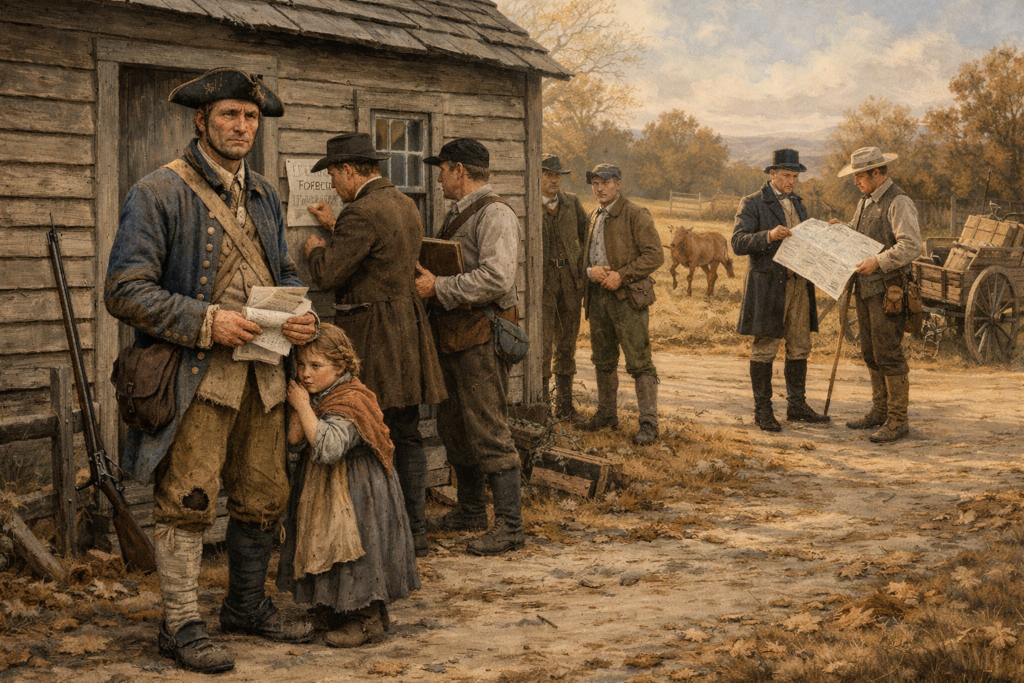
Last week I looked at how poorly revolutionary war veterans were treated in general. This week I’d like to take a look at a specific example —the contrast between how generals like Henry Knox and common soldiers like Joseph Plumb Martin fared after the Revolutionary War. It perfectly illustrates the class divide I discussed in my previous post. These two men served in the same army, helped win the same independence, and endured similar hardships—although Martin endured far greater hardship. Their post-war experiences couldn’t have been more different—and in a bitter twist, Knox’s prosperity came partly at Martin’s expense.
Knox’s Golden Parachute
Henry Knox entered the war as a Boston bookseller of modest means whose military knowledge was gained from reading rather than formal training. He rose to become Washington’s chief of artillery and a major general. When the war ended, Knox received benefits that set him up for life—or should have.
As an officer who served until the war’s end, Knox received the 1783 commutation payment: five years’ full pay in the form of government securities bearing six percent annual interest. This came after Knox himself helped lead the officer corps in pressuring Congress for payment during the near-mutiny known as the Newburgh Conspiracy in early 1783. In total, 2,480 officers received these commutation certificates
But Knox’s real windfall came from his marriage and his government connections. His wife Lucy came from a wealthy Loyalist family—her grandfather was Brigadier General Samuel Waldo, who’d gained control of a massive land patent in Maine in the 1730’s. When Lucy’s family fled to England, she became the sole heir to approximately 576,000 acres known as the Waldo Patent.
Knox used his position as the first Secretary of War (earning $3,000 annually in 1793) and his wartime connections to expand his land holdings and business ventures. He was able to ensure that his wife’s family lands were passed to her, rather than being seized by the government, as the holding of many loyalists were. Knox was firmly positioned on the creditor side of the equation, and his political connections helped shield him from the harsh economic reality faced by common soldiers.
He also acquired additional property in the Ohio Valley and engaged in extensive land speculation. He ran multiple businesses: timber operations, shipbuilding, brick-making, quarrying, and extensive real estate development.
After retiring from government in 1795, he built Montpelier, a magnificent three-story mansion in Thomaston, Maine, described as having “beauty, symmetry and magnificence” unequaled in Massachusetts. (My wife and I visited a reconstruction of his mansion this past summer and I can personally testify as to how elaborate a home it was.)
Martin’s Broken Promises
Joseph Plumb Martin’s story is the experience of the roughly 80,000-90,000 common soldiers who did most of the fighting. Martin enlisted at age 15 in 1776 and served seven years—fighting at Brooklyn, White Plains, Monmouth, surviving Valley Forge, and digging trenches at Yorktown. He rose from private to sergeant.
When Martin mustered out, he received certificates of indebtedness instead of actual pay—IOUs that depreciated rapidly. Unlike Knox, enlisted men received no pension, no commutation payment, nothing beyond those nearly worthless certificates. Martin, like many veterans, sold his certificates to speculators at a fraction of their face value just to survive.
After teaching briefly in New York, Martin settled in Maine in the early 1790s. Based on the promise of a land bounty from Massachusetts, Martin and other “Liberty Men” each claimed 100 acres in Maine, assuming that Loyalist lands would be confiscated and sold cheaply to the current occupants or, perhaps, even treated as vacant lands they could secure by clearing and improving.
Martin married Lucy Clewley in 1794 and started farming. He’d fought for independence and now just wanted to build a modest life in the belief that the country he had fought for would stand by its promises.
When Former Comrades Became Adversaries
Here’s where the story takes a dark turn. In 1794, Henry Knox—Martin’s former commanding general—asserted legal ownership of Martin’s 100-acre farm. Knox claimed the land was part of the Waldo Patent. Martin and other settlers argued they had the right to farm the land they’d improved, especially as it should be payment for their Revolutionary service.
The dispute dragged on for years, with some veterans even forming a guerrilla group called the “White Indians” who attacked Knox’s surveyors. But Knox had wealth, lawyers, and political connections. In 1797, the legal system upheld Knox’s claim. Martin’s farm was appraised at $170—payable over six years in installments.
To put that in perspective, when Martin finally received a pension in 1818—twenty-one years later—it paid only $96 per year. And to get even that meager pension, Martin had to prove he was destitute. The $170 Knox demanded represented nearly two years of the pension Martin wouldn’t receive for another two decades.
Martin begged Knox to let him keep the land. There’s no evidence Knox even acknowledged his letters. By 1811, Martin had lost more than half his farm. By 1818, when he appeared before the Massachusetts General Court with other veterans seeking their long-promised pensions, he owned nothing.
The Irony of “Fair Treatment”
Knox claimed he treated settlers on his Maine lands fairly, though he used intermediaries to evict those who couldn’t pay rent or whom he considered to be squatters. The settlers disagreed so strenuously that they once threatened to burn Montpelier to the ground
The situation’s bitter irony is hard to overstate. Knox had been one of the officers who organized the Society of the Cincinnati in 1783, ostensibly to support widows and orphans of Revolutionary War officers. He’d helped lead the push for officer commutation payments by threatening Congress during the Newburgh affair. Yet when common soldiers like Martin—men who’d literally dug the trenches that won the siege at Yorktown—needed help, Knox showed no mercy.
The Numbers Tell the Story
Let’s compare their situations side by side:
Henry Knox:
∙ Officer commutation: Five years’ full pay in securities with 6% interest
∙ Secretary of War salary: $3,000 per year (1793)
∙ Land holdings: 576,000+ acres in Maine, plus Ohio Valley properties
∙ Housing: Three-story mansion with extensive outbuildings
∙ Businesses: Multiple ventures in timber, ships, bricks, quarrying, real estate
∙ Death: 1806, in debt from failed business ventures but having lived in luxury
Joseph Plumb Martin:
∙ Enlisted pay: Mostly unpaid certificates sold at a loss to speculators
∙ Pension: None until 1818, then $96 per year (had to be destitute to qualify)
∙ Land holdings: Started with 100 acres, lost all most all of it to Knox by 1818
∙ Housing: Small farmhouse, struggling to farm 8 of his original 100 acres
∙ Income: Subsistence farming, served as town clerk for modest pay
∙ Death: 1850 at age 89, having struggled financially his entire post-war life
A Memoir Born of Frustration
In 1830, at age 70, Martin published his memoir anonymously. The full title captured his experience: “A Narrative of Some of the Adventures, Dangers, and Sufferings of a Revolutionary Soldier.” He published it partly to support other veterans fighting for their promised benefits and possibly hoping to earn some money from sales.
The book didn’t sell. It essentially disappeared until a first edition was rediscovered in the 1950s and republished in 1962. Today it’s considered one of the most valuable primary sources we have for understanding what common soldiers experienced during the Revolution. Historians praise it precisely because it’s not written by someone like Washington, Knox, or Greene—it’s the voice of a regular soldier
When Martin died in 1850, a passing platoon of U.S. Light Infantry stopped at his house and fired a salute to honor the Revolutionary War hero. But that gesture of respect came long after the country should have helped Martin when he needed it.
The Broader Pattern
Knox wasn’t unusual among officers, nor was Martin unusual among enlisted men. This was the pattern: officers with education, connections, and capital leveraged their wartime service into political positions, land grants, and business opportunities. Common soldiers received promises, waited decades for minimal pensions, and often lost what little property they had to the very elites who’d commanded them.
It’s worth noting that Knox’s business ventures eventually failed. He died in debt in 1806, having borrowed extensively to fund his speculations. His widow Lucy had to gradually sell off land to survive. But Knox still lived eleven years in a mansion, engaged in enterprises of his choosing, and died surrounded by family on his comfortable estate. Martin outlived him by forty-four years, spending most of them in poverty.
The story of Knox and Martin isn’t one of villainy versus heroism. Knox was a capable general who genuinely contributed to winning independence. Martin was a dedicated soldier who did the same. But the system they operated within distributed the benefits of that shared victory in profoundly unequal ways, and Knox—whether intentionally or not—used that system to take what little they had from soldiers who’d fought under his command. This was not corruption in the modern sense; it was the predictable outcome of a system that rewarded status, education, and proximity to power. Knox’s experience illustrates a broader truth of the post-Revolutionary period: independence redistributed political sovereignty, but economic security flowed upward, not downward.
When we talk about how Continental Army veterans were treated, this is what it looked like on the ground: the officer who led the charge for officer pensions living in a mansion on 600,000 acres, while the sergeant who dug the trenches at Yorktown lost his 100-acre farm and had to prove he was destitute to get $96 a year, decades too late to matter. This will always be a black mark on American history.
Illustrations generated by author using ChatGPT.
Personal note: I spent 12 years on active duty, both as an officer and an enlisted man. I’m proud of my service and I’m proud of the people who have served our country. I do not write this in order to condemn our history. I write it in order to make us aware that we need to always support the common people who contribute vitally to our national success and are seldom recognized.
Sources
Martin, Joseph Plumb. “A Narrative of a Revolutionary Soldier: Some of the Adventures, Dangers and Sufferings of Joseph Plumb Martin”
Originally published anonymously in 1830 at Hallowell, Maine as “A narrative of some of the adventures, dangers, and sufferings of a Revolutionary soldier, interspersed with anecdotes of incidents that occurred within his own observation.” The memoir fell into obscurity until a first edition copy was discovered in the 1950s and donated to Morristown National Historical Park. Republished by Little, Brown in 1962 under the title “Private Yankee Doodle” (edited by George F. Scheer). Current edition published 2001. This firsthand account by a Continental Army private who served seven years provides invaluable insight into the common soldier’s experience during the war and the struggles veterans faced afterward, including Martin’s own land dispute with Henry Knox. I highly recommend this book to anyone with an interest in ordinary people and their role in history.
American Battlefield Trust – The Newburgh Conspiracy
https://www.battlefields.org/learn/articles/newburgh-conspiracy
Maine Memory Network – Henry Knox: Land Dealings
https://thomaston.mainememory.net/page/735/display.html
World History Encyclopedia – Henry Knox
https://www.worldhistory.org/Henry_Knox/
Maine: An Encyclopedia – Knox, Henry
https://maineanencyclopedia.com/knox-henry/
American Battlefield Trust – Joseph Plumb Martin: Voice of the Common American Soldier
https://www.battlefields.org/learn/articles/joseph-plumb-martin
Wikipedia – Joseph Plumb Martin
https://en.wikipedia.org/wiki/Joseph_Plumb_Martin
Note on Additional Context: While these were the primary sources directly used in this article, the discussion also drew on information from my earlier Revolutionary War veterans article about the general treatment of enlisted soldiers, pension systems, and the class disparities in how benefits were distributed after the war.