
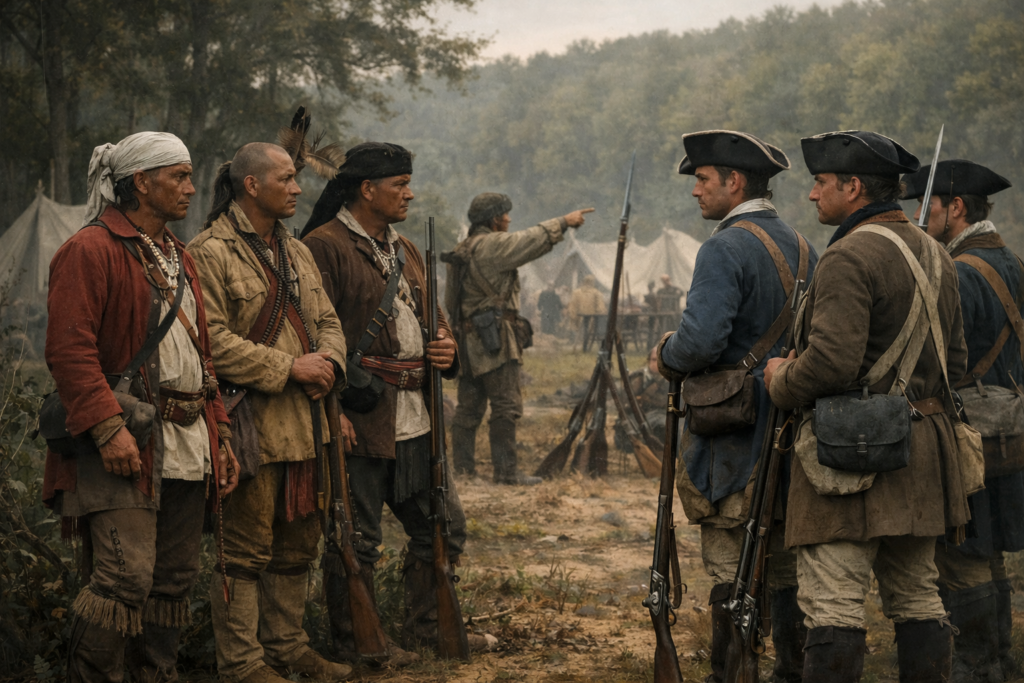
The American Revolution wasn’t just a showdown between colonists and the British Crown. For the more than 80 distinct Native American nations living east of the Mississippi River, the conflict posed an existential threat — one that would reshape their world no matter who won. They faced an agonizing choice: stay neutral in what many viewed as a family dispute within the British Empire, or pick a side and hope that alliance might help preserve their lands and sovereignty.
Most tribes that chose a side supported the British, and their reasoning was sound. The Proclamation of 1763 had attempted to block colonial settlement west of the Appalachians, and Native leaders correctly recognized that an independent America, freed from British constraints, would accelerate land seizures at a terrifying pace. As Mohawk leader Joseph Brant warned in 1775, independence for the colonists would likely mean disaster for indigenous peoples across the continent. History would prove him right.
The Patriots’ Native Allies
Still, several tribes made the difficult calculation to support the Revolutionary cause. The most significant were the Oneida and Tuscarora nations of the Iroquois Confederacy, along with the Stockbridge-Mohican people of Massachusetts and New York. Smaller contingents from the Catawba, Delaware, Maliseet, Pequot, Narragansett, Niantics, and Montauks also fought alongside colonial forces.
The Stockbridge-Mohican had a relatively clear-cut situation: surrounded by colonial settlements in western Massachusetts, neutrality was essentially impossible. They had already developed cultural and trade ties with their English neighbors, and they bet that loyalty might protect their remaining land rights in the new nation. They were among the very first Native people to take up arms, with members serving as minutemen at Lexington and Concord in April 1775 and fighting at Bunker Hill that June.
The Oneida’s decision was more complex. Unlike tribes facing immediate frontier pressure, they had some geographic breathing room. Their choice reflected relationships built with colonial missionaries and traders, but also a calculated gamble: that an American victory might better respect their territorial claims than continued British rule. In 1776, Congress formally authorized General Washington to recruit Stockbridge Indians, and the Oneida soon became crucial assets — not just as fighters, but as scouts who knew the terrain intimately, and as diplomats attempting to keep other tribes neutral.
Combat Contributions
Native Americans who fought for the Patriots contributed far beyond their numbers. Historian Pekka Hämäläinen has argued that proportionally more Indians than New Englanders served in Patriot forces during the war. Their most consequential military moment came at the Battle of Oriskany on August 6, 1777 — one of the bloodiest engagements of the entire conflict.
At least 60 Oneida warriors fought alongside New York militia against a combined British, Loyalist, and Mohawk force. Warrior Han Yerry, his wife Tyonajanegen, and their son all distinguished themselves that day. According to contemporary accounts, Han Yerry killed nine enemy fighters before a bullet disabled his gun hand, forcing him to continue with his tomahawk; Tyonajanegen fought on horseback with pistols throughout the battle. The engagement fractured the Iroquois Confederacy permanently and helped prevent British forces from reinforcing General Burgoyne before the decisive American victory at Saratoga two months later.
Perhaps the Oneida’s most vital — and least celebrated — contribution came during the winter of 1777-78 at Valley Forge. When Washington’s army faced starvation, Oneida Chief Shenandoah dispatched warriors carrying several hundred bushels of white corn. An Oneida woman named Polly Cooper made the 200-mile journey from Fort Stanwix and stayed at Valley Forge, teaching the starving soldiers how to properly cook the corn so it was actually digestible. Washington personally met with Oneida leaders to express his gratitude, presenting each with a wampum belt. It was a quiet act of generosity that may have saved the Continental Army.
The Oneida continued fighting throughout the war — at the Battle of Barren Hill in May 1778, where scouts stayed behind to allow Lafayette’s troops to escape a British trap; at the Battle of Monmouth; and in numerous northern campaigns. Ten Oneida soldiers earned officers’ commissions in the Continental Army, one rising to lieutenant colonel. Some even served as spies, gathering intelligence deep in enemy territory at enormous personal risk.
The Bitter Aftermath
And then came the betrayal. The 1783 Treaty of Paris, which ended the war, contained no Native American representatives and made no provisions whatsoever for protecting indigenous lands or sovereignty. Britain simply handed over all territory east of the Mississippi to the new United States — without consulting a single Native nation — treating indigenous homelands as British property to dispose of at will.
Even the tribes that had fought for the American cause found that wartime promises evaporated in peacetime. The Oneida, whose contributions had been genuinely critical, faced immediate pressure to cede their territories. By 1788, New York State had leveraged the Oneida into surrendering approximately 5.5 million acres, leaving them with just 300,000. Between 1785 and 1846, New York forced the Oneida to sign 26 additional treaties, stripping away nearly everything that remained.
In 1794, Congress did formally acknowledge the service of the Oneida, Tuscarora, and Stockbridge with the Treaty of Canandaigua, providing $5,000, a new church, and some mills. But the treaty also required the tribes to relinquish all other claims for compensation — effectively closing the books on their wartime losses. Historians estimate the Oneida lost nearly a third of their population during and immediately after the war through combat casualties, displacement, and the destruction of their villages and food stores. The Stockbridge-Mohican, similarly dispossessed, largely migrated west to present-day Wisconsin by the early 19th century.
The Larger Picture
British-allied tribes fared no better. When Britain ceded its eastern territories, it abandoned all its Native allies without protection or compensation. Joseph Brant’s Mohawk lost nearly all their land, though the British eventually granted Brant’s followers about 810,000 hectares along the Grand River in present-day Ontario — land where the Six Nations Reserve still exists today.
The pattern was consistent across tribes, regardless of which side they chose: the Revolution was a catastrophe for virtually every Native American nation. Those who supported the Patriots made contributions that were real, substantial, and in some cases decisive. The Oneida at Oriskany, the Stockbridge minutemen at Lexington, Polly Cooper at Valley Forge — these weren’t footnotes. They were participants in the founding of a nation that would spend the next century systematically dispossessing them.
The Revolution shattered longstanding indigenous alliances, set precedents for how the new United States would treat Native peoples, and demonstrated that for Native Americans, the choice between British and American sides was ultimately a choice between two different roads to the same devastating destination: the loss of their lands, their sovereignty, and their way of life. It’s a chapter of the founding era that deserves far more attention than it typically gets.
Illustration generated by the author using ChatGPT.
Sources
Oneida Nation — Revolutionary War contributions: https://www.oneida-nsn.gov/our-ways/history/
Treaty of Canandaigua (1794): https://www.onondaganation.org/history/1794-treaty-of-canandaigua/
Stockbridge-Mohican history: https://www.mohican.com/history/
Battle of Oriskany: https://www.nps.gov/orpi/index.htm
Pekka Hämäläinen — Native American roles in the Revolution: https://www.hup.harvard.edu/books/9780674248717
Proclamation of 1763: https://www.britannica.com/event/Proclamation-of-1763
Treaty of Paris (1783) and Native lands: https://avalon.law.yale.edu/18th_century/paris.asp
Six Nations Reserve, Ontario: https://www.sixnations.ca/