
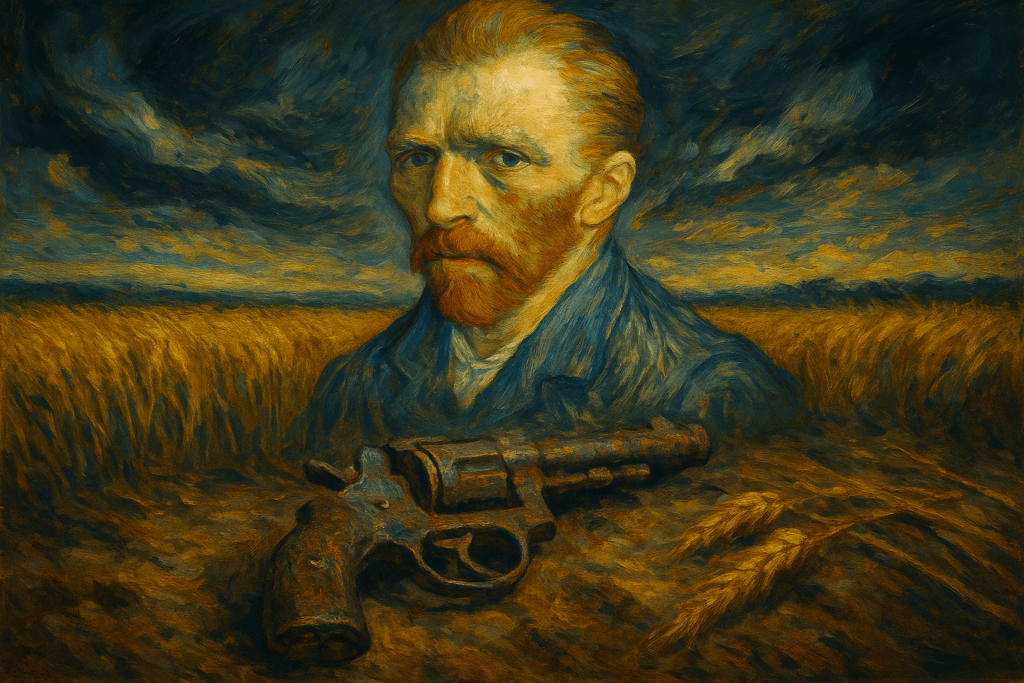
The wheat fields outside Auvers-sur-Oise have become one of art history’s most debated crime scenes. On the evening of July 27, 1890, Vincent van Gogh returned to his small inn, badly wounded and clutching his chest. What happened in those fields remains unsettled: did he shoot himself, as generations believed, or was he caught in some kind of accident—or even an intentional shooting by someone else?
When I first got interested in art, van Gogh grabbed me right away. His paintings felt urgent, almost breathless, as if he couldn’t get his vision out fast enough. The more I learned about his short, turbulent life, the more I wondered what forces drove that energy—and what cut it short.
How we interpret his death matters. If we see it as suicide, we reinforce the familiar trope of the “tortured genius,” a man undone by the same demons that fueled his creativity. If it wasn’t suicide, then that myth fractures, and we’re left with someone whose life ended not by fate or torment, but by chance and circumstance.
The Traditional Story: A Troubled Artist’s Final Day
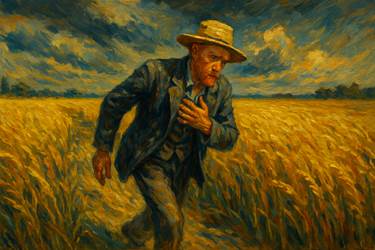
For more than a century, the standard version has been simple: van Gogh, struggling with depression and recurring psychiatric crises, walked into a wheat field and shot himself. He had been living in Auvers-sur-Oise and painting furiously—roughly 70 works in 70 days. Some saw that productivity as a sign of mounting instability.
According to Adeline Ravoux, the innkeeper’s daughter, he left after breakfast and didn’t return until after dark. When police asked what happened, he reportedly said, “Do not accuse anyone. It is I who wanted to kill myself.”
Van Gogh had a long history of mental-health struggles—severe depression, psychotic breaks, even earlier suicidal behavior. His letters often carried a tone of exhaustion; in one to his brother Theo, he wrote, “The sadness will last forever.”
Theo, who died just six months later, recalled his brother saying, “I wish I could have gone away like this.”
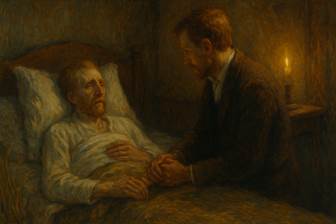
Doctors, friends, and family at the time took all this as confirmation of suicide. The narrative of a gifted but tormented artist ending his own life fit neatly into late-19th-century ideas about genius and madness—and it has persisted ever since. The Van Gogh Museum still supports this interpretation:
The Murder Theory: A Challenge to the Old Story
The debate shifted dramatically in 2011 when Steven Naifeh and Gregory White Smith published Van Gogh: The Life. They argued the suicide story didn’t fully line up with the evidence.
Their alternative theory centers on René Secrétan, a 16-year-old local who liked to tease van Gogh and who reportedly had access to a faulty pistol. The authors note several problems with the suicide explanation:
- Van Gogh rarely had access to weapons and had a stated dislike for them.
- His final paintings were calm, not despairing.
- He had described suicide as sinful.
- He somehow walked more than a mile back to the inn after being shot.
- His painting gear from that day was never found.
They speculate that Secrétan may have accidentally shot him—and that van Gogh, not wanting to ruin the boy’s life, claimed it was suicide. This remains speculation, but it’s one reason the theory caught fire.
The Forensic Debate
A 2020 study added fuel to the controversy. Researchers tested the same model of revolver and reported that a self-inflicted shot at that angle and range likely would have left powder burns—burns that weren’t noted in van Gogh’s case.
Their conclusion: the injury was “in all medical probability” inconsistent with suicide.
Critics push back, noting that van Gogh’s clothing could have blocked powder residue or that details simply weren’t recorded well in 1890. With no autopsy and no preserved clothing, much of this is still guesswork.
The Counterargument: Why Many Experts Still Reject The Murder Theory
Van Gogh scholar Martin Bailey—among others—finds the murder theory unconvincing. Key points include:
- Secrétan denied shooting van Gogh when interviewed later in life.
- He claimed he had left town before the incident.
- It’s extremely rare for a homicide victim to insist it was suicide.
- Theo, Dr. Paul Gachet, and others closest to the situation all believed it was self-inflicted.
- Van Gogh’s burial outside the Catholic cemetery was itself a sign the community accepted suicide—something they would likely have resisted if foul play had been suspected.
What We Actually Know
Despite a mountain of theories, only a handful of facts are certain:
- Van Gogh was shot in the chest on July 27, 1890.
- He survived for about 30 hours and died on July 29.
- No autopsy was performed.
- The weapon was never recovered.
- His art supplies from that day disappeared.
- He left no suicide note.
Everything else rests on testimony, conjecture, and the limits of 19th-century medical documentation.
Why This Debate Matters
The dispute has moved far beyond academia. Films like Loving Vincent (2017) and At Eternity’s Gate (2018) lean into the accident/murder theory. The discussion reflects a broader cultural question: why do we romanticize suffering when we talk about creativity?
If we assume suicide, we risk locking van Gogh into the stereotype that great art comes only from great pain. If we assume an accident, we open the door to imagining a different future—one where he kept painting, evolving, maybe even recovering.
Could Modern Forensics Solve It?
Some researchers want to exhume van Gogh’s remains to analyze the wound using modern techniques. Proponents argue that even degraded bone might show clues about firing distance or angle. That said:
- It would require major legal and ethical approval.
- There’s no guarantee the remains would provide answers after 130+ years.
At this point, it remains an academic long shot.
The Bottom Line
Most major institutions still support the traditional suicide explanation. But alternative theories—especially the forensic questions—have made the old story less airtight than it once seemed.
The most honest conclusion is also the least satisfying—we may never know exactly what happened in that wheat field. Too much evidence is missing, and too much time has passed. What remains is a mystery as layered and emotional as the brushstrokes he left behind.
Leave a Reply