
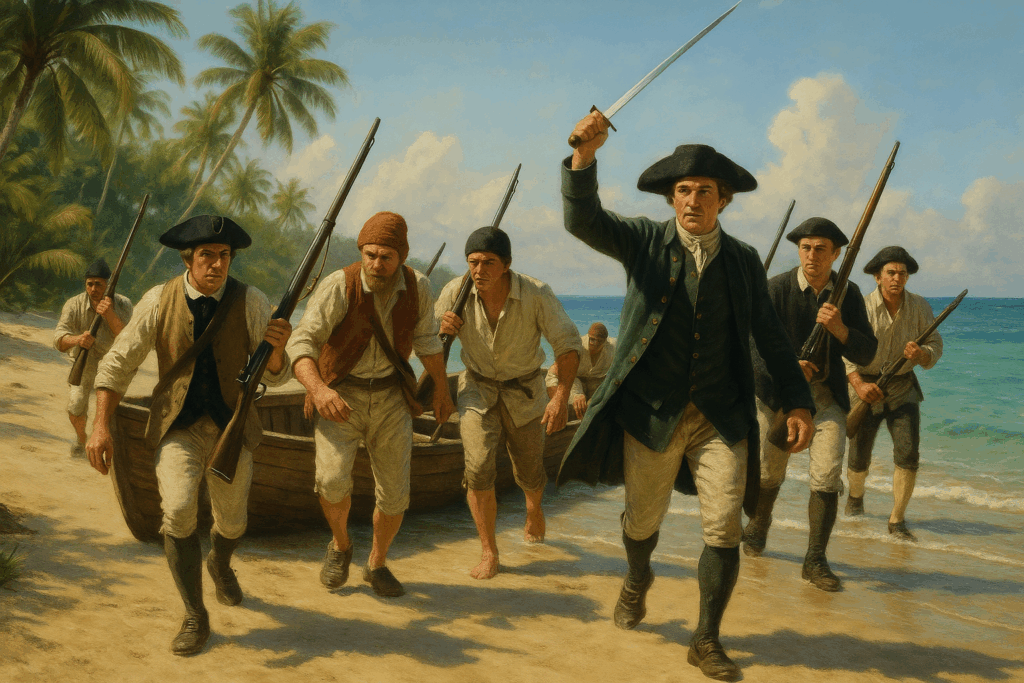
The Continental Marines at Nassau
When the Second Continental Congress authorized the creation of the Continental Marines on November 10, 1775, few could foresee their pivotal role in orchestrating North America’s first amphibious assault less than four months later. The operation against Nassau, on New Providence Island in the Bahamas, was born of necessity, marked by improvisation, and ultimately set the tone for Marine Corps operations—an audacious legacy that endures to this day.
Origins: Gunpowder Desperation and Strategic Vision
The American Revolution’s early years were marked by chronic shortages, especially of gunpowder. After the British seized stores destined for the Patriot cause, intelligence uncovered that significant quantities were stockpiled at Nassau. The Continental Congress approached this challenge with typical Revolutionary War creativity—they would use their brand-new Navy and even newer Marines to solve an Army problem. The Congress’ official instructions to Commodore Esek Hopkins focused on patrolling the Virginia and Carolina coasts, but “secret orders” directed attention to the Bahamas, setting in motion a bold plan to directly address the fledgling army’s supply crisis.
Organization: The Making of an Amphibious Battalion
With barely three months’ existence, the Continental Marines had hastily raised five companies of around 300 men. Captain Samuel Nicholas, tasked as the first Marine officer, oversaw their training and organization in Philadelphia. Their equipment was uneven—many wore civilian garb rather than uniforms and carried whatever muskets and bayonets were available. The uniform regulations specifying the now famous green coats with white facings were not promulgated until several months after the raid was over.
The Voyage South: Challenges and Preparation
Hopkins’ fleet consisted of the ships Alfred, Hornet, Wasp, Fly, Andrew Doria, Cabot, Providence, and Columbus. In addition to ships’ crews, the fleet carried more than 200 Continental Marines under the command of Captain Nicholas. The expedition began inauspiciously on January 4, 1776, when the fleet attempted to leave Philadelphia but became trapped by ice in the Delaware River for six weeks.
When they finally reached the Atlantic on February 17, 1776, the small fleet faced additional challenges. Disease found its way onboard most of the ships. Smallpox was a huge concern and was reported on at least four ships.
The fleet’s journey to the Caribbean took nearly two weeks of sailing through challenging winter conditions. Despite the hardships, Hopkins maintained the element of surprise—British intelligence had detected American naval preparations but assumed the fleet was bound for New York or Boston, not the distant Bahamas.
Implementation: Amphibious Innovation at Nassau
The element of surprise was initially lost when the fleet’s approach triggered alarm at Nassau. Plans to storm the stronger Fort Nassau dissolved, and Hopkins convened a council to identify a new landing point. A revised strategy saw about 230 Marines and 50 sailors, led by Captain Nicholas, land from longboats two miles east of the weaker Fort Montagu on March 3, 1776. They wore a patchwork of civilian clothes and white breeches—some men had managed to find green shirts as a form of identification. They set out marching toward the fort armed with muskets and bayonets, looking perhaps more like pirates than soldiers.
Their advance was met with only token resistance. Outnumbered and ill-prepared, local militia withdrew as Nicholas’s men captured Fort Montagu in what historian Edwin Simmons called a “battle as bemused as it was bloodless.”
Nicholas decided to wait until morning to advance on the town. His decision was tactically sound given the circumstances—he’d lost surprise, did not know the enemy’s strength, was operating in unknown terrain, night was falling, and he lacked naval support. However, this prudent military decision allowed Governor Browne to escape with over 80% of Nassau’s gunpowder stores, turning what could have been a complete strategic victory into a partial success. This incident highlights the tension between tactical prudence and strategic urgency that was destined to become a recurring theme in amphibious warfare.
The next day the Americans took Fort Nassau and arrested the Governor, Montfort Browne. Browne had already sent most of the coveted gunpowder on to St. Augustine, Florida, the night before. Despite this, American forces seized cannons, shells, and other military stores before occupying Nassau for nearly two weeks.
Marine discipline and flexibility were evident, as they pivoted from their surprise landing, conducted operations deep inland, and created their evolving amphibious reputation. The fleet departed on March 17, not before stripping Nassau and its forts of anything militarily useful.

Aftermath: Growing Pains and Enduring Lessons
Though the mission failed in its primary objective of securing a cache of gunpowder, its operational successes far outweighed the losses. The Marines returned with large quantities of artillery, munitions, and several recaptured vessels. On the return leg, they faced and fought (though did not defeat) HMS Glasgow; the squadron returned to New England by April 8, with several casualties including the first Marine officer killed in action, Lt. John Fitzpatrick.
Controversy followed—Hopkins was censured for failing to engage British forces as directed in his official orders. Nicholas was promoted to major and tasked with raising additional Marine companies for new frigates then under construction. These developments reflected both the lessons learned and the growing recognition of the value of the Marine force in expeditionary operations ashore.
A second raid on Nassau by Continental Marines occurred from January 27–30, 1778, under Captain John Peck Rathbun. Marines and seamen landed covertly at midnight, quickly seizing Fort Nassau and liberating American prisoners held by the British. The raiders proceeded to capture five anchored vessels, dismantled Fort Montagu, spiked the guns, and loaded 1,600 lbs of captured gunpowder before departing. This bold operation marked the first time the Stars and Stripes flew over a foreign fort and showcased the resourcefulness of American forces, who managed to strike a valuable blow against British power in the Caribbean without suffering casualties.
Long-Term Implications for the United States Marine Corps
The Nassau operation set powerful precedents:
- Amphibious Warfare Doctrine: This was the Marines’ first organized amphibious landing, shaping the Corps’ future focus on rapid deployment from sea to shore, a hallmark that continues in modern doctrine. This was likely referred to at the time as a Naval landing, as the word amphibious did not come into use in this context until the 1930s.
- Adaptability Under Fire: The improvisational tactics used at Nassau foreshadowed the Corps’ reputation for flexibility and mission focus.
- Naval Integration: Joint operations with the Navy not only succeeded tactically, but helped institutionalize the Marine-Navy partnership, with Marines serving as shipboard security, landing parties, and naval infantry.
- Legacy of Boldness: This first operation established a “first-in” ethos and a culture embracing challenge and audacity, foundational principles in Marine culture.
After the war, the Continental Marines disbanded, only to be re-established in 1798. Yet the legacy of Nassau endured. “Semper Fidelis”—always faithful—has its roots in that March 1776 assault, when the odds seemed long and the stakes critical.
Today’s United States Marine Corps draws a direct lineage from that small, ragtag battalion of Marines scrambling ashore at Nassau, forever entwining its identity with the promise, risk, and legacy of that first storied mission. Every modern Marine, stepping from ship to shore, walks in the footprints of Captain Samuel Nicholas and his men—soldiers of the sea whose boldness, improvisation, and teamwork have echoed across the centuries.
