Grumpy opinions about everything.

Tag: Continental Army

The Broken Promises: How America Treated Its Revolutionary War Veterans

The story of how the Continental Army’s veterans were treated after winning independence reads like a betrayal. These men had endured Valley Forge, fought without pay — — often without food or clothing — risking everything for a revolution that promised liberty and opportunity. What many received instead was financial ruin, confiscated land, and a harsh lesson in how political power and economic class determined who really benefited from their shared sacrifice.

The Pay That Never Came

Let me start with the most basic broken promise — pay. Continental soldiers were supposed to receive regular wages, but the Continental Congress lacked the power to tax and relied on increasingly worthless paper money. By war’s end, many soldiers hadn’t been paid in months or even years. When they finally returned home, they carried IOUs called “certificates of indebtedness” rather than actual money.

The wealthy and well-connected quickly figured out how to profit from this situation. Speculators traveled through rural areas buying up these certificates from desperate veterans at pennies on the dollar. The soldiers, facing immediate debts and no income, often had no choice but to sell. When the federal government eventually redeemed these certificates at full value under Alexander Hamilton’s financial plan in the 1790s, it was the speculators who made fortunes, not the men who’d earned the money, suffered and won the revolution.

Pensions: Promised to Officers, Denied to Enlisted Men

The pension situation revealed the class divisions even more starkly. In 1780, Congress promised officers who served until the war’s end a pension of half-pay for life. Common soldiers received no such promise. When the officers’ pensions proved controversial and expensive, Congress “commuted” them in 1783 to a one-time payment of five years’ full pay — still nothing for the enlisted men who’d done most of the fighting and dying.

It wasn’t until 1818 that Congress finally created a pension for Continental Army privates, and even then, only for those in “reduced circumstances” — meaning you had to prove you were poor to get it. The maximum annual pension was $96, hardly generous compensation for years of service. Soldiers who had served in militia units were generally excluded. By contrast, officers had already received their commutations decades earlier and often held positions of economic and political power.

Land Bounties: Another Empty Promise

Land bounties represented another avenue where common soldiers got shortchanged. Various colonies and Congress promised land grants to encourage enlistment — typically 100 acres for privates, scaling up to 500+ acres for officers and thousands of acres for generals. But there were problems from the start.

First, much of the promised land was in frontier territories like the Ohio Country, which remained dangerous and largely unsurveyed for years after the war. Second, the process of claiming your land required navigating bureaucratic systems, paying surveying fees, and sometimes traveling hundreds of miles. Third, the land often turned out to be of poor quality or in disputed areas. The average veteran with little education, almost no money and absolutely no political influence was seldom ever able to take advantage of the land bounty.

Predictably, speculators moved in. They bought up land bounty warrants from soldiers who lacked the resources or knowledge to claim them directly. One study found that in Virginia, which promised the most generous bounties, speculators ultimately controlled vast tracts while many veterans received little or nothing.

The Tax Collector Cometh

Here’s where the story gets particularly cruel. While veterans struggled with unpaid wages and unredeemed promises, the new state governments faced their own financial crises. They’d accumulated massive war debts and needed revenue. Their solution? Property taxes.

In Massachusetts, the legislature imposed heavy taxes payable in hard currency — gold or silver — which almost nobody in rural areas possessed. The same certificates of indebtedness that soldiers were given by the government weren’t accepted for tax payments, even though the state owed them that money. Veterans who’d sold their certificates for a fraction of their value to pay immediate debts now faced tax bills they couldn’t pay. These policies were not accidental side effects; they reflected the priorities of creditor classes concentrated in coastal towns, who preferred regressive property taxes over inflation or debt relief for veterans.

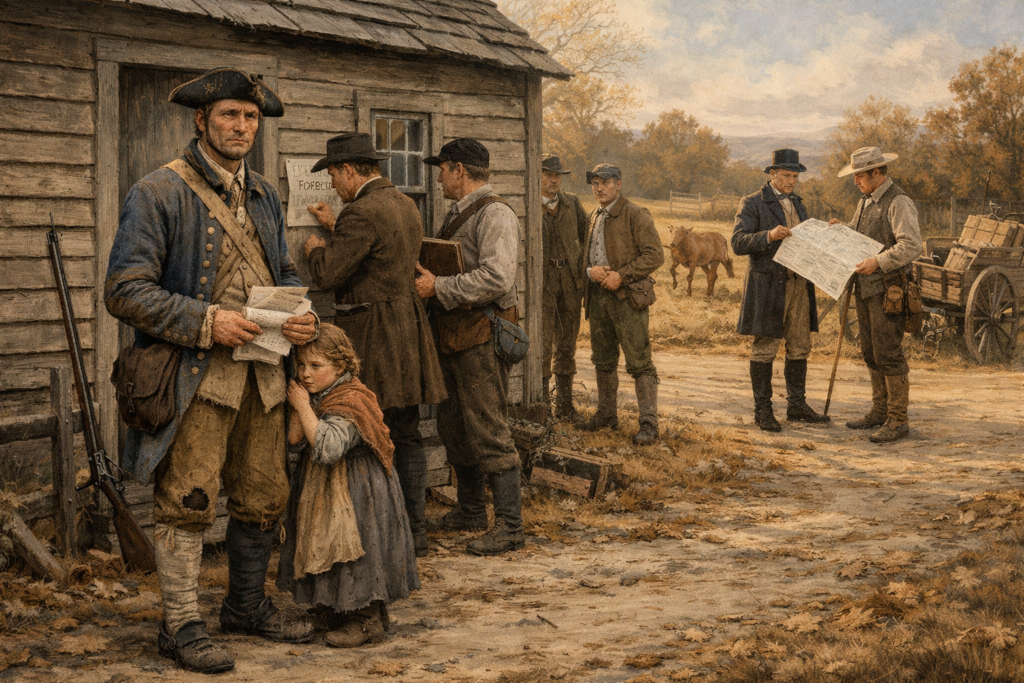
When farmers and veterans couldn’t pay these taxes, local sheriffs seized and auctioned their property. In many cases, the buyers at these auctions were the same merchant elites and speculators who’d bought up the certificates. This wasn’t accidental — it was a systematic transfer of wealth and property from those who’d fought the war to those who’d financed it, avoided personal risk and now controlled state governments. Elites did not overtly confiscate veterans’ land through direct political targeting; instead, they relied on neutral-looking fiscal policy — strict tax collection, aggressive debt enforcement, and courts unsympathetic to insolvency — to transfer property legally. The effect was unmistakable; veterans who fought for independence lost their farms to satisfy debts incurred during or immediately after their service, while wealthier investors accumulated land and made financial gains.

The Massachusetts situation became particularly egregious. Between 1784 and 1786, thousands of foreclosure proceedings were filed. Veterans who’d survived the war returned to find themselves losing their farms and, in some cases, being thrown into debtors’ prison.
Shays’ Rebellion: When Veterans Fought Back

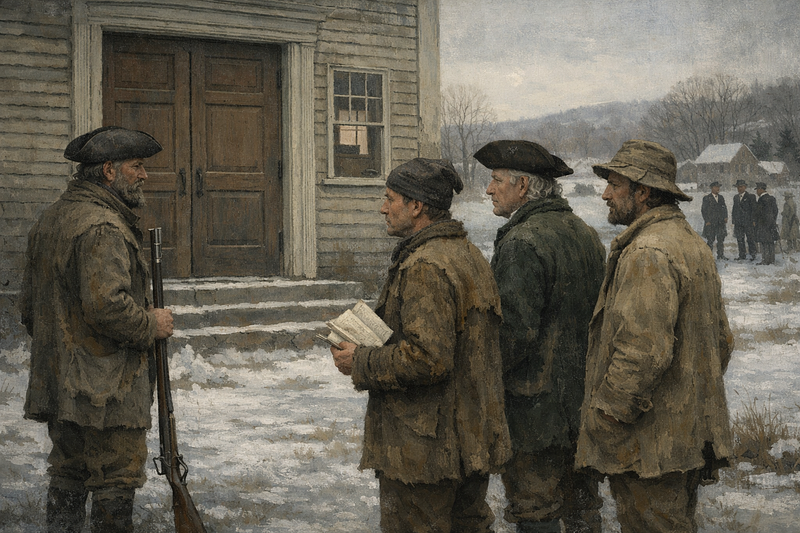
The breaking point came in 1786 with Shays’ Rebellion in Massachusetts. Daniel Shays, a former Continental Army captain, led hundreds of veterans and farmers in an armed uprising against foreclosures and debt courts. They physically prevented courts from sitting, trying to halt the cascade of farm seizures. They represented the soldiers who’d won independence and felt the new government had betrayed them.

The rebellion was suppressed by a militia funded by wealthy Boston merchants and creditors as the state treasury lacked ready cash to pay troops. This was a clear demonstration of how thoroughly economic power had concentrated among elites and sent shockwaves through the political establishment. To many rural farmers the suppression looked like creditors hiring an army to enforce unjust laws against impoverished veterans.

Interestingly, most of the rebels received pardons, and Massachusetts did eventually reduce some taxes and reform debtor laws. But the damage was done, and the pattern had been established.

The Class Divide in Revolutionary Benefits

The broader pattern is unmistakable. Officers, who were generally drawn from propertied classes, received pensions and larger land bounties, had the education and connections to navigate bureaucratic systems, and often held the political power to protect their interests. Common soldiers, usually farmers or laborers, received certificates they had to sell at a loss, faced tax collectors seizing their property, and had little political voice. They disproportionately bore the costs of the new fiscal order through unpaid or depreciated wages, lack of early pension support, and vulnerability to foreclosure, while many of the tangible financial benefits of their service migrated to wealthier elites.

Some historians argue this wasn’t conspiracy but circumstance — that the new nation genuinely lacked resources and that markets naturally concentrated certificates in wealthier hands. There’s some truth to this. The Continental Congress was genuinely broke, and state governments faced real fiscal crises.

But the specific policy choices — redeeming certificates from speculators at full value while rejecting them for tax payments, creating pensions for officers but not enlisted men, setting tax policies that required hard currency that poor farmers didn’t have — these weren’t inevitable, they were a choice. They reflected the interests of those who held power in state legislatures and the Continental Congress.

The Long Echo

The treatment of Continental Army veterans established patterns that would echo through American history: promises made during wartime, broken during peace; benefits flowing more generously to officers than enlisted men. Economic and political elites using legal mechanisms to transfer wealth from those who fought the revolution to those who financed it.

The first genuinely “service‑based” pension law that broadly covered surviving Continental soldiers — regardless of disability — did not arrive until 1818, three decades after the war, and it initially required proof of indigence, effectively screening out better‑off veterans and stigmatizing poorer ones. Not until the 1832 act did Congress move toward full pay for life for many surviving officers and enlisted men — including militia — based on length of service alone. But large numbers of veterans had already lost their farms, spent years in poverty, or died. The benefits came too late and too meagerly to undo decades of hardship. They were owed better.

Illustrations generated by author using ChatGPT.

Sources:

Mount Vernon Digital Encyclopedia — Veterans of the Revolutionary War https://www.mountvernon.org/library/digitalhistory/digital-encyclopedia/article/veterans-of-the-revolutionary-war/

This George Washington Presidential Library resource provides an overview of how Continental Army veterans were treated, including details on certificate speculation, payment issues, and the general economic struggles veterans faced after the war.

National Archives — Revolutionary War Pension Files https://www.archives.gov/research/military/war-of-1812/pension-files

While this link references War of 1812 pensions, the National Archives maintains extensive documentation on Revolutionary War pensions as well. The site explains the evolution of pension systems and eligibility requirements, including the 1818 act that finally provided pensions to enlisted men who could prove poverty.

Encyclopedia Virginia — Military Bounty Lands https://www.encyclopediavirginia.org/entries/military-bounty-lands/

This scholarly resource details Virginia’s land bounty system, which was among the most extensive. It documents how these bounties were promised, the challenges veterans faced in claiming them, and how speculators ultimately acquired much of the promised land.

American Battlefield Trust — Shays’ Rebellion https://www.battlefields.org/learn/articles/shays-rebellion

This article provides context on the 1786–1787 uprising in Massachusetts, explaining the economic conditions that drove veterans to armed resistance, the foreclosure crisis, and the rebellion’s impact on constitutional debates.

Massachusetts Historical Society — Shays’ Rebellion https://www.masshist.org/features/shays/
Divine Providence and Patriotism

Religion in the Ranks of the Continental Army

The Continental Army that fought for American independence from 1775 to 1783 represented a cross-section of colonial religious life, bringing together men from diverse faith traditions under a common cause. The religious faith of both enlisted soldiers and officers reflected the broader religious landscape of colonial America, and their regional differences contributed to a complex tapestry of faith within the ranks.

The Continental Army drew from a population where religious diversity was already well-established, particularly when compared to European armies of the same period. Protestant denominations were the majority within the ranks, reflecting the colonial religious demographics.

The American Revolution was not only a political and military struggle but also a deeply religious experience for many Continental Army soldiers. Their faith shaped how they interpreted the war, coped with its hardships, and interacted with comrades from diverse backgrounds.

Enlisted soldiers often relied on providentialism, the belief that God directly intervened in daily life, to make sense of battlefield chaos and suffering. Diaries and letters reveal troops attributing survival in skirmishes, unexpected weather shifts, and even mundane events to divine will. For example, many saw the Continental Army’s unlikely battlefield victories as evidence of God’s favor toward their cause.

Diversity in the Ranks

Congregationalists from New England formed a significant portion of the army, bringing with them the Puritan theological tradition that emphasized divine providence and moral responsibility.  Ministers in New England frequently preached that resistance to tyranny was a Christian duty and many soldiers viewed themselves as fighting against tyranny, much as their ancestors had fled religious persecution.

Presbyterian soldiers, many of Scots-Irish descent, comprised a substantial group. Concentrated heavily in the Middle Colonies and frontier areas, they tended toward evangelical and Presbyterian influences, regardless of their home colony . The challenging conditions of frontier life had already created a more individualistic and emotionally intense form of Christianity that adapted well to military service. These soldiers often brought a fatalistic acceptance of divine will combined with fierce determination.

Baptist and Methodist soldiers, though fewer in number, represented growing evangelical movements that would later transform American Christianity. German Reformed and Lutheran soldiers from Pennsylvania added to the religious diversity, while smaller numbers of Catholics, particularly from Maryland and Pennsylvania, served despite facing legal restrictions in many colonies. Even a few Jewish soldiers joined the cause, though their numbers were minimal given the tiny Jewish population in colonial America. The religious pluralism in regiments from the Middle Colonies created a more tolerant atmosphere that foreshadowed the religious diversity of the new nation.  

Quakers were generally pacifists and avoided military service, however some “Free Quakers” broke from their tradition and joined the Patriot cause. Other pacifist religious groups, such as Mennonites, abstained from combat but occasionally provided non-combatant support.

Anglicans, ironically fighting against their own church’s mother country, served in significant numbers, particularly from the Southern colonies where the Church of England frequently had been established as a state supported church. 

While religious diversity was generally a unifying force in the Continental Army, there were some instances of religious tension and while they were relatively limited, they were not entirely absent. One significant example occurred early in the war in November 1775, when some American troops planned to burn an effigy of the Pope on Guy Fawkes Day (also known as Pope’s Day in New England).  General Washington strongly condemned this anti-Catholic action, denouncing it as indecent and lacking common sense.

Washington actively tried to prevent sectarianism from undermining unity in the ranks, whether between Protestants and Catholics or among different Protestant denominations. The overall trend was towards religious tolerance and unity, with religious diversity ultimately contributing positively to the army’s cohesion and morale.

Officer Corps and Religious Leadership

The officer corps of the Continental Army reflected a somewhat different religious profile than the enlisted ranks. Many officers came from the colonial elite and were often Anglican or belonged to more established denominations. However, the Revolution’s anti-episcopal sentiment led many Anglican officers to distance themselves from their church’s political connections while maintaining their basic Christian beliefs.  The relationship between the soldiers and the established Church of England became increasingly strained as the Revolution progressed.

George Washington himself exemplified this complex relationship with religion. Though nominally Anglican, Washington never wrote about his personal faith.  He was likely influenced by Deist philosophy, then popular among Enlightenment thinkers including Jefferson and possibly Franklin. Deism holds that reason and observation of the natural world are sufficient to determine the existence of a Creator, but that this Creator does not intervene in the universe after its creation.

Washington regularly invoked divine providence in his correspondence and orders, understanding the importance of religious sentiment in maintaining morale, even while his personal beliefs remained ambiguous. His famous directive that “the blessing and protection of Heaven are at all times necessary but especially so in times of public distress and danger” reflected his understanding of religion’s role in military leadership.

Other prominent officers brought their own religious convictions to their leadership. Nathanael Greene, the Southern theater commander, was raised as a Quaker but was expelled from the Society of Friends for his military service. Rev. Peter Muhlenberg, a Lutheran minister, left the pulpit and joined the Continental Army, rising to the rank of Major General.  The Marquis de Lafayette, though Catholic, adapted to the predominantly Protestant environment of the American officer corps.

Officers, including Washington, viewed religion as a tool for discipline and unity. Washington mandated Sunday worship. He also appointed chaplains to every brigade, insisting they foster “obedience and subordination”.

 Continental Army Chaplain Service

Recognizing the importance of religion to morale and discipline, the Continental Congress authorized the appointment of chaplains to serve with the army. The chaplain system evolved throughout the war, beginning with regimental chaplains and eventually expanding to include brigade and division chaplains for larger organizational units.

Continental Army chaplains faced unique challenges. Unlike European armies with established state churches, American chaplains served religiously diverse units. They needed to provide spiritual comfort to soldiers from different denominational backgrounds while avoiding sectarian conflicts that could undermine unit cohesion. Most chaplains were Protestant ministers, reflecting the army’s composition, but they were expected to serve all soldiers regardless of specific denominational affiliation.

The duties of Continental Army chaplains extended beyond conducting religious services. They often served as informal counselors, helped soldiers write letters home, provided basic education to illiterate soldiers, and sometimes even served as medical assistants. Their moral authority made them valuable in maintaining discipline, and many commanders relied on chaplains to address problems of desertion, drunkenness, and other behavioral issues.

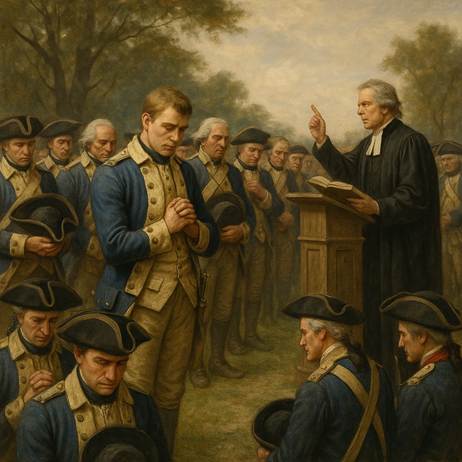
Chaplains also played important roles in significant military events. They conducted prayers before major battles and led thanksgiving services after victories. They provided comfort to the dying and services for the dead.

The British recognized the importance of chaplains to the Continental Army and in some cases offered rewards for their capture.

The famous painting of “The Prayer at Valley Forge” with its image of Washington praying alone in the snow, whether historically accurate or not, represents the type of spiritual leadership chaplains were expected to provide during the army’s darkest moments.

Conclusion Religion in the Continental Army reflected both the differing and the common aspects of colonial American faith. While denominational variations existed, most soldiers shared basic Christian beliefs that provided comfort during hardship and meaning to their sacrifice. The army’s religious diversity foreshadowed the religious pluralism that would characterize the new American nation, while the chaplain service established precedents for military religious support that continue today. The Revolution’s success owed much to the spiritual resources that sustained these soldiers through eight years of difficult warfare, demonstrating religion’s crucial role in the founding of the American republic.

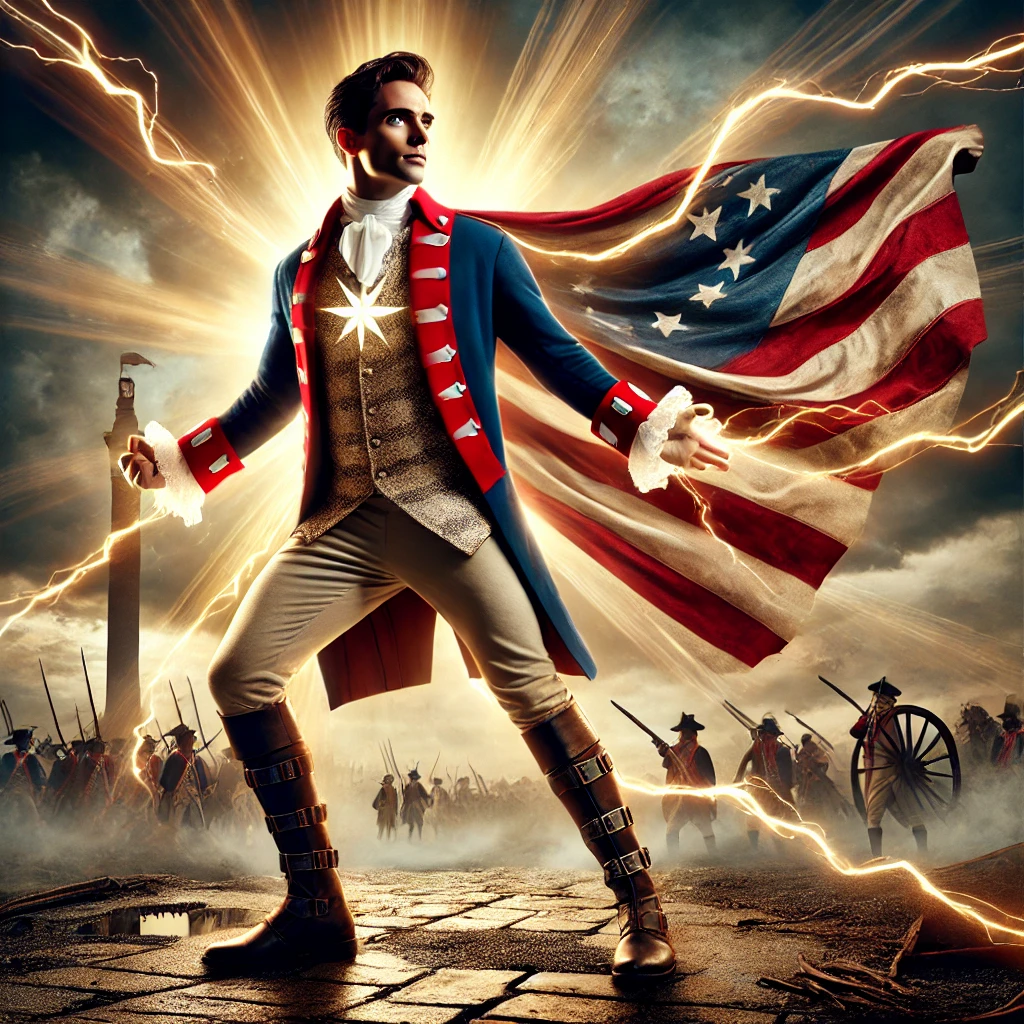
Superheros of the American Revolution

The American Revolution was fought not just by great leaders but by ordinary men and women who sacrificed everything for the promise of liberty. These “superheroes” of The Revolution—everyday soldiers of the Continental Army—endured unimaginable hardships and proved their resilience and commitment to a cause greater than themselves.

Who Were the Soldiers?
The typical soldier in the Continental Army was a young, able-bodied man in his late teens or twenties. However, recruits ranged widely in age, from boys as young as 16 to older men in their 40s or 50s. They came from all walks of life, reflecting the agrarian and small-town character of colonial America.

Work Background
Most soldiers were farmers or farm laborers, the backbone of the colonial economy. Others worked as apprentices or tradesmen, honing skills in blacksmithing, carpentry, and shoemaking. In coastal regions, fishermen and sailors also joined the ranks, bringing valuable maritime experience. Whatever their occupation, enlistment often meant leaving behind grueling but steady work, placing enormous burdens on their families and communities.

Education
Formal education was limited for most enlisted men. Literacy rates in colonial America, though higher than in Europe, were modest. Many soldiers could read and write only minimally, though these skills were sufficient for reading orders or sending letters home. Officers were generally better educated, often hailing from wealthier families with access to classical training and instruction in leadership and military strategy.

Family Life
Family ties were integral to the soldiers’ lives. Most were unmarried young men, but some older recruits left wives and children behind. Married soldiers relied on their families to manage farms and households in their absence, with women stepping into traditionally male roles to keep homes running. Communities often influenced enlistment decisions, with entire groups of men from the same town joining together, fostering camaraderie and mutual responsibility.

Why They Fought
Motivations for joining the Continental Army varied:
Patriotism: Many believed passionately in independence and the ideals of liberty and self-governance.
Economic Opportunity: For poorer colonists, enlistment promised steady (albeit delayed) pay and the promise of land grants after the war.
Community Expectations: Peer pressure and local leaders often spurred enlistments.
Adventure: For some young men, the army offered a chance for excitement and novelty.

Life in the Continental Army
Soldiers in the Continental Army faced extraordinary challenges that tested their endurance, commitment, and morale.
Logistical Struggles
The army constantly grappled with a lack of basic supplies:
Food: Soldiers often endured long periods of hunger, relying on inconsistent local contributions, sometimes going days without eating.
⦁ Clothing: Many lacked proper uniforms, footwear and blankets, suffering in harsh weather some even dying from exposure.
Ammunition: Weapons and ammunition were scarce, forcing soldiers to scavenge from battlefields.

At Valley Forge in the winter of 1777–1778, these shortages reached a critical point, with thousands suffering from frostbite, near starvation and exposure.
Extreme weather compounded the soldiers’ difficulties. Winter encampments like Valley Forge were marked by freezing temperatures, snow, and overcrowded, unsanitary conditions that led to outbreaks of smallpox, typhus, and dysentery.
Soldiers marched long distances with heavy packs, often on empty stomachs and in worn-out shoes. The physical strain was enormous, and separation from families added emotional stress. Many struggled to adapt to military life, which was vastly different from their previous experiences as farmers or tradesmen.

Financial Hardships
The fledgling American government struggled to fund the war:
⦁ Soldiers were rarely paid on time, leading to frustration and occasional mutinies.
⦁ Promised wages were often months or years late, making it difficult for soldiers to support their families.

Inconsistent Leadership and Training
Early in the war, the army lacked professional training and experienced leadership. While General George Washington provided steadfast guidance, many officers were political appointees with little military expertise. This began to change when Baron von Steuben arrived at Valley Forge, introducing systematic training and discipline.

Psychological Strain
The Revolutionary War dragged on for eight years, leaving soldiers to question whether their sacrifices would lead to victory. Early defeats against the better-equipped British Army demoralized many, and desertion rates were high. Still, the shared belief in the cause of liberty and the support of local communities kept many soldiers in the fight.

The Role of Communities
The army’s survival depended on civilian support. Local farmers, tradesmen, and women provided food, clothing, and moral encouragement. Civilians risked their lives to aid soldiers, and the collective belief in independence buoyed spirits even in the darkest times.

Conclusion
The common soldiers of the Continental Army were true superheroes of the American Revolution. Despite enduring hunger, cold, disease, and financial instability, they fought with unwavering determination. Their sacrifices laid the foundation for a new nation, proving that the quest for freedom often requires immense personal and collective sacrifice.

Sources:
Robert Middlekauff, The Glorious Cause: The American Revolution, 1763-1789
⦁ Caroline Cox, A Proper Sense of Honor: Service and Sacrifice in George Washington’s Army
⦁ Library of Congress: American Revolution resources

Powered by WordPress & Theme by Anders Norén