
The Cold Hard Facts
So, you’ve probably heard about cryonics—the practice of freezing dead bodies in hopes of future revival—whether from sci-fi movies, an episode of Twilight Zone, or news stories about tech billionaires planning for immortality. But is there any legitimate science behind it, or is it all wishful thinking dressed up in lab coats? Let’s dig into this fascinating and controversial field.
Fair warning: this topic gets technical fast. I’ll do my best to keep things accessible, but some science-speak is unavoidable. I won’t pretend to offer an exhaustive examination of every element—that would take a textbook, not a blog post.
First, Let’s Get Our Terms Straight
Before we dive in, there’s an important distinction to make. Cryogenics refers broadly to the science of producing and studying very low temperatures—generally below −150°C (−238°F). This is a legitimate field with real-world applications to everything from rocket fuel to medical equipment to food preservation.
Cryonics, on the other hand, is specifically the practice of preserving a person who has died, with the hope of reviving them sometime in the future. This is where things get speculative—and controversial.
The Scientific Foundations: How Did We Get Here?
The ability to produce extremely cold temperatures emerged from a deepening understanding of thermodynamics—the science of heat, energy, and work. The key theoretical developments happened between 1842 and 1852 when a number of scientists published foundational works on the first and second laws of thermodynamics.
The practical breakthrough came in 1877, when oxygen was first cooled to the point where it became a liquid (−183°C). The term “cryogenics” itself was coined in 1894 by Kamerlingh Onnes of the University of Leiden to describe the science of producing very low temperatures.
There is a theoretical lower limit to how cold anything can get, known as absolute zero: −273.15°C or −459.67°F. At that point, molecular motion essentially stops, though reaching it is physically impossible because the energy required approaches infinity.
The logic behind biological cryopreservation flows naturally from this: if cold temperatures slow and eventually halt chemical processes, then extreme cold could theoretically preserve living tissue indefinitely. At liquid nitrogen temperatures (−196°C), the chemical and biological reactions in cells slow dramatically—and in theory, stop—which is the core premise of cryonics.
A key conceptual pillar of cryonics is that “death” is a process, not a single moment: cells and tissues undergo a continuum of injury after circulation stops, and some damage that is irreversible today might be repairable with future nanotechnology or regenerative medicine. Technically, current procedures emphasize rapid cooling after legal death, cardiopulmonary support to circulate cold fluids, and perfusion of the vasculature with concentrated cryoprotectant solutions that aim to achieve vitrification (a glass‑like solid state with minimal ice).
The Ice Crystal Problem: Why Freezing Destroys Living Tissue
Here’s where things get complicated. While the physics of cold temperatures is well understood, the biology of what happens when you freeze living tissue is where cryonics runs into serious trouble.
Freezing is often catastrophic for cells. On the scale of organs, ice formation can cause mechanical damage through expansion and can literally shatter tissue. When ice forms inside a cell, that cell almost always dies. Wide scale freezing also disrupts capillaries and vessels so that even if the cells were intact, they could not be reperfused.
The brain presents particular challenges on top of all this. Neurons—the cells that form the biological basis of everything you are—are more intricate and vulnerable than any other cell type. They consume roughly a quarter of the body’s available energy just to keep themselves alive. And it’s not just the presence and number of neurons that supports consciousness and memory, but the extraordinarily precise way in which trillions of microscopic connections are arranged between them. Those connections are how your memories and identity are stored, and they are exactly the kind of delicate structures most vulnerable to freezing damage.
Vitrification: The Workaround
To sidestep the ice crystal problem, cryonicists developed a technique called vitrification—essentially turning the body into a glass-like solid without crystallization. The process involves replacing the body’s blood with a special solution of cryoprotectant chemicals. These compounds are believed to prevent ice crystal formation and reduce tissue damage. Bodies are then stored in specialized containers filled with liquid nitrogen at −196°C.
The idea is elegant: instead of freezing, you’re essentially turning biological tissue into an amorphous, glass-like state where nothing moves and nothing degrades. On paper, it sounds like a solution. In practice, it creates a whole new set of problems.
The Toxicity Problem: Cryoprotectants as a Double-Edged Sword
The chemicals that prevent ice formation are toxic to the cells they’re meant to protect, and that toxicity increases with concentration. You need high doses to stop ice from forming, but those same doses cause their own cellular damage.
Dimethyl sulfoxide (DMSO) is the most widely used cryoprotectant, and also the most problematic. It can trigger programmed cell death, induce unwanted cellular changes, create osmotic stress, and may be a potential neurotoxin. At higher concentrations, it may even promote tumor development.
Other cryoprotectants carry their own baggage. Glycerol, long used for preserving blood cells and sperm, simply doesn’t scale up for whole-organ preservation. Ethylene glycol—yes, the same compound found in automotive antifreeze—gets metabolized into glycolic acid, which can cause metabolic acidosis, destabilizes cell membranes and may disrupt protective water layers around critical biological molecules.
Researchers are actively pursuing alternatives, including antifreeze proteins, nanotechnology-based approaches and new cryoprotectants. Each target ice formation or membrane protection through mechanisms designed to reduce the toxicity trade-off that has plagued cryopreservation for decades, though none has yet solved the problem at the scale cryonics requires.
Can We Actually Revive Frozen Bodies?
Short answer: No. Not currently, and possibly not ever.
Dennis Kowalski, president of the Cryonics Institute, has acknowledged that cryonic reanimation is “100 percent not possible today.” Shannon Tessier, a cryobiologist with Harvard University and Massachusetts General Hospital, put it more bluntly: “…the harsh reality is that current cryonic methods give patients only false hope. As they are practiced, they are both unscientific and profoundly destructive, permanently damaging cells, tissues, and organs. For now, the dream of cryonics remains frozen.”
Even setting aside current limitations, revival would require solving an extraordinary stack of problems: repairing damage from oxygen deprivation prior to freezing, neutralizing cryoprotectant toxicity, addressing thermal fracturing that occurs during the cooling process, healing tissues that didn’t vitrify successfully, and then curing whatever originally caused death. In many cases, reversing aging would also be necessary. None of these are close to solvable today.
There’s also a deeply uncomfortable practical question embedded in all of this: even if future medicine could theoretically rebuild and restore neuronal connections, how would anyone know what connections belong where? While the scanning technology is advancing fast enough that reading a well-preserved brain’s connectome at molecular resolution looks plausible within the coming decades, whether that information would be sufficient to reconstruct a person — biologically or digitally — remains genuinely unknown. Unless a complete molecular-level brain scan is performed before freezing—and stored alongside the tissue—trying to reconstruct memories and personality would be like trying to rewrite a burned book by studying the ashes.
Nanotechnology and Recent Progress
Cryonicists often point to future nanotechnology as the solution to the repair problem. The central thesis is that nearly any structure consistent with the laws of chemistry and physics could theoretically be built at the molecular level. The idea is that tiny molecular machines could one day repair cellular damage caused by cryopreservation rapidly enough to make revival possible. This remains highly speculative, but it’s not impossible in theory.
There has been some genuine progress on the warming side of the equation. Scientists have developed methods for safely thawing frozen tissues using nanoparticles—specifically, silica-coated particles containing iron oxide. Tests on human skin cells, pig heart valve segments, and pig artery sections showed no signs of harm from the rewarming process, and the tissues preserved key physical properties like elasticity. Application at the whole organ level has yet to be demonstrated.
What Actually Works Today
It’s worth noting what cryopreservation can accomplish now. Medical laboratories have long used the technique to preserve animal cells, human embryos, and simple tissues—eggs, sperm, bone marrow, stem cells, corneas, and skin—for periods of up to three decades, with successful thawing and transplantation. This is established, working medicine.
The leap from preserving a cell or an embryo to preserving a whole human body, however, is enormous. Large vitrified organs tend to develop fractures during cooling. No one has successfully preserved and revived a large mammal from a fully vitrified state.
What About The Wood Frog?
Invariably, in the discussion of cryonics someone will bring up the wood frog. In northern climates, the wood frog can seemingly freeze solid in the winter and then be hopping around with no obvious injuries in the spring. But there are several reasons why this isn’t applicable to the human science of cryonics.
First, and most obvious, the wood frog is cold-blooded, and we are not. The wood frog survives freezing at -3°C to -16°C, while cryonics stores bodies at -196°C—temperatures no frog could survive. Crucially, wood frogs, thanks to eons of evolutionary adaptation, prepare biologically before freezing—their liver actively flooding tissues with glucose cryoprotectant through a functioning circulatory system. While most metabolic activity ceases, the frog’s cells remain alive throughout; cryonics begins with legally dead patients. Even Ken Storey, the leading wood frog researcher, is a prominent cryonics skeptic. The frog demonstrates cold-blooded animals can evolve freeze tolerance—not that dead mammals can be revived from liquid nitrogen temperatures.
The Bottom Line
Cryogenics as a branch of physics is legitimate, well-established science. Cryopreservation of cells, embryos, and simple tissues works and has real medical applications. Cryonics—preserving entire human bodies or brains for future revival—is built on legitimate scientific principles but requires technological capabilities that don’t exist and may never exist. The damage from freezing is extensive, cryoprotectants are toxic, and no proven method exists for repairing the accumulated harm, let alone reversing death itself.
One cryonicist summed it up honestly: “Most people do not think it’s going to work and they might be right.”
That said, given the remarkable arc of scientific progress over the past few centuries, it’s difficult to dismiss cryonics entirely. If the next few centuries bring comparable advances, arguing that tissue repair is inherently and forever impossible becomes harder to sustain.
For those who choose cryopreservation, it’s essentially a bet—a wager that future science will solve problems we can’t currently solve, using technologies we can’t currently imagine. Whether that’s a reasonable gamble or an expensive expression of unfounded technological faith is something each person has to decide for themselves.
There’s one practical question nobody seems to have a good answer for: if the technology to reanimate frozen bodies is ever developed, who pays for it? None of the current cryonics companies appear to have a clear idea of what future revival costs might look like, or what happens if the cost of maintaining storage outlives the payments made upfront. As it stands, collecting rent from the frozen is not a well-developed business model.
One last thought, more philosophical than technical. Just because science may one day be able to reanimate a cryonically preserved human, should we?
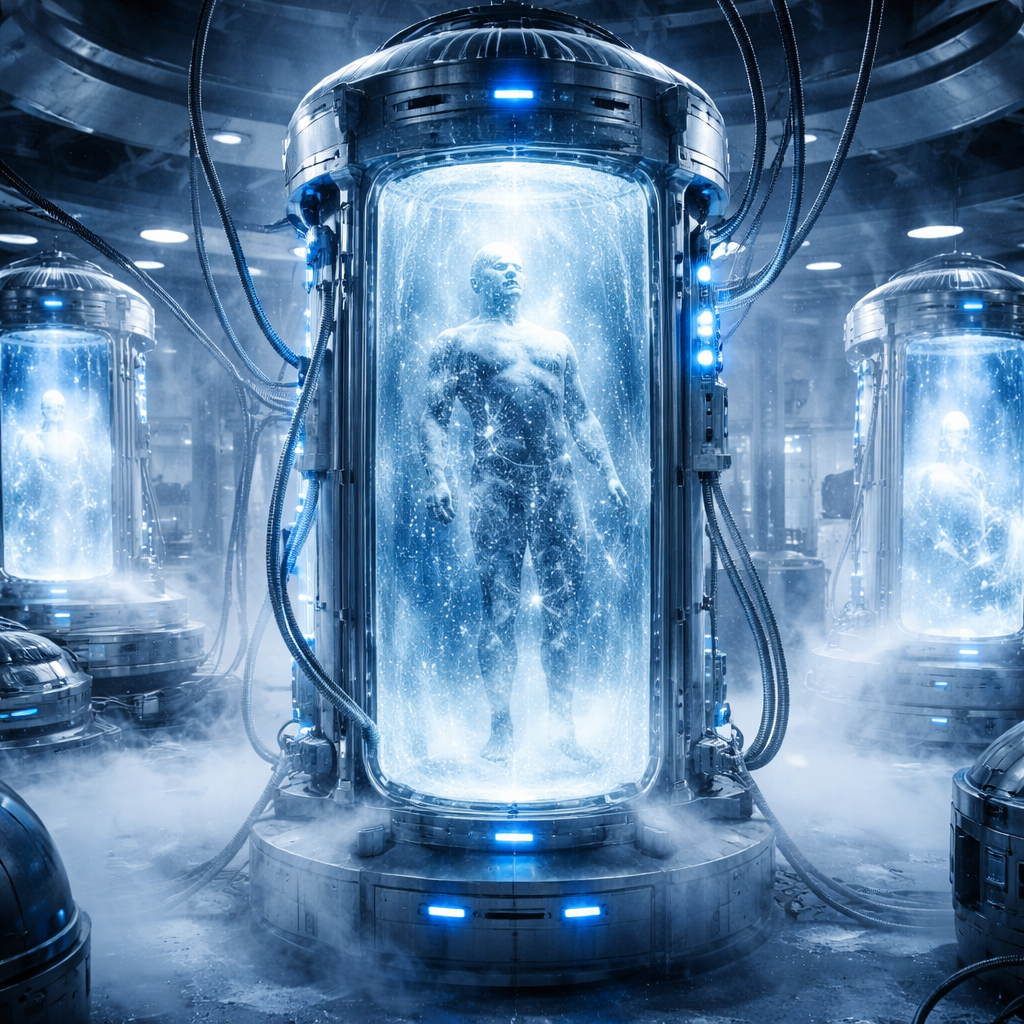
Illustration generated by author using ChatGPT
Sources:
NIST Cryogenics: https://trc.nist.gov/cryogenics/aboutCryogenics.html
Britannica on Cryogenics: https://www.britannica.com/science/cryogenics
Britannica on Cryonics: https://www.britannica.com/science/cryonics
National Library of Medicine-PMC – Scientific Justification of Cryonics: https://pmc.ncbi.nlm.nih.gov/articles/PMC4733321/
National Library of Medicine-PMC – Spending Eternity in Liquid Nitrogen: https://pmc.ncbi.nlm.nih.gov/articles/PMC3328517/
National Library of Medicine-PMC – Ice Inhibition for Cryopreservation: https://pmc.ncbi.nlm.nih.gov/articles/PMC7967093/
National Library of Medicine-PMC – Cryoprotectant Toxicity: https://pmc.ncbi.nlm.nih.gov/articles/PMC4620521/
National Library of Medicine-PMC – Cryopreservation Overview: https://pmc.ncbi.nlm.nih.gov/articles/PMC7995302/
National Library of Medicine-PMC – Cryopreservation of Animals and Cryonics: https://pmc.ncbi.nlm.nih.gov/articles/PMC9219731/
BMC Biology – Winter is Coming: https://link.springer.com/article/10.1186/s12915-021-00976-8
Live Science on Nanowarming: https://www.livescience.com/58098-nanotech-may-revive-frozen-organs.html
MIT Technology Review on Cryonics: https://www.technologyreview.com/2022/10/14/1060951/cryonics-sci-fi-freezing-bodies/
The Conversation on Cryonics: https://theconversation.com/will-we-ever-be-able-to-bring-cryogenically-frozen-corpses-back-to-life-a-cryobiologist-explains-69500
Discover Magazine on Cryonics: https://www.discovermagazine.com/technology/will-cryonically-frozen-bodies-ever-be-brought-back-to-life
BBC Science Focus: https://www.sciencefocus.com/the-human-body/freezing-brain-back-to-life
PMC: “Cryoprotectants and Extreme Freeze Tolerance in a Subarctic Population of the Wood Frog”: https://pmc.ncbi.nlm.nih.gov/articles/PMC4331536/
ScienceDirect – Ice Crystal Formation: https://www.sciencedirect.com/science/article/abs/pii/S0011224010000222
Wood frog freeze tolerance research: https://www.nature.com/articles/s41598-021-98073-4