
Grumpy opinions about everything.

Tag: Religion

Banned, Blessed, and Brewed

How Coffee Conquered the World
I don’t know about you, but I can’t get moving in the morning without a cup of coffee—or, if I’m honest, about three. Coffee has been a faithful companion through late nights and early mornings for most of my adult life.

I’ve written about it before, but there’s one story I’ve never shared—the time coffee actually sent me to the hospital.

A Pain in the Chest (and a Lesson Learned)

It happened not long before I turned forty. Back then, forty felt ancient. I started getting chest pains bad enough to send me to a cardiologist. After a battery of expensive tests, he said, “I don’t know what’s causing your pain, but it’s not your heart. Go see your family doctor.”

Problem was, I didn’t have one. (This was before I thought seriously about medical school.) So, I found a doctor, went in for a full workup, and after all the poking and prodding he casually asked, “How much coffee do you drink?”

“About eight cups a day,” I told him.

He raised an eyebrow. “You need to stop that.”

I asked if he really thought that was the problem. He didn’t hesitate—“Absolutely.”

This was before anyone talked much about reflux, at least not the way we do now. But I quit coffee cold turkey, and just like that, the chest pain disappeared.

These days I’ve learned my limit: three cups in the morning, and that’s it. Any more and the reflux reminds me who’s in charge.

It’s funny how something so simple can be both a comfort and a curse. Still, for all its quirks, I wouldn’t trade that first morning cup for anything.

From Goats to Global Obsession

My little coffee story fits neatly into a much older one. For centuries, coffee has stirred passion and controversy in equal measures. Its history is full of smuggling, religion, politics—and even the occasional threat of beheading.

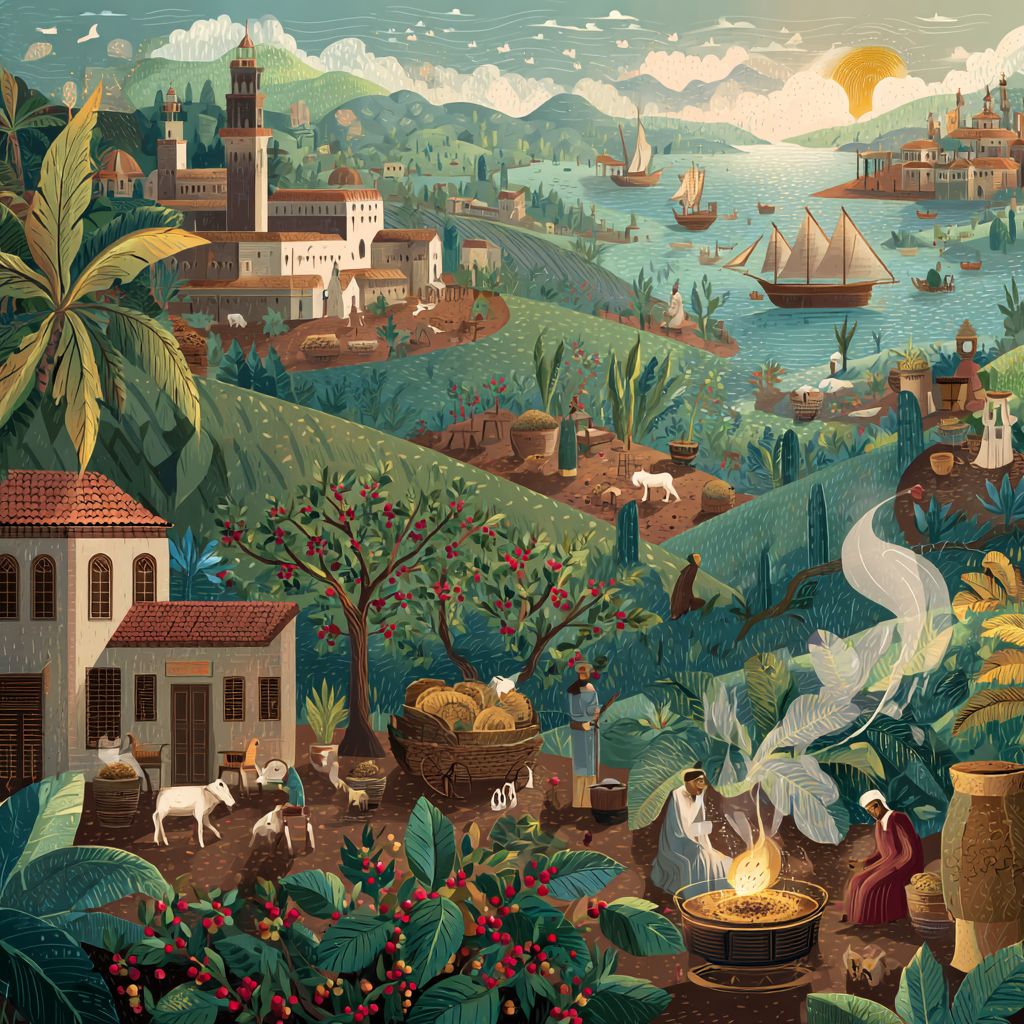
The story begins in the Ethiopian highlands, in a region called Kaffa—possibly the origin of the word coffee. Wild Coffea arabica plants grew there long before anyone thought to roast their seeds.

According to legend, around 850 CE a goat herder named Kaldi noticed his goats acting wildly energetic after eating the red berries. We will never know if Kaldi was real or just a great marketing story.

By the 1400s Yemeni traders brought coffee plants from Ethiopia across the Red Sea to Yemen.  The first recorded coffee drinker was Sheikh Jamal-al-Din al-Dhabhani of Aden, around 1454. He and other Sufi mystics used the brew to stay alert during long nights of prayer—a kind of early spiritual espresso shot.

Coffee and the Muslim World

By 1514, coffee had reached Mecca and through the early 1500s it spread across Egypt and North Africa, beginning in the Yemeni port of Mocha (yes, that Mocha). Coffeehouses—qahveh khaneh—sprang up everywhere. They were the original social networks: lively centers for news, politics, debate, and gossip, often called “Schools of the Wise.”

Coffee also had its critics. Some Muslim scholars debated whether it was halal, arguing that its stimulating effect made it suspiciously close to an intoxicant.

The governor of Mecca banned coffee altogether, calling coffeehouses hotbeds of sedition. Thirteen years later the Ottoman sultan lifted the ban, recognizing that you can’t outlaw people’s favorite drink. Similar bans came and went—including one by Sultan Murad IV in the 1600s, who reportedly made drinking coffee a capital crime. It didn’t work. Coffee had already conquered the Middle East.

Europe’s Complicated Love Affair

When coffee reached Europe—most likely through Venetian traders—it faced new suspicion. To many Europeans, coffee was “the drink of the infidel,” something foreign and threatening.

Some Catholic priests went so far as to call it “the bitter invention of Satan” or “the wine of Araby”.  The issue was both secular and theology—wine played a central role in Christian ritual and Muslims, forbidden to drink wine, had elevated coffee to their own social centerpiece.

Then around 1600 Pope Clement VIII joined the debate. Instead of banning coffee, he decided to try it first. The story goes that he found it so delicious he “baptized” it, declaring it too good to leave to the infidels.

True or not, coffee won papal approval—and from there, Europe was hooked. Coffeehouses spread like wildfire.

In England, they were called “penny universities” because for the price of a penny (the cost of a cup), you could join conversations on politics, science, and philosophy. Coffeehouses became the fuel of the Enlightenment—an alternative to taverns and alehouses. King Charles II tried to ban them in 1675, fearing they encouraged sedition, but public outrage forced him to back down.

The Global Takeover

For a long time, Yemen held a monopoly on coffee exports, carefully boiling or roasting beans to prevent anyone from planting them elsewhere. But where there’s money there’s smuggling.

The Dutch managed to steal a few live plants and in 1616 and began to grow them in Ceylon and Java—hence the nickname “java.” The French followed suit, planting coffee across the Caribbean. One French officer famously smuggled a single seedling to Martinique in 1723; within fifty years, it had produced over 18 million trees.

Brazil entered the scene in 1727 when Francisco de Melo Palheta snuck seeds out of French Guiana. Brazil’s climate proved perfect, and before long, it became the world’s coffee superpower.

The Bitter Truth

Coffee’s global spread had a dark side. Its plantations across the Caribbean and Latin America were built on enslaved labor. The beverage that fueled Enlightenment discussion in Europe was produced through brutality and exploitation in the colonies.

That’s the paradox of coffee—it has always been both a social leveler and a symbol of inequality.

Why It Still Matters

From Ethiopia’s wild forests to Ottoman coffeehouses, from Parisian salons to Brazilian plantations, coffee’s story mirrors the forces that shaped our modern world—trade, religion, colonization, and globalization.

That cup you’re sipping this morning connects you to centuries of human ingenuity, faith, conflict, and resilience.

Your latte isn’t just caffeine—it’s history in a cup.
Divine Providence and Patriotism

Religion in the Ranks of the Continental Army

The Continental Army that fought for American independence from 1775 to 1783 represented a cross-section of colonial religious life, bringing together men from diverse faith traditions under a common cause. The religious faith of both enlisted soldiers and officers reflected the broader religious landscape of colonial America, and their regional differences contributed to a complex tapestry of faith within the ranks.

The Continental Army drew from a population where religious diversity was already well-established, particularly when compared to European armies of the same period. Protestant denominations were the majority within the ranks, reflecting the colonial religious demographics.

The American Revolution was not only a political and military struggle but also a deeply religious experience for many Continental Army soldiers. Their faith shaped how they interpreted the war, coped with its hardships, and interacted with comrades from diverse backgrounds.

Enlisted soldiers often relied on providentialism, the belief that God directly intervened in daily life, to make sense of battlefield chaos and suffering. Diaries and letters reveal troops attributing survival in skirmishes, unexpected weather shifts, and even mundane events to divine will. For example, many saw the Continental Army’s unlikely battlefield victories as evidence of God’s favor toward their cause.

Diversity in the Ranks

Congregationalists from New England formed a significant portion of the army, bringing with them the Puritan theological tradition that emphasized divine providence and moral responsibility.  Ministers in New England frequently preached that resistance to tyranny was a Christian duty and many soldiers viewed themselves as fighting against tyranny, much as their ancestors had fled religious persecution.

Presbyterian soldiers, many of Scots-Irish descent, comprised a substantial group. Concentrated heavily in the Middle Colonies and frontier areas, they tended toward evangelical and Presbyterian influences, regardless of their home colony . The challenging conditions of frontier life had already created a more individualistic and emotionally intense form of Christianity that adapted well to military service. These soldiers often brought a fatalistic acceptance of divine will combined with fierce determination.

Baptist and Methodist soldiers, though fewer in number, represented growing evangelical movements that would later transform American Christianity. German Reformed and Lutheran soldiers from Pennsylvania added to the religious diversity, while smaller numbers of Catholics, particularly from Maryland and Pennsylvania, served despite facing legal restrictions in many colonies. Even a few Jewish soldiers joined the cause, though their numbers were minimal given the tiny Jewish population in colonial America. The religious pluralism in regiments from the Middle Colonies created a more tolerant atmosphere that foreshadowed the religious diversity of the new nation.  

Quakers were generally pacifists and avoided military service, however some “Free Quakers” broke from their tradition and joined the Patriot cause. Other pacifist religious groups, such as Mennonites, abstained from combat but occasionally provided non-combatant support.

Anglicans, ironically fighting against their own church’s mother country, served in significant numbers, particularly from the Southern colonies where the Church of England frequently had been established as a state supported church. 

While religious diversity was generally a unifying force in the Continental Army, there were some instances of religious tension and while they were relatively limited, they were not entirely absent. One significant example occurred early in the war in November 1775, when some American troops planned to burn an effigy of the Pope on Guy Fawkes Day (also known as Pope’s Day in New England).  General Washington strongly condemned this anti-Catholic action, denouncing it as indecent and lacking common sense.

Washington actively tried to prevent sectarianism from undermining unity in the ranks, whether between Protestants and Catholics or among different Protestant denominations. The overall trend was towards religious tolerance and unity, with religious diversity ultimately contributing positively to the army’s cohesion and morale.

Officer Corps and Religious Leadership

The officer corps of the Continental Army reflected a somewhat different religious profile than the enlisted ranks. Many officers came from the colonial elite and were often Anglican or belonged to more established denominations. However, the Revolution’s anti-episcopal sentiment led many Anglican officers to distance themselves from their church’s political connections while maintaining their basic Christian beliefs.  The relationship between the soldiers and the established Church of England became increasingly strained as the Revolution progressed.

George Washington himself exemplified this complex relationship with religion. Though nominally Anglican, Washington never wrote about his personal faith.  He was likely influenced by Deist philosophy, then popular among Enlightenment thinkers including Jefferson and possibly Franklin. Deism holds that reason and observation of the natural world are sufficient to determine the existence of a Creator, but that this Creator does not intervene in the universe after its creation.

Washington regularly invoked divine providence in his correspondence and orders, understanding the importance of religious sentiment in maintaining morale, even while his personal beliefs remained ambiguous. His famous directive that “the blessing and protection of Heaven are at all times necessary but especially so in times of public distress and danger” reflected his understanding of religion’s role in military leadership.

Other prominent officers brought their own religious convictions to their leadership. Nathanael Greene, the Southern theater commander, was raised as a Quaker but was expelled from the Society of Friends for his military service. Rev. Peter Muhlenberg, a Lutheran minister, left the pulpit and joined the Continental Army, rising to the rank of Major General.  The Marquis de Lafayette, though Catholic, adapted to the predominantly Protestant environment of the American officer corps.

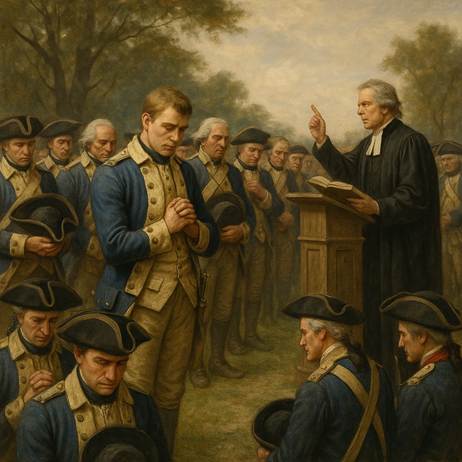
Officers, including Washington, viewed religion as a tool for discipline and unity. Washington mandated Sunday worship. He also appointed chaplains to every brigade, insisting they foster “obedience and subordination”.

 Continental Army Chaplain Service

Recognizing the importance of religion to morale and discipline, the Continental Congress authorized the appointment of chaplains to serve with the army. The chaplain system evolved throughout the war, beginning with regimental chaplains and eventually expanding to include brigade and division chaplains for larger organizational units.

Continental Army chaplains faced unique challenges. Unlike European armies with established state churches, American chaplains served religiously diverse units. They needed to provide spiritual comfort to soldiers from different denominational backgrounds while avoiding sectarian conflicts that could undermine unit cohesion. Most chaplains were Protestant ministers, reflecting the army’s composition, but they were expected to serve all soldiers regardless of specific denominational affiliation.

The duties of Continental Army chaplains extended beyond conducting religious services. They often served as informal counselors, helped soldiers write letters home, provided basic education to illiterate soldiers, and sometimes even served as medical assistants. Their moral authority made them valuable in maintaining discipline, and many commanders relied on chaplains to address problems of desertion, drunkenness, and other behavioral issues.

Chaplains also played important roles in significant military events. They conducted prayers before major battles and led thanksgiving services after victories. They provided comfort to the dying and services for the dead.

The British recognized the importance of chaplains to the Continental Army and in some cases offered rewards for their capture.

The famous painting of “The Prayer at Valley Forge” with its image of Washington praying alone in the snow, whether historically accurate or not, represents the type of spiritual leadership chaplains were expected to provide during the army’s darkest moments.

Conclusion Religion in the Continental Army reflected both the differing and the common aspects of colonial American faith. While denominational variations existed, most soldiers shared basic Christian beliefs that provided comfort during hardship and meaning to their sacrifice. The army’s religious diversity foreshadowed the religious pluralism that would characterize the new American nation, while the chaplain service established precedents for military religious support that continue today. The Revolution’s success owed much to the spiritual resources that sustained these soldiers through eight years of difficult warfare, demonstrating religion’s crucial role in the founding of the American republic.

Powered by WordPress & Theme by Anders Norén