
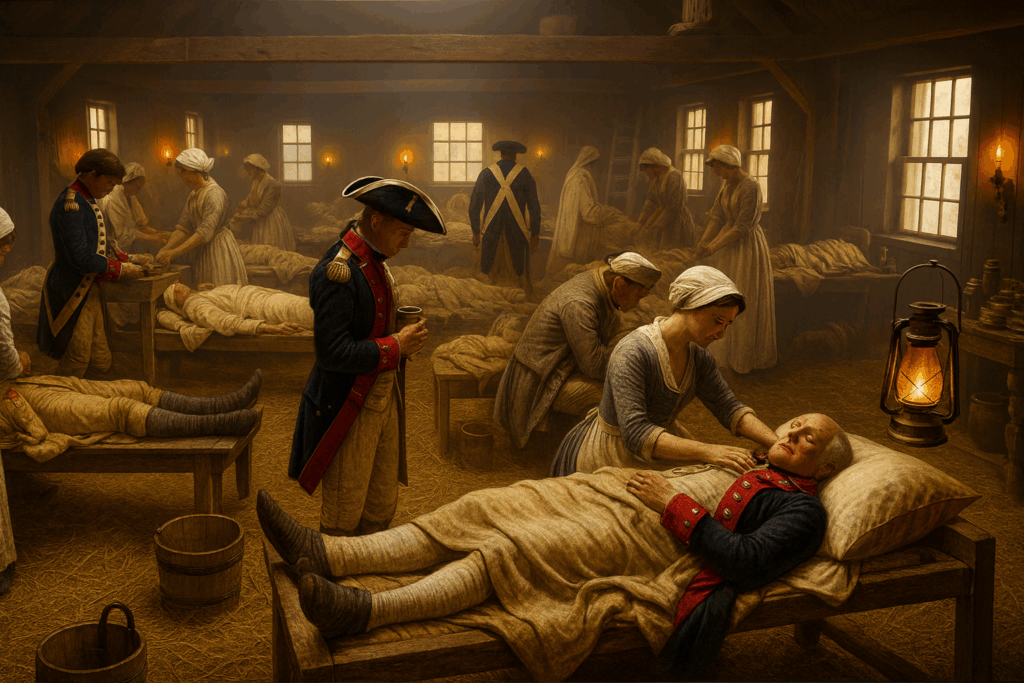
When you think about the American Revolution, you probably picture dramatic battles like Bunker Hill or the crossing of the Delaware. But here’s something that might surprise you: the biggest killer during the war wasn’t British muskets—it was disease. And it’s not even close.
The Numbers Tell a Grim Story
Let’s talk numbers for a second. On the American side, about 6,800 soldiers died from battlefield wounds. Sounds terrible, right? Well, disease killed an estimated 17,000 to 20,000. That’s roughly three times as many. The British and their Hessian allies faced similar odds: around 7,000 combat deaths versus 15,000 to 25,000 disease deaths.
Think about that for a moment. You were actually safer charging into battle than hanging around camp. In some regiments, disease wiped out more than a third of the troops before they even saw their first fight.
Why Was Disease So Deadly?
Picture yourself in a Revolutionary War military camp. Hundreds of men crammed together in makeshift shelters, no running water, primitive latrines dug too close to where everyone lives, and basically zero understanding of what we’d call “germ theory” today. It’s a perfect storm for infectious disease.
The big killers were:
Smallpox was the heavyweight champion of camp diseases. This virus killed about 30% of people it infected and spread like wildfire through packed military camps. Soldiers tried to protect themselves through a risky practice called inoculation—basically giving themselves a mild case of smallpox on purpose by rubbing infected pus into cuts on their skin. Without proper quarantine procedures, though, this sometimes made outbreaks worse instead of better.
Typhus (called “camp fever” back then) spread through lice and fleas. If you’ve ever been to a prolonged camping trip and felt gross after a few days, imagine that times a hundred. Soldiers lived in the same clothes for weeks, rarely bathed, and the parasites just had a field day. The fever, headaches, and diarrhea that came with typhus made it one of the most dreaded camp diseases.
Dysentery (charmingly nicknamed “bloody flux”) came from contaminated water and poor sanitation. When your latrine is 20 feet from your water source and you don’t understand how disease spreads, this becomes pretty much inevitable. The severe diarrhea weakened soldiers to the point where many couldn’t fight even if they wanted to and it made them even more susceptible to other diseases.
Malaria was especially important in the South, where mosquitoes thrived in the humid climate. This one actually played a fascinating role in how the war ended—but more on that in a bit.
When Disease Changed Everything
The 1776 invasion of Canada was a disaster largely because of smallpox. Out of 3,200 American soldiers in the Quebec campaign, 1,200 fell sick. You can’t mount much of an offensive when more than a third of your army is flat on their backs with fever. Similarly, during the siege of Boston, Washington couldn’t effectively engage the British because so many of his troops were sick with smallpox. These weren’t just setbacks—they were strategic catastrophes.
This is what pushed George Washington to make one of his boldest decisions in 1777: he ordered a mass inoculation of the Continental Army. This was controversial and dangerous at the time, but it worked. Washington had survived smallpox himself as a young man, so he understood both the risks and the benefits. The inoculation program probably saved the army from complete collapse.
Medical “Treatment” Was Often Worse Than Nothing
Here’s where things get really grim. Eighteenth-century medicine was basically medieval. Doctors believed in “balancing the humors” through bloodletting—literally draining blood from already weakened soldiers. They also gave powerful laxatives to people who were already suffering from diarrhea. Yeah, let that sink in.
Pain relief meant opium-based drinks or just straight alcohol. Some doctors used herbal remedies, but results were inconsistent at best. Quinine helped with malaria, though nobody really understood why. Mostly, if you got seriously sick, your survival came down to luck and a strong constitution.
Valley Forge: The Turning Point
Valley Forge is famous for being a brutal winter encampment, and disease was a huge part of why it was so terrible. Scabies left nearly half the troops unable to serve. Dysentery and camp fever killed somewhere between 1,700 and 2,000 soldiers during that single winter—and remember, these weren’t battle casualties. These men died from preventable diseases in what was supposed to be a safe encampment.
But Valley Forge taught the Continental Army a crucial lesson. After that nightmare winter, military leaders started taking sanitation seriously. They began focusing on camp hygiene, protecting water supplies, placing latrines away from living areas, and making sure soldiers could bathe and wash their clothes and bedding.
Baron von Steuben is famous for teaching the Continental Army how to march and drill, but he also deserves credit for implementing serious sanitation reforms. These changes helped prevent future disease outbreaks and kept the army functional for the rest of the war.
The Secret Weapon at Yorktown
Here’s one of my favorite historical details: mosquitoes may have helped win American independence. At Yorktown, roughly 30% of Cornwallis’s British army was knocked out by malaria and other diseases during the siege. The British commander was trying to hold off the American and French forces while also dealing with the fact that almost a third of his troops were too sick to fight.
Many American soldiers from the southern colonies had grown up with malaria and had some partial immunity. The British? Not so much. Some historians even think Cornwallis himself might have been suffering from malaria, which could have affected his decision-making. His second-in-command, Brigadier General Charles O’Hara, was definitely seriously ill during the siege. Fighting a war while you can barely stand is a pretty significant handicap.
The Bigger Picture
The American Revolution shows us something important: wars aren’t just won on battlefields. They’re won by the side that can keep its soldiers alive and healthy. Disease shaped strategic decisions, determined the outcomes of campaigns, and killed far more men than any British regiment ever did.
Washington’s decision to inoculate the army was genuinely revolutionary (pun intended). It showed a willingness to embrace controversial medical practices for the greater good. The sanitation reforms that came out of Valley Forge laid groundwork for modern military medicine and influenced public health policies in the new United States.
So next time someone mentions the American Revolution, remember: while we celebrate the military victories, one of the most important battles was fought against an enemy you couldn’t see—and for most of the war, nobody really knew how to fight it.
The casualty figures and major disease outbreaks are well-documented in historical records. The specific percentages and numbers are estimates based on historical research, as precise record-keeping was limited during this period. The overall narrative about disease being the primary cause of death is strongly supported by multiple historical sources.