
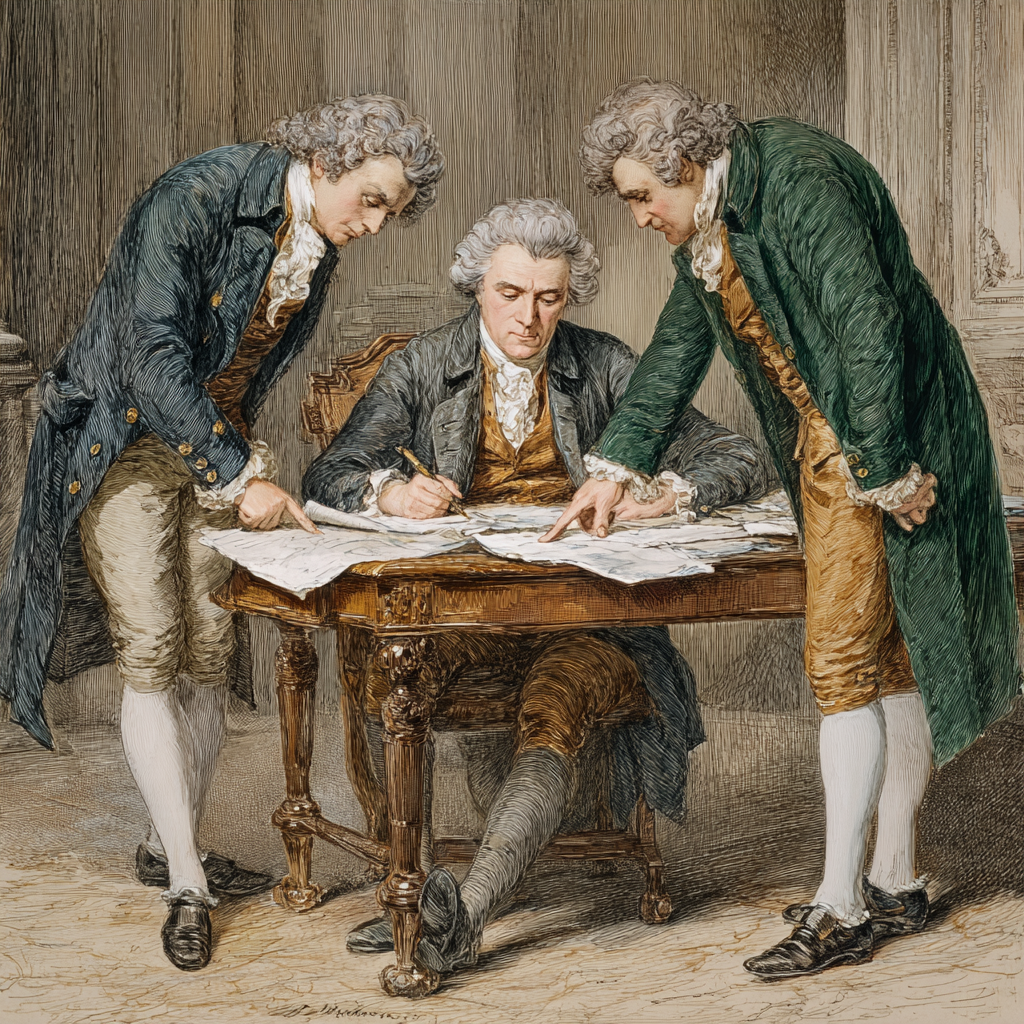
Here’s the thing about Thomas Jefferson that doesn’t always make it into the history textbooks: the guy who wrote those soaring words about liberty and limited government? He was also one of early America’s most skilled—and sometimes underhanded—political operators.
It’s surprising when you think about it. Jefferson genuinely believed in transparency, virtue in public life, and keeping government small. He wrote beautifully about these ideals. But when it came to actual politics? He played the game as hard as anyone, often using tactics that directly contradicted what he preached.
Jefferson’s public philosophy was straightforward. He thought America should be a nation of independent farmers—regular people who owned their own land and weren’t dependent on anyone else. He worried constantly about concentrated power, whether in government or in the hands of wealthy financiers or merchants. He believed people should be informed and engaged, and that government worked best when it stayed out of people’s lives.
His Declaration of Independence wasn’t just pretty rhetoric—it laid out a genuinely revolutionary idea: governments only have power because people agree to give it to them, and when governments stop serving the people, those people have the right to change things.
The Reality: How Jefferson Actually Operated
Here’s where it gets interesting. While Jefferson was writing about virtue and transparency, he was simultaneously running what today we’d recognize as opposition research, planting stories in the press, and organizing political operations—sometimes against people he was supposed to be working with.
The Freneau Setup: Paying for Attacks
The most blatant example happened in 1791. Jefferson was serving as Secretary of State under George Washington, which meant he was part of the administration. At the same time, he arranged for a guy named Philip Freneau to get a government job—technically as a translator. The real purpose? To give Freneau money to run a newspaper that would relentlessly attack Alexander Hamilton and other Federalists.
Think about that for a second. Jefferson was using his government position to fund media attacks on his own colleagues. When people called him out on it, he basically said, “Who, me? I have nothing to do with what Freneau publishes.” But the evidence shows Jefferson was actively encouraging and directing these attacks.
John Beckley: The Original Campaign Fixer
Jefferson also worked closely with John Beckley, who was essentially America’s first professional political operative. Beckley coordinated messaging, spread information (and sometimes misinformation) about opponents, and helped build the grassroots organization that would eventually become the Democratic-Republican Party.
This wasn’t a gentlemanly debate about ideas. This was organized political warfare—pamphlets, coordinated newspaper campaigns, and opposition research. Jefferson and Jame Madison quietly funded much of this work while maintaining public images as above-the-fray philosophers. We can’t know exactly what Jefferson said in every private conversation with Beckley, but the circumstantial evidence of coordination is convincing.
The Hamilton Rivalry: Ideological War
Jefferson’s conflict with Hamilton was both philosophical and deeply personal. Hamilton wanted a strong federal government, a national bank, and close ties with Britain. Jefferson saw all of this as a betrayal of the Revolution—a step toward creating the same kind of corrupt, elite-dominated system they’d just fought to escape.
But rather than just making his arguments publicly, Jefferson worked behind the scenes to undermine Hamilton’s policies. He encouraged Madison to lead opposition in Congress. He fed stories to friendly newspapers. He coordinated with Republican representatives to block Federalist initiatives.
The philosophical disagreement was real, but Jefferson’s methods were pure political calculation.
Turning on Washington: The Ultimate Betrayal?
Maybe the most damaging thing Jefferson did was secretly working against George Washington while still serving in his cabinet. By Washington’s second term, Jefferson had convinced himself that Washington was being manipulated by Hamilton and moving the country toward monarchy.
Jefferson stayed in the cabinet, maintaining cordial relations with Washington in person, while privately organizing resistance to administration policies. He encouraged attacks on Washington in the press. He coordinated with opposition leaders. And he did all of this while Washington trusted him as a loyal advisor.
When Washington found out, he was devastated. The betrayal broke their relationship permanently.
The Burr Situation: Using People
Jefferson’s handling of Aaron Burr shows just how pragmatic he could be. Jefferson never really trusted Burr—thought he was too ambitious and unprincipled. But in 1800, when Jefferson needed to win the presidency, Burr was useful for delivering New York’s votes.
After winning, Jefferson kept Burr as vice president but froze him out of any real power. Once Burr’s usefulness ended (especially after he killed Hamilton in that duel), Jefferson completely abandoned him, eventually supporting an unsuccessful prosecution for treason.
Deceiving Congress
Another example of Jefferson’s political manipulation was the Louisiana Purchase. This was a massive land acquisition that doubled the size of the United States. Jefferson knew that under the constitution he had no clear authority to acquire territory for the United States. He was able to secure the purchase by keeping it secret from both congress and his political opponents until after it was finalized. This allowed him to avoid a debate that could have derailed the deal. Does this sound familiar?
So, What Do We Make of This?
Here’s the uncomfortable question: Was Jefferson a hypocrite, or was he just being realistic about how politics actually works? Jefferson’s political manipulation was not always ethical, but it was effective. He was able to use his skills to achieve many of his political goals.
You could argue he was doing what he thought necessary to prevent Hamilton’s vision from taking over—that the ends justified the means. You could also argue that by using underhanded tactics, he corrupted the very democratic processes he claimed to be protecting.
My speculation: I think Jefferson was aware of the contradiction and wrestled with it. His private letters show moments of self-justification and lingering doubt. But ultimately, he kept doing it because he believed his vision for America was too important to lose by playing nice.
The Bottom Line
Thomas Jefferson remains one of our most brilliant political thinkers. But he was also willing to play dirty when he thought the stakes were high enough. That duality—beautiful ideals combined with hardball tactics—might actually make him more relevant today than ever. Because let’s be honest, that tension between principles and pragmatism hasn’t gone away in American politics.
Understanding both sides of Jefferson helps us see that even the founders we most revere weren’t simple heroes. They were complicated people operating in a messy political reality, trying to build something new while fighting over what that something should be.
The evidence for Jefferson’s political maneuvering is extensive and well-established by historians. Some interpretations of his motivations involve educated speculation, but the actions themselves are documented in letters, newspaper archives, and contemporary accounts.
Reference List
Primary Sources
Founders Online – National Archives https://founders.archives.gov/
- Digital collection of correspondence and papers from George Washington, Thomas Jefferson, Alexander Hamilton, Benjamin Franklin, John Adams, and James Madison. Essential for Jefferson’s own words and contemporaneous accounts of his political activities.
Library of Congress – Thomas Jefferson Exhibition https://www.loc.gov/exhibits/jefferson/
- Comprehensive digital exhibition covering Jefferson’s life, philosophy, and political career with original documents and interpretive essays.
Thomas Jefferson Encyclopedia – Monticello https://www.monticello.org/site/research-and-collections/
- Scholarly resource maintained by the Thomas Jefferson Foundation, covering specific topics including Jefferson’s relationships with Aaron Burr and other political figures.
Secondary Sources – Books
Chernow, Ron. Alexander Hamilton. New York: Penguin Press, 2004.
- Pulitzer Prize-winning biography that extensively covers the Jefferson-Hamilton rivalry and Jefferson’s behind-the-scenes political maneuvering, including the Freneau affair. Particularly strong on the 1790s conflicts within Washington’s cabinet.
Chernow, Ron. Washington: A Life. New York: Penguin Press, 2010.
- Provides Washington’s perspective on Jefferson’s activities within his administration and the betrayal Washington felt when learning of Jefferson’s covert opposition.
Ellis, Joseph J. American Sphinx: The Character of Thomas Jefferson. New York: Alfred A. Knopf, 1996.
- National Book Award winner that explores Jefferson’s contradictions and complexities, particularly the gap between his philosophical writings and political practices.
Ferling, John. Jefferson and Hamilton: The Rivalry That Forged a Nation. New York: Bloomsbury Press, 2013.
- Detailed examination of the ideological and personal conflict between Jefferson and Hamilton, showing how their struggle shaped early American politics and party formation.
Isenberg, Nancy. Fallen Founder: The Life of Aaron Burr. New York: Penguin Books, 2007.
- Comprehensive biography of Burr that includes extensive coverage of his complex relationship with Jefferson, from their 1800 alliance through Jefferson’s eventual abandonment of his vice president.
Pasley, Jeffrey L. The Tyranny of Printers: Newspaper Politics in the Early American Republic. Charlottesville: University of Virginia Press, 2001.
- Scholarly examination of how newspapers and partisan press became political weapons in the 1790s, with detailed coverage of Jefferson’s relationship with Philip Freneau and the National Gazette.
Secondary Sources – Journal Articles and Academic Papers
Sharp, James Roger. “The Journalist as Partisan: The National Gazette and the Origins of the First Party System.” The Virginia Magazine of History and Biography 97, no. 4 (1989): 391-420.
- Academic analysis of Freneau’s National Gazette and its role in forming political opposition, including Jefferson’s involvement in funding and directing the publication.
Cunningham, Noble E., Jr. “John Beckley: An Early American Party Manager.” The William and Mary Quarterly 13, no. 1 (1956): 40-52.
- Scholarly examination of Beckley’s role as America’s first professional political operative and his work organizing Jefferson’s political machine.
Historiographical Note
The interpretation of Jefferson’s political behavior has evolved over time. Earlier biographies (pre-1960s) tended to minimize or excuse his behind-the-scenes maneuvering, while more recent scholarship has been willing to examine the contradictions between his philosophy and practice more critically. The works cited above represent current historical consensus based on documentary evidence, though historians continue to debate Jefferson’s motivations and whether his tactics were justified given the political stakes he perceived.