
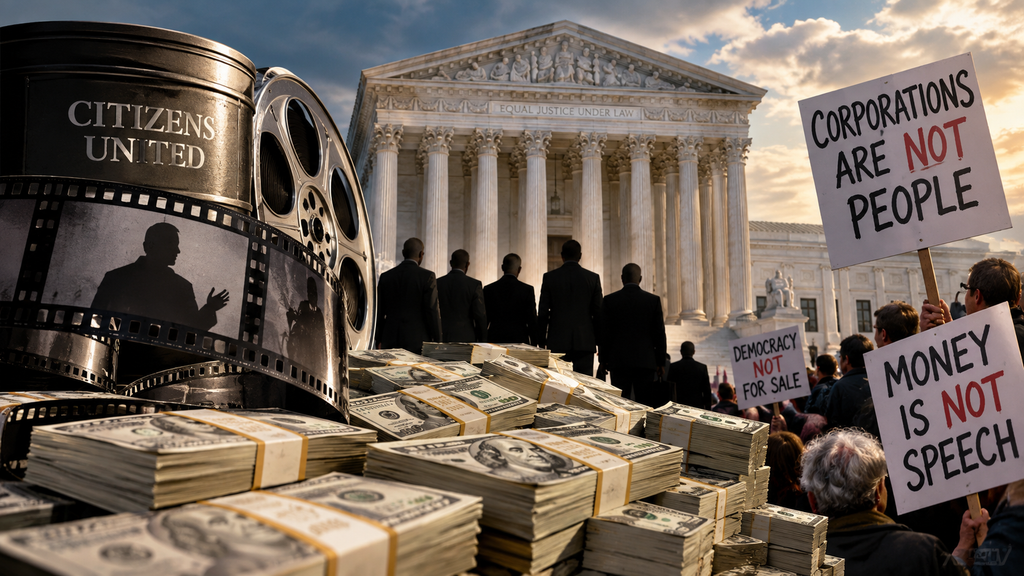
In January 2010, the U.S. Supreme Court issued one of the most consequential and controversial campaign-finance decisions in modern American history: Citizens United v. Federal Election Commission. The 5–4 ruling dramatically altered the regulatory restrictions on political spending. It allowed corporations, labor unions, and nonprofit organizations to spend unlimited amounts of organizational funds to independently support or oppose political candidates.
It was hailed by supporters as an important victory for freedom of speech and condemned by critics as opening American elections to the unprecedented influence of special-interest money. For more than sixteen years, Citizens United has shaped the way political campaigns have been financed and continues to do so as we approach the 2026 midterm elections.
I first published this article a little over a year ago and with the reports of increasing sums of dark money being spent on this election, I decided it was time to update it.
The Origins of the Case
In 2008, Citizens United, a conservative nonprofit organization, produced Hillary: The Movie, a 90-minute documentary highly critical of then-Senator Hillary Clinton, who was seeking the Democratic presidential nomination. Citizens United planned to distribute the film as a video-on-demand during the primary season.
The Bipartisan Campaign Reform Act of 2002, also known as McCain-Feingold, prohibited corporations and labor unions from using their general funds for “electioneering communications” during federal elections. Citizens United challenged the restriction, arguing that it violated the First Amendment.
A three-judge federal district court ruled against Citizens United and the organization appealed to the Supreme Court.
The Supreme Court could have decided the case narrowly; but the justices chose to address the larger question of whether previous precedents restricting corporate political expenditures should be overturned.
The Supreme Court’s Ruling
On January 21, 2010, the Court ruled 5–4 in favor of Citizens United. Justice Anthony Kennedy wrote the majority opinion, joined by Chief Justice John Roberts and Justices Antonin Scalia, Clarence Thomas, and Samuel Alito.
The Court concluded that the government could not restrict independent political expenditure based on the identity of the speaker. Corporations and unions could now use treasury funds to pay for independent communications supporting or opposing candidates.
Kennedy wrote that political speech is “indispensable to decision making in a democracy,” even when the speaker was a corporation.
The decision overturned Austin v. Michigan Chamber of Commerce (1990) and part of the Court’s earlier ruling in McConnell v. Federal Election Commission (2003).
Justice John Paul Stevens wrote a lengthy dissent. He argued that corporations were different from individual citizens in ways that legitimately justify different campaign-finance rules. He warned that the decision would undermine public confidence in democratic government.
The Court did not rule that corporations could contribute unlimited amounts directly to candidates. Limits on direct campaign contributions remained in effect. The ruling concerned independent expenditures—money spent advocating for or against candidates without legally prohibited coordination with their campaigns.
Super PACs
It is misleading to say that Citizens United alone created super PACs, but it certainly laid the groundwork.
Two months after Citizens United, relying on the Supreme Court’s reasoning in that case, the U.S. Court of Appeals for the District of Columbia Circuit decided SpeechNow.org v. FEC. It concluded that the government could not limit contributions to organizations that made only independent expenditures.
The combination of Citizens United and SpeechNow produced the legal foundation for what would become known as the super PAC.
Unlike an ordinary political action committee, a super PAC can accept unlimited contributions from individuals, corporations, unions, and other political committees. It cannot contribute directly to a candidate, and its expenditures must remain legally independent of the candidate it supports.
The distinction sounds significant on paper, but it has become one of the most disputed features of modern campaign finance.
While federal law still prohibits actual coordination as defined by FEC regulations, critics argue that the rules leave considerable room for outside organizations and campaigns to operate in parallel while maintaining the legal fiction of independence. Super PACs can be organized by people who previously worked for a candidate. They can devote all their resources to electing a single candidate. They can conduct advertising and voter-mobilization programs that closely mirror a campaign’s own activities.
The Explosion of Outside Spending
Outside political spending has increased enormously during the post-Citizens United era. According to an OpenSecrets analysis reported after the 2024 election, spending outside reached a record of approximately $4.5 billion. Super PACs accounted for a large portion of that spending.
America PAC, the super PAC closely associated with Elon Musk, reported approximately $263 million in receipts and $261 million in expenditures during 2024. About $174 million of its spending was reported to the FEC as independent expenditures.
While Musk was hardly the only wealthy donor, OpenSecrets estimated that he gave more than $291 million to Republican candidates, political committees, and “unaffiliated” organizations during the 2024 cycle. Five other individuals each contributed more than $100 million to groups supporting Republican candidates and issues. Democrats likewise benefited from wealthy donors though to a significantly lesser degree.
The Rise of Dark Money
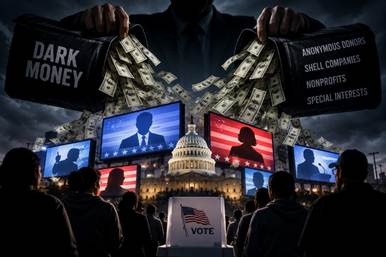
The least transparent part of the system is what has become known as “dark money.”
Super PACs themselves generally must disclose their donors. But some nonprofit organizations and shell companies can participate in political spending without publicly revealing the source of their money. These organizations can also contribute money to super PACs, producing situations in which the super PAC discloses the organization that gave it the money without necessarily revealing the original source.
A Brennan Center analysis published in 2025 estimated that at least $1.9 billion in dark money entered federal elections during the 2024 cycle, nearly twice the comparable total for 2020. Approximately $1.3 billion came from nonprofits and shell companies contributing to super PACs.
The researchers cautioned that even the $1.9 billion figure was probably an underestimate because some political activity, particularly certain forms of digital advertising and spending, cannot be fully tracked. They estimated that dark-money organizations probably have spent at least $4.3 billion influencing federal elections since Citizens United.
What About Corruption?
The Court rejected the argument that independent expenditures created the same corruption concerns as direct contributions to candidates. The Court reasoned that if a corporation or individual independently purchases an advertisement supporting a candidate, that expenditure does not create the same potential quid pro quo arrangement as giving money directly to the candidate.
Critics argue that this distinction has little validity in the real world. A donor may give millions of dollars to a super PAC devoted almost entirely to electing one politician. Even without an explicit agreement between donor and candidate, it is hard to believe that such spending doesn’t provide extraordinary access and influence.
Supporters of the decision say that influence is not the same thing as bribery or corruption. Wealthy people, corporations, unions, newspapers, advocacy organizations, and ordinary citizens all have constitutional rights to advocate political ideas. From this perspective, allowing government to decide that some speakers possess too much influence creates its own threat to political expression.
What Americans Think
Public reaction to the ruling has historically been negative, although the best-known nationwide polls are now over a decade old.
A Washington Post–ABC News poll conducted shortly after the 2010 decision found that 80 percent of respondents opposed the ruling, including 85 percent of Democrats, 76 percent of Republicans, and 81 percent of independents. Two years later, Pew Research Center found that 65 percent of registered voters who knew about the new independent spending rules believed they were having a negative effect on the presidential campaign.
Reform Efforts
Some reform advocates favor a constitutional amendment allowing Congress and the states greater authority to regulate campaign spending. Others concentrate on disclosure requirements, arguing that even if independent spending remains unlimited, voters should at least be able to determine who ultimately supplied the money.
Another approach is to restrict contributions to super PACs through legislation designed to invite reconsideration of the constitutional issues by the Supreme Court.
The Abolish Super PACs Act, H.R. 2352, was introduced in the House in March 2025. A Senate version, S. 4602, was introduced by Senator Bernie Sanders in May 2026. Both seek to impose contribution limits on super PACs. As of October 2026, neither has become law.
The prospects for major reform are complicated by the First Amendment principles established in a series of campaign-finance decisions extending back decades. Congress cannot simply reenact the restrictions struck down by the Court and expect them to survive constitutional review by a court that still has many of the justices who made the original ruling.
Citizens United and the 2026 Elections
As November 3, 2026, midterm elections approach, Citizens United remains firmly in place. The super PACs and other outside organizations are still important participants in congressional races.
The enormous sums involved have changed the nature of political campaigns. The individual candidate is no longer the largest financial force in most national and in some state and local elections. A few wealthy donors or organizations can influence the outcome by spending millions of dollars supporting or opposing candidates without ever contributing money directly to any campaign.
It is hotly debated whether this represents an expansion of political freedom or a form of de facto political bribery. This is the fundamental disagreement about Citizens United.
Citizens United did not invent money in American politics. Wealthy donors, corporations, unions, political machines, and special interests have influenced elections since the founding of the republic. The decision didn’t eliminate contribution limits, and it didn’t allow every form of political spending to be kept secret.
It did change one of the rules governing political power. The government can no longer limit independent political expenditure simply because the speaker is a corporation or union. Combined with SpeechNow, it produced a political system in which billions of dollars can be raised and spent outside the traditional campaign structure.
The debate reaches well beyond campaign finance law and asks a question we have struggled with since our first elections. When does protecting political liberty for individuals and organizations begin to conflict with preserving political equality among citizens?
More than sixteen years after Citizens United, we are still trying to answer it.
Images generated by author using ChatGPT.
References
Supreme Court of the United States. Citizens United v. Federal Election Commission, 558 U.S. 310 (2010). The Court’s official published opinion.
Supreme Court — Citizens United v. FEC
Federal Election Commission. “SpeechNow.org v. FEC.” Summary of the 2010 D.C. Circuit decision that helped establish the legal basis for independent-expenditure-only committees.
FEC — SpeechNow.org v. FEC
Federal Election Commission. “Understanding Independent Expenditures.” Explanation of federal rules governing independent and coordinated spending.
FEC — Understanding Independent Expenditures
Federal Election Commission. “Types of Nonconnected PACs.” Explanation of super PACs and hybrid PACs.
FEC — Types of Nonconnected PACs
Federal Election Commission. “America PAC — Committee Overview.” Official campaign-finance reports for America PAC.
FEC — America PAC
Brennan Center for Justice. Marina Pino and Julia Fishman, “Fifteen Years Later, Citizens United Defined the 2024 Election,” January 14, 2025.
Brennan Center — Citizens United and the 2024 Election
Brennan Center for Justice. Anna Massoglia, “Dark Money Hit a Record High of $1.9 Billion in 2024 Federal Races,” May 7, 2025.
Brennan Center — 2024 Dark Money Report
OpenSecrets. Anna Massoglia, analysis of record outside spending in the 2024 federal elections. The analysis calculated approximately $4.5 billion in outside spending.
OpenSecrets analysis — 2024 Outside Spending
Pew Research Center. “Super PACs Having Negative Impact, Say Voters Aware of ‘Citizens United’ Ruling,” January 17, 2012.
Pew Research Center — Citizens United and Super PAC Polling
U.S. Government Publishing Office. Abolish Super PACs Act, H.R. 2352, 119th Congress, introduced March 26, 2025.
GovInfo — H.R. 2352
U.S. Government Publishing Office. Abolish Super PACs Act, S. 4602, 119th Congress, introduced May 20, 2026.
GovInfo — S. 4602
Leave a Reply