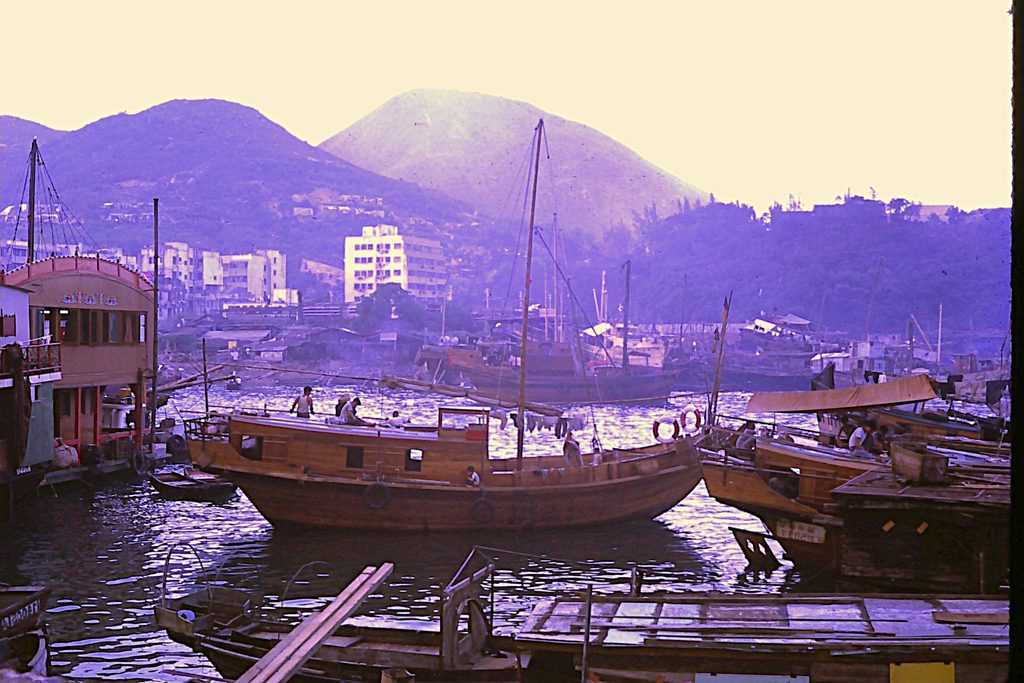

I joined the Navy when I was 19 and I’ve been fascinated with ships ever since, ships of all kinds from square rigged clippers to super tankers. One type of ship that has always held a particular fascination for me is the Chinese junk. Perhaps, it’s because it seems so exotic and it gives hints of adventure. I can remember the first time I saw a junk under full sail. It was 1970 when I visited Hong Kong. I had just got off the Star Ferry, and I caught sight of it sailing across the harbor. I just stood there, watching it until it disappeared from sight and wishing I hadn’t left my camera in the hotel.
The Chinese junk isn’t a single ship design. It’s a family of crafts design to sail in China’s rivers and estuaries, along the coast, and on the open sea. It’s an example of practical shipbuilding, designed to be adaptable to multiple environments.
The word junk isn’t even a Chinese one. It was most likely coined by English traders. The Chinese referred junks by the general name chuan, which means simply “ship” or ‘boat’. Junk may have been derived from the Javanese word jong or the Malay word ajong, both of which refer to a large ship.
We don’t know exactly when the junk was first developed but it may extend all the way back to the Han dynasty, roughly 220 BCE. The earliest versions were likely made of wood, bamboo or reeds and those materials rarely survive for later examination. Early versions of the junk have been documented as operating in the Yangtze River and coastal waters and estuaries and even venturing into maritime trade throughout East Asia.
The most distinctive feature of the junk is its flat or shallow bottom hull, rather than the deep keel vessels associated with European design. The design makes it susceptible to being pushed sideways by the wind while under sail. But the Chinese shipbuilders outfitted it with leeboards, center boards and large adjustable rudders which could extend it into the water to prevent sideways drift and to help maintain course, much like a keel on European ships. Unlike European ships, these elements could be retracted to allow it to enter shallow water and even to be beached to load or unload supplies or make repairs.
The broad beam of the ship and its flat bottom also gave it the ability to handle a large volume of cargo. This was an advantage for traders carrying bulky commodities such as rice, ceramics, textiles or salt. The design also provided a military advantage because it could carry larger numbers of troops and horses than could be carried on a European style ship.
The most significant innovation in the Chinese junk may have been the development of watertight bulkheads. The bulkhead is a wall that separates portions of the ship to prevent flooding should any portion of the hull develop a leak. That way the integrity of the entire ship would not be compromised by a hole in a single area. The bulkheads also strengthened the hull of the ship allowing it to endure greater stress from violent waves and wind. It also increased the capability to carry larger cargo. This is probably the major contribution that the Chinese made to the greater science of shipbuilding and naval technology. Western shipbuilders later adapted this same principle for their ship construction.
The junk sails are both innovative and distinctive. The sails are often fan shaped and are divided into sections separated by horizontal battens usually made of bamboo or wood. These distribute the stress across the fabric and help the sail retain its shape. The early sails were mostly made from woven matts or grasses while later examples were made from more durable cloth. The battens make it easier to raise and lower the sails without requiring sailors to climb up into the riggings to furl or unfurl canvas. Sails can be more quickly and easily adjusted to the weather conditions, allowing the ships to operate with smaller crews. The sails also feature another innovation that was not common among European ships. They can be easily rotated, giving the junk additional maneuverability in harbors and narrow rivers.
Depending on the size of the ship, they may have anywhere from one reportedly up to as many as nine masts on the largest of the naval vessels. The greater number of masts spread the sail area across the ship to adapt to varying wind conditions, allowing the ship to continue under sail in heavy weather, even if a mast or a sail was damaged or completely lost.
Junks have an extremely high stern area. This is useful both as a living and a working space. It can accommodate crew’s quarters, storage, cargo, and historically provided a defensive position in case of attack. Most junks are steered by a tiller operated rudder, and the high stern provides additional leverage to operate the rudder.
The junks aren’t simply limited to the local Chinese area. During the Ming dynasty between 1405 and 1433 CE Chinese fleets operated throughout Southeast Asia, across the Indian Ocean, into the Persian Gulf, and the ports of Arabia and East Africa. They carried political envoys, trade goods, supplies, and tribute. They conducted trade with Buddhist, Muslim, Hindu, and Christian communities and facilitated some of the earliest interactions between these groups.
Junks are best known to western historians from a voyage that occurred in the early 15th century. Admiral Zheng He commanded what became known as “treasure voyages” for the Ming dynasty. His fleets reportedly included massive junks up to 400 feet in length with as many 9 masts, although many historians doubt they were this large. Regardless of the actual size, they were far superior to any European ships of the same era both in size and technology.
Today, we think of the junk most often as a quaint and picturesque tourist symbol usually associated with Hong Kong. But the junk isn’t merely an attractive photo op. It is a sophisticated design that met the demands of a seafaring community. It has an innovative hull with an adjustable steering system, compartmental construction, and battened sails that set the standard for centuries before the advent of steam propulsion. It carried more than cargo. It carried knowledge, technology, and civilization across the waters of Asia and eventually across the waters of the world.
If you’re a history buff like me, you’ve probably run across fascinating but obscure characters who played a large role in a small region in distant history. I recently came across one of those people who was only referenced on a single page of a book I was reading. But the description of her was enough to get me interested in finding out more.
History has a habit of forgetting women who shaped it, especially women from Africa. But Amanirenas, the warrior queen of the ancient empire of Meroë, pulled off something that almost no one else in the ancient world ever managed. She fought Rome to a standstill and walked away with her kingdom’s independence intact. That alone makes her story remarkable.
A Kingdom You Have Never Heard Of
To understand Amanirenas, you first need to understand Meroë, and most western history classes have completely skipped it. Meroë was the capital of the Kingdom of Kush in what is now northern Sudan. It was a sophisticated, wealthy empire and was a major power in northeastern Africa for over 1000 years. The Egyptians called it Nubia “Ta-Seti”, the Land of Bows, as a tribute to the extraordinary skill of Kushite archers.
Meroë was one of the most important trading hubs of the ancient world. It sat at a natural crossroads between the Mediterranean world and sub-Saharan Africa. Ivory, gold, iron, grains, and livestock all flowed through the city. The Egyptians depended heavily on this trade, giving Meroë’s rulers extraordinary power.
Unlike much of the ancient world, Kush had a long tradition of powerful female leaders known as the kandakes. They commanded armies, negotiated treaties, and governed with the same authority as a male king.
Amanirenas was one of these kandakes. Her full title in the Meroitic language was “Amanirenas qore li kdwe li” meaning she held both the “qore” (king) and “kandake” (queen) titles simultaneously. It was a clear signal that she was the sole independent ruler of Kush.
Rome Moves In
Kush had profited handsomely from trade with Ptolemaic Egypt for generations. Around 30 BCE, Augustus Caesar defeated Cleopatra and Mark Antony and folded Egypt into the Roman Empire. Rome was a different kind of neighbor; it was hungrier, more aggressive, and believed in its divine right to expand. Roman tax collectors and administrators moved into lower Nubia, imposing heavy levies on the people of Meroë. Rome wasn’t interested in just trading; it was extracting tribute.
Amanirenas ruled alongside her husband, King Teriteqas, until he died in battle around 27 BCE, leaving her in sole command of the Kingdom and its army. She was a widow, a queen, and increasingly, a general, and she faced the most powerful military machine in the world.
The One-Eyed Queen Strikes First
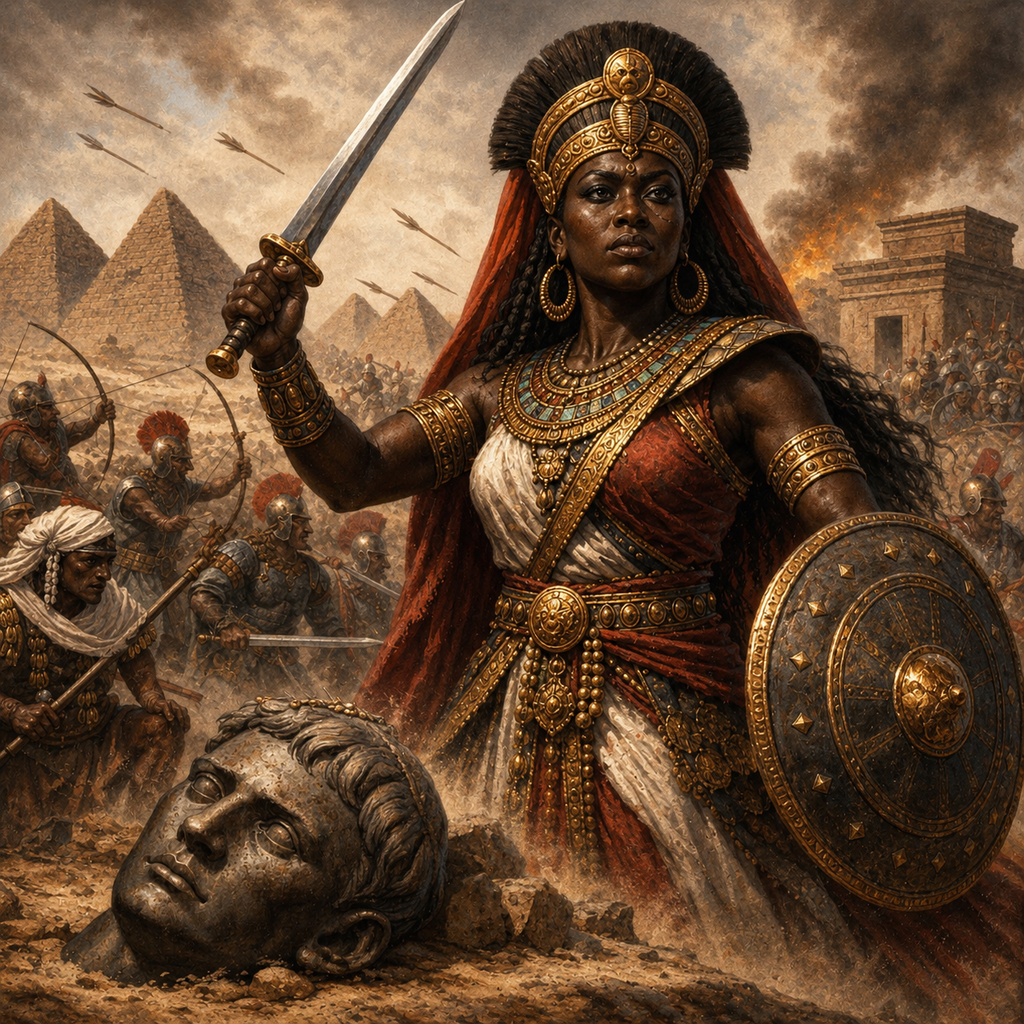
Amanirenas grew tired of being exploited by Rome. When Roman forces were pulled back for a campaign in Arabia, she acted quickly. Around 24 BCE, she led her army of some 30,000 soldiers into Roman occupied territory. Her forces captured three major Roman held cities, Syene (modern Aswan), Philae, and Elephantine. They enslaved Roman citizens and plundered the cities. In a particularly pointed act of defiance, her warriors tore down statues of Caesar Augustus throughout the captured territory.
The severed bronze head of Augustus was carried back to Meroë as a trophy. Amanirenas had it buried under the steps of a temple dedicated the victory, so that her people could walk over the face of the Roman emperor every day. This artifact, now known as the Meroë head, was rediscovered by archaeologists in the early 20th century and is on display at the British Museum.
The Greek historian Strabo, writing around 21 BCE, described Amanirenas as “a masculine sort of woman, and blind in one eye.” Strabo clearly did not mean this as a compliment and today it stands as grudging acknowledgment that this was not a queen to be taken lightly.
Rome Pushes Back and Meets Its Match
Rome predictably was not going to accept this without responding. Augustus dispatched his prefect Petronius with a veteran Roman army. The ensuing campaign pushed Kushite forces back, recapturing the occupied cities and pressing deep into Kush. Petronius sacked Napta, a city sacred to the Kushites.
But Rome found it couldn’t hold the territory it was taking. Logistics were brutal. The harsh desert environment, the long supply lines from Egypt, and Amanirenas’ aggressive guerrilla tactics all wore down Rome’s ability to sustain its army.
Amanirenas counter attacked repeatedly, keeping Roman forces off balance. Historical accounts mention her using war elephants, a weapon that would have been unnerving to even experienced Roman soldiers. The war ground on for years. Eventually, Petronius recognized he could not achieve a decisive victory and urged negotiations.
When Amanirenas’ envoys finally met with Augustus at Samos, they acted formally, not as a defeated foe. According to historian Dr. Robert Stephen Bianchi, this is believed to be the first recorded instance of Black African diplomats traveling to Europe to negotiate a peace treaty on behalf of an independent African ruler. Amanirenas sent representatives rather than going herself as a deliberate signal that she considered herself Rome’s equal, not a supplicant.
A Peace Deal That Rewrote The Map
The resulting Treaty of Samos, signed around 20 or 21 BCE, was an extraordinary diplomatic victory for Kush. Rome agreed to exempt Kush from all tribute payments, withdrawal from disputed territories and recognized Kushite sovereignty in lower Nubia. Rome’s southern border in Africa was essentially fixed, and Meroë remained fully independent. The treaty held for nearly 300 years.
Amanirenas then turned her attention to rebuilding her kingdom. The last decade of her reign, from around 21 to 10 BCE, is described as one of the most prosperous periods in Kushite history. It was the golden age of monument building, culture, and trade. The peace with Rome opened new commercial opportunities and increased the wealth of Kush.
Amanirenas never remarried. She died around 10 BCE and was buried at Jabel Barkal in Sudan. A wall painting in a pyramid chapel at Meroë commemorates her legacy, depicting her holding a bow, arrows and a spear, with seven Roman captives tethered at her feet.
Why Her Story Matters
Amanirenas checks almost every box that typically earns someone a place in the mainstream history books: military genius, savvy diplomat, resilient under fire, and a Kingdom that flourished under her leadership. Yet most people have never heard her name. Part of that is a legacy of colonial era scholarship which systematically undervalued African history. Part of it is the Meroitic language problem. Because the language still is largely undeciphered the story is told mostly through Roman and Greek eyes, with all the bias that implies.
What is clear, even from those biased sources, is that she did something extraordinary. She took on Rome, the same Rome that crushed Carthage, absorbed Egypt, and eventually swallowed up most of the known world, and she proved herself their equal. She proved that the Roman Empire had limits and she did it as a one-eyed widow, commanding an army in the field, in a desert, against the most formidable military force of the ancient world.
History, as it turns out, has a lot of catching up to do.
Image generated by the author using ChatGPT.
References
1. Wikipedia — Amanirenas: https://en.wikipedia.org/wiki/Amanirenas
2. HISTORY.com — The Nubian Queen Who Fought Back Caesar’s Army: https://www.history.com/articles/nubian-queen-amanirenas-roman-army
3. Narratively — The One-Eyed African Queen Who Defeated the Roman Empire: https://www.narratively.com/p/the-one-eyed-african-queen-who-defeated-the-roman-empire
4. Ancient Origins — The One-Eyed African Queen Who Defeated the Roman Empire: Amanirenas: https://www.ancient-origins.net/history-famous-people/queen-amanirenas-0018872
5. African History Extra — The Meroitic Empire, Queen Amanirenas and the Candaces of Kush: https://www.africanhistoryextra.com/p/the-meroitic-empire-queen-amanirenas
6. History Is Now Magazine — The Kingdom of Kush & the 27-22 BC War with Rome: http://www.historyisnowmagazine.com/blog/2023/9/18/the-kingdom-of-kush-amp-the-27-22-bc-war-with-rome
7. All That’s Interesting — The Shocking Story of Queen Amanirenas: https://allthatsinteresting.com/amanirenas
8. History Heroines — Amanirenas: One-Eyed Warrior Queen: http://historyheroines.com/2020/02/28/amanirenas/
9. Rejected Princesses — Amanirenas: The One-Eyed Queen Who Fought Rome Tooth and Nail: https://www.rejectedprincesses.com/princesses/amanirenas
10. Google Arts & Culture — Queen Amanirenas: The Story of the White Nile Nubi Archeress: https://artsandculture.google.com/story/queen-amanirenas-the-story-of-the-white-nile-nubi-archeress/bALSN3WTK_YEJA
Cholesterol has an odd reputation. It’s usually treated as a villain, but your body can’t function without it. Every cell membrane relies on it, and it’s the raw material for hormones like estrogen and testosterone, as well as for vitamin D. The trouble starts when you have too much of the wrong kind circulating in your blood for too long a time. Excess cholesterol can quietly build up inside your artery walls for many years before you’re aware of it. The consequences of ignoring it can range from an abnormal stress test to a heart attack. Let’s walk through how your doctor diagnoses a cholesterol problem, how you can treat it, and what happens if it goes unaddressed.
How Cholesterol Is Diagnosed
The starting point is a lipid panel. That is a blood test that’s usually done after you’ve been fasting. Although newer research has shown non-fasting panels work nearly as well for most purposes. The panel reports several numbers, and each identifies a different type of cholesterol.
LDL cholesterol, low-density lipoprotein, is the one most people mean when they say “bad cholesterol.” It’s the particle that tends to stick to artery walls and starts the buildup of plaque, the main component of blockages.
HDL, high-density lipoprotein, works in the opposite direction. It helps carry cholesterol back to the liver for disposal, which is why it’s nicknamed “good cholesterol.”
Triglycerides, a different type of fat entirely, round out the standard panel and, when elevated, add their own risk on top of LDL.
There isn’t one universal LDL number that applies to everyone. Instead, doctors weigh your LDL alongside your overall cardiovascular risk that also considers age, blood pressure, diabetes status, smoking history, and family history. If you’ve already had a heart attack, stroke, or other diagnosed artery disease you have increased risk.
The 2026 guideline from the American College of Cardiology and American Heart Association, sets LDL goals that correspond with risk: under 100 mg/dL for people at borderline or intermediate risk, under 70 mg/dL for those at high risk, and under 55 mg/dL for people who already have known artery disease and are considered very high risk. Additionally, initial lipid panels are now recommended starting at age 19, rather than waiting until later adulthood.
Two additional tests are being used more often now. Apolipoprotein B, or apoB, counts the actual number of cholesterol-carrying particles in your blood rather than just the cholesterol mass inside them. The newest guideline lists it as a more accurate risk predictor, even though it sometimes disagrees with the standard LDL number.
Lipoprotein(a), or Lp(a), is a genetically determined particle that raises artery-disease risk independent of LDL. An elevated Lp(a), even in the absence of an elevated LDL, is considered an increased risk. The update also recommends adults be screened for it once, since it isn’t affected by diet or exercise. When it’s high, your doctor may be more aggressive in treating your other numbers.
There are two tests that are not strictly cholesterol but are related to the risk associated with elevated cholesterol. They may be ordered for patients considered to be at risk or to evaluate their risk if it is unknown or uncertain.
Coronary artery calcium (CAC) scoring is a noninvasive, low-radiation CT scan that measures calcified atherosclerotic plaque in the coronary arteries and reports a calcium score. A score of zero indicates no detectable coronary calcium, while progressively higher scores indicate a greater level of coronary atherosclerosis and generally greater future cardiovascular risk. CAC is particularly useful when a person’s need for preventive treatment, such as a statin, is uncertain.
The new American Heart Association PREVENT (Predicting Risk of Cardiovascular Disease EVENTs) calculator, is recommended in the 2026 dyslipidemia guideline in place of older methods. It estimates the 10- and 30-year risk of atherosclerotic cardiovascular disease, heart failure, and total cardiovascular disease in adults ages 30–79 who do not have established cardiovascular disease. It incorporates age, sex, blood pressure, cholesterol, smoking, diabetes, body mass index, kidney function and medication use. PREVENT and CAC complement one another. PREVENT provides an initial estimate based primarily on clinical risk factors, while CAC can selectively provide direct evidence of coronary atherosclerosis.
Lifestyle Modifications
For most people with mild to moderately elevated cholesterol, lifestyle change is the first line of treatment. It isn’t just a box to check before starting medication. It can meaningfully move the numbers on its own.
Diet has the most consistent evidence behind it. Cutting back on saturated fat (found in fatty cuts of meat, butter, and full-fat dairy) and replacing it with unsaturated fats from sources like olive oil, nuts, and fatty fish can lower LDL. Soluble fiber, the kind found in oats, beans, and fruits like apples and pears, binds cholesterol in the digestive tract and carries it out of the body before it can be absorbed.
Exercise helps too, primarily by raising HDL and improving how your body handles triglycerides. Most clinical guidelines recommend at least 150 minutes a week of moderate activity, like brisk walking. More vigorous exercise appears to help more. Even a modest weight loss tends to improve the whole lipid panel.
Quitting smoking doesn’t lower LDL by much, but it dramatically improves HDL function. It also reduces the inflammation that turns cholesterol deposits into unstable, rupture-prone plaque.
Alcohol is not as clear cut. Heavy drinking clearly raises triglycerides and worsens overall risk but claims that moderate drinking meaningfully protects the heart have not held up well. It’s clearly not a reason to start drinking for health purposes.
Treatments
Doctors generally fall into one of two categories when dealing with our own health issues. Some tend to obsess about their health and check their labs and other tests repeatedly and sometimes undertake unnecessary or only marginally beneficial treatments. Others ignore their own health in ways they would never accept from their patients. I tend to fall into the latter category, and I ignored my marginally elevated cholesterol for several years until my cardiologist, who is also a friend, told me to quit being “stupid” and start treating it.
When lifestyle change isn’t enough on its own (mine wasn’t), or when your risk is high enough or your doctor doesn’t want to wait and see, medication is an option. Statins remain the default first step for most patients. They work by blocking an enzyme your liver uses to make cholesterol, which prompts the liver to pull more LDL out of the bloodstream. Decades of large trials tie this to real reductions in heart attacks and strokes.
If you don’t reach their goal on a statin alone, or you can’t tolerate one, several add-on options exist. Ezetimibe, a daily pill, blocks cholesterol absorption in the gut and is usually the first addition tried because it’s inexpensive and well tolerated. PCSK9 inhibitors, injectable medications like evolocumab and alirocumab, block a liver protein that normally limits how much LDL the liver can clear. They can lower LDL by roughly 50 to 65 percent on top of a statin. Inclisiran works on the same PCSK9 pathway but through a different mechanism, silencing the gene that produces LDL. It only needs to be injected twice a year rather than biweekly. Its long-term effect on heart attacks and strokes is still being evaluated in ongoing trials. Bempedoic acid, a newer oral option, works further upstream in the same cholesterol-production pathway as statins and has shown to reduce cardiovascular events in people who can’t take statins. It’s a more modest LDL reducer than the injectable options and carries a higher risk of gout and gallstones.
Specialists disagree about how aggressively to treat cholesterol, and what the target should be. Guidance has shifted more than once in the last decade. The 2026 multi-society guideline leans toward “lower for longer” as the general philosophy. Some professional groups have pushed back, arguing the most aggressive targets are better supported only for people who have already had a cardiac event. For what it’s worth, my own philosophy is “lower is better.” It’s worth discussing with your own physician.
What Happens If It Goes Untreated
This is the part that makes cholesterol worth taking seriously even though it produces no symptoms of its own for years or decades. Excess LDL particles work their way into the walls of arteries, where they trigger an inflammatory response. Immune cells arrive to clean up the cholesterol, become engorged with it, and form the fatty streaks that eventually mature into plaque. This process, called atherosclerosis, narrows and stiffens arteries throughout the body. It’s essentially silent until it isn’t.
Plaque in the arteries feeding the heart, can cause angina, chest discomfort during exertion when narrowed vessels can’t deliver enough blood. Later it can cause a heart attack if a plaque ruptures and a clot suddenly completely blocks the vessel.
The same rupture-and-clot process occurs in the arteries feeding the brain when a piece of plaque breaks loose and travels downstream causing an ischemic stroke. In the legs, arms, or abdomen, narrowed arteries produce peripheral artery disease, which shows up as cramping or pain with walking and, in advanced untreated cases, can progress to gangrene and amputation.
Chronic kidney disease and, less commonly, vascular dementia are also linked to long-term uncontrolled atherosclerosis, since the same narrowing process affects the small vessels feeding the kidneys and brain. This link is not as well documented as the coronary and peripheral vascular effects.
People with familial hypercholesterolemia, a genetic condition that causes very high LDL from birth, have an accelerated risk. Without treatment, clinically apparent artery disease can show up as early as someone’s thirties or forties instead of the more typical sixth or seventh decade of life.
It’s a useful reminder that the danger of high cholesterol isn’t only about the number itself. It’s also about the cumulative years of exposure. Starting treatment earlier, even modestly, tends to pay off more than starting aggressively later on.
Medical Disclaimer
The information provided in this article is intended for general educational and informational purposes only and does not constitute medical advice. It should not be used as a substitute for professional medical advice, diagnosis, or treatment.
Always seek the guidance of a qualified healthcare provider with any questions you may have regarding a medical condition or treatment. Never disregard professional medical advice or delay seeking it because of something you have read here.
If you are experiencing a medical emergency, call 911 or your local emergency number immediately.
The author of this article is a licensed physician, but the views expressed here are solely those of the author and do not represent the official position of any hospital, health system, or medical organization with which the author may be affiliated.
Illustration generated by the author using ChatGPT.
Not long ago I was reading a history of early English kings. It struck me how the work of a single person may represent all that we know about a period of history. Such a person was The Venerable Bede.
Imagine a world without a reliable calendar, without a coherent narrative of your own people’s past, and without any agreed-upon system for numbering the years. Now imagine a single monk, living out his entire life within the walls of a remote Northumbrian monastery, quietly fixing all three problems while also rewriting the intellectual map of early medieval Europe. That was Bede — a man whose influence was so vast and enduring that the Catholic Church eventually declared him a saint and a Doctor of the Church, and scholars still call him the Father of English History nearly thirteen centuries after his death.
Origins and Family
Bede was born around 672 or 673 AD in the Kingdom of Northumbria, most likely near the mouth of the River Wear in what is now Tyne and Wear in northeast England. While the precise location is disputed, Monkton in Durham is the traditional candidate. But what is clear is that he came into the world on or very near the land that would later become the twin monastery of Wearmouth-Jarrow. His family appears to have been Saxon and, by the modest standards of the day, reasonably prosperous. Beyond that, we know almost nothing about them. Bede himself provided the only substantive autobiographical sketch in the closing pages of his masterwork, the Ecclesiastical History of the English People, and he said nothing at all about his parents or siblings. They are, for history, invisible.
What we do know is that at the age of seven, an age that strikes us as astonishingly young, Bede was entrusted by his family to the care of Abbot Benedict Biscop at the newly founded monastery of St. Peter at Wearmouth. Whether this was driven by economic necessity, genuine piety, or both is impossible to say. In the early medieval world, placing a child in a monastic school was both a religious act and a pragmatic one. It offered the child the best available education and freed the family from one mouth to feed. Whatever the motive, the decision launched one of the most consequential scholarly careers in Western history.
Entering the Church
A year or two after his arrival at Wearmouth, around 681 or 682, the young Bede was transferred to the newly founded companion monastery of St. Paul at Jarrow, under Abbot Ceolfrith. He would remain there for the rest of his life. In 686, not long after his arrival, a devastating plague swept through Jarrow and killed most of the community. According to Ceolfrith’s anonymous biographer, only two monks survived with the full capacity to sing the liturgical offices, Ceolfrith himself and a young boy. That boy was almost certainly Bede, then about fourteen years old. The two of them maintained the full round of daily worship until the monastery could be rebuilt around them.
Bede was ordained a deacon around 691 or 692, in his nineteenth year, and was ordained a priest around 702 or 703, at the age of thirty, both times by Bishop John of Beverley. He later recalled that following his admission to the priesthood, he devoted every year to scriptural study and commentary. His own words, written near the end of his life, are striking in their simplicity: “It has been ever my delight to learn or teach or write.” For a man of towering intellect, that is a remarkably modest mission statement and he kept it faithfully for over four decades.
Impact During His Lifetime
Bede’s monastery at Jarrow was not an intellectual backwater. Northumbria in the late seventh century was a kingdom where Christianization and the consolidation of royal power went hand in hand. Monastic houses such as Wearmouth–Jarrow were founded and endowed by noble patrons like Benedict Biscop, a Northumbrian aristocrat who had traveled to Rome multiple times and brought back books, relics, and ideas that served as the raw material for a new Christian intellectual culture. Thanks to the energetic collecting of Abbot Biscop, St. Paul’s boasted a library of roughly 700 volumes. It was an extraordinary resource by the standards of 7th- and 8th-century Europe. Bede put this collection to relentless use, producing somewhere around forty works across his lifetime spanning theology, natural science, poetry, biography, and history.
Bede received a broad education for the time, including Latin and some Greek, biblical exegesis, theology, grammar, poetry, computus (the calculation of the date of Easter), and even elements of what would be called natural philosophy (science) and astronomy.
During his lifetime, Bede’s reputation rested more on his scriptural commentaries and didactic treatises than on the historical work for which he is best known today.
His earliest writings were practical aids for students: treatises on spelling, verse composition, and figures of speech. He then turned to chronology, producing De Temporibus (On Times) in 703 and its much more substantial successor, De Temporum Ratione (On the Reckoning of Time), in 725. These works addressed one of the most contentious practical problems in the early medieval church, how to calculate the date of Easter, which changes each year according to a complex lunar formula. The controversy over the correct method of calculation had split the English church for generations, with Celtic Christians and Roman Christians using different systems. Bede’s meticulous analysis helped consolidate the Roman method and contributed to a lasting resolution.
He also pioneered what is now the standard system for numbering years in the Western world. Although the anno Domini (AD) convention had been invented by the monk Dionysius Exiguus in the sixth century, it was through Bede’s Ecclesiastical History that it entered general use across Europe. Before Bede made the system widely accessible, dates were typically reckoned from the regnal years of various kings, a system that was chaotic at best and impenetrable at worst. The AD framework Bede popularized gave Europe a shared chronological language it still uses today.
His most celebrated achievement was the Ecclesiastical History of the English People, completed in 731, just four years before his death. Divided into five books, it traced the history of Britain from Julius Caesar’s raids through to the early eighth century, with special emphasis on the conversion of the Anglo-Saxon kingdoms to Christianity. Bede was a careful historian by the standards of any era: he named his sources, often quoted them directly, sought written testimony from across Britain and even from the papal archives in Rome, and distinguished between what he knew firsthand and what he was reporting at second hand. He was not infallible, he sometimes accepted miraculous accounts uncritically and he misread some historical processes as single events, but his commitment to sourcing and accuracy was genuinely unusual for his age.
During his lifetime, Bede’s scriptural commentaries were even more widely read than his historical work. Copies circulated to monastic libraries across western Europe, spreading his reputation well beyond the British Isles. He corresponded with bishops and abbots, was known to the Archbishop of York, and dedicated his masterwork to King Ceolwulf of Northumbria. He never traveled to Rome or met a pope, but he was, by any measure, one of the most connected intellectuals in early medieval Europe.
Legacy and Lasting Influence
Bede died on May 25, 735, still dictating a translation of the Gospel of John to his scribes. Within a generation, he had acquired the honorific “Venerable”, the same title used later for his tomb’s Latin inscription at Durham Cathedral: Hic sunt in fossa Bedae Venerabilis ossa (“Here are buried the bones of the Venerable Bede”). His bones were brought to Durham in 1022 and eventually moved to the Galilee Chapel of Durham Cathedral, where they remain.
The intellectual debt owed to Bede is difficult to overstate. Alfred the Great, the ninth-century king who did more than anyone to preserve English learning during the Viking Age, had Bede’s Ecclesiastical History translated into Old English so that it could reach readers beyond the monastery walls. The scholars Alcuin and Boniface promoted Bede’s work on the European continent, ensuring that his reputation stretched from Ireland to the court of Charlemagne. The nineteenth-century historian Thomas Carlyle called him “the greatest historical writer since Herodotus”, a comparison that places Bede in remarkably elite company across the full span of Western civilization.
In 1899, Pope Leo XIII officially declared Bede a saint and a Doctor of the Church, one of only 37 individuals in Catholic history to receive that dual distinction, which requires both recognized holiness and a body of teaching that has profoundly enriched the faith. He is the only Englishman ever to hold that title. His feast day is celebrated on May 25 in the Catholic Church and May 26 in the Church of England.
Bede’s influence extends in more practical directions as well. His framework for the AD dating system underpins every secular and religious calendar in use across the Western world today. His Ecclesiastical History remains an indispensable primary source for early Anglo-Saxon history. Without it, enormous stretches of English history from roughly 400 to 730 AD would be lost to near-total darkness. The annual Jarrow Lecture, held at St. Paul’s Church in Jarrow since 1958, continues to honor his legacy, and the Jarrow Hall museum (formerly known as Bede’s World) preserves the site where he lived and worked.
A Life Well Spent
What makes Bede’s story compelling beyond the resume is the character behind it. By all accounts he was modest, genuinely curious, and deeply rooted in the rhythms of monastic life — prayer, study, teaching, writing. He seems to have had no particular ambition beyond doing his work well. He never sought a bishop’s throne or a place at court. He spent his entire adult life within the walls of a single monastery in the northeast of England, and from that narrow geographic perch he somehow managed to reshape how all of Western civilization thinks about time, history, and the English past. There is something almost improbable about that. And yet the bones of the Venerable Bede still rest in Durham Cathedral, and the calendar on your phone still counts the years the way he taught the world to count them.
Illustration generated by the author using ChatGPT.
Most people think of the Founding era as a time of stately deliberation — powdered wigs, quill pens, and gentlemanly debate. Yet beneath that polished surface existed another reality, one filled with political gossip, anonymous attacks, newspaper manipulation, patronage, espionage-like intelligence gathering, and organized partisan warfare.
Many leading Americans hoped the new republic would avoid the factionalism that had plagued European politics. George Washington famously warned against “the baneful effects of the spirit of party.” But from the moment the new federal government took shape in 1789, it became a battleground of competing visions, personal vendettas, and bare-knuckled political maneuvering
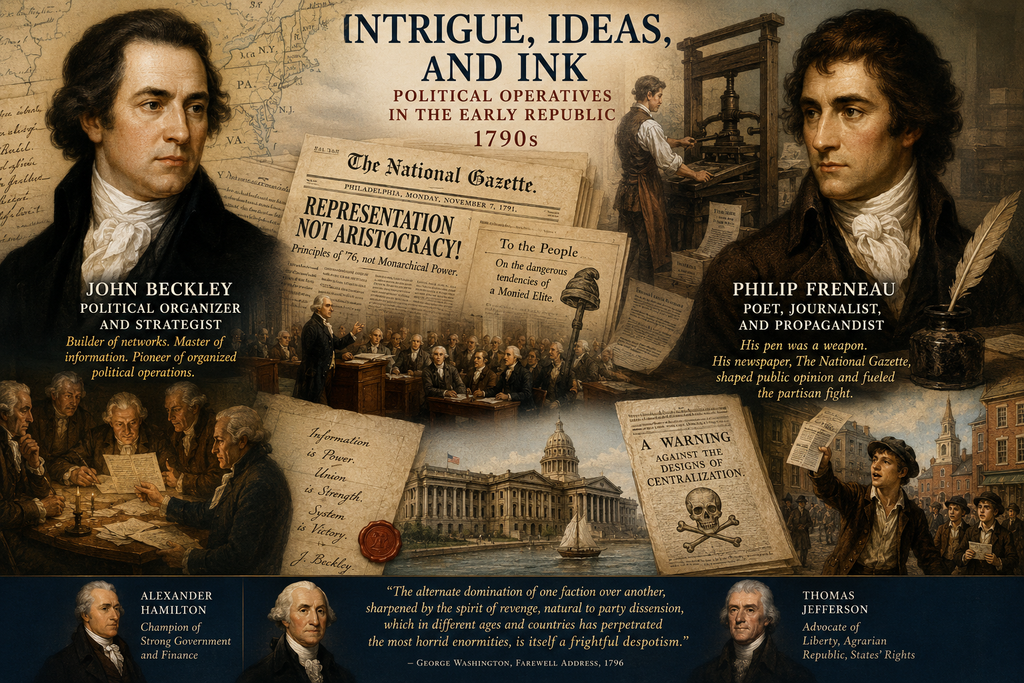
Two men who rarely get starring roles in the history books, John Beckley and Philip Freneau, were at the heart of it all. One was a former indentured servant who reinvented himself as America’s first professional campaign manager. The other was a Princeton-educated poet who turned journalism into a weapon. Working with Thomas Jefferson and James Madison, they helped shape the very concept of organized political opposition in the United States.
John Beckley: From Indentured Servant to Political Operative
John James Beckley was born on August 4, 1757, the son of obscure English parents, and was sent to Virginia in 1769 as an indentured servant. It is a remarkable origin story for a man who would go on to become one of the most consequential political operatives of the early republic. His master was John Clayton, clerk of court for Gloucester County. It was in Clayton’s household that Beckley developed his extraordinary clerical skills, the tools that would eventually open every door ahead of him.
Prior to earning a position with Congress, Beckley worked in various clerking jobs, including clerk of the committee of trade of the Virginia House of Delegates, clerk of the Virginia Senate, and clerk of the Virginia House of Delegates. In the 1780s, he was elected mayor of Richmond three times. He failed to win the clerkship of the Constitutional Convention but was successful in gaining the position of secretary of the Virginia ratifying convention. That last role put him in the room where Virginia’s crucial debate over ratification unfolded. It was an experience that shaped his understanding of how political outcomes are manufactured, not argued into existence.
Although Beckley was just a boy when he came to Virginia as an indentured servant, he rose to become a potent force in Virginia politics. Beckley and Jefferson began their political partnership during the American Revolution. Though never close personal friends, Beckley became a key political supporter and adviser to Jefferson. This was the relationship that would define his career. Jefferson provided the vision. Beckley provided the machinery.
Beginning April 1, 1789, Beckley was elected Clerk of the United States House of Representatives to the first four Congresses. As the very first person to hold that office, he was responsible for establishing its procedures from scratch. He prepared the rules for the Office of Clerk, as well as the parliamentary rules for the entire House, and established the procedural system for House operations. It was a position of enormous institutional power, and Beckley exploited every inch of it.
Philip Freneau: Poet, Privateer, and Pamphleteer
Philip Freneau came from a very different world. He was born on January 2, 1752, in New York City, the oldest of five children of Huguenot wine merchant Pierre Freneau and his Scottish wife. He attended the College of New Jersey, later renamed Princeton University, where he studied under John Witherspoon. Princeton in the 1760s and 1770s was a hotbed of pre-revolutionary sentiment, and Freneau absorbed it all.
At Princeton, Freneau was close friends with James Madison, and this relationship led to his co-founding the National Gazette with Madison and Thomas Jefferson. He graduated in 1771 and immediately found himself torn between the literary life and the political turmoil swirling around him. After graduating he tried teaching and briefly pursued theology, neither of which suited his restless temperament.
When the Revolution arrived, Freneau threw himself into it, literally. He eventually became a crew member on a revolutionary privateer and was captured along with the rest of the crew.
He was held on a British prison ship for about six weeks. This experience, which nearly killed him, was detailed in his work The British Prison Ship. It prompted many more patriotic and anti-British writings throughout the revolution and after. For this, he was nicknamed “The Poet of the American Revolution.”
After the war, Freneau alternated between seafaring and journalism. By 1790, he had published two collections of poetry. He was celebrated for his verse and respected for his Revolutionary credentials. Soon Jefferson and Madison came calling with a proposition that would redirect his entire career.
The War of the Gazettes
By 1790, the new federal government was riven with ideological conflict. Alexander Hamilton, as Secretary of the Treasury, had pushed through an ambitious financial program that included assumption of state debts, a national bank, and an excise tax. Jefferson and Madison viewed these proposals as a dangerous consolidation of federal power and a gift to merchant and financial elites. Madison and John Beckley began organizing a party to oppose Hamilton and his allies, whom Jefferson derisively referred to as “stock jobbers.” This “Anti-Administration” faction became what later was called the Democratic-Republican Party.
The Federalists already had their press organ, the Gazette of the United States. It was edited by John Fenno and backed by Hamilton. Jefferson and Madison needed someone with a sharp pen and a fighting spirit to run a counter-operation.
Freneau was exactly that man. He was strongly anti-Federalist and skilled at using wit, ridicule, and irony in his poetry and prose to attack his opponents. At times he would at times use sheer blunt force in his writing to make a strong point.
In 1791, encouraged by James Madison and others, Jefferson hired Freneau as a translating clerk for the State Department. The salary was a modest $250 a year. The position was largely fiction. Jefferson was criticized for hiring Freneau as a translator, even though he spoke no foreign languages except French, in which Jefferson was already fluent. Freneau accepted this undemanding position, which left him free time to head the Democratic-Republican newspaper Jefferson and Madison envisioned.
Jefferson leaked information to Freneau by leaving items out in his office, which Freneau was then able to access with his key. Jefferson also provided financial support to the National Gazette by giving Freneau State Department printing contracts and urging others to subscribe to the newspaper. James Madison, then a congressman for Virginia, contributed at least 18 anonymous articles to the paper — a standard practice of the day.
President Washington himself grew deeply frustrated with the increasingly toxic political climate. Although he tried to remain above party conflict, he came to resent the Republican newspaper attacks upon his administration as he believed them to be personal insults. Washington eventually concluded that Jefferson was surreptitiously encouraging these assaults through allies such as Freneau.
John Beckley was busy trying to form a barrier against what Republicans called John Fenno’s “monarchism.” Beckley recruited subscribers, coordinated with Republican allies in multiple states, and used his insider access to Congress to channel information into the opposition press.
The National Gazette was read widely, with leading Republicans such as John Hancock and Samuel Adams promoting it in Massachusetts, while others ensured that copies of the newspaper were delivered to the frontier. Articles from the National Gazette were reproduced in other Republican newspapers around the country.
Washington was irritated, reportedly complaining to friends about “that Rascal Freneau.” Jefferson, for his part, later credited Freneau’s paper with having saved the Constitution from sliding toward monarchy — revealing just how seriously the Republicans took the threat they believed Hamilton represented.
Hamilton Fights Back — and Exposes His Own Scandal
Hamilton was not a man who absorbed attacks quietly. He tried to silence the National Gazette through a letter published on August 4, 1792, in the Gazette of the United States, in which he criticized Freneau for attacking the government while receiving a government salary and called on Jefferson to resign. Jefferson stood by Freneau, though the pressure eventually forced Freneau to surrender his State Department position, dealing a financial blow to the paper.
But the most damaging episode for the Federalists wasn’t the press war, it was the Reynolds affair. In 1791, Hamilton began a romantic affair with Maria Reynolds, a married woman. Her husband, James Reynolds, soon discovered the affair and, rather than try to stop it, decided to profit from the situation by extorting money from Hamilton.
When congressional investigators, including Senator James Monroe, confronted Hamilton with evidence of payments to James Reynolds, Hamilton confessed to the affair to prove the money was hush money, not financial speculation. The investigators agreed to keep the matter private.
What happened next illustrated just how ruthless the early republic’s political culture could be. Monroe made a copy of the incriminating letters and sent them to Thomas Jefferson, Hamilton’s chief adversary. John Beckley, as Republican clerk of the House of Representatives, may also have surreptitiously copied them. It remains unclear whether Jefferson or Beckley was ultimately responsible for leaking the materials to journalist James Callender, who published the story in 1797.
Hamilton was forced to issue a lengthy public pamphlet admitting to the affair in order to disprove the financial speculation charges. It was a devastating personal and political blow that permanently ended any realistic hope he had of reaching the presidency.
The 1796 Campaign: America’s First Professional Political Operation
Beckley’s most audacious performance came in the presidential election of 1796, when Jefferson ran against John Adams. Beckley operated as the nation’s first political party manager, organizing the Pennsylvania campaign effort to elect Thomas Jefferson president of the United States.
In the 1796 presidential election there were no pre-printed ballots. Voters were expected to arrive at the polls with a slip of paper, or “ticket”, on which they had written the name of their preferred candidate. Printed tickets were not allowed. Beckley blanketed the state with agents who passed out 30,000 hand-written tickets for Jefferson electors.
Historians consider Beckley to be one of the first American professional campaign managers, and his techniques were quickly adopted in other states. He also invented or popularized other modern campaign methods such as mass distribution of pamphlets, coordinated messaging across multiple newspapers, and systematic grassroots voter outreach.
Jefferson lost narrowly to Adams, and the Federalists made Beckley pay for his open partisanship. He lost his job as clerk of the House of Representatives following the Federalist victories in the elections of 1796. It was a stark reminder that the clerkship, which Beckley had treated as a partisan instrument, was not yet insulated from electoral politics.
Aftermath and Legacy
The National Gazette collapsed in late 1793. Freneau’s loss of his State Department salary, combined with unpaid subscriptions and the economic devastation caused by a yellow fever epidemic in Philadelphia, proved to be more than the paper’s stretched finances could handle. Freneau returned to New Jersey and spent his remaining decades alternating between seafaring, farming, and sporadic literary work. He died in 1832, frozen to death in a blizzard near his home in Monmouth County — a fitting, if grim, end for a man who had spent his whole life in storms.
Beckley fared better, at least temporarily. When Jefferson won the presidency in 1800, Beckley was reelected as clerk of the House of Representatives and also secured the newly created title of Librarian of Congress. It was a fitting reward for the man who had done as much as anyone to put Jefferson in office. He died in Washington in 1807.
What Beckley and Freneau built together — with Jefferson and Madison providing the strategic direction — was genuinely new. The combination of a dedicated partisan press, a professional ground-level campaign organization, coordinated messaging, and the willingness to weaponize personal scandals established patterns that American politics has never really abandoned. Neither man is a household name today, but the infrastructure they pioneered is very much with us.*
*Though few current residents recognize it, Beckley, West Virginia was named for John Beckley.
Image generated by author using ChatGPT.
Sources
West Virginia Encyclopedia — John Beckley. Encyclopedia of West Virginia History and Culture. https://www.wvencyclopedia.org/entries/390
Quill Project — John Beckley Biography. https://www.quillproject.net/person/4606
Library of Congress Information Bulletin — “First Librarian Featured in New Book” (1996). https://www.loc.gov/loc/lcib/9610/beckley.html
Dictionary of Virginia Biography — John James Beckley. Library of Virginia. https://old.lva.virginia.gov/public/dvb/bio.asp?b=Beckley_John_James
U.S. House of Representatives History, Art & Archives — BECKLEY, John. https://history.house.gov/People/Detail/38343
Wikipedia — John J. Beckley. https://en.wikipedia.org/wiki/John_J._Beckley
Library of Congress — John James Beckley (1757–1807). https://www.loc.gov/item/n84136150/john-james-beckley-1757-1807/
Wikipedia — Philip Freneau. https://en.wikipedia.org/wiki/Philip_Freneau
Poetry Foundation — Philip Freneau. https://www.poetryfoundation.org/poets/philip-freneau
Britannica — Philip Freneau. https://www.britannica.com/biography/Philip-Freneau
Founders Online, National Archives — Philip Freneau to Thomas Jefferson, 8 April 1809 (with editorial note). https://founders.archives.gov/documents/Jefferson/03-01-02-0104
Newspapers.com — National Gazette archive and history. https://www.newspapers.com/paper/national-gazette/32593/
Library of Congress — National Gazette (Philadelphia), 1791–1793. https://www.loc.gov/item/sn83025887/
Founders Online, National Archives — Origins of Freneau’s National Gazette, 25 July 1791 (editorial note). https://founders.archives.gov/documents/Madison/01-14-02-0046
Founders Online, National Archives — Jefferson, Freneau, and the Founding of the National Gazette (editorial note). https://founders.archives.gov/documents/Jefferson/01-20-02-0374-0001
Wikipedia — Jeffersonian Democracy. https://en.wikipedia.org/wiki/Jeffersonian_democracy
Wikipedia — First Party System. https://en.wikipedia.org/wiki/First_Party_System
Wikipedia — Federalist Party. https://en.wikipedia.org/wiki/Federalist_Party
Smithsonian Magazine — “Alexander Hamilton’s Adultery and Apology.” https://www.smithsonianmag.com/history/alexander-hamiltons-adultery-and-apology-18021947/
New-York Historical Society — The Reynolds Pamphlet. https://www.nyhistory.org/exhibitions/reynolds-pamphlet
If you’ve ever laughed a little too hard, sprinted across the street, or simply gotten older, you may have noticed your bladder has developed opinions of its own. You’re suddenly chagrined to discover that you’ve developed more than a passing acquaintance with urinary incontinence. Since my own prostate surgery, a little over 10 years ago, I’ve become all too familiar with the inconvenience and the embarrassment of urinary incontinence.
It’s one of those conditions that’s extraordinarily common and yet still gets talked about in whispers, if it gets talked about at all. That’s a shame, because it’s rarely something people simply have to live with. Roughly six in ten women and about one in seven men will deal with some form of it at some point. The reasons range from childbirth to prostate surgery to the ordinary business of getting older.
The bladder is essentially a muscular storage reservoir. As urine enters the bladder, the bladder muscle—the detrusor—normally remains relaxed while the urinary sphincter and pelvic floor help keep the outlet closed. When we decide to urinate, a coordinated neurologic process causes the bladder to contract and the sphincter to relax.
Incontinence is a disruption, either structural or physiological, of this process.
Let’s walk through the main types, how the picture differs for men and women, what surgery can do to bladder control, and why aging tilts the odds toward leakage without making it inevitable.
The Main Types, and Why the Distinction Matters
Doctors sort urinary incontinence into a handful of categories, and getting the category right matters because the treatments diverge from one type to the next.
Stress incontinence is the leakage that shows up during a cough, a sneeze, a laugh, or a heavy lift. It can occur at any moment when pressure inside the abdomen spikes and overwhelms a weakened sphincter or a poorly supported urethra.
Urge incontinence is a different animal entirely. It’s the sudden, hard-to-ignore need to go, often followed by leakage before you can get to a bathroom. It traces back to a bladder muscle that contracts on its own schedule rather than yours.
Plenty of people have some of both, which is fittingly called mixed incontinence and is in fact the most common pattern among women with bladder symptoms.
Then there’s overflow incontinence, a steady dribble that happens when the bladder never quite empties and eventually overflows. Frequently something, often an enlarged prostate in men, is partially blocking the outlet.
Functional incontinence isn’t really a bladder problem at all It happens when the bladder and urethra work fine but a physical or cognitive barrier, arthritis, dementia, an unfamiliar building, keeps you from reaching a toilet in time.
Reflex incontinence, less commonly discussed, involves the bladder contracting without any warning sensation at all, usually the result of nerve damage from conditions like multiple sclerosis or spinal cord injury.
How the Picture Differs Between Women and Men
Sex matters quite a bit here, both in how common incontinence is and in which type shows up. In women, stress incontinence is the single most common variety, and pregnancy and vaginal childbirth are the biggest reasons why. They stretch and sometimes injure the pelvic floor muscles and connective tissue that ordinarily keep the urethra snugly closed.
Menopause adds another layer, since declining estrogen thins the urethral lining and can weaken sphincter function further. Cleveland Clinic data estimate roughly 62 percent of women age twenty and older experience some form of incontinence, a striking number that reflects just how common, and how underreported, this condition is.
Men have a lower overall rate, on the order of 14 percent, but their pattern looks different. Because men don’t have the childbirth-related stresses on the pelvic floor, stress incontinence in men is less common on its own and shows up mainly after prostate surgery, which we’ll get to shortly.
Overflow incontinence is proportionally more of a male problem, since an enlarging prostate gland can squeeze the urethra and prevent the bladder from emptying completely.
Urge incontinence and overactive bladder symptoms affect both sexes and become more common with age regardless of gender.
What Hysterectomy Does to Bladder Control
Hysterectomy is one of the most common major surgeries performed on women, and extensive research has looked at what it does to the bladder over the years following surgery. The short version: removing the uterus appears to modestly raise the long-term risk of stress incontinence, likely because the surgery can disturb the nerves, ligaments, and connective tissue that support the bladder neck and urethra. These structures sit close to the uterus and cervix.
A large systematic review found that during the first decade after hysterectomy, women faced a higher likelihood of urinary incontinence of any type, and stress incontinence specifically, compared with women who hadn’t had the surgery. Beyond ten years out, the gap widens further for stress incontinence.
A nationwide Finnish cohort that followed five thousand women for over a decade found that about one in fifty ultimately needed a surgical procedure to correct stress incontinence, with the risk running somewhat higher after vaginal or laparoscopic hysterectomy than after the abdominal approach.
It’s worth remembering that most women who have a hysterectomy never develop significant incontinence. Surgery is often the right choice for the underlying problem being treated, whether that’s fibroids, heavy bleeding, or cancer. But the association is real enough that it belongs in the conversation that women have with their surgeons beforehand. Particularly if they have already had vaginal deliveries, since that appears to carry extra risk.
What Prostatectomy Does to Bladder Control
For men, radical prostatectomy, the surgical removal of the prostate gland, most often performed for prostate cancer, is by a wide margin the leading cause of urinary incontinence. Nearly every man leaks to some degree immediately after the catheter comes out, which sounds alarming but reflects basic anatomy. The prostate normally works alongside the external sphincter to hold urine back, and removing it shifts the entire job onto that external sphincter, which needs time to adapt to the extra workload.
Continence rates climb steadily over the following year, with studies reporting roughly a quarter to half of men fully continent by three months, somewhere around two-thirds to three-quarters by six months, and the large majority continent by twelve months.
The American Urological Association’s guidelines note that incontinence is expected in the short term and generally improves toward baseline by a year after surgery, though for a minority, often cited as around a third of patients, some degree of leakage persists longer and occasionally requires further treatment such as pelvic floor therapy or, less often, a surgical procedure. Surgical technique matters too: preserving the nerve bundles that run alongside the prostate and maintaining a longer stretch of urethra during the operation are both associated with faster, more complete recovery of continence.
Late onset urinary incontinence effects approximately 10 to 15 percent of men who regained continence after a radical prostatectomy. It can begin anywhere from 5 to 15 years after surgery. This is frequently believed to be exacerbated by age-related changes.
The Effects of Ordinary Aging
Even without surgery in the picture, the bladder changes as we get older, and those changes tilt the odds toward incontinence for both sexes. Bladder capacity tends to shrink somewhat, meaning it fills to an uncomfortable point sooner.
The detrusor muscle, the smooth muscle that squeezes urine out, becomes more prone to firing off contractions on its own rather than only when you decide it’s time to go. This is a big part of what drives urge incontinence in later life.
The bladder also tends to leave more urine behind after each trip to the bathroom, called increased residual volume, raising the risk of both overflow symptoms and urinary tract infections that can trigger or worsen leakage.
The details diverge a bit by sex. In women, the drop in estrogen after menopause thins and shortens the urethral lining, loosening the seal the sphincter can form and compounding whatever pelvic floor weakening already occurred from childbirth.
In men, incontinence related to aging alone tends to show up later, generally after the seventh decade of life, and often travels alongside prostate enlargement. This is a nearly universal feature of male aging that can produce overflow-type symptoms even without prior surgery.
Incontinence prevalence rises sharply after age 65, and some nursing-home studies put rates as high as two-thirds among residents in their late eighties. Women’s rates consistently outpace men’s at every stage of later life.
None of this means incontinence is simply the toll of aging and that nothing can be done about it. While the physiological changes make leakage more likely, they don’t make it unavoidable. The same toolkit used with younger patients, pelvic floor exercises, bladder training, medications, and in some cases surgery, works for older adults too.
The bigger obstacle tends to be that people, especially older adults, often wait years before mentioning symptoms to a doctor, quietly reorganizing their lives around bathroom access instead of asking for help that’s readily available.
The Bottom Line
Urinary incontinence is sometimes dismissed as an embarrassing inconvenience, but its consequences can be substantial. People may stop exercising, traveling, attending social events, or even leaving home because they are worried about finding a bathroom. Older adults rushing to the toilet at night may also increase their risk of falling.
While urinary incontinence is common, it’s rarely discussed as openly as it deserves to be, and it is seldom explained to patients in plain language.
The consistent message across the research is that this is a treatable condition rather than a life sentence, and the first step toward treatment is usually just being willing to bring it up.
Illustration generated by author using ChatGPT
Medical Disclaimer
The information provided in this article is intended for general educational and informational purposes only and does not constitute medical advice. It should not be used as a substitute for professional medical advice, diagnosis, or treatment.
Always seek the guidance of a qualified healthcare provider with any questions you may have regarding a medical condition or treatment. Never disregard professional medical advice or delay seeking it because of something you have read here.
If you are experiencing a medical emergency, call 911 or your local emergency number immediately.
The author of this article is a licensed physician, but the views expressed here are solely those of the author and do not represent the official position of any hospital, health system, or medical organization with which the author may be affiliated.