

Image generated by author using ChatGPT
I joined the Navy when I was 19 and I’ve been fascinated with ships ever since, ships of all kinds from square rigged clippers to super tankers. One type of ship that has always held a particular fascination for me is the Chinese junk. Perhaps, it’s because it seems so exotic and it gives hints of adventure. I can remember the first time I saw a junk under full sail. It was 1970 when I visited Hong Kong. I had just got off the Star Ferry, and I caught sight of it sailing across the harbor. I just stood there, watching it until it disappeared from sight and wishing I hadn’t left my camera in the hotel.
The Chinese junk isn’t a single ship design. It’s a family of crafts design to sail in China’s rivers and estuaries, along the coast, and on the open sea. It’s an example of practical shipbuilding, designed to be adaptable to multiple environments.
The word junk isn’t even a Chinese one. It was most likely coined by English traders. The Chinese referred junks by the general name chuan, which means simply “ship” or ‘boat’. Junk may have been derived from the Javanese word jong or the Malay word ajong, both of which refer to a large ship.
We don’t know exactly when the junk was first developed but it may extend all the way back to the Han dynasty, roughly 220 BCE. The earliest versions were likely made of wood, bamboo or reeds and those materials rarely survive for later examination. Early versions of the junk have been documented as operating in the Yangtze River and coastal waters and estuaries and even venturing into maritime trade throughout East Asia.
The most distinctive feature of the junk is its flat or shallow bottom hull, rather than the deep keel vessels associated with European design. The design makes it susceptible to being pushed sideways by the wind while under sail. But the Chinese shipbuilders outfitted it with leeboards, center boards and large adjustable rudders which could extend it into the water to prevent sideways drift and to help maintain course, much like a keel on European ships. Unlike European ships, these elements could be retracted to allow it to enter shallow water and even to be beached to load or unload supplies or make repairs.
The broad beam of the ship and its flat bottom also gave it the ability to handle a large volume of cargo. This was an advantage for traders carrying bulky commodities such as rice, ceramics, textiles or salt. The design also provided a military advantage because it could carry larger numbers of troops and horses than could be carried on a European style ship.
The most significant innovation in the Chinese junk may have been the development of watertight bulkheads. The bulkhead is a wall that separates portions of the ship to prevent flooding should any portion of the hull develop a leak. That way the integrity of the entire ship would not be compromised by a hole in a single area. The bulkheads also strengthened the hull of the ship allowing it to endure greater stress from violent waves and wind. It also increased the capability to carry larger cargo. This is probably the major contribution that the Chinese made to the greater science of shipbuilding and naval technology. Western shipbuilders later adapted this same principle for their ship construction.
The junk sails are both innovative and distinctive. The sails are often fan shaped and are divided into sections separated by horizontal battens usually made of bamboo or wood. These distribute the stress across the fabric and help the sail retain its shape. The early sails were mostly made from woven matts or grasses while later examples were made from more durable cloth. The battens make it easier to raise and lower the sails without requiring sailors to climb up into the riggings to furl or unfurl canvas. Sails can be more quickly and easily adjusted to the weather conditions, allowing the ships to operate with smaller crews. The sails also feature another innovation that was not common among European ships. They can be easily rotated, giving the junk additional maneuverability in harbors and narrow rivers.
Depending on the size of the ship, they may have anywhere from one reportedly up to as many as nine masts on the largest of the naval vessels. The greater number of masts spread the sail area across the ship to adapt to varying wind conditions, allowing the ship to continue under sail in heavy weather, even if a mast or a sail was damaged or completely lost.
Junks have an extremely high stern area. This is useful both as a living and a working space. It can accommodate crew’s quarters, storage, cargo, and historically provided a defensive position in case of attack. Most junks are steered by a tiller operated rudder, and the high stern provides additional leverage to operate the rudder.
The junks aren’t simply limited to the local Chinese area. During the Ming dynasty between 1405 and 1433 CE Chinese fleets operated throughout Southeast Asia, across the Indian Ocean, into the Persian Gulf, and the ports of Arabia and East Africa. They carried political envoys, trade goods, supplies, and tribute. They conducted trade with Buddhist, Muslim, Hindu, and Christian communities and facilitated some of the earliest interactions between these groups.
Junks are best known to western historians from a voyage that occurred in the early 15th century. Admiral Zheng He commanded what became known as “treasure voyages” for the Ming dynasty. His fleets reportedly included massive junks up to 400 feet in length with as many 9 masts, although many historians doubt they were this large. Regardless of the actual size, they were far superior to any European ships of the same era both in size and technology.
Today, we think of the junk most often as a quaint and picturesque tourist symbol usually associated with Hong Kong. But the junk isn’t merely an attractive photo op. It is a sophisticated design that met the demands of a seafaring community. It has an innovative hull with an adjustable steering system, compartmental construction, and battened sails that set the standard for centuries before the advent of steam propulsion. It carried more than cargo. It carried knowledge, technology, and civilization across the waters of Asia and eventually across the waters of the world.
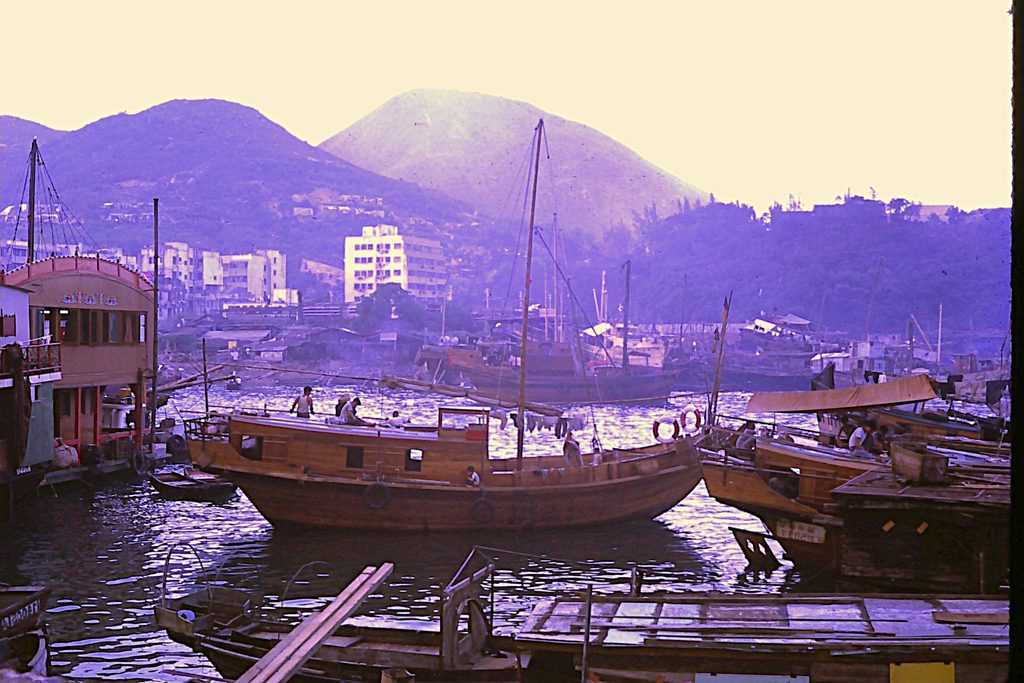
Photo by author
Sources:
- https://en.wikipedia.org/wiki/Junk_(ship)
- https://www.newworldencyclopedia.org/entry/Junk_(ship)
- https://worldhistorycommons.org/chinese–junk–early-18th–century
- https://en.wikipedia.org/wiki/Junk_rig
- https://exploration.marinersmuseum.org/watercra /junk–ship/
- https://theculturetrip.com/asia/china/hong–kong/articles/a–brief–history–of–the–chinese–junk
- https://www.historyanswers.co.uk/inventions/chinese–junks/