
Cholesterol has an odd reputation. It’s usually treated as a villain, but your body can’t function without it. Every cell membrane relies on it, and it’s the raw material for hormones like estrogen and testosterone, as well as for vitamin D. The trouble starts when you have too much of the wrong kind circulating in your blood for too long a time. Excess cholesterol can quietly build up inside your artery walls for many years before you’re aware of it. The consequences of ignoring it can range from an abnormal stress test to a heart attack. Let’s walk through how your doctor diagnoses a cholesterol problem, how you can treat it, and what happens if it goes unaddressed.
How Cholesterol Is Diagnosed
The starting point is a lipid panel. That is a blood test that’s usually done after you’ve been fasting. Although newer research has shown non-fasting panels work nearly as well for most purposes. The panel reports several numbers, and each identifies a different type of cholesterol.
LDL cholesterol, low-density lipoprotein, is the one most people mean when they say “bad cholesterol.” It’s the particle that tends to stick to artery walls and starts the buildup of plaque, the main component of blockages.
HDL, high-density lipoprotein, works in the opposite direction. It helps carry cholesterol back to the liver for disposal, which is why it’s nicknamed “good cholesterol.”
Triglycerides, a different type of fat entirely, round out the standard panel and, when elevated, add their own risk on top of LDL.
There isn’t one universal LDL number that applies to everyone. Instead, doctors weigh your LDL alongside your overall cardiovascular risk that also considers age, blood pressure, diabetes status, smoking history, and family history. If you’ve already had a heart attack, stroke, or other diagnosed artery disease you have increased risk.
The 2026 guideline from the American College of Cardiology and American Heart Association, sets LDL goals that correspond with risk: under 100 mg/dL for people at borderline or intermediate risk, under 70 mg/dL for those at high risk, and under 55 mg/dL for people who already have known artery disease and are considered very high risk. Additionally, initial lipid panels are now recommended starting at age 19, rather than waiting until later adulthood.
Two additional tests are being used more often now. Apolipoprotein B, or apoB, counts the actual number of cholesterol-carrying particles in your blood rather than just the cholesterol mass inside them. The newest guideline lists it as a more accurate risk predictor, even though it sometimes disagrees with the standard LDL number.
Lipoprotein(a), or Lp(a), is a genetically determined particle that raises artery-disease risk independent of LDL. An elevated Lp(a), even in the absence of an elevated LDL, is considered an increased risk. The update also recommends adults be screened for it once, since it isn’t affected by diet or exercise. When it’s high, your doctor may be more aggressive in treating your other numbers.
There are two tests that are not strictly cholesterol but are related to the risk associated with elevated cholesterol. They may be ordered for patients considered to be at risk or to evaluate their risk if it is unknown or uncertain.
Coronary artery calcium (CAC) scoring is a noninvasive, low-radiation CT scan that measures calcified atherosclerotic plaque in the coronary arteries and reports a calcium score. A score of zero indicates no detectable coronary calcium, while progressively higher scores indicate a greater level of coronary atherosclerosis and generally greater future cardiovascular risk. CAC is particularly useful when a person’s need for preventive treatment, such as a statin, is uncertain.
The new American Heart Association PREVENT (Predicting Risk of Cardiovascular Disease EVENTs) calculator, is recommended in the 2026 dyslipidemia guideline in place of older methods. It estimates the 10- and 30-year risk of atherosclerotic cardiovascular disease, heart failure, and total cardiovascular disease in adults ages 30–79 who do not have established cardiovascular disease. It incorporates age, sex, blood pressure, cholesterol, smoking, diabetes, body mass index, kidney function and medication use. PREVENT and CAC complement one another. PREVENT provides an initial estimate based primarily on clinical risk factors, while CAC can selectively provide direct evidence of coronary atherosclerosis.
Lifestyle Modifications
For most people with mild to moderately elevated cholesterol, lifestyle change is the first line of treatment. It isn’t just a box to check before starting medication. It can meaningfully move the numbers on its own.
Diet has the most consistent evidence behind it. Cutting back on saturated fat (found in fatty cuts of meat, butter, and full-fat dairy) and replacing it with unsaturated fats from sources like olive oil, nuts, and fatty fish can lower LDL. Soluble fiber, the kind found in oats, beans, and fruits like apples and pears, binds cholesterol in the digestive tract and carries it out of the body before it can be absorbed.
Exercise helps too, primarily by raising HDL and improving how your body handles triglycerides. Most clinical guidelines recommend at least 150 minutes a week of moderate activity, like brisk walking. More vigorous exercise appears to help more. Even a modest weight loss tends to improve the whole lipid panel.
Quitting smoking doesn’t lower LDL by much, but it dramatically improves HDL function. It also reduces the inflammation that turns cholesterol deposits into unstable, rupture-prone plaque.
Alcohol is not as clear cut. Heavy drinking clearly raises triglycerides and worsens overall risk but claims that moderate drinking meaningfully protects the heart have not held up well. It’s clearly not a reason to start drinking for health purposes.
Treatments
Doctors generally fall into one of two categories when dealing with our own health issues. Some tend to obsess about their health and check their labs and other tests repeatedly and sometimes undertake unnecessary or only marginally beneficial treatments. Others ignore their own health in ways they would never accept from their patients. I tend to fall into the latter category, and I ignored my marginally elevated cholesterol for several years until my cardiologist, who is also a friend, told me to quit being “stupid” and start treating it.
When lifestyle change isn’t enough on its own (mine wasn’t), or when your risk is high enough or your doctor doesn’t want to wait and see, medication is an option. Statins remain the default first step for most patients. They work by blocking an enzyme your liver uses to make cholesterol, which prompts the liver to pull more LDL out of the bloodstream. Decades of large trials tie this to real reductions in heart attacks and strokes.
If you don’t reach their goal on a statin alone, or you can’t tolerate one, several add-on options exist. Ezetimibe, a daily pill, blocks cholesterol absorption in the gut and is usually the first addition tried because it’s inexpensive and well tolerated. PCSK9 inhibitors, injectable medications like evolocumab and alirocumab, block a liver protein that normally limits how much LDL the liver can clear. They can lower LDL by roughly 50 to 65 percent on top of a statin. Inclisiran works on the same PCSK9 pathway but through a different mechanism, silencing the gene that produces LDL. It only needs to be injected twice a year rather than biweekly. Its long-term effect on heart attacks and strokes is still being evaluated in ongoing trials. Bempedoic acid, a newer oral option, works further upstream in the same cholesterol-production pathway as statins and has shown to reduce cardiovascular events in people who can’t take statins. It’s a more modest LDL reducer than the injectable options and carries a higher risk of gout and gallstones.
Specialists disagree about how aggressively to treat cholesterol, and what the target should be. Guidance has shifted more than once in the last decade. The 2026 multi-society guideline leans toward “lower for longer” as the general philosophy. Some professional groups have pushed back, arguing the most aggressive targets are better supported only for people who have already had a cardiac event. For what it’s worth, my own philosophy is “lower is better.” It’s worth discussing with your own physician.
What Happens If It Goes Untreated
This is the part that makes cholesterol worth taking seriously even though it produces no symptoms of its own for years or decades. Excess LDL particles work their way into the walls of arteries, where they trigger an inflammatory response. Immune cells arrive to clean up the cholesterol, become engorged with it, and form the fatty streaks that eventually mature into plaque. This process, called atherosclerosis, narrows and stiffens arteries throughout the body. It’s essentially silent until it isn’t.
Plaque in the arteries feeding the heart, can cause angina, chest discomfort during exertion when narrowed vessels can’t deliver enough blood. Later it can cause a heart attack if a plaque ruptures and a clot suddenly completely blocks the vessel.
The same rupture-and-clot process occurs in the arteries feeding the brain when a piece of plaque breaks loose and travels downstream causing an ischemic stroke. In the legs, arms, or abdomen, narrowed arteries produce peripheral artery disease, which shows up as cramping or pain with walking and, in advanced untreated cases, can progress to gangrene and amputation.
Chronic kidney disease and, less commonly, vascular dementia are also linked to long-term uncontrolled atherosclerosis, since the same narrowing process affects the small vessels feeding the kidneys and brain. This link is not as well documented as the coronary and peripheral vascular effects.
People with familial hypercholesterolemia, a genetic condition that causes very high LDL from birth, have an accelerated risk. Without treatment, clinically apparent artery disease can show up as early as someone’s thirties or forties instead of the more typical sixth or seventh decade of life.
It’s a useful reminder that the danger of high cholesterol isn’t only about the number itself. It’s also about the cumulative years of exposure. Starting treatment earlier, even modestly, tends to pay off more than starting aggressively later on.
Medical Disclaimer
The information provided in this article is intended for general educational and informational purposes only and does not constitute medical advice. It should not be used as a substitute for professional medical advice, diagnosis, or treatment.
Always seek the guidance of a qualified healthcare provider with any questions you may have regarding a medical condition or treatment. Never disregard professional medical advice or delay seeking it because of something you have read here.
If you are experiencing a medical emergency, call 911 or your local emergency number immediately.
The author of this article is a licensed physician, but the views expressed here are solely those of the author and do not represent the official position of any hospital, health system, or medical organization with which the author may be affiliated.
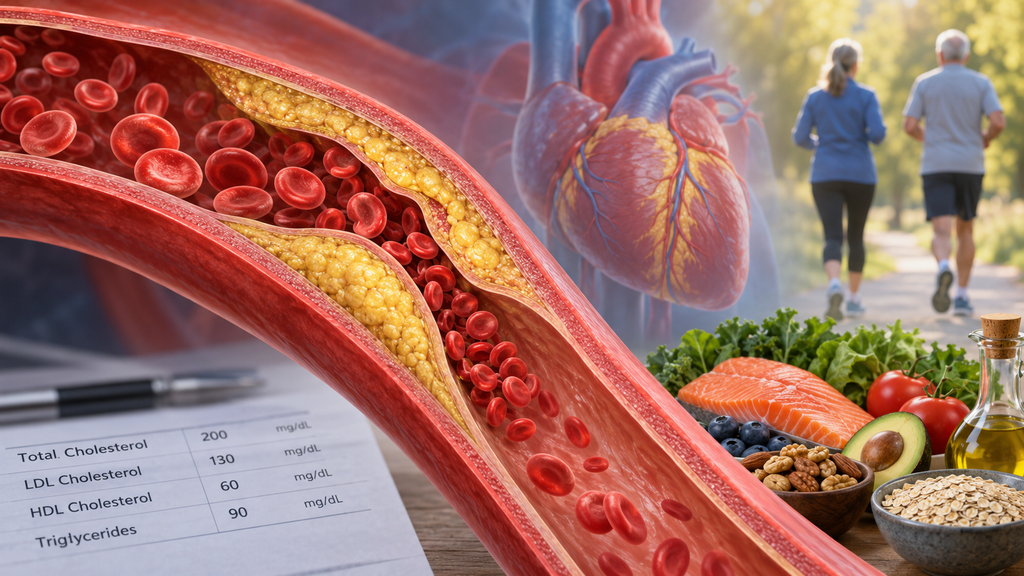
Illustration generated by the author using ChatGPT.
Sources
1. National Lipid Association, summary of the 2026 ACC/AHA/Multisociety Dyslipidemia Guideline — https://www.lipid.org/nla/2026-accahamultisociety-dyslipidemia-guideline-released
2. American College of Cardiology, news release on the 2026 ACC/AHA dyslipidemia guideline — https://www.acc.org/latest-in-cardiology/journal-scans/2026/03/13/15/20/acc-aha-release-new-clinical-guideline-for-managing-dyslipidemia
3. 2026 ACC/AHA/AACVPR/ABC/ACPM/ADA/AGS/APhA/ASPC/NLA/PCNA Guideline on the Management of Dyslipidemia, Circulation — https://www.ahajournals.org/doi/10.1161/CIR.0000000000001423
4. JACC, Maturation of Lipid Management in the 2025 ACC/AHA Acute Coronary Syndrome Guideline — https://www.jacc.org/doi/10.1016/j.jacc.2025.04.024
5. PMC, Current and emerging PCSK9-directed therapies to reduce LDL-C and ASCVD risk — https://pmc.ncbi.nlm.nih.gov/articles/PMC11755694/
6. Harvard Health, The changing landscape of LDL lowering drugs — https://www.health.harvard.edu/heart-health/the-changing-landscape-of-ldl-lowering-drugs
7. ScienceDirect, Advances in targeting LDL cholesterol: PCSK9 inhibitors and beyond — https://www.sciencedirect.com/science/article/pii/S2666667724000692
8. Cleveland Clinic, Hypercholesterolemia: Causes, Symptoms & Treatment — https://my.clevelandclinic.org/health/diseases/23921-hypercholesterolemia
9. Medical News Today, Complications of high cholesterol and tips to prevent them — https://www.medicalnewstoday.com/articles/high-cholesterol-complications
10. StatPearls (NCBI Bookshelf), Atherosclerosis — https://www.ncbi.nlm.nih.gov/books/NBK507799/
11. PMC, Familial Hypercholesterolemia Patients with COVID-19 — effective cholesterol-lowering therapy is urgent — https://www.ncbi.nlm.nih.gov/pmc/articles/PMC11270387/
12. PMC, A 72-Year-Old Patient with Longstanding, Untreated Familial Hypercholesterolemia but no Coronary Artery Calcification: A Case Report — https://www.ncbi.nlm.nih.gov/pmc/articles/PMC5991918/