Most people think of the Founding era as a time of stately deliberation — powdered wigs, quill pens, and gentlemanly debate. Yet beneath that polished surface existed another reality, one filled with political gossip, anonymous attacks, newspaper manipulation, patronage, espionage-like intelligence gathering, and organized partisan warfare.
Many leading Americans hoped the new republic would avoid the factionalism that had plagued European politics. George Washington famously warned against “the baneful effects of the spirit of party.” But from the moment the new federal government took shape in 1789, it became a battleground of competing visions, personal vendettas, and bare-knuckled political maneuvering
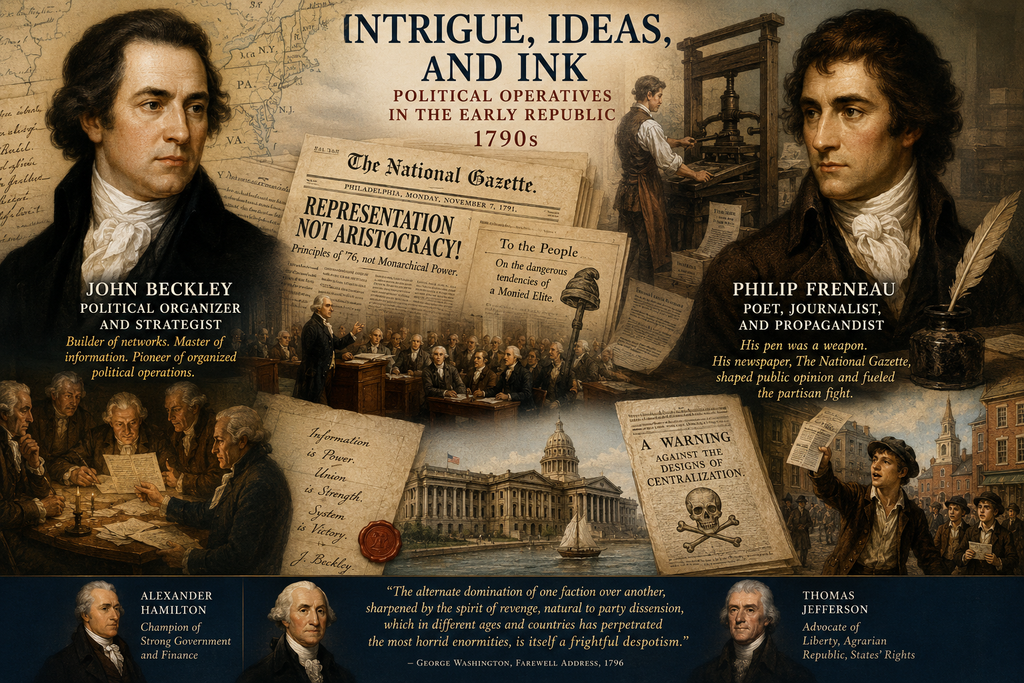
Two men who rarely get starring roles in the history books, John Beckley and Philip Freneau, were at the heart of it all. One was a former indentured servant who reinvented himself as America’s first professional campaign manager. The other was a Princeton-educated poet who turned journalism into a weapon. Working with Thomas Jefferson and James Madison, they helped shape the very concept of organized political opposition in the United States.
John Beckley: From Indentured Servant to Political Operative
John James Beckley was born on August 4, 1757, the son of obscure English parents, and was sent to Virginia in 1769 as an indentured servant. It is a remarkable origin story for a man who would go on to become one of the most consequential political operatives of the early republic. His master was John Clayton, clerk of court for Gloucester County. It was in Clayton’s household that Beckley developed his extraordinary clerical skills, the tools that would eventually open every door ahead of him.
Prior to earning a position with Congress, Beckley worked in various clerking jobs, including clerk of the committee of trade of the Virginia House of Delegates, clerk of the Virginia Senate, and clerk of the Virginia House of Delegates. In the 1780s, he was elected mayor of Richmond three times. He failed to win the clerkship of the Constitutional Convention but was successful in gaining the position of secretary of the Virginia ratifying convention. That last role put him in the room where Virginia’s crucial debate over ratification unfolded. It was an experience that shaped his understanding of how political outcomes are manufactured, not argued into existence.
Although Beckley was just a boy when he came to Virginia as an indentured servant, he rose to become a potent force in Virginia politics. Beckley and Jefferson began their political partnership during the American Revolution. Though never close personal friends, Beckley became a key political supporter and adviser to Jefferson. This was the relationship that would define his career. Jefferson provided the vision. Beckley provided the machinery.
Beginning April 1, 1789, Beckley was elected Clerk of the United States House of Representatives to the first four Congresses. As the very first person to hold that office, he was responsible for establishing its procedures from scratch. He prepared the rules for the Office of Clerk, as well as the parliamentary rules for the entire House, and established the procedural system for House operations. It was a position of enormous institutional power, and Beckley exploited every inch of it.
Philip Freneau: Poet, Privateer, and Pamphleteer
Philip Freneau came from a very different world. He was born on January 2, 1752, in New York City, the oldest of five children of Huguenot wine merchant Pierre Freneau and his Scottish wife. He attended the College of New Jersey, later renamed Princeton University, where he studied under John Witherspoon. Princeton in the 1760s and 1770s was a hotbed of pre-revolutionary sentiment, and Freneau absorbed it all.
At Princeton, Freneau was close friends with James Madison, and this relationship led to his co-founding the National Gazette with Madison and Thomas Jefferson. He graduated in 1771 and immediately found himself torn between the literary life and the political turmoil swirling around him. After graduating he tried teaching and briefly pursued theology, neither of which suited his restless temperament.
When the Revolution arrived, Freneau threw himself into it, literally. He eventually became a crew member on a revolutionary privateer and was captured along with the rest of the crew.
He was held on a British prison ship for about six weeks. This experience, which nearly killed him, was detailed in his work The British Prison Ship. It prompted many more patriotic and anti-British writings throughout the revolution and after. For this, he was nicknamed “The Poet of the American Revolution.”
After the war, Freneau alternated between seafaring and journalism. By 1790, he had published two collections of poetry. He was celebrated for his verse and respected for his Revolutionary credentials. Soon Jefferson and Madison came calling with a proposition that would redirect his entire career.
The War of the Gazettes
By 1790, the new federal government was riven with ideological conflict. Alexander Hamilton, as Secretary of the Treasury, had pushed through an ambitious financial program that included assumption of state debts, a national bank, and an excise tax. Jefferson and Madison viewed these proposals as a dangerous consolidation of federal power and a gift to merchant and financial elites. Madison and John Beckley began organizing a party to oppose Hamilton and his allies, whom Jefferson derisively referred to as “stock jobbers.” This “Anti-Administration” faction became what later was called the Democratic-Republican Party.
The Federalists already had their press organ, the Gazette of the United States. It was edited by John Fenno and backed by Hamilton. Jefferson and Madison needed someone with a sharp pen and a fighting spirit to run a counter-operation.
Freneau was exactly that man. He was strongly anti-Federalist and skilled at using wit, ridicule, and irony in his poetry and prose to attack his opponents. At times he would at times use sheer blunt force in his writing to make a strong point.
In 1791, encouraged by James Madison and others, Jefferson hired Freneau as a translating clerk for the State Department. The salary was a modest $250 a year. The position was largely fiction. Jefferson was criticized for hiring Freneau as a translator, even though he spoke no foreign languages except French, in which Jefferson was already fluent. Freneau accepted this undemanding position, which left him free time to head the Democratic-Republican newspaper Jefferson and Madison envisioned.
Jefferson leaked information to Freneau by leaving items out in his office, which Freneau was then able to access with his key. Jefferson also provided financial support to the National Gazette by giving Freneau State Department printing contracts and urging others to subscribe to the newspaper. James Madison, then a congressman for Virginia, contributed at least 18 anonymous articles to the paper — a standard practice of the day.
President Washington himself grew deeply frustrated with the increasingly toxic political climate. Although he tried to remain above party conflict, he came to resent the Republican newspaper attacks upon his administration as he believed them to be personal insults. Washington eventually concluded that Jefferson was surreptitiously encouraging these assaults through allies such as Freneau.
John Beckley was busy trying to form a barrier against what Republicans called John Fenno’s “monarchism.” Beckley recruited subscribers, coordinated with Republican allies in multiple states, and used his insider access to Congress to channel information into the opposition press.
The National Gazette was read widely, with leading Republicans such as John Hancock and Samuel Adams promoting it in Massachusetts, while others ensured that copies of the newspaper were delivered to the frontier. Articles from the National Gazette were reproduced in other Republican newspapers around the country.
Washington was irritated, reportedly complaining to friends about “that Rascal Freneau.” Jefferson, for his part, later credited Freneau’s paper with having saved the Constitution from sliding toward monarchy — revealing just how seriously the Republicans took the threat they believed Hamilton represented.
Hamilton Fights Back — and Exposes His Own Scandal
Hamilton was not a man who absorbed attacks quietly. He tried to silence the National Gazette through a letter published on August 4, 1792, in the Gazette of the United States, in which he criticized Freneau for attacking the government while receiving a government salary and called on Jefferson to resign. Jefferson stood by Freneau, though the pressure eventually forced Freneau to surrender his State Department position, dealing a financial blow to the paper.
But the most damaging episode for the Federalists wasn’t the press war, it was the Reynolds affair. In 1791, Hamilton began a romantic affair with Maria Reynolds, a married woman. Her husband, James Reynolds, soon discovered the affair and, rather than try to stop it, decided to profit from the situation by extorting money from Hamilton.
When congressional investigators, including Senator James Monroe, confronted Hamilton with evidence of payments to James Reynolds, Hamilton confessed to the affair to prove the money was hush money, not financial speculation. The investigators agreed to keep the matter private.
What happened next illustrated just how ruthless the early republic’s political culture could be. Monroe made a copy of the incriminating letters and sent them to Thomas Jefferson, Hamilton’s chief adversary. John Beckley, as Republican clerk of the House of Representatives, may also have surreptitiously copied them. It remains unclear whether Jefferson or Beckley was ultimately responsible for leaking the materials to journalist James Callender, who published the story in 1797.
Hamilton was forced to issue a lengthy public pamphlet admitting to the affair in order to disprove the financial speculation charges. It was a devastating personal and political blow that permanently ended any realistic hope he had of reaching the presidency.
The 1796 Campaign: America’s First Professional Political Operation
Beckley’s most audacious performance came in the presidential election of 1796, when Jefferson ran against John Adams. Beckley operated as the nation’s first political party manager, organizing the Pennsylvania campaign effort to elect Thomas Jefferson president of the United States.
In the 1796 presidential election there were no pre-printed ballots. Voters were expected to arrive at the polls with a slip of paper, or “ticket”, on which they had written the name of their preferred candidate. Printed tickets were not allowed. Beckley blanketed the state with agents who passed out 30,000 hand-written tickets for Jefferson electors.
Historians consider Beckley to be one of the first American professional campaign managers, and his techniques were quickly adopted in other states. He also invented or popularized other modern campaign methods such as mass distribution of pamphlets, coordinated messaging across multiple newspapers, and systematic grassroots voter outreach.
Jefferson lost narrowly to Adams, and the Federalists made Beckley pay for his open partisanship. He lost his job as clerk of the House of Representatives following the Federalist victories in the elections of 1796. It was a stark reminder that the clerkship, which Beckley had treated as a partisan instrument, was not yet insulated from electoral politics.
Aftermath and Legacy
The National Gazette collapsed in late 1793. Freneau’s loss of his State Department salary, combined with unpaid subscriptions and the economic devastation caused by a yellow fever epidemic in Philadelphia, proved to be more than the paper’s stretched finances could handle. Freneau returned to New Jersey and spent his remaining decades alternating between seafaring, farming, and sporadic literary work. He died in 1832, frozen to death in a blizzard near his home in Monmouth County — a fitting, if grim, end for a man who had spent his whole life in storms.
Beckley fared better, at least temporarily. When Jefferson won the presidency in 1800, Beckley was reelected as clerk of the House of Representatives and also secured the newly created title of Librarian of Congress. It was a fitting reward for the man who had done as much as anyone to put Jefferson in office. He died in Washington in 1807.
What Beckley and Freneau built together — with Jefferson and Madison providing the strategic direction — was genuinely new. The combination of a dedicated partisan press, a professional ground-level campaign organization, coordinated messaging, and the willingness to weaponize personal scandals established patterns that American politics has never really abandoned. Neither man is a household name today, but the infrastructure they pioneered is very much with us.*
*Though few current residents recognize it, Beckley, West Virginia was named for John Beckley.
Image generated by author using ChatGPT.
Sources
- West Virginia Encyclopedia — John Beckley. Encyclopedia of West Virginia History and Culture. https://www.wvencyclopedia.org/entries/390
- Quill Project — John Beckley Biography. https://www.quillproject.net/person/4606
- Library of Congress Information Bulletin — “First Librarian Featured in New Book” (1996). https://www.loc.gov/loc/lcib/9610/beckley.html
- Dictionary of Virginia Biography — John James Beckley. Library of Virginia. https://old.lva.virginia.gov/public/dvb/bio.asp?b=Beckley_John_James
- U.S. House of Representatives History, Art & Archives — BECKLEY, John. https://history.house.gov/People/Detail/38343
- Wikipedia — John J. Beckley. https://en.wikipedia.org/wiki/John_J._Beckley
- Library of Congress — John James Beckley (1757–1807). https://www.loc.gov/item/n84136150/john-james-beckley-1757-1807/
- Wikipedia — Philip Freneau. https://en.wikipedia.org/wiki/Philip_Freneau
- Poetry Foundation — Philip Freneau. https://www.poetryfoundation.org/poets/philip-freneau
- Britannica — Philip Freneau. https://www.britannica.com/biography/Philip-Freneau
- Founders Online, National Archives — Philip Freneau to Thomas Jefferson, 8 April 1809 (with editorial note). https://founders.archives.gov/documents/Jefferson/03-01-02-0104
- Newspapers.com — National Gazette archive and history. https://www.newspapers.com/paper/national-gazette/32593/
- Library of Congress — National Gazette (Philadelphia), 1791–1793. https://www.loc.gov/item/sn83025887/
- Founders Online, National Archives — Origins of Freneau’s National Gazette, 25 July 1791 (editorial note). https://founders.archives.gov/documents/Madison/01-14-02-0046
- Founders Online, National Archives — Jefferson, Freneau, and the Founding of the National Gazette (editorial note). https://founders.archives.gov/documents/Jefferson/01-20-02-0374-0001
- Wikipedia — Jeffersonian Democracy. https://en.wikipedia.org/wiki/Jeffersonian_democracy
- Wikipedia — First Party System. https://en.wikipedia.org/wiki/First_Party_System
- Wikipedia — Federalist Party. https://en.wikipedia.org/wiki/Federalist_Party
- Smithsonian Magazine — “Alexander Hamilton’s Adultery and Apology.” https://www.smithsonianmag.com/history/alexander-hamiltons-adultery-and-apology-18021947/
- New-York Historical Society — The Reynolds Pamphlet. https://www.nyhistory.org/exhibitions/reynolds-pamphlet
- Georgia Tech Historical Annotation Project — Reynolds Pamphlet Analysis. https://sites.gatech.edu/1102hamilton/2018/06/09/document-transcription-reynolds-pamphlet/