
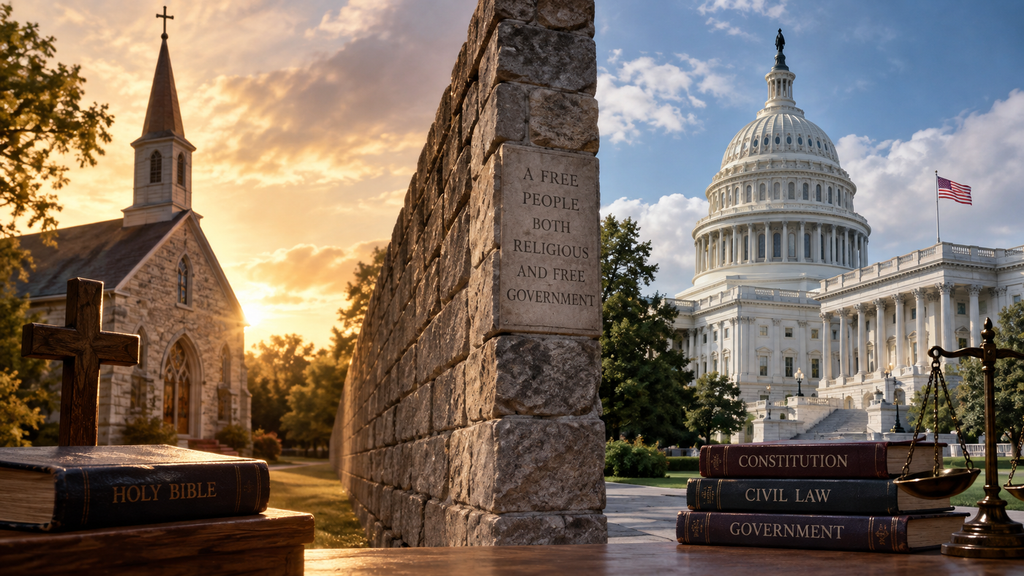
Americans have been arguing about the place of religion and government since before the constitution was written. Is this a Christian nation, or did the founders deliberately create a government that was not Christian? The question has never really gone away it has resurfaced in a 224-page draft report from President Trump’s Religious Liberty Commission.
The Founding Generation
The Declaration of Independence unquestionably assumes a divine source for human rights. But that is not the same thing as declaring that the United States is a Christian nation, particularly if “Christian nation” means a country whose government was founded upon Christianity, biblical law, or Christian doctrine.
We would be equally mistaken to portray the Declaration as an atheistic or thoroughly secular document. God is clearly present in its philosophical framework.
The more difficult question is: What kind of God? The Declaration never mentions Jesus Christ, Christianity, the Bible, salvation, the Trinity, the Church, the Gospel, or Christian revelation. Instead, its terminology, “Nature’s God,” “Creator,” “Supreme Judge,” and “divine Providence,” is broad enough to encompass traditional Christians, more rationalistic Christians, and people influenced by the Enlightenment and natural religion.
That appears intentional. The Declaration was a political statement intended to speak for thirteen colonies containing Anglicans, Congregationalists, Presbyterians, Quakers, Baptists, Catholics, and others. The National Archives describes its preamble as deliberately “universal in tone and scope.”
The phrase most often cited as evidence of a Christian founding, that all men are “created equal” and “endowed by their Creator” with unalienable rights, comes from the Declaration of Independence. It is a document Thomas Jefferson drafted in language borrowed heavily from Enlightenment natural rights philosophy, particularly John Locke’s.
The word Creator was compatible with the rational religious language favored by Jefferson and other enlightened thinkers, but it was hardly exclusive. An orthodox Christian could embrace the same language. What is significant is that the declaration does not identify the Creator specifically with Christianity or Christian doctrine.
Jefferson himself held famously unorthodox religious views and has been referred to by some as a deist. He later produced his own edited version of the Bible that removed its miracles. Benjamin Franklin’s religious views were also unorthodox by conventional Christian standards. Labeling individual founders simply as deist can obscure how complicated their beliefs actually were.
That is not to say Christianity was irrelevant to the founding generation. Many signers were devout, and Christian moral vocabulary saturated their writing. But the founders were not of one mind on religion, and they did not create a sectarian Christian statement.
The political argument was straightforward. Rights did not originate with government. Government existed to protect them, and a government that persistently violated them undermined its own claims of legitimate authority.
The Constitution Says Nothing About God
Whatever we may make of the Declaration’s phrasing, we should remember that it did not create the American government. The Constitution did, thirteen years later. The Constitution is conspicuously silent on the subject of God or Christianity.
Article VI bars any religious test for holding federal office, and the First Amendment forbids Congress from establishing a religion.
Nineteenth-century efforts to amend the Constitution to explicitly acknowledge God failed to gain traction. If the founding generation intended to build an officially Christian government, it’s odd they would leave it out of the document that established that government.
This doesn’t make the founding generation hostile to religion. Rather, it shows a constitutional design in which religious belief could flourish voluntarily but would not be the condition of citizenship, officeholding, or federal legal authority.
The Treaty
One of the most frequently cited founding-era statements comes from the 1797 Treaty of Tripoli. The English version submitted to the Senate declared that “the government of the United States of America is not in any sense founded on the Christian Religion.” The Senate approved the treaty and President John Adams signed it.
There is, however, an important complication. That famous sentence has no counterpart in the surviving Arabic text. How the English version came to contain the statement remains unexplained.
Even so, the fact that a Senate full of men who had lived through the founding felt no need to qualify or debate that sentence before ratifying it indicates they didn’t object to the wording.
The Same Argument, Two Hundred and Fifty Years Later
This argument resurfaced in 2026 around the report of the Religious Liberty Commission. The White House describes its membership as representing many religious and professional backgrounds. PBS has characterized the Commission as composed almost entirely of conservative Christians along with one orthodox rabbi.
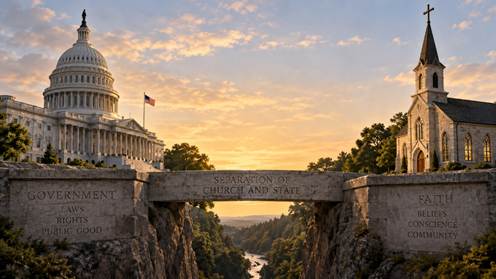
According to reporting from PBS and NBC News, the commission’s draft report argues for replacing the traditional “wall of separation” framing of church and state with the idea of religious liberty as a “bridge” connecting the two. It leans on the premise that the country was founded on Judeo-Christian or Christian principles.
Historical record is messier than either side of the modern controversy acknowledges. Religious ideas unquestionably influenced many of the founders. At the same time the constitution they produced did not establish Christianity as the basis of federal authority. Americans have been arguing about the significance of those two facts ever since.
Indeed, one of the remarkable achievements of the nation’s founding was that people whose religious beliefs differed substantially could agree upon the proposition that human beings possess rights that government did not give them and therefore government cannot legitimately take away.
That was Jefferson’s political point. For the purposes of the declaration, it is the source of those rights that matters. Defining the precise theology of the Creator does not.
Illustrations generated by author using ChatGPT
Sources
1. National Archives, Declaration of Independence, transcript. https://www.archives.gov/founding-docs/declaration-transcript
2. National Archives, Constitution of the United States, transcript. https://www.archives.gov/founding-docs/constitution-transcript
3. Americans United for Separation of Church and State, “A Word From John Adams: A 224-Year-Old Treaty Says the U.S. Was Not Founded as a Christian Nation.” https://www.au.org/the-latest/church-and-state/articles/a-word-from-john-adams-a-224-year-old-treaty/
4. American Quarterly (Johns Hopkins University Press), “Reading American Secularism in the 1797 Treaty of Tripoli.” https://muse.jhu.edu/article/758950/summary
5. The White House, Fact Sheet: President Donald J. Trump Establishes the Religious Liberty Commission. https://www.whitehouse.gov/fact-sheets/2025/05/fact-sheet-president-donald-j-trump-establishes-the-religious-liberty-commission
6. PBS News, coverage of the Religious Liberty Commission’s draft report. https://www.pbs.org/newshour/politics/watch-trump-receives-report-from-religious-liberty-commission-in-the-oval-office
7. NBC News, coverage of the Religious Liberty Commission’s draft report. https://www.nbcnews.com/politics/trump-administration/religious-commission-urges-bridges-church-state-sweeping-draft-report-rcna352015
8. American Humanist Association, statement on the Religious Liberty Commission report. https://americanhumanist.org/featured/trump-religious-liberty-commission-report-provides-pathway-to-christian-nationalism/
Leave a Reply