
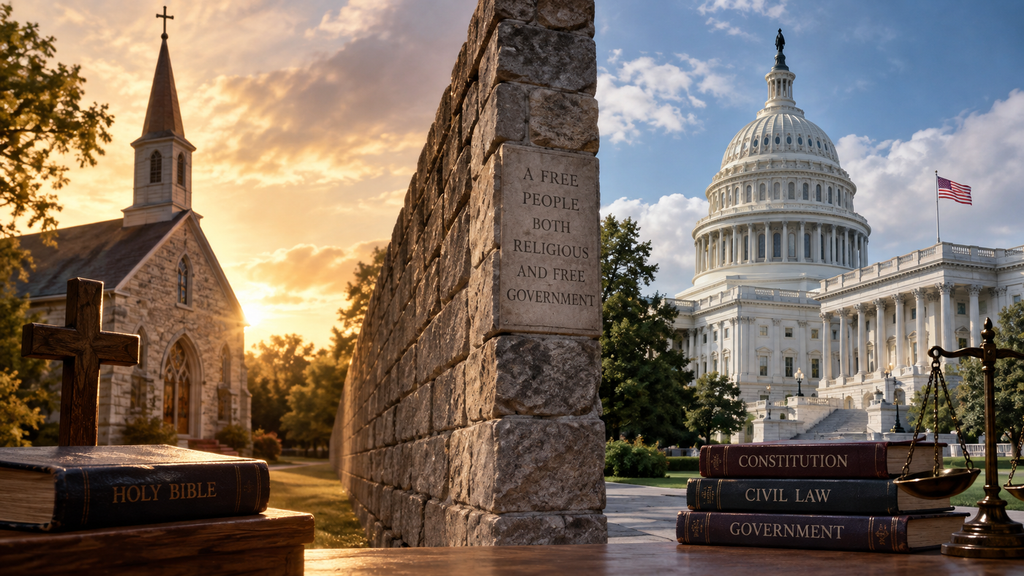
Americans have been arguing about the place of religion and government since before the constitution was written. Is this a Christian nation, or did the founders deliberately create a government that was not Christian? The question has never really gone away it has resurfaced in a 224-page draft report from President Trump’s Religious Liberty Commission.
The Founding Generation
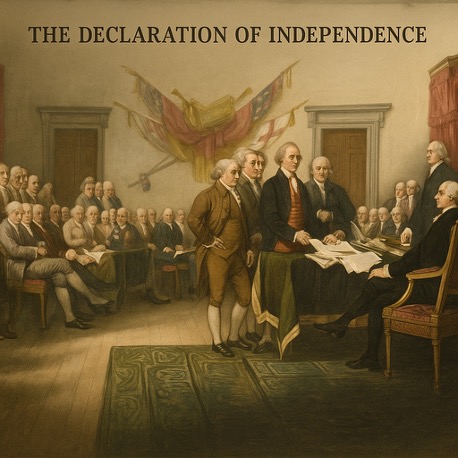
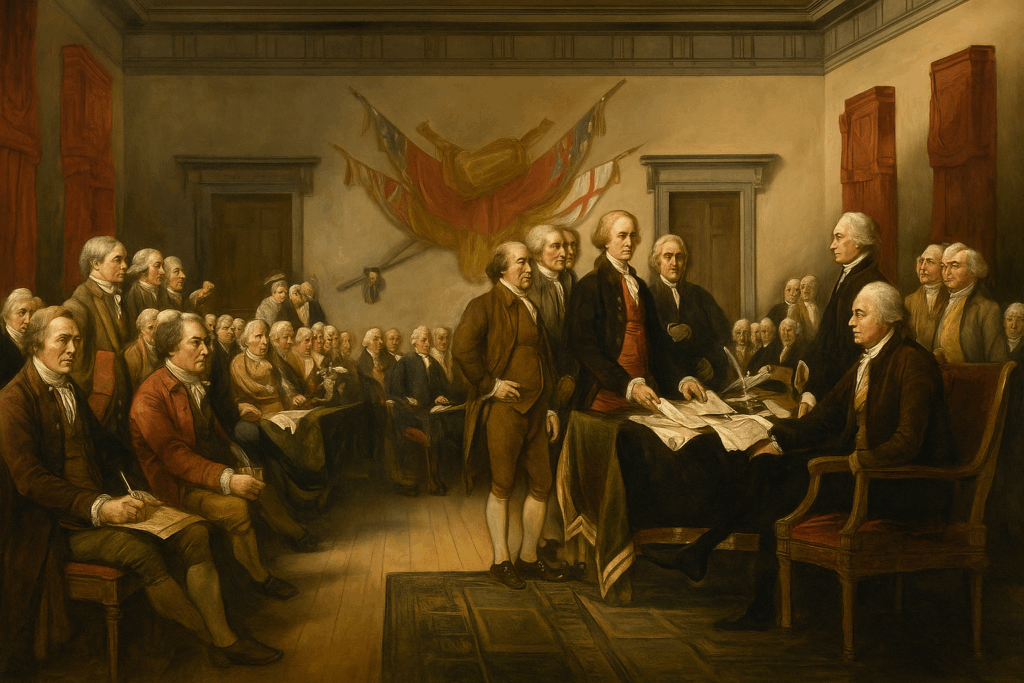
The Declaration of Independence unquestionably assumes a divine source for human rights. But that is not the same thing as declaring that the United States is a Christian nation, particularly if “Christian nation” means a country whose government was founded upon Christianity, biblical law, or Christian doctrine.
We would be equally mistaken to portray the Declaration as an atheistic or thoroughly secular document. God is clearly present in its philosophical framework.
The more difficult question is: What kind of God? The Declaration never mentions Jesus Christ, Christianity, the Bible, salvation, the Trinity, the Church, the Gospel, or Christian revelation. Instead, its terminology, “Nature’s God,” “Creator,” “Supreme Judge,” and “divine Providence,” is broad enough to encompass traditional Christians, more rationalistic Christians, and people influenced by the Enlightenment and natural religion.
That appears intentional. The Declaration was a political statement intended to speak for thirteen colonies containing Anglicans, Congregationalists, Presbyterians, Quakers, Baptists, Catholics, and others. The National Archives describes its preamble as deliberately “universal in tone and scope.”
The phrase most often cited as evidence of a Christian founding, that all men are “created equal” and “endowed by their Creator” with unalienable rights, comes from the Declaration of Independence. It is a document Thomas Jefferson drafted in language borrowed heavily from Enlightenment natural rights philosophy, particularly John Locke’s.
The word Creator was compatible with the rational religious language favored by Jefferson and other enlightened thinkers, but it was hardly exclusive. An orthodox Christian could embrace the same language. What is significant is that the declaration does not identify the Creator specifically with Christianity or Christian doctrine.
Jefferson himself held famously unorthodox religious views and has been referred to by some as a deist. He later produced his own edited version of the Bible that removed its miracles. Benjamin Franklin’s religious views were also unorthodox by conventional Christian standards. Labeling individual founders simply as deist can obscure how complicated their beliefs actually were.
That is not to say Christianity was irrelevant to the founding generation. Many signers were devout, and Christian moral vocabulary saturated their writing. But the founders were not of one mind on religion, and they did not create a sectarian Christian statement.
The political argument was straightforward. Rights did not originate with government. Government existed to protect them, and a government that persistently violated them undermined its own claims of legitimate authority.
The Constitution Says Nothing About God
Whatever we may make of the Declaration’s phrasing, we should remember that it did not create the American government. The Constitution did, thirteen years later. The Constitution is conspicuously silent on the subject of God or Christianity.
Article VI bars any religious test for holding federal office, and the First Amendment forbids Congress from establishing a religion.
Nineteenth-century efforts to amend the Constitution to explicitly acknowledge God failed to gain traction. If the founding generation intended to build an officially Christian government, it’s odd they would leave it out of the document that established that government.
This doesn’t make the founding generation hostile to religion. Rather, it shows a constitutional design in which religious belief could flourish voluntarily but would not be the condition of citizenship, officeholding, or federal legal authority.
The Treaty
One of the most frequently cited founding-era statements comes from the 1797 Treaty of Tripoli. The English version submitted to the Senate declared that “the government of the United States of America is not in any sense founded on the Christian Religion.” The Senate approved the treaty and President John Adams signed it.
There is, however, an important complication. That famous sentence has no counterpart in the surviving Arabic text. How the English version came to contain the statement remains unexplained.
Even so, the fact that a Senate full of men who had lived through the founding felt no need to qualify or debate that sentence before ratifying it indicates they didn’t object to the wording.
The Same Argument, Two Hundred and Fifty Years Later
This argument resurfaced in 2026 around the report of the Religious Liberty Commission. The White House describes its membership as representing many religious and professional backgrounds. PBS has characterized the Commission as composed almost entirely of conservative Christians along with one orthodox rabbi.
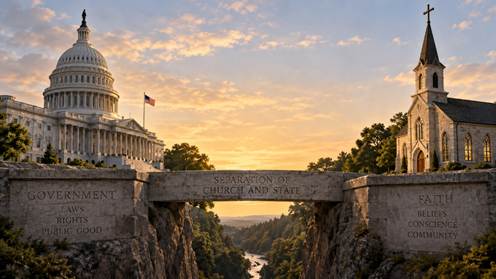
According to reporting from PBS and NBC News, the commission’s draft report argues for replacing the traditional “wall of separation” framing of church and state with the idea of religious liberty as a “bridge” connecting the two. It leans on the premise that the country was founded on Judeo-Christian or Christian principles.
Historical record is messier than either side of the modern controversy acknowledges. Religious ideas unquestionably influenced many of the founders. At the same time the constitution they produced did not establish Christianity as the basis of federal authority. Americans have been arguing about the significance of those two facts ever since.
Indeed, one of the remarkable achievements of the nation’s founding was that people whose religious beliefs differed substantially could agree upon the proposition that human beings possess rights that government did not give them and therefore government cannot legitimately take away.
That was Jefferson’s political point. For the purposes of the declaration, it is the source of those rights that matters. Defining the precise theology of the Creator does not.
Illustrations generated by author using ChatGPT
Sources
1. National Archives, Declaration of Independence, transcript. https://www.archives.gov/founding-docs/declaration-transcript
2. National Archives, Constitution of the United States, transcript. https://www.archives.gov/founding-docs/constitution-transcript
3. Americans United for Separation of Church and State, “A Word From John Adams: A 224-Year-Old Treaty Says the U.S. Was Not Founded as a Christian Nation.” https://www.au.org/the-latest/church-and-state/articles/a-word-from-john-adams-a-224-year-old-treaty/
4. American Quarterly (Johns Hopkins University Press), “Reading American Secularism in the 1797 Treaty of Tripoli.” https://muse.jhu.edu/article/758950/summary
5. The White House, Fact Sheet: President Donald J. Trump Establishes the Religious Liberty Commission. https://www.whitehouse.gov/fact-sheets/2025/05/fact-sheet-president-donald-j-trump-establishes-the-religious-liberty-commission
6. PBS News, coverage of the Religious Liberty Commission’s draft report. https://www.pbs.org/newshour/politics/watch-trump-receives-report-from-religious-liberty-commission-in-the-oval-office
7. NBC News, coverage of the Religious Liberty Commission’s draft report. https://www.nbcnews.com/politics/trump-administration/religious-commission-urges-bridges-church-state-sweeping-draft-report-rcna352015
8. American Humanist Association, statement on the Religious Liberty Commission report. https://americanhumanist.org/featured/trump-religious-liberty-commission-report-provides-pathway-to-christian-nationalism/
America at 250: A Revolution Remembered, Forgotten — or Rewritten?
By John Turley
On June 1, 2026
In Commentary, History
I’m old enough to remember the 200th anniversary of the American Revolution. Bicentennial symbols were everywhere — Liberty Bells, eagles, and that ubiquitous red, white, and blue stylized five-point star logo slapped on hats, T-shirts, socks, soft drink cups, beer cans, and even a special “Spirit of ’76” edition of the Ford Mustang II. Commemorative events were springing up everywhere, and people had full-blown bicentennial fever.
The 250th anniversary is a different animal entirely. Even the official name — Semiquincentennial — sounds like something you’d need a medical degree to pronounce. But the tongue-twisting label is the least of its problems.
The bicentennial came after a decade of national trauma: Vietnam, Watergate, and the civil rights struggles had left the country battered. By 1976, most Americans were ready to feel good about themselves again, and the bicentennial became a giant, colorful celebration of “American resilience.” The 250th arrives in a different kind of trauma — one that is arguably more confusing because it comes dressed as patriotism.
A Celebration Gets Complicated
While the 250th is being marked by numerous events, commemorations, and official proclamations, it has not yet captured the national imagination the way 1976 did. The official nonpartisan U.S. Semiquincentennial Commission, established by Congress in 2016 and supported by both George W. Bush and Barack Obama as Honorary Co-Chairs, has been working toward what it calls the “largest and most inclusive” anniversary celebration in American history. But its efforts have increasingly been overshadowed — and, critics argue, undermined — by a parallel White House effort with a very different philosophy about what American history should look like.
Shortly after taking office in January 2025, President Trump signed an executive order titled “Celebrating America’s 250th Birthday,” creating his own body — Task Force 250 — to coordinate anniversary plans and promising “a grand celebration worthy of the momentous occasion.” A full year of festivities was planned, beginning on Memorial Day 2025 and running through July 4, 2026. On paper, more attention on the anniversary sounds like good news. In practice, the story is more complicated.
When “Restoring History” Means Removing It
Two months after launching his anniversary task force, Trump signed a second executive order — this one titled “Restoring Truth and Sanity to American History” — directing Vice President Vance to eliminate what the order calls “divisive race-centered ideology” from Smithsonian museums, educational and research centers, and the National Zoo (the Zoo??). The Smithsonian, one of the world’s great repositories of American history, was accused by the president of having come “under the influence of a divisive, race-centered ideology” that portrayed “American and Western values as inherently harmful and oppressive.”
That executive order set off a chain of events that has complicated the 250th anniversary in ways the founding fathers would have found darkly ironic, given that the Revolution was, at its core, a fight against the arbitrary exercise of executive power.
At Philadelphia’s Independence National Historical Park — one of the most historically significant sites in the country — National Park Service employees abruptly removed exhibits about the nine people George Washington held in slavery while Philadelphia served as the nation’s capital. Passersby reportedly heard an employee repeating, “I’m just following orders” as the displays came down. The city of Philadelphia promptly sued the federal government, arguing that the removal violated a cooperative agreement for the site’s development.
This wasn’t an isolated incident. According to reporting from Poynter and PEN America, National Park Service employees were ordered to survey all signage and interpretive materials across the nation’s 400-plus parks and monuments, flagging anything “negative about either past or living Americans.” Exhibits about slavery, Indigenous history, women’s rights, and climate change were all swept into the review. At Fort Sumter in South Carolina — where the Civil War began — even a sign explaining the risks the site faces from rising sea levels was removed.
The Interior Department issued a November 2025 memo ordering National Park Service gift shops to remove items promoting DEI or “gender expression.” Free admission days that had previously honored Martin Luther King Jr. Day and Juneteenth were dropped; June 14 — Flag Day and President Trump’s birthday (does anyone thinks that’s a coincidence?) — was added instead.
Meanwhile, a proposed commemorative dollar coin design featured President Trump on the obverse and the words “Fight! Fight! Fight!” on the reverse — evoking the imagery from the July 2024 assassination attempt. The Commission of Fine Arts, whose members Trump dismissed in October 2025 and replaced with his own appointees, subsequently recommended the design.
The Money Problem
The nonpartisan America250 Commission hasn’t just faced ideological headwinds. It has also faced financial ones. By early 2026, the Commission had received only $25 million of its congressionally appropriated $150 million, with the remainder at risk of being redirected to Trump-aligned Freedom 250’s “Freedom Trucks” — six state-of-the-art mobile museums traveling the country telling a version of American history that aligns with the administration’s vision. Representative Bonnie Watson Coleman raised concerns about the funding diversion, though the Commission stated it had enough to continue its core programming.
What Actually Happened at Lexington and Concord
Against this backdrop, the 250th anniversary of the Battles of Lexington and Concord on April 19, 2025, became a preview of what the full anniversary might look like. The battle reenactments drew large crowds, along with protesters carrying signs reading “No Kings” and “Resist Like It’s 1775,” explicitly drawing parallels between opposition to King George III and what they saw as autocratic tendencies in current leadership.
Massachusetts Governor Maura Healey told the crowd at the North Bridge ceremony that “we see things that would be familiar to our Revolutionary predecessors — the silencing of critics, the disappearing people from our streets, demands for unquestioned fealty.” Whether one agrees with that characterization or not, the spectacle of Americans invoking the Revolution to oppose their own government at a Revolution commemoration is at minimum historically interesting — and arguably points to the enduring vitality of Revolutionary ideals.
Historians have noted that the Revolution itself was messier and more ambiguous than either side of today’s debate wants to acknowledge. As University of South Carolina professor Woody Holton observed, most colonists in April 1775 weren’t seeking independence — they wanted better treatment within the British Empire and a return to pre-1763 arrangements. The revolution was improvised, contentious, and full of people who disagreed about its meaning even while it was happening. Sound familiar?
The Founding Fathers Were Not a Monolith
Here is what is genuinely troubling about selectively sanitizing Revolutionary history: the founders themselves would not have recognized the sanitized version. George Washington, the hero of the Revolution, held people in slavery, including at the presidential residence in Philadelphia — the very site where exhibits were just torn down. Benjamin Franklin, who helped draft the Declaration of Independence, owned enslaved people and only became an abolitionist late in his life. Thomas Jefferson wrote “all men are created equal” while holding more than 600 people in bondage over his lifetime.
Removing this history doesn’t honor the founders. It patronizes them by pretending their contradictions didn’t exist — and it patronizes us by suggesting we can’t handle the full truth. Even they recognized the contradictions. The founders were brilliant, flawed, and human. That’s what makes the Revolution worth studying.
Resistance in the Courts and in the Institutions
It’s worth noting that the administration’s efforts have met significant resistance. Federal courts have blocked some removals. Scholars, activists, and historians have pushed back forcefully. A coalition of groups filed suit in February 2026 arguing that the Interior Department’s mandate to strip historical information from national parks violated the Administrative Procedure Act. Philadelphia’s lawsuit over the Washington slavery exhibit is ongoing.
Northwestern University historian Leslie M. Harris, author of five books on American slavery, has said that no previous presidential administration has interfered with historic sites in this way, and warned of a potential long-term consequence: public distrust of government-maintained historical sites, or outright avoidance of them.
What We Can Do
I wrote earlier about a friend on the West Virginia 250th committee who told me their initial meeting accomplished nothing and, almost two years later, they’ve had not had a further meeting. They have only just in the past few weeks announced their plans for America 250. That’s disappointing, but in some ways, it underscores the larger point: the commemoration of this anniversary is going to be shaped by whoever shows up.
Here in West Virginia, we showed what’s possible when citizens take the lead. In October 2024, without any state or national organizational or financial help, the City of Point Pleasant and the West Virginia Sons of the American Revolution organized a commemoration of the 250th anniversary of the Battle of Point Pleasant — a battle many consider a precursor to the Revolution. It worked. People came. History was honored.
We can do more of that. We don’t need to live in Massachusetts to commemorate Lexington and Concord. We don’t need federal approval to mark the signing of the Declaration of Independence, the Battle of Saratoga, or the crossing of the Delaware. We don’t need the government’s permission to tell complete history — including the parts about who was left out and who fought to be included anyway.
All across the country, individuals and small groups are working to recognize the revolution. In West Virginia, we’ve organized commemorations of the Boston Tea Party, the 250th anniversary of the founding of the Continental Navy and the Continental Marines, George Washington’s Birthday, and a special America 250 Memorial Day service at the West Virginia Veterans Memorial, all without any governmental support or funding. There have been presentations at local libraries and civic groups about the lives of average people during the time of the revolution, the origin of the American flag and even demonstrations of cooking and foods from the time of the revolution. If we had waited for state or national support these activities never would have happened. Just because your event may be small doesn’t mean it’s unimportant.
The Revolution, after all, was not a government program. It was a citizen uprising.
The Stakes
The American Revolution matters to world history precisely because it planted ideas — self-governance, the rule of law, the consent of the governed, the equality of all people before the law — that were genuinely radical ideas in 1776 and remain contested in much of the world today. Those ideas were aspirational when they were written. They remain aspirational now. The gap between the ideal and the reality is not a reason to hide the history; it is the history.
If the 250th anniversary is remembered primarily as a moment when the federal government selectively curated which parts of the founding era the public was allowed to encounter, that will itself become a significant historical footnote — and not a flattering one.
It will be our great shame if we allow the commemoration of an event so significant in both American and world history to be used — by anyone, of any political stripe — to divide us rather than to strengthen our common bond. The Revolution was imperfect, contentious, and incomplete. So is the republic it created. That is not a cause for despair. It is a call to engagement and improvement.
We the people. Still the operative phrase.
Illustration generated by author using ChatGPT.
—
Sources