Americans have been arguing about the place of religion and government since before the constitution was written. Is this a Christian nation, or did the founders deliberately create a government that was not Christian? The question has never really gone away it has resurfaced in a 224-page draft report from President Trump’s Religious Liberty Commission.
The Founding Generation
The Declaration of Independence unquestionably assumes a divine source for human rights. But that is not the same thing as declaring that the United States is a Christian nation, particularly if “Christian nation” means a country whose government was founded upon Christianity, biblical law, or Christian doctrine.
We would be equally mistaken to portray the Declaration as an atheistic or thoroughly secular document. God is clearly present in its philosophical framework.
The more difficult question is: What kind of God? The Declaration never mentions Jesus Christ, Christianity, the Bible, salvation, the Trinity, the Church, the Gospel, or Christian revelation. Instead, its terminology, “Nature’s God,” “Creator,” “Supreme Judge,” and “divine Providence,” is broad enough to encompass traditional Christians, more rationalistic Christians, and people influenced by the Enlightenment and natural religion.
That appears intentional. The Declaration was a political statement intended to speak for thirteen colonies containing Anglicans, Congregationalists, Presbyterians, Quakers, Baptists, Catholics, and others. The National Archives describes its preamble as deliberately “universal in tone and scope.”
The phrase most often cited as evidence of a Christian founding, that all men are “created equal” and “endowed by their Creator” with unalienable rights, comes from the Declaration of Independence. It is a document Thomas Jefferson drafted in language borrowed heavily from Enlightenment natural rights philosophy, particularly John Locke’s.
The word Creator was compatible with the rational religious language favored by Jefferson and other enlightened thinkers, but it was hardly exclusive. An orthodox Christian could embrace the same language. What is significant is that the declaration does not identify the Creator specifically with Christianity or Christian doctrine.
Jefferson himself held famously unorthodox religious views and has been referred to by some as a deist. He later produced his own edited version of the Bible that removed its miracles. Benjamin Franklin’s religious views were also unorthodox by conventional Christian standards. Labeling individual founders simply as deist can obscure how complicated their beliefs actually were.
That is not to say Christianity was irrelevant to the founding generation. Many signers were devout, and Christian moral vocabulary saturated their writing. But the founders were not of one mind on religion, and they did not create a sectarian Christian statement.
The political argument was straightforward. Rights did not originate with government. Government existed to protect them, and a government that persistently violated them undermined its own claims of legitimate authority.
The Constitution Says Nothing About God
Whatever we may make of the Declaration’s phrasing, we should remember that it did not create the American government. The Constitution did, thirteen years later. The Constitution is conspicuously silent on the subject of God or Christianity.
Article VI bars any religious test for holding federal office, and the First Amendment forbids Congress from establishing a religion.
Nineteenth-century efforts to amend the Constitution to explicitly acknowledge God failed to gain traction. If the founding generation intended to build an officially Christian government, it’s odd they would leave it out of the document that established that government.
This doesn’t make the founding generation hostile to religion. Rather, it shows a constitutional design in which religious belief could flourish voluntarily but would not be the condition of citizenship, officeholding, or federal legal authority.
The Treaty
One of the most frequently cited founding-era statements comes from the 1797 Treaty of Tripoli. The English version submitted to the Senate declared that “the government of the United States of America is not in any sense founded on the Christian Religion.” The Senate approved the treaty and President John Adams signed it.
There is, however, an important complication. That famous sentence has no counterpart in the surviving Arabic text. How the English version came to contain the statement remains unexplained.
Even so, the fact that a Senate full of men who had lived through the founding felt no need to qualify or debate that sentence before ratifying it indicates they didn’t object to the wording.
The Same Argument, Two Hundred and Fifty Years Later
This argument resurfaced in 2026 around the report of the Religious Liberty Commission. The White House describes its membership as representing many religious and professional backgrounds. PBS has characterized the Commission as composed almost entirely of conservative Christians along with one orthodox rabbi.
According to reporting from PBS and NBC News, the commission’s draft report argues for replacing the traditional “wall of separation” framing of church and state with the idea of religious liberty as a “bridge” connecting the two. It leans on the premise that the country was founded on Judeo-Christian or Christian principles.
Historical record is messier than either side of the modern controversy acknowledges. Religious ideas unquestionably influenced many of the founders. At the same time the constitution they produced did not establish Christianity as the basis of federal authority. Americans have been arguing about the significance of those two facts ever since.
Indeed, one of the remarkable achievements of the nation’s founding was that people whose religious beliefs differed substantially could agree upon the proposition that human beings possess rights that government did not give them and therefore government cannot legitimately take away.
That was Jefferson’s political point. For the purposes of the declaration, it is the source of those rights that matters. Defining the precise theology of the Creator does not.
Most people think of the Founding era as a time of stately deliberation — powdered wigs, quill pens, and gentlemanly debate. Yet beneath that polished surface existed another reality, one filled with political gossip, anonymous attacks, newspaper manipulation, patronage, espionage-like intelligence gathering, and organized partisan warfare.
Many leading Americans hoped the new republic would avoid the factionalism that had plagued European politics. George Washington famously warned against “the baneful effects of the spirit of party.” But from the moment the new federal government took shape in 1789, it became a battleground of competing visions, personal vendettas, and bare-knuckled political maneuvering
Two men who rarely get starring roles in the history books, John Beckley and Philip Freneau, were at the heart of it all. One was a former indentured servant who reinvented himself as America’s first professional campaign manager. The other was a Princeton-educated poet who turned journalism into a weapon. Working with Thomas Jefferson and James Madison, they helped shape the very concept of organized political opposition in the United States.
John Beckley: From Indentured Servant to Political Operative
John James Beckley was born on August 4, 1757, the son of obscure English parents, and was sent to Virginia in 1769 as an indentured servant. It is a remarkable origin story for a man who would go on to become one of the most consequential political operatives of the early republic. His master was John Clayton, clerk of court for Gloucester County. It was in Clayton’s household that Beckley developed his extraordinary clerical skills, the tools that would eventually open every door ahead of him.
Prior to earning a position with Congress, Beckley worked in various clerking jobs, including clerk of the committee of trade of the Virginia House of Delegates, clerk of the Virginia Senate, and clerk of the Virginia House of Delegates. In the 1780s, he was elected mayor of Richmond three times. He failed to win the clerkship of the Constitutional Convention but was successful in gaining the position of secretary of the Virginia ratifying convention. That last role put him in the room where Virginia’s crucial debate over ratification unfolded. It was an experience that shaped his understanding of how political outcomes are manufactured, not argued into existence.
Although Beckley was just a boy when he came to Virginia as an indentured servant, he rose to become a potent force in Virginia politics. Beckley and Jefferson began their political partnership during the American Revolution. Though never close personal friends, Beckley became a key political supporter and adviser to Jefferson. This was the relationship that would define his career. Jefferson provided the vision. Beckley provided the machinery.
Beginning April 1, 1789, Beckley was elected Clerk of the United States House of Representatives to the first four Congresses. As the very first person to hold that office, he was responsible for establishing its procedures from scratch. He prepared the rules for the Office of Clerk, as well as the parliamentary rules for the entire House, and established the procedural system for House operations. It was a position of enormous institutional power, and Beckley exploited every inch of it.
Philip Freneau: Poet, Privateer, and Pamphleteer
Philip Freneau came from a very different world. He was born on January 2, 1752, in New York City, the oldest of five children of Huguenot wine merchant Pierre Freneau and his Scottish wife. He attended the College of New Jersey, later renamed Princeton University, where he studied under John Witherspoon. Princeton in the 1760s and 1770s was a hotbed of pre-revolutionary sentiment, and Freneau absorbed it all.
At Princeton, Freneau was close friends with James Madison, and this relationship led to his co-founding the National Gazette with Madison and Thomas Jefferson. He graduated in 1771 and immediately found himself torn between the literary life and the political turmoil swirling around him. After graduating he tried teaching and briefly pursued theology, neither of which suited his restless temperament.
When the Revolution arrived, Freneau threw himself into it, literally. He eventually became a crew member on a revolutionary privateer and was captured along with the rest of the crew.
He was held on a British prison ship for about six weeks. This experience, which nearly killed him, was detailed in his work The British Prison Ship. It prompted many more patriotic and anti-British writings throughout the revolution and after. For this, he was nicknamed “The Poet of the American Revolution.”
After the war, Freneau alternated between seafaring and journalism. By 1790, he had published two collections of poetry. He was celebrated for his verse and respected for his Revolutionary credentials. Soon Jefferson and Madison came calling with a proposition that would redirect his entire career.
The War of the Gazettes
By 1790, the new federal government was riven with ideological conflict. Alexander Hamilton, as Secretary of the Treasury, had pushed through an ambitious financial program that included assumption of state debts, a national bank, and an excise tax. Jefferson and Madison viewed these proposals as a dangerous consolidation of federal power and a gift to merchant and financial elites. Madison and John Beckley began organizing a party to oppose Hamilton and his allies, whom Jefferson derisively referred to as “stock jobbers.” This “Anti-Administration” faction became what later was called the Democratic-Republican Party.
The Federalists already had their press organ, the Gazette of the United States. It was edited by John Fenno and backed by Hamilton. Jefferson and Madison needed someone with a sharp pen and a fighting spirit to run a counter-operation.
Freneau was exactly that man. He was strongly anti-Federalist and skilled at using wit, ridicule, and irony in his poetry and prose to attack his opponents. At times he would at times use sheer blunt force in his writing to make a strong point.
In 1791, encouraged by James Madison and others, Jefferson hired Freneau as a translating clerk for the State Department. The salary was a modest $250 a year. The position was largely fiction. Jefferson was criticized for hiring Freneau as a translator, even though he spoke no foreign languages except French, in which Jefferson was already fluent. Freneau accepted this undemanding position, which left him free time to head the Democratic-Republican newspaper Jefferson and Madison envisioned.
Jefferson leaked information to Freneau by leaving items out in his office, which Freneau was then able to access with his key. Jefferson also provided financial support to the National Gazette by giving Freneau State Department printing contracts and urging others to subscribe to the newspaper. James Madison, then a congressman for Virginia, contributed at least 18 anonymous articles to the paper — a standard practice of the day.
President Washington himself grew deeply frustrated with the increasingly toxic political climate. Although he tried to remain above party conflict, he came to resent the Republican newspaper attacks upon his administration as he believed them to be personal insults. Washington eventually concluded that Jefferson was surreptitiously encouraging these assaults through allies such as Freneau.
John Beckley was busy trying to form a barrier against what Republicans called John Fenno’s “monarchism.” Beckley recruited subscribers, coordinated with Republican allies in multiple states, and used his insider access to Congress to channel information into the opposition press.
The National Gazette was read widely, with leading Republicans such as John Hancock and Samuel Adams promoting it in Massachusetts, while others ensured that copies of the newspaper were delivered to the frontier. Articles from the National Gazette were reproduced in other Republican newspapers around the country.
Washington was irritated, reportedly complaining to friends about “that Rascal Freneau.” Jefferson, for his part, later credited Freneau’s paper with having saved the Constitution from sliding toward monarchy — revealing just how seriously the Republicans took the threat they believed Hamilton represented.
Hamilton Fights Back — and Exposes His Own Scandal
Hamilton was not a man who absorbed attacks quietly. He tried to silence the National Gazette through a letter published on August 4, 1792, in the Gazette of the United States, in which he criticized Freneau for attacking the government while receiving a government salary and called on Jefferson to resign. Jefferson stood by Freneau, though the pressure eventually forced Freneau to surrender his State Department position, dealing a financial blow to the paper.
But the most damaging episode for the Federalists wasn’t the press war, it was the Reynolds affair. In 1791, Hamilton began a romantic affair with Maria Reynolds, a married woman. Her husband, James Reynolds, soon discovered the affair and, rather than try to stop it, decided to profit from the situation by extorting money from Hamilton.
When congressional investigators, including Senator James Monroe, confronted Hamilton with evidence of payments to James Reynolds, Hamilton confessed to the affair to prove the money was hush money, not financial speculation. The investigators agreed to keep the matter private.
What happened next illustrated just how ruthless the early republic’s political culture could be. Monroe made a copy of the incriminating letters and sent them to Thomas Jefferson, Hamilton’s chief adversary. John Beckley, as Republican clerk of the House of Representatives, may also have surreptitiously copied them. It remains unclear whether Jefferson or Beckley was ultimately responsible for leaking the materials to journalist James Callender, who published the story in 1797.
Hamilton was forced to issue a lengthy public pamphlet admitting to the affair in order to disprove the financial speculation charges. It was a devastating personal and political blow that permanently ended any realistic hope he had of reaching the presidency.
The 1796 Campaign: America’s First Professional Political Operation
Beckley’s most audacious performance came in the presidential election of 1796, when Jefferson ran against John Adams. Beckley operated as the nation’s first political party manager, organizing the Pennsylvania campaign effort to elect Thomas Jefferson president of the United States.
In the 1796 presidential election there were no pre-printed ballots. Voters were expected to arrive at the polls with a slip of paper, or “ticket”, on which they had written the name of their preferred candidate. Printed tickets were not allowed. Beckley blanketed the state with agents who passed out 30,000 hand-written tickets for Jefferson electors.
Historians consider Beckley to be one of the first American professional campaign managers, and his techniques were quickly adopted in other states. He also invented or popularized other modern campaign methods such as mass distribution of pamphlets, coordinated messaging across multiple newspapers, and systematic grassroots voter outreach.
Jefferson lost narrowly to Adams, and the Federalists made Beckley pay for his open partisanship. He lost his job as clerk of the House of Representatives following the Federalist victories in the elections of 1796. It was a stark reminder that the clerkship, which Beckley had treated as a partisan instrument, was not yet insulated from electoral politics.
Aftermath and Legacy
The National Gazette collapsed in late 1793. Freneau’s loss of his State Department salary, combined with unpaid subscriptions and the economic devastation caused by a yellow fever epidemic in Philadelphia, proved to be more than the paper’s stretched finances could handle. Freneau returned to New Jersey and spent his remaining decades alternating between seafaring, farming, and sporadic literary work. He died in 1832, frozen to death in a blizzard near his home in Monmouth County — a fitting, if grim, end for a man who had spent his whole life in storms.
Beckley fared better, at least temporarily. When Jefferson won the presidency in 1800, Beckley was reelected as clerk of the House of Representatives and also secured the newly created title of Librarian of Congress. It was a fitting reward for the man who had done as much as anyone to put Jefferson in office. He died in Washington in 1807.
What Beckley and Freneau built together — with Jefferson and Madison providing the strategic direction — was genuinely new. The combination of a dedicated partisan press, a professional ground-level campaign organization, coordinated messaging, and the willingness to weaponize personal scandals established patterns that American politics has never really abandoned. Neither man is a household name today, but the infrastructure they pioneered is very much with us.*
*Though few current residents recognize it, Beckley, West Virginia was named for John Beckley.
Image generated by author using ChatGPT.
Sources
West Virginia Encyclopedia — John Beckley. Encyclopedia of West Virginia History and Culture. https://www.wvencyclopedia.org/entries/390
Quill Project — John Beckley Biography. https://www.quillproject.net/person/4606
Library of Congress Information Bulletin — “First Librarian Featured in New Book” (1996). https://www.loc.gov/loc/lcib/9610/beckley.html
Dictionary of Virginia Biography — John James Beckley. Library of Virginia. https://old.lva.virginia.gov/public/dvb/bio.asp?b=Beckley_John_James
U.S. House of Representatives History, Art & Archives — BECKLEY, John. https://history.house.gov/People/Detail/38343
Wikipedia — John J. Beckley. https://en.wikipedia.org/wiki/John_J._Beckley
Library of Congress — John James Beckley (1757–1807). https://www.loc.gov/item/n84136150/john-james-beckley-1757-1807/
Wikipedia — Philip Freneau. https://en.wikipedia.org/wiki/Philip_Freneau
Poetry Foundation — Philip Freneau. https://www.poetryfoundation.org/poets/philip-freneau
Britannica — Philip Freneau. https://www.britannica.com/biography/Philip-Freneau
Founders Online, National Archives — Philip Freneau to Thomas Jefferson, 8 April 1809 (with editorial note). https://founders.archives.gov/documents/Jefferson/03-01-02-0104
Newspapers.com — National Gazette archive and history. https://www.newspapers.com/paper/national-gazette/32593/
Library of Congress — National Gazette (Philadelphia), 1791–1793. https://www.loc.gov/item/sn83025887/
Founders Online, National Archives — Origins of Freneau’s National Gazette, 25 July 1791 (editorial note). https://founders.archives.gov/documents/Madison/01-14-02-0046
Founders Online, National Archives — Jefferson, Freneau, and the Founding of the National Gazette (editorial note). https://founders.archives.gov/documents/Jefferson/01-20-02-0374-0001
Wikipedia — Jeffersonian Democracy. https://en.wikipedia.org/wiki/Jeffersonian_democracy
Wikipedia — First Party System. https://en.wikipedia.org/wiki/First_Party_System
Wikipedia — Federalist Party. https://en.wikipedia.org/wiki/Federalist_Party
Smithsonian Magazine — “Alexander Hamilton’s Adultery and Apology.” https://www.smithsonianmag.com/history/alexander-hamiltons-adultery-and-apology-18021947/
New-York Historical Society — The Reynolds Pamphlet. https://www.nyhistory.org/exhibitions/reynolds-pamphlet
I’ve been a member of the Sons of the American Revolution for quite some time now. At the beginning of April, I started looking around for a Memorial Day event that we could join. I had assumed that my hometown of Charleston WV, being the state capital, would surely have an event since it is the 250th anniversary of the Declaration of Independence. I was surprised to find that none was planned.
I believed that it was especially important that a Memorial Day service be held here because West Virginia has, since World War II, one of the highest per capita rates of military service and combat casualties in the country. So, another SAR member and I got together, and we planned our own event and arranged for it to be held on the state capitol grounds. At the end of our service, I looked out at the group that was gathered: there was no right or left, there was no red or blue, there was no conservative or liberal. There were only proud Americans who had come together to honor our country, its veterans and its history.
Americans disagree about almost everything these days. Politics, religion, education, history, and even the meaning of patriotism have all become subjects of bitter debate. Too often, we define ourselves more by the groups we oppose than by the country we share.
Yet there are still opportunities to remember that before we were Republicans or Democrats, conservatives or progressives, we were Americans. The ongoing 250th Anniversary of the Revolutionary Era offers one of those rare opportunities to express what we share, not how we differ.
The semiquincentennial should be far more than fireworks, parades, and historical reenactments. It should be an invitation to rediscover the remarkable story we all inherited. The American Revolution was not perfect. The nation it created was imperfect from the beginning, carrying the stain of slavery, denying women equal rights, and often failing to live up to its own ideals. Those shortcomings do not erase the extraordinary achievement of creating a republic founded on the revolutionary belief that legitimate government derives its authority from the consent of the governed.
The founders left us more than a nation. They left us a challenge. Every generation has been asked to move the country a little closer to the principles expressed in the Declaration of Independence—that all people are created equal and possess inherent rights that no government should take away. Those words have inspired abolitionists, suffragists, civil rights leaders, immigrants seeking freedom, and millions of ordinary citizens who believed America could become better than it was.
That is a heritage worth celebrating together.
Organizations devoted to civic life have an important role to play in that celebration. Groups such as the Sons of the American Revolution, the Daughters of the American Revolution, the American Legion, Rotary clubs, Civitan clubs, veterans’ organizations, scouting groups, historical societies, libraries, museums, churches, and countless other local groups have spent decades preserving history, encouraging volunteerism, supporting education, and strengthening their communities. While each has its own mission and traditions, they all remind us that citizenship is more than voting every few years. It is an ongoing commitment to serving neighbors and improving the places where we live.
These organizations also offer something increasingly rare in modern America: opportunities for people with different political views to work side by side on practical goals. A community service project, a scholarship program, a veterans’ memorial, a food drive, or a history program rarely asks participants how they voted. It asks only if they are willing to help.
That is a lesson our country desperately needs. Social media and cable television often reward outrage. Algorithms profit by convincing us that our fellow Americans are enemies rather than neighbors. It becomes easy to believe that our differences outweigh everything we have in common.
History tells a different story. Americans have survived fierce political battles before. We have argued over the Constitution, endured civil war, struggled through economic depression and assassinations, fought world wars, and confronted profound disagreements about civil rights and social change. Our history has never been one of perfect unity. Instead, it has been a continuing effort to find common purpose despite deep disagreements.
The Revolution itself offers an example. The thirteen colonies differed enormously in religion, economy, geography, and culture. New England merchants, Virginia planters, Pennsylvania farmers, and South Carolina traders often had conflicting interests. Yet they discovered that some principles were more important than their differences. Their unity was never complete, but it was sufficient to build a nation. We face no less important a challenge today.
The 250th anniversary should encourage every community to host public readings of the Declaration of Independence, historical lectures, concerts, service projects, naturalization ceremonies, veterans’ recognitions, student essay contests, and volunteer events that welcome everyone. These occasions should not become platforms for partisan speeches. They should remind us that our history belongs to all Americans.
Celebrating our shared heritage does not require us to ignore the darker chapters of our past. Mature patriotism is honest enough to acknowledge failures while remaining grateful for the ideals that allowed those failures to be challenged and corrected. A confident nation can tell its whole story without either whitewashing its mistakes or denying its accomplishments.
Perhaps that is the greatest gift the 250th anniversary can offer is reminding us that America has always been a work in progress. Each generation inherits both the nation’s achievements and its unfinished work. If we can gather to honor the courage, sacrifice, and aspirations of those who came before us, perhaps we can rediscover something that has become increasingly scarce — the ability to see one another first as fellow citizens.
Our common heritage cannot solve every political disagreement. It will not erase ideological differences or end heated debates about the country’s future. Nor should it. Democracy depends upon vigorous debate. But it also depends upon something deeper — a shared commitment to our republic and our active participation as citizens. We need to become informed participants in our society and we need to vote and encourage others to vote.
As we celebrate America’s 250th birthday, the greatest act of patriotism is not winning another political argument. It is remembering that despite our many differences, we remain participants in the same remarkable American experiment. If civic organizations, veterans’ groups, historical societies, schools, churches, and local communities can help us rediscover that simple truth, they will have performed one of the greatest public services imaginable.
The founders gave us a republic, and they challenged each generation to preserve it and to improve it. Two hundred and fifty years later, that responsibility belongs to all of us. We must not fail.
Every vaccine the United States has ever rolled out has arrived with a shadow twin: a countermovement insisting the shot poses more danger than the disease it prevents, or that no government has the right to demand it. That pattern predates the country itself, and it has recurred with almost eerie consistency across three centuries — from the smallpox pustules of colonial Boston to the mRNA vials of 2021.
Colonial Boston and Smallpox
The story usually begins in Boston in 1721, during the sixth smallpox epidemic to strike the city since its founding. A ship called the Seahorse arrived from the Caribbean that April carrying a sailor with active smallpox, and within weeks the disease was moving through a city of roughly 11,000 people. By the time the epidemic burned out the following year, more than 6,000 Bostonians had been infected and about 850 had died.
The remedy that split the town in two was not vaccination in the modern sense but variolation, or inoculation — deliberately introducing live smallpox matter into a small cut in the skin, on the theory that a controlled, minor case would produce immunity without the risk of the full-blown disease. The technique had circulated for generations across West Africa, the Ottoman Empire, and Asia, and it reached Boston through the injustice of slavery. The Puritan minister Cotton Mather learned of it from Onesimus, a man he held in bondage, who described having undergone the procedure himself in Africa. Mather corroborated the account with other enslaved Africans in Boston and read reports out of Constantinople before becoming inoculation’s loudest champion.
Physician Zabdiel Boylston put the idea into practice, inoculating his own son and two enslaved members of his household first, then expanding the program despite fierce opposition. The city’s medical establishment largely revolted. Dr. William Douglass, one of the few Bostonians who actually held a medical degree, led the case against inoculation on grounds that ranged from the religious objection, that deliberately spreading disease usurped divine providence, to a reasonable-for-the-time scientific worry that the practice itself was seeding new outbreaks. The argument did not stay academic. Someone threw a lit grenade through Mather’s window that November, with a note attached reading, in essence, that he could inoculate himself with the bomb. It failed to detonate.
The case against inoculation was never purely religious or clinical; it was tangled up with its origin. Opposition writers repeatedly invoked its African and Ottoman source as grounds for distrust, treating its foreign, non-Christian lineage as evidence of danger apart from any medical argument. One Boston pamphleteer asked why residents should “cherish the cruel Blood of Africa or Asia” in their bodies, and a London critic writing a decade later dismissed inoculation as a “barbarous and dangerous Invention” imported from Turkey that had wrought “Havock and Slaughter” once it took hold. Because the technique reached Boston through Onesimus, the racial dimension of the debate was impossible to separate from the medical one — critics were rejecting a treatment in part because of who had brought it, not because of what it did.
What makes 1721 more than a historical curiosity is that Boylston and his allies did something close to a clinical study. They tallied outcomes among the inoculated against outcomes among those who caught smallpox naturally, and the inoculated group fared markedly better. That comparison helped slowly tip opinion in inoculation’s favor over the following decades. By the time George Washington ordered mandatory inoculation of the Continental Army in 1777, the practice — though still controversial — had become an accepted tool of public health.
The Gilded Age Leagues: Liberty, Quackery, and the Courts
Edward Jenner’s cowpox vaccine, introduced in 1796, eventually replaced variolation as the standard smallpox prevention. As vaccination spread across the Atlantic world through the nineteenth century, so did organized resistance. Britain passed an 1853 law making infant vaccination compulsory, and an 1867 act extended the mandate to age fourteen with real penalties attached for refusal. Britons who objected on religious, medical, or libertarian grounds organized the Anti-Vaccination League and, in 1867, the Anti-Compulsory Vaccination League, and within a few years it claimed over a hundred branches and roughly 10,000 members.
The British campaigner William Tebb carried that movement across the Atlantic. Following Tebb’s visit, Americans opposed to compulsory vaccination founded the Anti-Vaccination Society of America in 1879, and the New England Anti-Compulsory Vaccination League followed in 1882. These organizations drew on a mix of motives that will sound familiar to a modern reader: a libertarian objection to state intrusion into personal and parental decisions, religious conviction that disease and its prevention were matters for providence, and — more cynically — the financial interests of the era’s patent-medicine sellers and homeopaths, whose loosely regulated business model was directly threatened by a state-endorsed, evidence-based alternative.
The movement’s grievances were not entirely invented. In 1901, contaminated diphtheria antitoxin killed thirteen children in St. Louis, and contaminated smallpox vaccine killed several more in Camden, New Jersey, in the same year. Congress responded with the Biologics Control Act of 1902, the first federal law requiring licensure and safety standards for vaccine manufacturers — an early ancestor of the FDA’s modern oversight role. Those tragedies, however, did not settle the legal question of whether a state could force the issue. That came in 1905, when the Supreme Court decided Jacobson v. Massachusetts, upholding a Cambridge ordinance that fined residents who refused smallpox vaccination during an outbreak. The Court held that individual liberty was not absolute and could yield to a state’s power to protect public health — the first Supreme Court ruling on the subject, and one still cited today in disputes over compulsory vaccination and other public health mandates.
The ruling galvanized rather than pacified the opposition. Three years later, in 1908, opponents founded the Anti-Vaccination League of America in Philadelphia, built on the principle — in the League’s own words — that health was nature’s greatest safeguard against disease and that no state had the right to demand its impairment. It had the stated goal of abolishing what it called oppressive medical laws. Charles Higgins, one of the League’s most prolific pamphleteers, published tracts like his 1912 broadside “Open Your Eyes Wide!” arguing that vaccination was both dangerous and a violation of fundamental freedom. When Texas tried to require vaccination for public school attendance, the League’s arguments resurfaced in Zucht v. King, a 1922 case in which the Supreme Court again sided with the state.
Polio and The Vaccine Disasters of the 20th Century
By the mid-twentieth century, American vaccine skepticism had a new source of fuel, manufacturing failures serious enough to validate the movement’s oldest fear, that the shot itself might cause the disease. On April 12, 1955, officials announced that Jonas Salk’s inactivated polio vaccine, tested in a trial of 1.8 million children, was safe and effective, and the federal government licensed five manufacturers within days to begin mass production. One of them, Cutter Laboratories of Berkeley, California, shipped batches in which the virus-inactivation process had failed, leaving live, virulent polio virus in vaccine given to roughly 200,000 children across five states. An estimated 40,000 developed abortive polio, 200 were left with some degree of paralysis, and at least ten died. The program was suspended within weeks, federal oversight of vaccine manufacturing was overhauled, and vaccination resumed that fall under tighter controls.
The Cutter Incident became a formative episode in the history of American vaccine regulation and it had a lasting effect: a generation of parents who had watched the worst-case scenario for the trustworthiness of vaccines play out on the evening news, and that memory did not fade quickly.
Two decades later, a different kind of failure struck the flu vaccine. In early 1976, an Army recruit at Fort Dix, New Jersey, died of an influenza strain resembling the one responsible for the catastrophic 1918 pandemic. Fearing a repeat, the Ford administration pushed Congress to fund a crash national vaccination campaign, and nearly 43 million Americans were vaccinated within about ten weeks — an extraordinary logistical feat. The anticipated pandemic never arrived. Worse, as vaccinations proceeded, epidemiologists began detecting a modest but real increase in Guillain-Barré syndrome, a rare autoimmune paralytic condition, among recipients — roughly one additional case per 100,000 doses by later estimates. The program was suspended in December 1976, the CDC director was fired on live television, and the New York Times dubbed the whole affair a “fiasco,” a label that stuck for decades.
The Flu Shot’s Persistent Image Problem
Unlike smallpox or polio vaccination, the annual flu shot has never fully shaken a reputation for being optional, unpleasant, and only modestly effective in any given year. This is largely because the vaccine’s composition is re-engineered annually against strains predicted months in advance. That combination of a recurring injections, a variable and sometimes underwhelming efficacy rate, and the folk memory of 1976 has kept flu vaccination rates well below public health targets in most seasons, hovering in recent years around half of American adults, with substantial swings by age, region, and political affiliation. There is still the belief among some groups that the vaccine itself can cause flu even though flu vaccines do not contain live virus and cannot cause the disease.
COVID-19: An Old Argument at Unprecedented Speed
The COVID-19 pandemic compressed a century of vaccine controversy into about eighteen months. The mRNA vaccines developed by Pfizer-BioNTech and Moderna, along with a viral-vector vaccine from Johnson & Johnson, received emergency authorization by early 2021 after a development timeline that was, by historical standards, astonishingly fast. It was a point public health officials framed as a triumph of scientific investment and one that vaccine skeptics framed as a reason for caution. By September 2021, about 62 percent of Americans age twelve and older had received at least one dose, but demand had already begun slowing well before the country approached anything like universal coverage.
What followed diverged from earlier vaccine controversies in one important respect, hesitancy did not fade as more safety data accumulated, and in some respects it hardened. One national longitudinal study found that COVID-19 vaccine refusal actually rose from about 41 percent of adults in 2021 to nearly 45 percent in 2022. Even as overall vaccination coverage climbed, belief in the vaccine’s broader social benefit fell sharply, from roughly 48 percent to 25 percent. Parental hesitancy about vaccinating children against COVID-19 rose by nearly 16 percentage points in just nine months of 2021 and 2022, notably concentrated among white and rural parents, a pattern that cut against the demographic profile of vaccine resistance in earlier eras of American history. By the 2025–26 respiratory virus season, CDC surveillance found that only about 16 percent of American adults had received that season’s COVID-19 vaccine, with somewhat higher uptake — about 31 percent — among adults sixty-five and older, who face the greatest risk from the disease.
COVID-19 did not create vaccine skepticism, but it sharply politicized and enlarged the anti-vaccine movement by tying vaccination to partisan identity, distrust of government and public-health institutions, and debates over mandates, individual liberty, and pandemic restrictions. Political leaders, partisan media, and online networks often framed vaccination less as a medical decision grounded in evidence than as a symbol of cultural allegiance or resistance to perceived government overreach. Anti-vaccine activists used that environment to spread misinformation and reach audiences far beyond earlier disputes over childhood immunizations. The result was a more organized “health freedom” politics in which skepticism about COVID-19 vaccines could spill over into opposition to other routine vaccines, making public health a continuing front in America’s broader political polarization.
The pandemic-era pattern echoes several of its historical predecessors at once: distrust of a fast-moving federal program (echoing 1976), suspicion of a technology many found unfamiliar and difficult to evaluate (echoing the original inoculation debates of 1721), and a fusion of libertarian and religious objection to government mandates (echoing the Anti-Vaccination League of America a century earlier).
A Recurring American Argument
Over the last 50 years, advocacy groups have questioned the growing number of childhood vaccines and raised concerns about vaccine ingredients, scheduling, and possible long-term effects. The movement gained momentum after publication in 1998 of a now-retracted paper by Andrew Wakefield that falsely suggested a link between the measles-mumps-rubella (MMR) vaccine and autism. Numerous large studies subsequently found no evidence supporting such a connection, and investigations revealed ethical violations and scientific misconduct in Wakefield’s work, but the damage was done and the foundation was laid for the modern anti vaccination movement.
Read across three centuries, American vaccine resistance is not one continuous movement so much as the same underlying argument recurring in new costumes. It is a tension between collective protection and individual or parental autonomy, sharpened at each turn by episodes — some tragic and real, like Cutter and the 1976 swine flu campaign, some largely fabricated, like William Tebb’s invented nineteenth-century casualty statistics — that gave skeptics evidence, or the appearance of it, to point to. The debate has never been resolved so much as relitigated, generation after generation, against whatever the era’s most feared disease happens to be.
Disclaimer: The author writes independently. The views expressed here are his own and are not made on behalf of, and should not be attributed to, any hospital, university, or other institution with which he is affiliated. This article is a work of historical journalism, not medical advice.
Nobody plans for a myth. The Lost Cause grew out of a very specific and very human problem: how do you explain to a grieving, ruined society that the cause it sacrificed everything for was not just defeated but morally indefensible? Roughly eighteen percent of white Southern men of military age died fighting for the Confederacy, an almost unfathomable toll for any society to absorb. For the widows, mothers, and veterans left behind, the idea that all of that loss had been in service of preserving slavery was, as one historian has put it, simply unthinkable.
Former Confederates faced the psychological and political task of explaining catastrophic loss, human devastation, and the failure of a slaveholding social order they had claimed was divinely sanctioned and constitutionally sound. So, a different story took shape, and it took shape fast. Even before the war had formally ended, Confederate leaders were already laying the rhetorical groundwork. In his farewell address to the Army of Northern Virginia the day after Appomattox, Robert E. Lee thanked his men for four years of “unsurpassed courage and fortitude,” framing the surrender as a matter of being overwhelmed by superior numbers and resources rather than a defeat on the merits of the cause itself.
The term “Lost Cause” itself entered print in 1866, when the Richmond journalist Edward Pollard published a book titled The Lost Cause: A New Southern History of the War of the Confederates. Pollard’s argument was strategic rather than sentimental. Having lost the war on the battlefield, he wrote, the South still had a “war of ideas” left to fight, and that war could still be won.
At its core, The Lost Cause is less a historical interpretation than a civil religion and propaganda project, designed to preserve white Southern honor and racial hierarchy under new conditions. It is hard to overstate how much that single phrase came to shape the next century and a half of American memory.
Pillars of a Comforting Fiction
Historians who study the Lost Cause generally point to a recognizable cluster of claims that, taken together, formed its core. Secession and the war, in this telling, had little or nothing to do with slavery and everything to do with defending states’ rights against federal overreach. The antebellum South was recast as a place of benevolent enslavers and a contented, loyal enslaved population. Confederate soldiers were honorable men fighting a defensive war, not traitors who took up arms against their own government. Military defeat was attributed almost entirely to the Union’s overwhelming advantage in manpower and industrial capacity, never to any failure of Confederate leadership or to the moral weakness of the cause. Robert E. Lee, in particular, was elevated into something close to secular sainthood. African Americans were described as “faithful slaves,” loyal to their masters and the Confederate cause and supposedly unprepared for freedom. Reconstruction was portrayed as a vindictive, corrupt imposition on a prostrate South, justifying the violent reassertion of white political control that followed. Finally, the myth insisted that though the Confederacy had fallen politically, the “spirit” of the South survived and might “rise again” if white Southerners preserved their distinctive culture, honor, and racial order. In this way, the Lost Cause provided continuity between antebellum slavery, wartime rebellion, and postwar white supremacist politics.
Every one of these claims runs directly against the documented record. The secession declarations of South Carolina, Mississippi, Georgia, Texas, and other states say plainly and repeatedly that the preservation of slavery was the cause, not an incidental issue among many. But factual accuracy was never really the point of the Lost Cause. Its purpose was psychological and political: to let the white South live with its defeat, and, just as importantly, to lay the moral groundwork for restoring the racial order that the war had supposedly settled.
Spreading the Story: Memorial Societies, Veterans, and the Pen of Jubal Early
The earliest carriers of the Lost Cause were not generals but grieving women. Ladies’ Memorial Associations formed across the South almost immediately after the war, organizing the reburial of Confederate dead and the upkeep of cemeteries. Their work was tender and local at first, but it built the emotional infrastructure — the rituals, the orations, the sanctified ground — on which a much larger ideological project would later be built.
Among former Confederate officers, the most consequential figure in shaping the Lost Cause as formal history was General Jubal Early. Early devoted much of his postwar life to defending Lee’s reputation and to attacking the record of Lee’s subordinate James Longstreet, whom Early and his allies scapegoated for the defeat at Gettysburg, protecting Lee from any share of the blame. Through groups like the Southern Historical Society, Early and like-minded veterans worked to control the historical record of the war, vetting books and articles to make sure they conformed to the approved narrative.
But the organization that did more than any other to plant the Lost Cause permanently in American culture was the United Daughters of the Confederacy, founded in 1894. The UDC’s reach extended into nearly every institution that shapes how a society remembers itself: cemeteries, churches, civic ceremonies, street names, and above all, public school textbooks. Led by figures such as Mildred Lewis Rutherford, the UDC reviewed and effectively censored history textbooks used across the South, blacklisting books that strayed from the Lost Cause storyline and rewarding those that conformed to it.
The UDC’s other great instrument was the monument. Beginning in earnest around the turn of the twentieth century and continuing well into the Jim Crow era, the organization raised money for hundreds of Confederate statues and memorials across the South and beyond. Surprisingly, at least 14 confederate monuments were established in West Virginia, a state that itself seceded from the Confederacy.
The timing of the monument wave is revealing: most went up not in the immediate aftermath of the war but decades later, in the 1890s through the 1920s, precisely as Jim Crow segregation laws were being written into state codes. Confederate iconography was being erected at the same time Black political and civil rights were being systematically stripped away. In 1904 the UDC even campaigned for so-called “faithful slave” monuments, intended to memorialize the fiction of contented, loyal enslaved people.
Churches also played a central role, effectively transforming the Lost Cause into a “culture religion” that blended Christianity with Confederate civil mythology. Clergymen like J. William Jones, sometimes called the “Evangelist of the Lost Cause,” framed Confederate soldiers as Christian martyrs and linked fidelity to Southern memory with fidelity to the faith, sanctifying the cause and its leaders. Rituals such as Confederate Memorial Day, graveside decoration, and monument dedication ceremonies functioned as recurring liturgies that reinforced the myth, with symbols like “Dixie,” the battle flag, and the gray uniform serving as quasi-sacred emblems
These organizations presented themselves as guardians of memory, but in practice they curated a highly selective recollection that emphasized honor, sacrifice, and white unity, while erasing slavery, Black agency, and Confederate internal dissent.
Popular culture did its own work alongside the formal organizations. D.W. Griffith’s 1915 film The Birth of a Nation, a massive commercial and cultural success, was adapted from a novel sympathetic to the Ku Klux Klan. It presented Reconstruction as a period of Black misrule rescued by Klan heroism. Margaret Mitchell’s 1936 novel Gone with the Wind and its 1939 film adaptation did similar work in a softer key, romanticizing the antebellum plantation South for a national, as well as Southern, audience.
A Useful Story for the Whole Country, Not Just the South
It would be a mistake to treat the Lost Cause as a purely Southern phenomenon that was merely tolerated by the rest of the country. Northern white Americans had their own reasons to embrace a version of the war that didn’t dwell too long on slavery or its aftermath. As the decades passed and the Gilded Age’s industrial culture left many white Americans disillusioned, a sentimental story of Northern and Southern soldiers as equally brave men fighting on opposite sides of a tragic but honorable conflict offered a tidy path to national reconciliation. Popular fiction of the era often symbolized this reunion literally, pairing a wealthy Northern man with an impoverished but spiritually superior Southern woman as a stand-in for the reunited nation.
That impulse for reconciliation came at a steep price and the price was paid almost entirely by Black Americans, whose claims to full citizenship and civil rights were quietly set aside so that the white North and the white South could embrace one another over Confederate graves. The historian David Blight argued that this national reunion was built directly on top of the abandonment of Reconstruction’s promises.
From Veterans’ Memory to Civil Rights Backlash
The Lost Cause did not simply persist after its turn-of-the-century peak; it surged again whenever white supremacy felt politically threatened. Its second major resurgence came during the civil rights movement of the 1950s and 1960s, when Confederate flags, monuments, and rhetoric were deployed by segregationists as symbols of resistance to federal civil rights enforcement and to the broader push for racial equality. The display of Confederate iconography on state capitol grounds and on state flags during this period was viewed by many as a calculated act of contemporary political defiance dressed up as heritage and not a simple continuation of nineteenth-century commemoration.
Politically, the Lost Cause served the interests of Southern Democratic elites and white supremacist movements seeking to roll back Reconstruction and to legitimize Jim Crow segregation. By re-framing the war as a righteous defense of self-government and by portraying Reconstruction as illegitimate “Northern rule,” the myth provided a moral vocabulary for resisting Black voting, officeholding, and civil equality. Supporters of the Lost Cause were not simply being nostalgic; they were engaging in active political work, using historical distortion to shape contemporary policy.
By the mid-twentieth century, professional historians had begun dismantling the Lost Cause’s factual claims in earnest. Scholars such as Eric Foner, Barbara Fields, David Blight, and others reoriented Civil War and Reconstruction history around the documentary evidence: the secession declarations, the wartime speeches, the Confederate constitution’s explicit protections for slavery. Among professional historians today, the Lost Cause is treated not as a contested interpretation but as a settled case of historical negation — a comforting story constructed and maintained for reasons that had little to do with what actually happened.
How the Lost Cause Shows Up Today
The most visible modern flashpoint has been the fight over Confederate monuments. The removal of statues in cities such as New Orleans and Charlottesville in the 2010s, and the surge of removals following the 2020 protests over the killing of George Floyd, were not really arguments about bronze and granite. They were arguments about which story of the war and which set of values a public square should honor.
The Lost Cause also survives in quieter, more subtle ways. Many people still describe the Civil War as a conflict over “states’ rights.” They often leave out the specific right Southern states were determined to protect: slavery. Family heritage organizations, such as the Sons of Confederate Veterans, continue much of the commemorative work begun by the United Daughters of the Confederacy. Some textbooks and museum exhibits are still being revised to remove decades of Lost Cause interpretation, though this action is currently coming under attack. Popular culture also continues to romanticize the antebellum South as gracious and orderly, while overlooking that its economy depended on enslaved labor.
For many Americans, this version of history became the story they learned as children. Ideas learned early are often the hardest to change. Understanding the Lost Cause as a myth rather than a mere mistaken interpretation is crucial, because it underscores that this narrative was consciously constructed to serve specific social and political ends. It helped white Southerners cope with defeat, but it also justified the continued subordination of African Americans and shaped national memory in ways that obscured the realities of slavery and racial violence. Its persistence into the present suggests that struggles over the historical narrative are inseparable from struggles over power: how Americans remember the Civil War is bound up with how they understand inequality, citizenship, and the responsibilities of the modern state.
Why the Story Still Matters
The Lost Cause endures, I think, because it solves a problem every defeated society faces: what do you do with the dead, and with the cause they died for, when that cause turns out to have been wrong? The honest answer — that hundreds of thousands of men died defending a system built on human bondage — is almost unbearable to sit with, and the Lost Cause offered, and still offers, an alternative that lets descendants feel pride instead of horror. That emotional utility is precisely what has made it so durable, and precisely why dismantling it has taken historians the better part of a century and is, by most accounts, still unfinished work that may never be complete.
Donald Trump did not invent a new American bigotry. He did something more subtle—and perhaps more consequential. He transformed long-standing resentments into a political identity and gave many people permission to express views they had previously kept private.
The central question surrounding the Make America Great Again movement is: has it created a new ethical worldview, or has it simply exposed attitudes that have long existed beneath the surface of American society? The answer is probably: both.
The resentments themselves are not new. Long before Trump entered politics, historians and political scientists documented the enduring influence of racial resentment, nativism, religious nationalism, and cultural anxiety. Many Americans believed their country was changing too quickly and that immigration, globalization, and shifting social norms threatened a way of life they once took for granted.
American history offers countless examples. Anti-immigrant movements flourished in the nineteenth century. Segregation and white supremacy were embedded in law for generations. George Wallace’s “law and order” campaigns, Pat Buchanan’s culture-war speeches, and the Tea Party’s reaction to Barack Obama’s presidency all reflected recurring fears that “real America” was slipping away.
Obama’s election encouraged hopes that the nation had entered a post-racial era, yet research continued to show that racial and cultural anxieties remained powerful undercurrents. Trump did not create those sentiments. He recognized them, embraced them, and gave them a simple narrative.
“Make America Great Again” is more than a campaign slogan. It tells a story of loss, restoration, and retribution. It suggests that something valuable has been taken away and that reclaiming it is both necessary and morally justified. For many supporters, it became less about policy than identity.
Trump’s most significant innovation was not ideological but cultural. Previous politicians often relied on coded language while preserving at least the appearance of restraint. Trump discarded those conventions. He mocked opponents, encouraged inflammatory chants, proposed banning Muslims from entering the country, and described immigrants as “poisoning the blood” of America. Many supporters interpreted this not as recklessness but as authenticity—a rejection of what they viewed as the constraints of political correctness.
That shift changed more than political rhetoric. It altered the boundaries of acceptable public behavior. Conduct once viewed as disqualifying became, for many supporters, evidence of courage and honesty. Loyalty increasingly outweighed character. Offending critics became proof that one was willing to stand up to elite opinion.
Political scientists describe this process as norm erosion. Laws remain the same, but the unwritten rules governing public life gradually weaken. Loyalty becomes more important than truth, institutions are trusted only when they favor one’s own side, and democratic restraints come to be seen as obstacles rather than safeguards.
Trump did not invent this dynamic. Populist movements throughout history have divided society into virtuous insiders and corrupt outsiders. His contribution was to make that style of politics a daily spectacle. Political conflict became a struggle between patriots and traitors, real Americans and dangerous enemies. Once politics is framed in existential terms, compromise becomes betrayal and restraint begins to look like weakness.
It would be inaccurate to say Trump created prejudice from nothing. A more persuasive argument is that he reduced the social cost of expressing it. Social norms matter because they define the boundaries of acceptable conduct. When prominent public figures use inflammatory language or repeat conspiracy theories without losing support from their followers, those boundaries inevitably shift.
Supporters who might once have hesitated can now dismiss criticism as media bias or political correctness. The line between prejudice and plain speaking becomes increasingly blurred.
This may prove to be Trump’s most enduring legacy. Even if his personal political influence fades, the standards governing public discourse may not return to where they once were. Future politicians can imitate the style—its confrontation, norm-breaking, and appeals to grievance—even if they reject parts of Trump’s agenda.
That is why the distinction between creating prejudice and legitimizing it matters. If Trump merely invented these impulses, defeating one political leader might solve the problem. But if he tapped into deeper currents already present in American society, then the challenge extends far beyond one election.
Trump is best understood as both symptom and accelerant. He gave shape to existing resentments, transformed them into a powerful political identity, and lowered the barriers against openly expressing them. The prejudices themselves were not new. The confidence with which they could be publicly displayed—and sometimes celebrated—was.
Whether that change proves temporary or enduring may become one of the defining questions facing American democracy.
How the Myth of 1950s America Is Being Weaponized by the Modern Right
Not long ago, I was sitting in a waiting room waiting to get an X-ray done. They had MeTV on the television and Leave It To Beaver was playing. You know, the classic 1950s television show where dad went to work, mom stayed at home and did housework while wearing pearls, a dress and heels, and the kids were well behaved even though they may occasionally have been “scamps”. Few ideas exert a stronger pull on the American imagination than the belief that there was once a lost golden age—a time when the nation was more prosperous, more moral, more unified, and more secure than it is today.
Ask most Americans when the country was at its best and there’s a decent chance you’ll hear something like: ” the ’50s.” Clean neighborhoods. Stable families. Everyone going to church on Sunday. One income paying the bills. It’s a seductive image and it’s one that right-wing politicians and evangelical leaders have been selling hard for decades. The only problem is that it was never the whole truth. In 2025, the effort to resurrect that selective memory began the move from campaign rhetoric into actual governance.
Let’s take a close look at the mythology of postwar America and examine what the 1940s and 1950s actually looked like for the millions of Americans excluded from the postcard image and explore how modern conservative politicians and religious leaders are drawing on that mythology to reshape the country today.
The Legend: America’s Postwar Paradise
It’s easy to understand the emotional pull. After the trauma of World War II and the deprivation of the Great Depression, the late 1940s and 1950s did, for a particular slice of America, offer something genuinely new: suburban homes, new cars, television sets, and a sense of safety and prosperity that earlier generations couldn’t have imagined. For white, middle-class families in the northern and midwestern United States, the GI Bill opened the door to homeownership and college education. Real wages rose. Life expectancy improved. The birth rate climbed.
Televisions went from being owned by 12 percent of households in 1950 to over 90 percent by the end of the decade and beamed idealized domestic life straight into living rooms across the country. Programs like Father Knows Best and, of course, Leave It to Beaver were essentially aspirational advertising. Nobody was poor. Nobody was Black. Nobody was gay. Nobody was confused. Everyone’s lawn was neatly trimmed and their problems resolved in 22 minutes.
It is worth acknowledging that aspects of this nostalgia reflect real experience for a limited few. The cultural stability and sense of community that many Americans remember from the era were genuine features of daily life for some people in some places. Writer Alan Ehrenhalt, who wrote extensively about 1950s Chicago neighborhoods, documented the authentic bonds people formed and the coherent community life that anchored their lives. The nostalgia is not entirely manufactured. But the question is: whose nostalgia counts, and who pays the price for making it policy?
The Reality Check: Who Got Left Out
Here is what the postcard left out: the United States of the 1950s was a country of legally enforced racial segregation, economic exclusion, and profound gender inequality. It was, in many respects, a country operating an unofficial domestic system of apartheid.
Jim Crow laws governed daily life for Black Americans from the post-Reconstruction era through the mid-1960s. Schools, workplaces, public transportation, medical facilities, and parks were racially segregated across the South and informally segregated in much of the North. Poll taxes and literacy tests suppressed Black voting. Vagrancy laws effectively criminalized unemployment among Black men. Physical terror, including lynching and the threat of violence, was used as a tool of social control.
Black Americans in the 1950s faced a starkly different economic reality than white Americans. Discriminatory lending practices, including the federally sanctioned “redlining” that denied mortgages to Black families in certain zip codes, locked millions out of the very suburban prosperity that defines the nostalgic image of the era. The GI Bill, widely celebrated as the engine of postwar middle-class expansion, was administered locally and largely excluded Black veterans in the South through discriminatory implementation.
Women fared little better by today’s standards. The idealization of the 1950s housewife conceals the coercive nature of women’s domestic confinement in that era. Women were largely excluded from professional careers, could not obtain credit cards in their own names until 1974, and faced deeply limited legal recourse against workplace discrimination or domestic violence. The image of the contented housewife was, for many women, less a personal choice than the only option available to them.
The economy itself was more volatile than the mythology suggests. The United States suffered four recessions between 1949 and 1960. Average GDP growth during the Eisenhower years ran at about 2.5 percent — respectable, but hardly the sustained boom of legend. And when measured by real GDP per capita in today’s dollars, the average American is roughly 3.7 times better off financially now than in 1955, which complicates the argument that things were economically superior back then.
The period was also marked by intense Cold War anxiety. Americans conducted nuclear attack drills in schools and lived with the constant fear of atomic war. I can remember the “duck and cover” drills that we had in school, as if hiding under our desk would protect us from a nuclear blast. The era also witnessed the rise of McCarthyism, during which accusations of communist sympathies, most without proof, damaged careers and chilled political dissent.
In this version of history, America was once united, moral, prosperous, and respected. Something then went wrong—often identified as secularization, feminism, immigration, globalization, civil rights activism, cultural liberalism, or government expansion. The nation’s challenges are therefore attributed not to complex economic and social forces but to a departure from traditional values.
Building the Myth: The Role of Religion and Cold War Politics
One of the most significant and least understood aspects of 1950s nostalgia is how deliberately constructed it was at the time. The “Christian America” that modern evangelical conservatives point to as a foundational model was, in large part, a Cold War invention.
Historian Kevin Kruse, in his book “One Nation Under God,” documents in detail how business, political, and religious leaders worked during the 1940s and 1950s to fuse Christianity with American national identity in an explicit effort to distinguish the United States from “godless communism.” The phrase “under God” was inserted into the Pledge of Allegiance in 1954 following a lobbying campaign by the Knights of Columbus. “In God We Trust” was adopted as the national motto in 1956, replacing the unofficial but far more pluralistic “E Pluribus Unum” — “Out of Many, One.” Both initiatives had the explicit goal of defining American identity through religious contrast with the Soviet Union, not of recovering some ancient tradition.
President Eisenhower was the central political figure in this fusion of piety and patriotism. Though he had little religious affiliation for most of his life, in 1953 he was baptized in the Presbyterian Church and became active in what historians called the “religious revival” of 1950s America. He signed the National Association of Evangelicals’ “Statement of Seven Divine Freedoms” in 1953 and became what many regarded as a symbolic pastor-in-chief. The Advertising Council ran a nationwide “Religion in American Life” campaign encouraging church attendance. Corporate America joined in: Walt Disney incorporated explicitly patriotic and religious themes into his Anaheim park. The annual National Prayer Breakfast was institutionalized. Presidential speeches began ending with “God bless America” as a matter of course.
Kruse is careful to note that this represented something genuinely new, not the recovery of something original. The “Christian founding” narrative so beloved by modern evangelical conservatives is, in his assessment, more myth than history. What the 1950s actually produced was a strategic civil religion built for Cold War propaganda — a useful fiction that has since been mistaken for ancient truth.
For many voters, such appeals are less about historical accuracy than emotional reassurance. They promise stability amid rapid change and offer a sense of continuity in a world that often feels uncertain.
The Political Machinery: From Reagan to MAGA
“Make America Great Again” is not, as many people assume, a phrase that originated with Donald Trump. Ronald Reagan used it extensively during his 1980 presidential campaign. Its emotional logic — that there was a better time, that it was taken from us, that we can return to it — has been a structural feature of American right-wing politics for at least four decades.
What Trump did was amplify it and make the temporal reference more explicit. When pressed, Trump has pointed to the late 1940s and 1950s as the era he has in mind as a model of national greatness. And his supporters appear to share that view. A 2024 survey by the Public Religion Research Institute (PRRI) found that approximately 70 percent of Republicans believe that America’s culture and way of life has changed for the worse since the 1950s.
That survey finding is worth thinking about. Seven in ten members of one of the nation’s two major political parties believe the country was better when segregation was legal, women couldn’t get a credit card, and McCarthyism was destroying careers on the basis of rumor and suspicion. The longing is, of course, more selective than that, most of those respondents are thinking of the community, stability, and cultural coherence of the era, not its injustices. But the political machinery that exploits that nostalgia does not make those fine distinctions.
Project 2025, the 900-page policy blueprint produced by the Heritage Foundation and dozens of allied conservative organizations, is perhaps the most systematic expression of this restorationist project. Its stated goals include restoring “the family as the centerpiece of American life,” reducing federal government size, centralizing executive power, and returning to what it calls “foundational values.” The document explicitly frames the current moment as a crisis requiring urgent corrective action to restore something that has been lost: a rhetorical structure that assumes the loss of a golden past as its premise.
The Evangelical Revival: Reclaiming a Nation That Never Quite Was
For evangelical Christians in the MAGA coalition, the 1950s hold special significance because of the Eisenhower-era fusion of Christianity and national identity. The addition of “under God” to the Pledge and “In God We Trust” to the currency are treated as evidence of a deep historical tradition — proof that America has “always” been a Christian nation. As one analysis published in Mere Orthodoxy noted, among proponents of Christian nationalism, there is broad agreement that “the cultural Christianity of the Eisenhower era presents a model to which we should aspire.”
The political ambitions of this movement are not subtle. During the first year of Trump’s second term, a series of executive orders moved explicitly toward institutionalizing evangelical Christian priorities within the federal government. One established a task force to “eradicate Christian bias” from government. Another created a White House Faith Office. A third established a Religious Liberty Commission. The rhetorical framing was consistently restorative — “bringing back” religion, returning to foundational truths, recovering what was lost.
What this narrative omits, as historians of religion have carefully documented, is that the “Christian America” of the 1950s was itself a political construction, not an inherited tradition. The founders were, at best, a religiously mixed group whose Enlightenment-influenced constitutional framework was deliberately secular. As Americans United for Separation of Church and State ha noted, the Cold War-era religious symbols that Christian nationalists now treat as bedrock tradition would have been unfamiliar and to the actual founders.
The 1950s that evangelicals and Christian nationalists embrace as a Christian model was also the decade that ended with Supreme Court rulings in 1962 and 1963 prohibiting sponsored prayer and Bible reading in public schools. From the Christian nationalist perspective, those rulings mark the beginning of America’s moral decline. Which means the golden age they want to restore existed for, at most, a few years before it was, by their own account, already being dismantled.
Nostalgia as a Political Tool: The Psychology Behind the Appeal
None of this is to say that nostalgia is inherently dishonest or manipulative. Research in psychology consistently shows that people misremember the past by emphasizing positive personal experiences and filtering out context that complicates the picture. This is normal human cognition, not bad faith. For working-class white Americans who experienced the 1950s as a period of genuine stability and upward mobility, the memory is not false. The problem arises when personal memory is converted into universal history and then into policy prescription.
Political movements have always understood the emotional power of a remembered golden age. The appeal to restoration allows politicians to diagnose the present as fallen and to promise recovery without having to specify precisely what they’re recovering. It is a rhetorically flexible tool: it can mean lower taxes, stronger churches, tougher borders, whiter neighborhoods, or simply the vague sense that things made more sense once and someone took them away from you. The ambiguity is a feature, not a bug. It allows a coalition of people with different specific grievances to unite around a shared emotional posture.
What makes the current moment distinctive is the ambition and specificity of the institutional project. Earlier iterations of “Make America Great Again” were largely rhetorical. Project 2025, Christian nationalism’s White House offices, and the executive order campaign of Trump’s second term represent an attempt to translate nostalgic sentiment into durable structural change. The mythology is no longer just a campaign slogan. It is becoming, or attempting to become, a governing framework.
What Gets Left Out When We Go Back
The practical consequences of any serious attempt to restore something like 1950s governance deserve direct examination. The America of that era did not inadvertently exclude Black citizens, women, LGBTQ+ Americans, and religious minorities from full participation in public life. It excluded them by law and by deliberate institutional design. Any genuine “return” to the social order of that era would require actively undoing the legal and social progress of the intervening seven decades.
Some elements of the contemporary right’s agenda move explicitly in that direction: challenges to voting rights provisions, rollbacks of civil rights protections for LGBTQ+ Americans, attacks on DEI programs, restrictions on reproductive autonomy, and pressure on the constitutional separation of church and state. Whether these specific policies will achieve their stated goals is a matter of legitimate political debate. But the historical record of the 1950s for the Americans who were not white, male, heterosexual, and Protestant is not ambiguous. For them it was not a golden age, not even close.
Perhaps the most honest thing one can say about the 1950s is what the historical record shows: it was a complex, contradictory decade. For some Americans, it genuinely offered stability, community, and opportunity. For others, it was a system of legal oppression maintained by violence and economic exclusion. Both things are true. A serious engagement with the era requires recognizing that contradiction. A political mythology that acknowledges only one of those truths is not history. It is propaganda.
A Final Thought
The golden age of America is a powerful story. It has the great advantage of being partly true — enough to feel authentic to those who experienced it, enough to resonate with people who wish the present were simpler and more coherent. But it is a partial truth that has been shaped, amplified, and in some cases invented to serve political ends. The religious symbolism of the Eisenhower era was a Cold War construction, not an ancient tradition. The prosperity of the postwar years was real for some but radically unequal. The community stability that people remember was purchased, in part, through the enforced subordination of millions of Americans.
Understanding all of this doesn’t require abandoning the genuine good things of that era — community, stability, the importance of family and neighborhood. It requires being honest about the terms on which those good things were available and for whom. And it requires asking whether the politicians and religious leaders invoking that era’s memory are interested in what made it work for many Americans and extending those benefits to everyone, or whether they are more interested in what made it work specifically for white, Christian, heterosexual men.
History does not go backward. But it can be selectively remembered in ways that carry serious consequences for the present. That is worth thinking carefully about.
Sources
1. Petit, K. (2025). “The Myth of the American Golden Age.” Medium
2. Cochrane, J. H. (2026). “The 1950s: A Not-So-Golden Age.” Coolidge Review
3. Kabaservice, G. (2025). “Populism and Working-Class Nostalgia for the 1950s.” Niskanen Center
4. Americans United for Separation of Church and State. (2020). “Trapped in a Time Warp: Christian Nationalists Pine for the 1950s.” au.org
5. Fea, J. (2015). “One Nation Under God.” Review of Kruse, K., “One Nation Under God: How Corporate America Invented Christian America.” Christianity Today
6. Americans United for Separation of Church and State. (2025). “In God We Trust: Don’t Blame It on the Founders.” au.org
7. Baptist News Global. (2023). “Christian Nationalism: How Evangelical Christianity Became a Political Religion.” baptistnews.com
8. Homeaddict.io. (2025). “19 Myths About the 1950s.” homeaddict.io
When Americans celebrate the Fourth of July, we imagine fireworks, flags, and a dramatic reading of the Declaration of Independence. We think we know the story—The Continental Congress selected Thomas Jefferson to write the declaration. He labored alone to produce this famous document. Congress then approved it unanimously and it was signed on the 4th of July.
But the truth is far different and more complex. The story behind this iconic document—the how, who, and why of its creation—is just as explosive and illuminating as the day it represents. Far from a spontaneous outburst of rebellion, the Declaration was the product of political strategy, collaborative writing, and a shared sense of urgency among men who knew their words would change the course of history.
Setting the Stage: Why a Declaration?
By the spring of 1776, the American colonies were deep in conflict with Great Britain. Battles at Lexington and Concord had already been fought. George Washington was attempting to transform the continental army into a professional fighting force. Thomas Paine’s Common Sense had ignited widespread public support for full separation from the British Crown. The Continental Congress had been meeting in Philadelphia, debating how far they were willing to go. By June, the mood had shifted from reconciliation to revolution.
On June 7, 1776, Richard Henry Lee of Virginia introduced a resolution to the Continental Congress declaring “that these United Colonies are, and of right ought to be, free and independent States.” The motion was controversial—some delegates wanted more time to consult their colonies. But most in Congress knew that if independence was going to happen, it needed to be explained and justified to the world, so they created a committee to draft a formal declaration.
The Committee of Five
On June 11, 1776, the Continental Congress appointed a “Committee of Five” to write the declaration. The members were:
Thomas Jefferson of Virginia
John Adams of Massachusetts
Benjamin Franklin of Pennsylvania
Roger Sherman of Connecticut
Robert R. Livingston of New York
This was not a random selection. Each man represented a different region of the colonies and had earned the trust of fellow delegates. Jefferson was relatively young but already known for his eloquence. Adams was an outspoken advocate of independence. Franklin brought wisdom, wit, diplomatic experience, and international prestige. Sherman brought New England theological perspectives and legislative experience, while Livingston represented the more moderate New York delegation and brought keen legal insight.
Jefferson Takes the Pen
Although it was a group project on paper, the heavy lifting fell to Thomas Jefferson. The committee chose him to draft the initial version. Why Jefferson? According to John Adams, Jefferson was chosen for three reasons: he was from Virginia (the most influential colony), he was popular, and, Adams admitted, “you can write ten times better than I can.”
Jefferson wrote the draft in a rented room at 700 Market Street in Philadelphia. He leaned heavily on Enlightenment ideas, especially those of John Locke, emphasizing natural rights and the notion that government derives its power from the consent of the governed. He also borrowed phrasing from earlier colonial declarations, including his own A Summary View of the Rights of British America and borrowed extensively from George Mason’s Virginia Declaration of Rights.
The Editing Process: Group Work Gets Messy
After Jefferson completed the initial draft (likely by June 28), he shared it with Adams and Franklin. Both men suggested revisions. Franklin, ever the editor, softened some of Jefferson’s sharpest attacks and corrected language for flow and diplomacy. His most famous contribution was changing Jefferson’s phrase “We hold these truths to be sacred and undeniable” to the more secular and philosophically precise “We hold these truths to be self-evident.”
Adams contributed to structural suggestions and to tone. He also contributed to the strategic presentation of grievances against King George III, understanding that the declaration needed to justify revolution in terms that would be acceptable to both colonial readers and potential European allies.
Sherman and Livingston played more limited but still meaningful roles. Sherman, with his theological background, helped ensure the document’s religious references would appeal to Puritan New England, while Livingston’s legal expertise helped refine the constitutional arguments against British rule. Otherwise, their involvement in the actual content of the declaration was likely minimal.
The revised draft was presented to the full Continental Congress on June 28, 1776. What followed was a few days of intense debate and revision by the entire body.
Congress Takes the Red Pen
From July 1 to July 4, the Continental Congress debated the resolution for independence and edited the Declaration. Jefferson watched as more than two dozen changes were made to his prose. The Congress cut about a quarter of the original text, including a lengthy passage condemning King George III for perpetuating the transatlantic slave trade that would have sparked deep division among the delegates, especially those from Southern colonies.
Other modifications included strengthening the religious language, toning down some of the more inflammatory rhetoric, and making the grievances more specific and legally grounded. Congress made 86 edits, removing about a quarter of Jefferson’s original content. Jefferson was reportedly frustrated by the changes, calling them “mutilations,” but he recognized that compromise was the cost of consensus
Approval and Promulgation
Despite the extensive revisions, the core of Jefferson’s vision remained intact and on July 2, 1776, the Continental Congress voted in favor of Lee’s resolution for independence. That’s the actual date the colonies officially broke from Britain. John Adams even predicted in a letter to his wife that July 2 would be celebrated forever as America’s Independence Day. He was close—but the official adoption of the Declaration came two days later.
On July 4, 1776, Congress formally approved the final version of the Declaration of Independence. Contrary to popular belief, most of the signers did not sign it on that day. Only John Hancock, as president of Congress, and Charles Thomson, as secretary, signed then. The famous handwritten version, now in the National Archives, wasn’t signed until August 2. But the document approved on July 4 was immediately printed by John Dunlap, the official printer to Congress.
These first copies, known as Dunlap Broadsides, were distributed throughout the colonies and sent to military leaders, state assemblies, and even King George III. George Washington had it read aloud to the Continental Army. This rapid dissemination was crucial to its impact, as it was needed to rally public support for the revolutionary cause and explain the colonies’ actions to the world.
Legacy and Impact
The Declaration wasn’t just a break-up letter to the British Crown—it was a manifesto for a new kind of political order. Its assertion that “all men are created equal” would echo through centuries of American history, invoked by abolitionists, suffragists, civil rights leaders, and more.
The creation of the Declaration of Independence demonstrates that even the most iconic documents in American history emerged from collaborative processes involving compromise, revision, and collective wisdom. While Jefferson deserves primary credit for the document’s eloquent expression of revolutionary ideals, the contributions of his committee colleagues and the broader Continental Congress were essential to creating a text that could unite thirteen diverse colonies in common cause.
This collaborative origin reflects the democratic principles the declaration itself proclaimed, showing that American independence was achieved not through the vision of a single individual, but through the collective efforts of representatives working together to articulate their shared commitment to liberty, equality, and self-governance. The process that created the Declaration of Independence thus embodied the very democratic ideals it proclaimed to the world.
Today, the Declaration of Independence is enshrined as one of the foundational texts of American democracy. But it’s worth remembering that it was created under immense pressure, forged by committee, and edited by compromise. Its authors knew they were taking a dangerous step. As Franklin quipped at the signing, “We must all hang together, or most assuredly we shall all hang separately.”
The Articles of Confederation: Birth, Failures, and Legacy
The United States Constitution, ratified in 1788 and implemented in 1789, is often treated as the nation’s true founding framework. Yet before it, there existed another governing document, one far less celebrated but no less essential to understanding the early republic. The Articles of Confederation and Perpetual Union served as America’s first constitution from their adoption by the Continental Congress in 1777 to their replacement just over a decade later. Imperfect, fragile, and ultimately unsustainable, the Articles nevertheless provided the institutional bridge between revolution and nationhood.
To understand why the Articles were structured as they were—and why they ultimately failed we need to step back into the mindset of the revolutionary generation. The men who drafted them were not political theorists operating in calm conditions; they were wartime leaders grappling with uncertainty, scarcity, and deep suspicion of centralized authority. They had just rebelled against British tyranny, and they were determined not to allow such power on American soil. The result was a system deliberately designed to restrain national authority, even at the cost of efficiency. The Articles represented both a solution to immediate wartime needs and a reflection of deeply held ideological fears. Their story is not merely one of failure, but of experimentation, adaptation, and political learning.
Revolutionary Context and the Need for Union
The intellectual origins of the Articles stretch back well before independence. Colonial leaders had long recognized the potential benefits of intercolonial cooperation. Benjamin Franklin’s Albany Plan of Union in 1754 proposed a centralized colonial government capable of coordinating defense and managing relations with Native nations. Though ultimately rejected by the colonies, the plan foreshadowed later efforts at union by raising the fundamental question of how semi-autonomous political entities might cooperate without surrendering their independence.
That question became urgent during the American Revolution. When the Second Continental Congress convened in 1775, it functioned as a provisional government, but its authority was ambiguous and largely dependent on voluntary compliance. As the war intensified, it became increasingly clear that thirteen separate colonies could not effectively wage a coordinated struggle against the British Empire without some formal political structure. Congress needed legitimacy—not merely as a gathering of delegates, but as a governing body with recognized authority over military, diplomatic, and financial matters.
On June 11, 1776, Congress appointed a committee to draft a plan of confederation, even as another committee worked on the Declaration of Independence. The parallel timing was no coincidence. Independence required not only separation from Britain but also the creation of a new political order. The Articles were intended to provide that order, a framework through which the states could act collectively while preserving their individual sovereignty.
Drafting Under Pressure
The drafting process unfolded under extraordinary circumstances. John Dickinson of Pennsylvania, a respected lawyer and political thinker, chaired the committee and produced the initial draft in July 1776. Debate over its provisions, however, proved slow and contentious. Congress was simultaneously managing a war, and immediate military concerns often took precedence over constitutional deliberation.
Disagreements over representation, taxation, and western land claims delayed progress for more than a year. It was not until November 15, 1777, while Congress was in exile in York, Pennsylvania, following the British capture of Philadelphia, that the Articles were finally approved. Even then, the document was widely understood as a compromise rather than an ideal solution.
Ratification presented an additional challenge. Because the Articles required unanimous consent, any single state could delay their implementation. The principal obstacle came from disputes over western lands. States with expansive territorial claims, such as Virginia, were reluctant to relinquish them, while smaller states like Maryland insisted that such lands should be held in common for the benefit of the union. Only after Virginia agreed to cede its claims did Maryland ratify the Articles on March 1, 1781, bringing them into full effect.
Structure and Principles
The Articles of Confederation established a national government that was intentionally limited in scope. At its core was a unicameral Congress in which each state, regardless of size or population, held a single vote. This arrangement reflected the primacy of state sovereignty: the union was conceived not as a single nation but as a “league of friendship” among independent states.
The national government possessed certain powers, including the authority to declare war, negotiate treaties, coin money, and manage relations with Native nations. However, these powers were constrained by critical limitations. Congress could not levy taxes directly, regulate interstate commerce, or enforce its decisions upon the states. Instead, it relied on requisitions, little more than requests for funds, which states frequently ignored or, at best, only partially fulfilled.
Equally significant was the absence of both an executive branch and a national judiciary. There was no president to enforce laws or coordinate policy, and no federal court system to interpret them. Administrative functions were handled by committees and departments accountable to Congress, resulting in a diffuse and often ineffective system of governance.
Amending the Articles required unanimous consent, a provision that made meaningful reform nearly impossible. While intended to protect state sovereignty, this requirement ensured that structural weaknesses could not be easily corrected.
Achievements Under the Articles
Despite their limitations, the Articles of Confederation were not without success. Most importantly, they provided a legal framework that enabled the colonies to prosecute and ultimately win the Revolutionary War. The Continental Congress, operating under the authority of the Articles, secured crucial alliances, most notably with France, and negotiated the Treaty of Paris in 1783, which formally ended the conflict and recognized American independence.
The Confederation government also achieved lasting success in western land policy. The Land Ordinances of 1784 and 1785, followed by the Northwest Ordinance of 1787, established a systematic process for surveying, selling, and governing western territories. These measures ensured that new states would enter the union on equal footing with the original thirteen and prohibited slavery in the Northwest Territory. This framework not only facilitated orderly expansion but also set important precedents for federal authority over territories.
The Articles also fostered a sense of national identity, however fragile. They affirmed the name “United States of America” and maintained a formal union during a period when regional differences might easily have led to fragmentation.
Structural Weaknesses and Growing Crisis
The weaknesses of the Articles, however, became increasingly apparent in the postwar period. Financial instability was among the most pressing issues. Without the power to tax, Congress struggled to pay war debts, fund the military, or support basic governmental functions. Inflation, currency devaluation, and economic dislocation further compounded these difficulties.
Interstate economic conflict added another layer of instability. In the absence of federal regulation, states imposed tariffs and trade barriers against one another, undermining economic cohesion. Competing currencies and inconsistent policies created an environment of uncertainty that hindered recovery and growth.
The lack of enforcement mechanisms proved equally problematic. Congress could pass laws and enter into treaties, but it had no means of compelling compliance. States frequently ignored national directives, and often violated provisions of the Treaty of Paris, particularly regarding the treatment of loyalists and British creditors. This inability to enforce national policy damaged American credibility abroad.
These structural deficiencies reflected the underlying philosophy of the Articles: a deep distrust of centralized power. By the mid-1780s, it was becoming clear that excessive decentralization carried its own dangers.
Shays’ Rebellion and the Turning Point
The crisis reached a breaking point with Shays’ Rebellion in 1786–1787. Economic hardship, particularly among farmers in western Massachusetts, led to widespread unrest. Burdened by debt and high taxes, many farmers faced foreclosure and imprisonment. When legal and political remedies failed, they turned to direct action, closing courts and attempting to seize the federal arsenal at Springfield.
The Confederation government was effectively powerless to respond. Lacking both funds and military authority, Congress could offer no assistance. The rebellion was ultimately suppressed by a state militia supported by private funds, underscoring the inability of the national government to maintain order.
The implications were profound. For many leaders, including George Washington and Alexander Hamilton, Shays’ Rebellion demonstrated that the existing system was untenable. A government that could not enforce laws or ensure domestic tranquility was doomed to collapse.
Toward a New Constitution
Efforts to address these problems began modestly. The Annapolis Convention of 1786, initially convened to discuss trade issues, concluded that broader reforms were necessary and called for a general convention in Philadelphia. In February 1787, Congress endorsed this proposal, though officially only to revise the Articles.
The Philadelphia Convention, however, quickly moved beyond revision. Delegates recognized that the Articles’ fundamental structure, particularly the reliance on voluntary state compliance, could not support an effective national government. The solution was to become an entirely new framework: the United States Constitution.
Ratified in 1788 and implemented the following year, the Constitution addressed the central weaknesses of the Articles by establishing a stronger federal government with the power to tax, regulate commerce, enforce laws, and operate through separate executive, legislative, and judicial branches.
Legacy and Historical Significance
It is tempting to view the Articles of Confederation solely as a failure, a flawed experiment quickly discarded in favor of a superior system. Such a perspective, however, overlooks their broader significance. The Articles represented a necessary first step in the creation of the American republic. They reflected the political realities and ideological commitments of their time, particularly the pervasive fear of centralized authority.
Their shortcomings provided invaluable lessons. The Constitution did not emerge in a vacuum; it was shaped directly by the experience of governing under the Articles. The framers understood, from hard experience, the dangers of both excessive centralization and excessive decentralization. The resulting system sought to balance these concerns, creating a government strong enough to function yet constrained enough to preserve liberty.
The Articles also demonstrated that political systems can evolve. They were not the final word on American governance, but an early chapter in an ongoing process of constitutional development. Their legacy lies not only in what they achieved, but in what they revealed about the challenges of building a nation.
In this sense, the Articles of Confederation were not a failure so much as an experiment, one conducted under extraordinary pressure, with limited precedent, and with stakes that could scarcely have been higher. They held the union together long enough for a more durable system to emerge. That alone secures their place in the story of American constitutional history.
There it sits in a climate-controlled room in Philadelphia, drawing roughly 1.5 million visitors a year — a 2,080-pound bronze bell with a crack running through it that everyone recognizes and almost no one fully understands. The Liberty Bell is arguably the most mythologized object in American history, which is saying something in a country that has turned its founding era into something close to civic religion.
But here’s the thing: the myths aren’t just harmless embellishments. Many of the most beloved stories about the Liberty Bell — when it rang, why it cracked, how it got its name — turn out to be products of 19th-century fiction writers, political activists, and the particular American genius for turning complicated history into a clean, inspirational tale about how a relatively obscure object became one of the most powerful symbols in American culture.
Before It Was the Liberty Bell
Let’s start with a basic fact that surprises most people: the bell wasn’t originally called the Liberty Bell at all. For the better part of a century, it went by the rather mundane name of the State House Bell, because that’s exactly what it was, the bell that hung in the steeple of the Pennsylvania State House, now known as Independence Hall.
The bell was commissioned in 1751 by the Pennsylvania Provincial Assembly to mark the 50th anniversary of William Penn’s 1701 Charter of Privileges, Pennsylvania’s founding constitutional document. It was cast by the Whitechapel Bell Foundry in London and arrived in Philadelphia in 1752. The inscription it carried — “Proclaim LIBERTY Throughout all the Land unto all the Inhabitants Thereof” — comes from Leviticus 25:10, a biblical passage about the Jubilee Year, during which debts were forgiven and slaves were freed. It was selected by Quaker Isaac Norris, speaker of the Assembly, as a fitting tribute to Penn’s legacy of religious tolerance.
The bell didn’t become the Liberty Bell until the 1830s, when anti-slavery activists seized on that Leviticus inscription as a powerful rallying cry. It first appeared as the “Liberty Bell” in an 1835 abolitionist publication, and the name was subsequently popularized through William Lloyd Garrison’s The Liberator. Ironically, the object that Americans associate most with the founding of a free nation earned its famous name not from the Revolution, but from the fight to end slavery, a cause the Revolution had conspicuously left unfinished.
Did It Actually Ring on July 4th?
Here’s the myth most Americans carry around: the Liberty Bell rang out joyfully on July 4, 1776, to announce the adoption of the Declaration of Independence. It’s a great image. Practically cinematic. And historians are fairly confident it didn’t happen.
The problem is straightforward: the Declaration wasn’t publicly announced on July 4th. The Continental Congress voted on independence, but the first public readings of the Declaration didn’t take place until four days later, on July 8, 1776. It was on that date that Philadelphians gathered to hear the document read aloud and yes, bells around the city were reportedly rung in celebration. Whether the State House Bell was among them is genuinely unknown.
There’s an additional wrinkle: historians believe the State House steeple was in poor condition at the time, possibly too deteriorated to support bell-ringing. As John C. Paige noted in a historical study for the National Park Service, there simply is no way to confirm whether the steeple was structurally sound enough to ring the bell that day.
So where did the famous image of the bell ringing on the Fourth come from? Mostly from one man: a journalist named George Lippard. In January 1847, he published a short story in the Saturday Courier depicting an elderly bellman waiting anxiously in the steeple, doubting that Congress would have the courage to declare independence, until his grandson bursts in crying “Ring, Grandfather! Ring!” It was fiction and was presented as fiction, but it was republished repeatedly, eventually winding up in history books and school primers as if it were fact. That’s how myths work.
The Mystery of the Crack
The crack is the bell’s most defining feature, and its origin is almost as murky as the ringing story. What we know for certain is that the bell has cracked multiple times.
The first crack came almost immediately — the bell cracked during its initial testing after arriving in Philadelphia in 1752. It was judged unusable and recast twice by local metalworkers John Pass and John Stow (whose names you can still see on the bell today). Their second casting is what we look at today.
The later, more famous crack, the wide fissure visible in every photograph, developed sometime in the first half of the 19th century after roughly 90 years of use. Popular tradition long held that the bell cracked in 1835 while tolling for the funeral of Chief Justice John Marshall. It’s a great story but historians largely reject it. The evidence points more convincingly to February 1846, when the bell was rung to celebrate Washington’s Birthday. In an attempt to prevent the crack from spreading, metalworkers widened it — a repair technique of the era and ironically created the wide, distinctive fissure we recognize today. The repair didn’t hold, and the bell has been silent ever since.
The Road Trip Nobody Talks About
This is the part of the Liberty Bell’s history that tends to get overlooked in favor of the Revolutionary founding mythology. Between 1885 and 1915, the cracked bell was loaded onto railroad cars and sent on seven separate tours around the United States, stopping in cities and towns so that ordinary Americans could see it up close.
The post-Civil War tours were explicitly about national healing. After the devastation of that war, the Liberty Bell became a symbol of unity: a reminder of something Americans had once fought for together. Crowds mobbed the bell at every stop. In Biloxi, Mississippi, Jefferson Davis, the former President of the Confederacy, visited the bell and gave a speech calling for national unity. That’s a remarkable image: the Confederacy’s leader paying homage to a symbol of American liberty. Whatever you make of his sincerity, it illustrates how powerfully the bell had been woven into the country’s emotional fabric.
The 1915 tour to San Francisco was the last. By then it was clear the bell’s condition couldn’t withstand further travel, and it has stayed in Philadelphia ever since.
Movements, Meanings, and the Justice Bell
One of the most interesting things about the Liberty Bell’s history is how many different movements claimed it as their own. After abolitionists gave it its name, suffragists were next. In 1915, the Pennsylvania Woman Suffrage Association commissioned a replica called the Justice Bell, with the same inscription as the Liberty Bell but two extra words — “establish justice” — borrowed from the Preamble to the Constitution. The clapper was chained so it couldn’t ring, symbolizing women’s silenced political voice. When the 19th Amendment passed in 1920, the Justice Bell finally rang at Independence Hall. It’s now at the Washington Memorial Chapel at Valley Forge.
Later in the 20th century, civil rights activists gathered at the Liberty Bell. It became a backdrop for Cold War messaging about American freedom. During the 1960s it was a site for protests of various kinds. The bell has proven remarkably elastic as a symbol — capable of representing almost any cause that frames itself in the language of liberty.
What’s Actually True
To be fair, some important facts about the Liberty Bell are both true and underappreciated. It did ring for significant events during its functional lifetime — not just vaguely, but for specific occasions: the signing of the Constitution, and the deaths of Benjamin Franklin, George Washington, Alexander Hamilton, and Thomas Jefferson. It was genuinely used for decades as a civic alarm clock, summoning legislators to session and citizens to public meetings.
And when the British occupied Philadelphia in 1777, Patriots really did smuggle the bell out of the city, along with other bells, and hide it in the floorboards of the Zion Reformed Church in Allentown, Pennsylvania. The concern was legitimate. British forces routinely seized metal church bells and melted them down for cannon shot. The Liberty Bell sat hidden there for nearly a year before returning to Philadelphia after the British withdrew.
The Bell We Deserve
The real lesson of the Liberty Bell’s history might be this: the gap between its legend and its reality says as much about American culture as the bell itself does. Americans in the 19th century needed a tangible symbol of their founding ideals, and the bell, already old, already cracked, already inscribed with a verse about proclaiming liberty, was right there waiting to be mythologized.
The abolitionists who named it, the fiction writer who gave it its most famous story, and the railroad men who carted it around the country in the 1880s were all, in their different ways, helping to construct a national icon that could absorb whatever freedom meant in their particular moment. The Liberty Bell is not important because it rang at a specific hour in 1776—there is little evidence that it did. It is important because Americans, over generations, chose to invest it with meaning. That’s not a cynical observation. It’s inspiring that a cracked, imperfect bell became the symbol of a cracked, imperfect republic still trying to live up to its inscription.

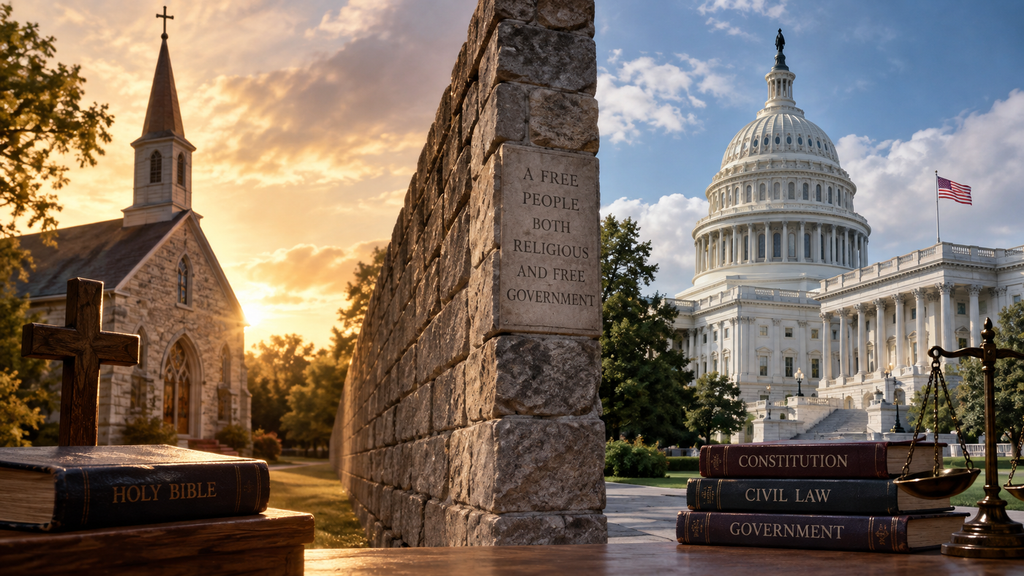
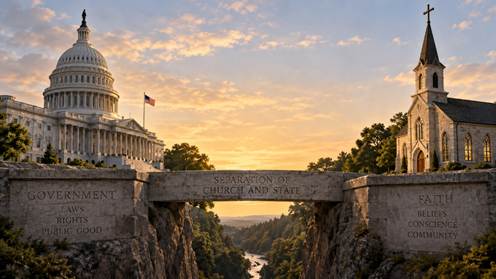
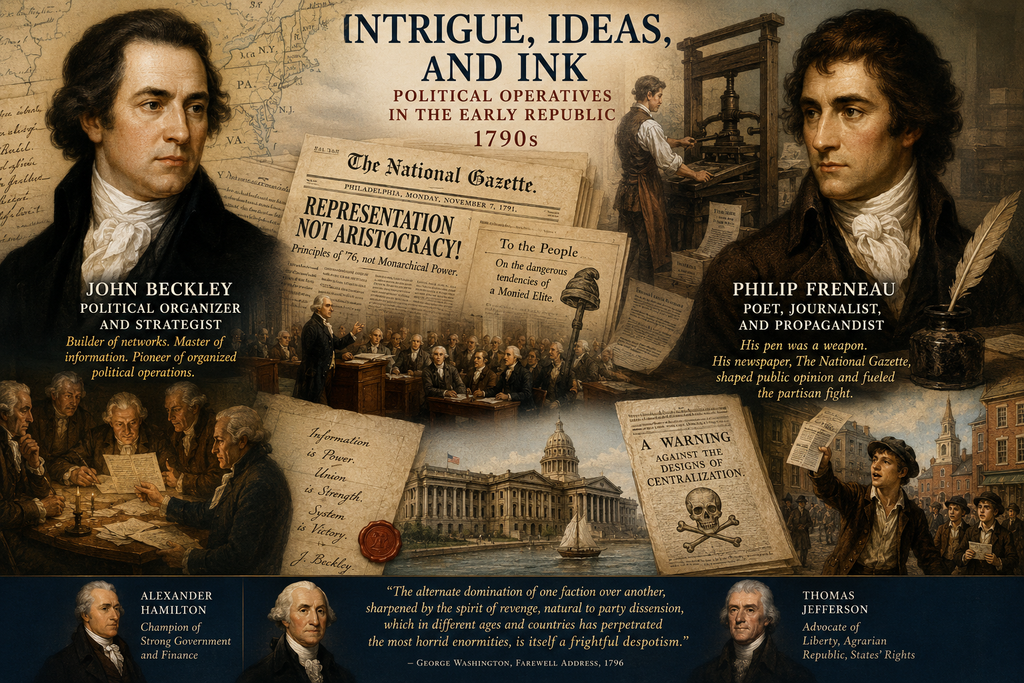

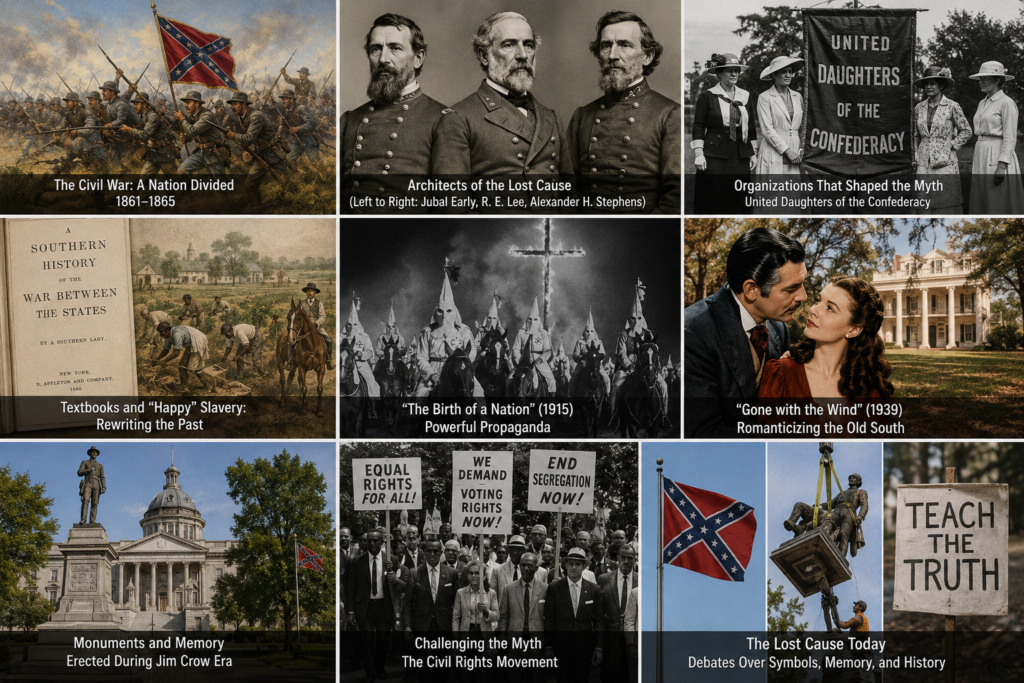
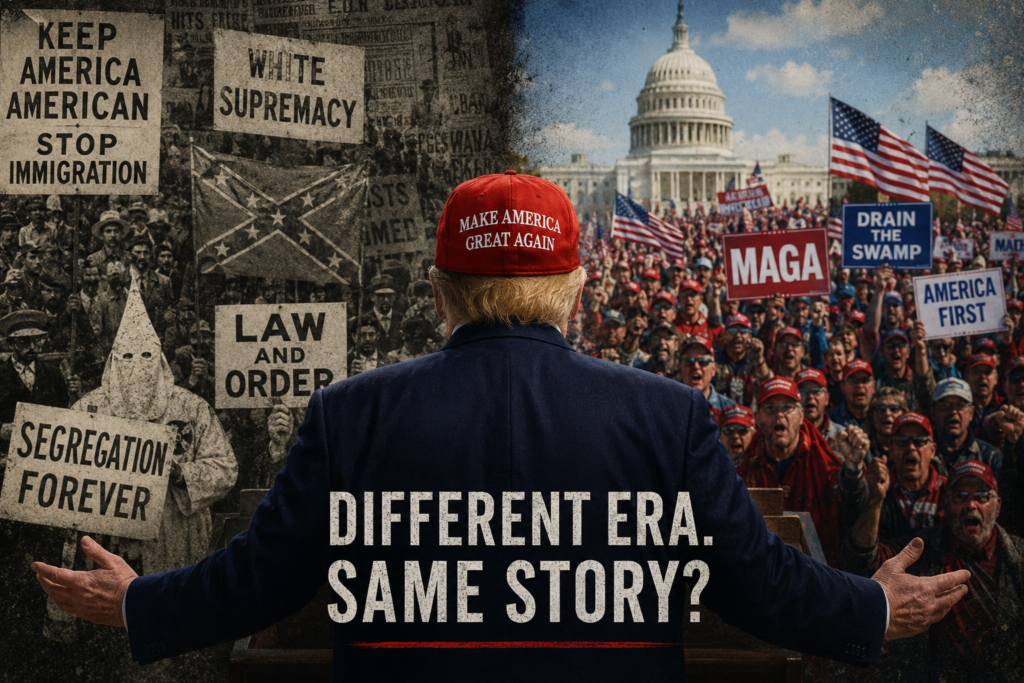

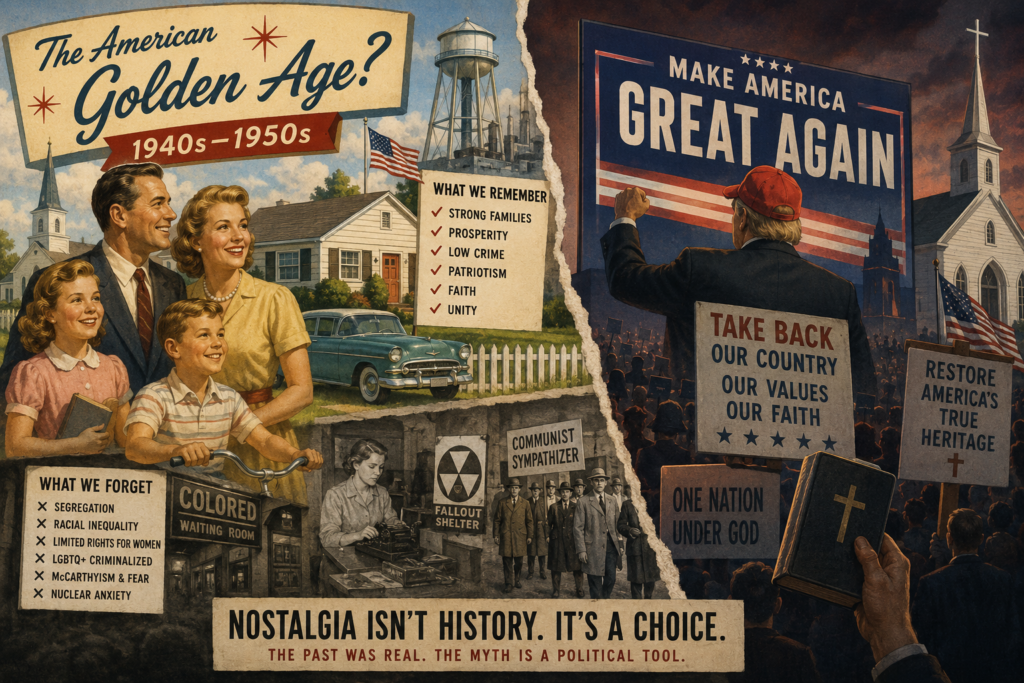
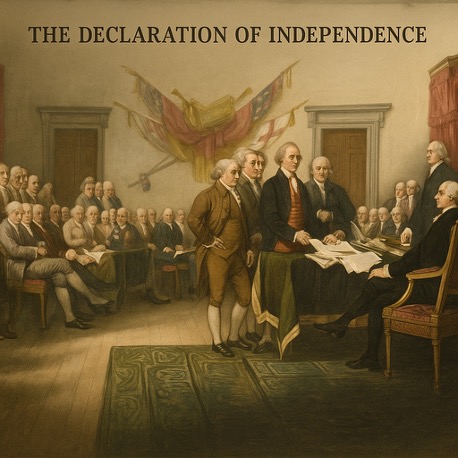
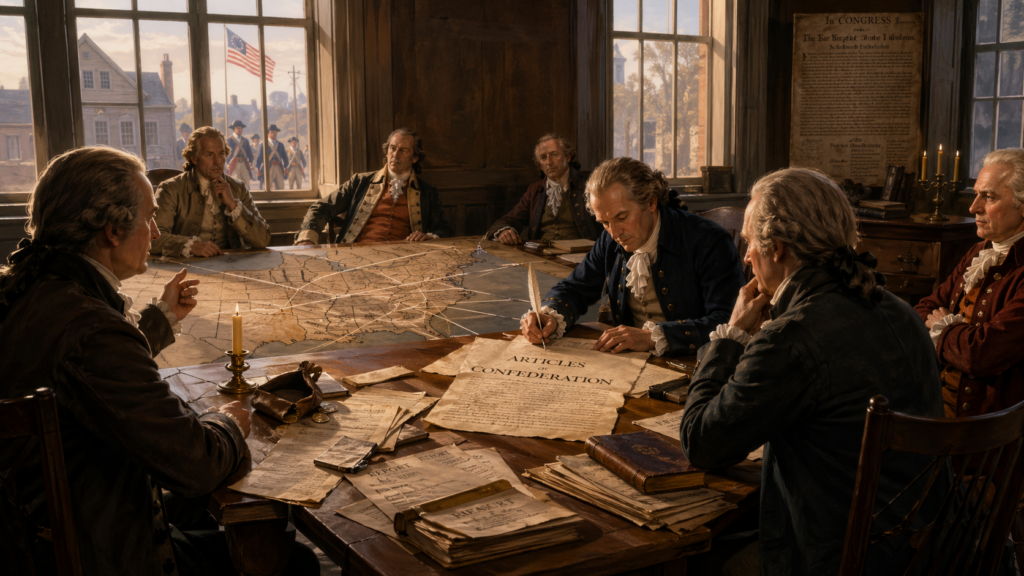
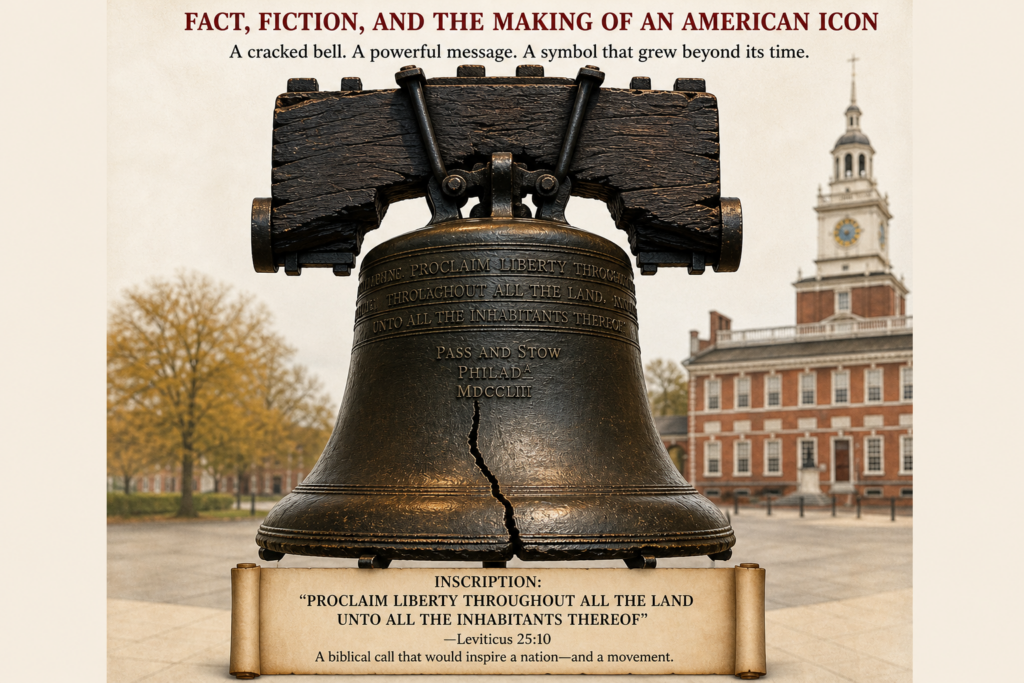
Our Shared Story Can Still Bring Us Together
By John Turley
On August 18, 2026
In Commentary
I’ve been a member of the Sons of the American Revolution for quite some time now. At the beginning of April, I started looking around for a Memorial Day event that we could join. I had assumed that my hometown of Charleston WV, being the state capital, would surely have an event since it is the 250th anniversary of the Declaration of Independence. I was surprised to find that none was planned.
I believed that it was especially important that a Memorial Day service be held here because West Virginia has, since World War II, one of the highest per capita rates of military service and combat casualties in the country. So, another SAR member and I got together, and we planned our own event and arranged for it to be held on the state capitol grounds. At the end of our service, I looked out at the group that was gathered: there was no right or left, there was no red or blue, there was no conservative or liberal. There were only proud Americans who had come together to honor our country, its veterans and its history.
Americans disagree about almost everything these days. Politics, religion, education, history, and even the meaning of patriotism have all become subjects of bitter debate. Too often, we define ourselves more by the groups we oppose than by the country we share.
Yet there are still opportunities to remember that before we were Republicans or Democrats, conservatives or progressives, we were Americans. The ongoing 250th Anniversary of the Revolutionary Era offers one of those rare opportunities to express what we share, not how we differ.
The semiquincentennial should be far more than fireworks, parades, and historical reenactments. It should be an invitation to rediscover the remarkable story we all inherited. The American Revolution was not perfect. The nation it created was imperfect from the beginning, carrying the stain of slavery, denying women equal rights, and often failing to live up to its own ideals. Those shortcomings do not erase the extraordinary achievement of creating a republic founded on the revolutionary belief that legitimate government derives its authority from the consent of the governed.
The founders left us more than a nation. They left us a challenge. Every generation has been asked to move the country a little closer to the principles expressed in the Declaration of Independence—that all people are created equal and possess inherent rights that no government should take away. Those words have inspired abolitionists, suffragists, civil rights leaders, immigrants seeking freedom, and millions of ordinary citizens who believed America could become better than it was.
That is a heritage worth celebrating together.
Organizations devoted to civic life have an important role to play in that celebration. Groups such as the Sons of the American Revolution, the Daughters of the American Revolution, the American Legion, Rotary clubs, Civitan clubs, veterans’ organizations, scouting groups, historical societies, libraries, museums, churches, and countless other local groups have spent decades preserving history, encouraging volunteerism, supporting education, and strengthening their communities. While each has its own mission and traditions, they all remind us that citizenship is more than voting every few years. It is an ongoing commitment to serving neighbors and improving the places where we live.
These organizations also offer something increasingly rare in modern America: opportunities for people with different political views to work side by side on practical goals. A community service project, a scholarship program, a veterans’ memorial, a food drive, or a history program rarely asks participants how they voted. It asks only if they are willing to help.
That is a lesson our country desperately needs. Social media and cable television often reward outrage. Algorithms profit by convincing us that our fellow Americans are enemies rather than neighbors. It becomes easy to believe that our differences outweigh everything we have in common.
History tells a different story. Americans have survived fierce political battles before. We have argued over the Constitution, endured civil war, struggled through economic depression and assassinations, fought world wars, and confronted profound disagreements about civil rights and social change. Our history has never been one of perfect unity. Instead, it has been a continuing effort to find common purpose despite deep disagreements.
The Revolution itself offers an example. The thirteen colonies differed enormously in religion, economy, geography, and culture. New England merchants, Virginia planters, Pennsylvania farmers, and South Carolina traders often had conflicting interests. Yet they discovered that some principles were more important than their differences. Their unity was never complete, but it was sufficient to build a nation. We face no less important a challenge today.
The 250th anniversary should encourage every community to host public readings of the Declaration of Independence, historical lectures, concerts, service projects, naturalization ceremonies, veterans’ recognitions, student essay contests, and volunteer events that welcome everyone. These occasions should not become platforms for partisan speeches. They should remind us that our history belongs to all Americans.
Celebrating our shared heritage does not require us to ignore the darker chapters of our past. Mature patriotism is honest enough to acknowledge failures while remaining grateful for the ideals that allowed those failures to be challenged and corrected. A confident nation can tell its whole story without either whitewashing its mistakes or denying its accomplishments.
Perhaps that is the greatest gift the 250th anniversary can offer is reminding us that America has always been a work in progress. Each generation inherits both the nation’s achievements and its unfinished work. If we can gather to honor the courage, sacrifice, and aspirations of those who came before us, perhaps we can rediscover something that has become increasingly scarce — the ability to see one another first as fellow citizens.
Our common heritage cannot solve every political disagreement. It will not erase ideological differences or end heated debates about the country’s future. Nor should it. Democracy depends upon vigorous debate. But it also depends upon something deeper — a shared commitment to our republic and our active participation as citizens. We need to become informed participants in our society and we need to vote and encourage others to vote.
As we celebrate America’s 250th birthday, the greatest act of patriotism is not winning another political argument. It is remembering that despite our many differences, we remain participants in the same remarkable American experiment. If civic organizations, veterans’ groups, historical societies, schools, churches, and local communities can help us rediscover that simple truth, they will have performed one of the greatest public services imaginable.
The founders gave us a republic, and they challenged each generation to preserve it and to improve it. Two hundred and fifty years later, that responsibility belongs to all of us. We must not fail.
Image generated br author using ChatGPT.