
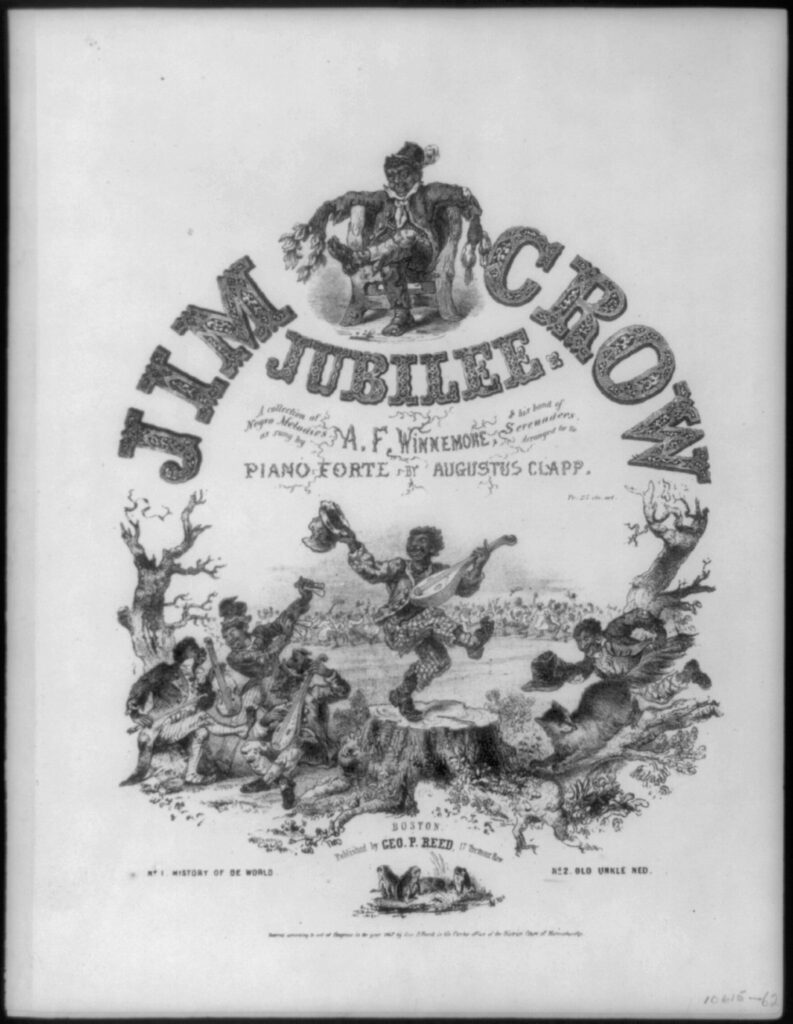
Source: Library of Congress via Wikimedia Commons, public domain
Few phrases in American history carry as much weight as Jim Crow. It is shorthand for a century of systematic racial oppression — separate schools, separate water fountains, disenfranchisement and even terror. But the term itself has an origin that is both surprising and telling: it began not in a courthouse or a legislature, but on a minstrel stage in the 1820s, as the punchline of a song-and-dance act performed by a white man in blackface.
Jump Jim Crow: The Birth of a Slur
The story starts with Thomas Dartmouth “Daddy” Rice, a struggling white actor from the Lower East Side of Manhattan who would go on to become one of the most famous entertainers of his era. Around 1828, Rice developed a stage character he called Jim Crow — a singing, dancing, shuffling caricature of a Black man, performed in blackface makeup made from burnt cork and wearing ragged clothes. The precise inspiration for the character is disputed and has, as historians put it, been lost to legend. Rice claimed to have based it on a disabled enslaved stableman he observed singing and dancing to amuse himself, though the time, place, and truth of this claim have never been verified.
What is not disputed is the impact. Rice’s “Jump Jim Crow” routine was a sensation. By 1832 he had turned the character into his signature act, touring from Louisville to Cincinnati to Philadelphia to New York, playing to sold-out houses. He eventually took the show to London and Dublin, where audiences were equally enthralled. Rice became known as “Jim Crow Rice,” the self-proclaimed “Father of American Minstrelsy.”
The character Rice created was deliberately degrading — a dim-witted, lazy, buffoonish caricature built to confirm the worst racial stereotypes white audiences held about Black Americans and to reinforce a racial hierarchy that portrayed Black people as naturally suited to servitude and exclusion from the rights of citizenship. He and his imitators spread these images across the country. By 1838, the term “Jim Crow” had crossed from the stage into everyday speech as a collective racial slur for Black people. The minstrel show had given American racism a catchy name.
It is worth pausing on the cultural mechanics of what minstrelsy did. It was not just entertainment — it was propaganda. Rice and his many imitators, including the wildly popular Christy Minstrels (for whom Stephen Foster wrote songs), systematically presented Black Americans as subhuman, unworthy of social participation, and fundamentally inferior and ridiculous figures. These depictions played to a stereotype that reinforced racial prejudice among white audiences and softened their moral resistance to segregation and violence long before those policies were ever written into law.
Reconstruction and Its Violent Undoing
The Civil War ended in 1865 with the abolition of slavery, and the Reconstruction era that followed was a genuine, if incomplete, experiment in racial equality. The 13th, 14th, and 15th Amendments abolished slavery, granted citizenship, and extended voting rights to Black men. For a brief window, Black Americans served in state legislatures and held federal office across the South.
That window slammed shut in 1877, when President Rutherford B. Hayes withdrew the last federal troops from the South as part of a political compromise. Southern white Democrats — calling themselves “Redeemers” — systematically retook their state legislatures using violence, voter fraud, and paramilitary terror groups like the Ku Klux Klan, the White League, and the Red Shirts. Republican officeholders were run out of town or worse. Black voters were lynched as a warning to others.
Once back in power, Southern legislatures began passing the laws that would become known as Jim Crow — a name borrowed directly from Rice’s minstrel slur. The term had traveled from the stage to common speech and then into the legal codebook and reflected the same racist assumptions embodied in the minstrel character: that Black Americans were inherently inferior and should occupy a subordinate social and legal position.
Beginning with Florida in 1887, states required railroads to maintain separate cars for Black and white passengers. Similar laws quickly spread segregation to schools, restaurants, hospitals, theaters, cemeteries, parks, waiting rooms, and virtually every other point of public contact between the races. Many facilities were marked with signs reading “White” and “Colored” to emphasize the exclusion of Black citizens. The laws varied by state but shared a common goal—racial separation and political exclusion.
Plessy v. Ferguson: The Supreme Court Blesses Segregation
In 1892, a group of Black and mixed-race citizens in New Orleans organized a deliberate legal challenge to Louisiana’s Separate Car Act. They recruited Homer Plessy — a man who was seven-eighths white but legally classified as Black under Louisiana law — to board a whites-only train car and refuse to move. He was arrested on cue, and his case wound its way through the court system to the United States Supreme Court.
In Plessy v. Ferguson (1896), the Court ruled 7-1 that racial segregation was constitutional as long as the separate facilities were nominally equal. The lone dissenter, Justice John Harlan, stated that the constitution should be color blind and warned prophetically that the decision would prove as pernicious as the Dred Scott ruling. He was right. The “separate but equal” doctrine became the legal foundation for a total apartheid system across the South — and, in many respects, well beyond it.
In practice, of course, the facilities were never equal. Black schools were chronically underfunded, with inferior buildings, used textbooks, and far lower teacher salaries. Black hospitals, where they existed at all, were understaffed and under-equipped. “Separate but equal” was a legal fiction that everyone understood as a polite cover for second-class citizenship.
Between 1890 and 1910, ten of the eleven former Confederate states rewrote constitutions or passed amendments to systematically disenfranchise Black voters through poll taxes, literacy tests administered by white registrars, grandfather clauses, and outright violent intimidation. African Americans who had briefly held political power during Reconstruction effectively disappeared from public life.
The Long Arm of Jim Crow: Life Under the System
For the better part of a century, Jim Crow was not merely a set of legal rules — it was a total social order enforced by custom, economic pressure, and the ever-present threat of violence. A Black man who looked a white man in the eye too long, or failed to step off the sidewalk, or was accused of anything at all, could find himself facing a lynch mob. Between Reconstruction and World War II, thousands of Black Americans — men, women and even children — were lynched, often publicly and festively, with onlookers smiling while posing for pictures with the victim. Law enforcement often did nothing and at times even actively participated.
The Great Migration — the mass movement of Black Americans from the South to Northern and Midwestern cities beginning around 1910 — was driven in large part by Jim Crow. Millions fled to Chicago, Detroit, New York, and Los Angeles in search of something approaching equal treatment. What they often found instead was a northern variant: informal segregation through redlining (systematic denial of mortgages in Black neighborhoods), discriminatory hiring, and residential segregation enforced by real estate covenants and social pressure.
The Legal Dismantling: Brown, the Civil Rights Act, and the Voting Rights Act
The legal edifice of Jim Crow began to crack in 1954, when the Supreme Court issued its unanimous decision in Brown v. Board of Education. Directly overturning Plessy, the Court held that segregated schools were inherently unequal and unconstitutional. The ruling did not end segregation — Southern states resisted fiercely, and desegregation proceeded at a glacial pace well into the 1970s — but Brown pulled the legal rug out from under “separate but equal.”
The civil rights movement of the late 1950s and early 1960s — marked by sit-ins, freedom rides, the Birmingham campaign, the March on Washington, and countless acts of individual courage in the face of brutal repression — built the political pressure that forced legislative action. The Civil Rights Act of 1964 prohibited discrimination in public accommodations and employment. The Voting Rights Act of 1965 dismantled the machinery of Black disenfranchisement in the South, sending federal examiners into states with histories of discrimination to ensure that Black citizens could actually register and vote. By 1965 the majority of the formal Jim Crow laws had been overturned.
The Vestiges: Jim Crow’s Long Shadow
Ending Jim Crow legally is not the same as ending its consequences — or, as some argue, its functional successors. Legal scholar Michelle Alexander, in her landmark 2010 book The New Jim Crow, argues that mass incarceration has emerged as a new system of racialized social control. Black Americans are incarcerated at roughly five times the rate of white Americans. A felony conviction — often stemming from drug offenses prosecuted far more aggressively in Black communities despite similar rates of drug use across races — carries a cascade of legal disabilities: loss of voting rights in most states, exclusion from public housing and many jobs, and ineligibility for certain federal benefits. Nearly 30% of Black men carry felony records.
The racial wealth gap stands as perhaps the most stubborn vestige of a century of legal exclusion. The median Black family holds roughly one-tenth the wealth of the median white family — a gap driven not by individual choices but by generations of legally enforced exclusion from homeownership, inheritance, and wealth-building opportunities. Redlining — the systematic denial of mortgages in Black neighborhoods by federally-backed banks — was official federal policy from the 1930s through the 1960s and left neighborhood segregation patterns that persist visibly today.
Voting rights remain contested territory. The Supreme Court’s 2013 ruling in Shelby County v. Holder gutted the preclearance requirement of the Voting Rights Act, which had required states with histories of discrimination to get federal approval before changing election laws. Since then, a wave of new restrictions — voter ID laws, aggressive voter roll purges, reduced polling locations, and aggressive felony disenfranchisement — has fallen disproportionately on Black, Latino, and Indigenous voters. As of April 2024, 19 states require photo identification to vote, a requirement critics note functions as a modern poll tax for those who lack access to the required documents.
Residential segregation, too, endures. American neighborhoods and, by extension, their schools remain largely segregated by race — a product not of individual choice but of policies like redlining, racially restrictive housing covenants, and “white flight” that were actively promoted by governments at every level. These patterns mean that school quality, which is largely tied to local property tax revenues, continues to diverge sharply by race.
Conclusion
The arc of Jim Crow runs from the absurd to the tragic: from a white comedian in burnt-cork makeup doing a shuffling dance routine, to a legal apparatus that stripped millions of Americans of their dignity, their rights, and their lives for a century. The name itself tells you what the architects of segregation thought of their project — it was always a contemptuous slap in the face of Black Americans.
While the formal system was legally dismantled between 1954 and 1965 — which is rightly understood as a profound achievement — the legal end of Jim Crow is not the same as justice, and it is not the same as equality. The wealth gap, the incarceration gap, the voting access gap, and the education gap all bear the fingerprints of a system that successfully kept Black Americans subordinate for generations.
Understanding Jim Crow fully requires tracing it from its shameful origins in a minstrel song, through its deadly flowering as a legal regime, to its present-day aftereffects. The name may have disappeared from the law books, but the consequences have not and some critics of the current administration see the dismantling of DEI as an indirect form of Jim Crow revival or neo-segregation. They believe that race-neutral language is being used to reproduce racial inequality without openly naming race. This is sometimes described this as “Jim Crow 2.0” or “colorblind Jim Crow” and should be no more acceptable than its more blatant ancestor.
Sources
1. Wikipedia — Thomas D. Rice: https://en.wikipedia.org/wiki/Thomas_D._Rice
2. Wikipedia — Jim Crow (Character): https://en.wikipedia.org/wiki/Jim_Crow_(character)
3. Wikipedia — Jump Jim Crow: https://en.wikipedia.org/wiki/Jump_Jim_Crow
4. Jim Crow Museum, Ferris State University — Who Was Jim Crow?: https://jimcrowmuseum.ferris.edu/who/index.htm
5. Jim Crow Museum, Ferris State University — The Origins of Jim Crow: https://jimcrowmuseum.ferris.edu/origins.htm
6. Britannica — What Is the Origin of the Term “Jim Crow”?: https://www.britannica.com/story/what-is-the-origin-of-the-term-jim-crow
7. Britannica — Jim Crow Law: https://www.britannica.com/event/Jim-Crow-law
8. National Archives — Plessy v. Ferguson (1896): https://www.archives.gov/milestone-documents/plessy-v-ferguson
9. Wikipedia — Plessy v. Ferguson: https://en.wikipedia.org/wiki/Plessy_v._Ferguson
10. Wikipedia — Jim Crow Laws: https://en.wikipedia.org/wiki/Jim_Crow_laws
11. PBS — Jim Crow & Plessy v. Ferguson: https://www.pbs.org/tpt/slavery-by-another-name/themes/jim-crow/
12. Howard University School of Law — Reconstruction and Jim Crow Eras: https://library.law.howard.edu/civilrightshistory/blackrights/jimcrow
13. American Battlefield Trust — The Jim Crow Era: https://www.battlefields.org/learn/articles/jim-crow-era
14. Michelle Alexander — The New Jim Crow (Introduction Excerpt): https://newjimcrow.com/about/excerpt-from-the-introduction
15. Economic Policy Institute — Voter Suppression Rooted in Racism: https://www.epi.org/publication/rooted-racism-voter-suppression/
16. American Academy of Arts and Sciences — Somewhere Between Jim Crow and Post-Racialism: https://www.amacad.org/publication/daedalus/somewhere-between-jim-crow-post-racialism
17. Yale Macmillan — History of Minstrel Shows and Jim Crow: https://macmillan.yale.edu/glc/history-minstrel-shows-and-jim-crow
Leave a Reply