
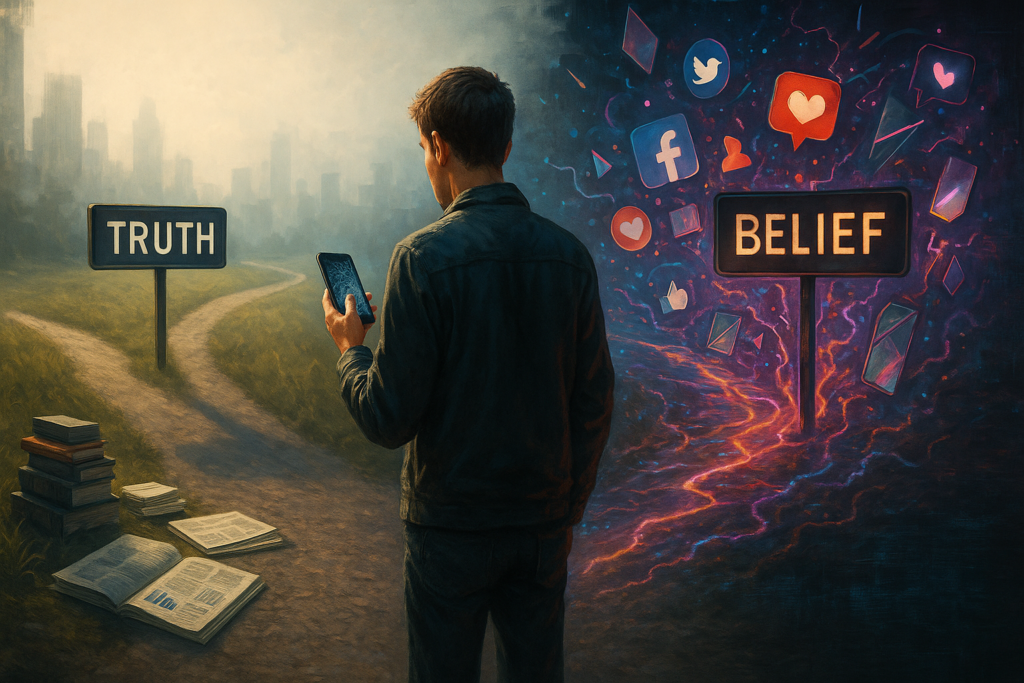
When Oxford Dictionaries declared “post-truth” its word of the year in 2016, it crystallized something many people had been feeling: that we’d entered a strange new era where objective facts seemed less influential in shaping public opinion than appeals to emotion and personal belief. The term exploded in usage that year, becoming shorthand for a troubling shift in how we process information. But have we really entered uncharted territory, or is this just the latest chapter in a very old story?
The short answer is: it’s complicated. The phenomenon itself isn’t new, but the scale and speed at which misinformation spreads certainly is. We are in a new world where the boundary between truth and untruth is blurred, institutions that once arbitrated facts are losing authority, and politics are running on “truthiness” and spectacle more than evidence.
The Psychology of Believing What We Want to Believe
To understand why people increasingly seem to choose sources over facts, we need to dive into how our minds actually work. People now seem to routinely sort themselves into information camps, each with its own “truth,” trusted voices, and shared worldview. But why is this and why does it seem to be getting worse?
Psychologists have spent decades studying something called confirmation bias—essentially, the tendency to seek out information that supports our existing beliefs while avoiding or dismissing information that contradicts them. This isn’t just about being stubborn. Research shows we actively sample more information from sources that align with what we already believe, and the higher our confidence in our initial beliefs, the more biased our information gathering becomes.
But there’s something even more powerful at play called motivated reasoning. While confirmation bias is about seeking information that confirms our beliefs, motivated reasoning is about protecting ideological beliefs by selectively crediting or discrediting facts to fit our identity-defining group’s position. In other words, we don’t just want to be right—we want to belong.
This matters because humans are fundamentally tribal creatures. When we form attachments to groups like political parties or ideological movements, we develop strong motivations to advance the group’s relative status and experience emotions like pride, shame, and anger on behalf of the group. Information processing becomes less about truth-seeking and more about identity protection.
Why Source Trumps Fact
So why do people trust a source they identify with over objective facts that contradict their worldview? Research points to several interconnected reasons.
First, there’s the practical matter of cognitive shortcuts. We’re bombarded with information daily, and people judge the reliability of evidence by using mental shortcuts called heuristics, such as how readily a particular idea comes to mind. If someone we trust says something, that’s an easier mental pathway than laboriously fact-checking every claim. This reliance becomes problematic when “trusted” means ideologically comfortable rather than factually reliable.
Analysts of the post‑truth phenomenon also highlight declining trust in traditional “truth tellers” such as mainstream media, scientific institutions, and government agencies. As these institutions lose authority, counter‑elites or influencers can present alternative narratives that followers treat as at least as plausible as established facts
Second, and more importantly, is the issue of identity. When individuals engage in identity-protective thinking, their processing of information more likely guides them to positions that are congruent with their membership in ideologically or culturally defined groups than to ones that reflect the best available scientific evidence. Being wrong about a fact might sting for a moment, but being cast out of your social group could have real consequences for your emotional support, social standing, and sense of self.
Third, there’s a feedback loop at work. In social media, confirmation bias is amplified by filter bubbles and algorithmic editing, which display to individuals only information they’re likely to agree with while excluding opposing views. The more we’re exposed only to sources that confirm our beliefs, the more alien and untrustworthy contradictory information appears.
Interestingly, being smarter doesn’t necessarily protect you from these biases. Some research suggests that people who are adept at using effortful, analytical modes of information processing may actually be even better at fitting their beliefs to their group identities, using their intelligence to construct more sophisticated justifications for what they already want to believe.
The Historical Echo Chamber
Despite the way it feels, this isn’t the first time truth has had competition. History is full of eras when myth, rumor, propaganda, and identity overshadowed facts.
During The Reformation of the1500s, misinformation was spread on both sides of the catholic-protestant divide. Pamphlets—many of them highly distorted or outright fabricated—spread rapidly thanks to the printing press. Propaganda became a political weapon. Ordinary people suddenly had access to arguments they weren’t equipped to verify. People were ostracized and some even executed based on little more than rumors or lies. We might have hoped for better from religious leaders.
The French Revolution (1780s–1790s) was awash in claims and counterclaims, many of them—if not most—had little basis in fact.Competing newspapers told wildly different stories about the same events. Rumors fueled paranoia, purges, and violence. Truth became secondary to whichever faction controlled the narrative.
Following the Civil War and Reconstruction, the “Lost Cause” narrative became a powerful example of source-driven myth making. Despite historical evidence, generations accepted a version of events shaped by postwar Southern elites, not by facts. Echoes of it still reverberate today, driving much of the opposition to the civil rights movement.
Fast forward to the 1890s, and we see something remarkably familiar. Yellow journalism, characterized by sensationalism and manipulated facts, emerged from the circulation war between Joseph Pulitzer’s New York World and William Randolph Hearst’s New York Journal. These papers used exaggerated headlines, unverified claims, faked interviews, misleading headlines, and pseudoscience to boost sales.
As early as 1898, a publication for the newspaper industry wrote that “the public is becoming heartily sick of fake news and fake extras”—sound familiar?
During the 20th-century propaganda states, typified by both fascist and communist regimes perfected source-based truth. The leader or the party defined reality, and disagreement was literally dangerous. In these systems, truth wasn’t debated—it was assigned.
What Makes Now Different?
While the psychological mechanisms and even the tactics aren’t new, several factors make our current moment distinct. The speed and scale of information spread is unprecedented. A false claim can circle the globe in hours. Studies show that people are bombarded by fake information online, leading the distinction between facts and fiction to become increasingly blurred as blogs, social media, and citizen journalism are awarded similar or greater credibility than other information sources.
We’re also experiencing a fragmentation of trusted authorities. Where once a handful of major newspapers and broadcast networks served as gatekeepers, now the fragmentation of centralized mass media gatekeepers has fundamentally altered information seeking, including ways of knowing, shared authorities, and trust in institutions.
So Are We in a Post-Truth Era?
Yes and no. The term “post-truth” captures something real about our current moment—the scale, speed, and sophistication of misinformation is unprecedented. But calling it “post-truth” suggests we’ve crossed some bright line into entirely new territory. I’d argue we’re not quite there—but we are navigating a world where truth is sometimes lost in the collision of ancient human tendencies and modern technology
The data clearly show that confirmation bias, motivated reasoning, and identity-protective cognition are real and powerful forces. Historical evidence demonstrates that propaganda, misinformation, and the choice of tribal loyalty over objective fact have been with us for millennia. What’s changed is our information ecosystem driven by the technology that allows false information to spread faster than ever, and the by the fragmentation of shared sources of authority that once helped create common ground.
Perhaps a better framing would be that we’re in an era of “turbo-charged tribal epistemology”—where our very human tendency to trust our tribe’s narrative over contradicting evidence has been supercharged by algorithms that feed us what we want to hear and isolate us from alternative perspectives. (I wish I could take credit for the term turbo-charged tribal epistemology. I really like it, but I read it somewhere, I just can’t remember where.)
The question isn’t really whether we’re in a post-truth society. The question is whether we can develop the individual and collective skills to navigate an information environment that exploits every cognitive bias we have. The environment has changed, but the task remains the same: finding ways to establish shared facts despite our deep-seated tendency to believe what we want to believe.
Sources:
- Oxford Dictionaries Word of the Year 2016: https://languages.oup.com/word-of-the-year/2016/
- Wikipedia article on confirmation bias: https://en.wikipedia.org/wiki/Confirmation_bias
- Political Studies Association on post-truth: https://www.psa.ac.uk/psa/news/post-truth-its-meaning-and-implications-democracy
- History Guild on propaganda throughout history: https://historyguild.org/fake-news-misinformation-and-propaganda-throughout-history/
- Digital Public Library of America on yellow journalism: https://dp.la/primary-source-sets/fake-news-in-the-1890s-yellow-journalism








What Is This Thing Called Love?
By John Turley
On February 14, 2026
In Commentary
Every February 14th, we’re reminded that we’re supposed to understand love well enough to celebrate it with cards, chocolates, and carefully chosen gifts. Yet if you ask a hundred people to define love, you’ll get a hundred different answers—and most of them will involve a lot of hand-waving and phrases like “you just know.”
So, what is love? After thousands of years of poetry, philosophy, and now neuroscience, we still don’t have a tidy answer. But we do know more than we used to about how it works, why it matters, and what makes it one of the most powerful forces in human experience.
The Chemistry of Connection
Let’s start with the brain, because love—for all its mystery—has a biological basis we can measure. When you’re falling in love, your brain lights up like a Christmas tree in very specific ways. The caudate nucleus and ventral tegmental area, both parts of the brain’s reward system, show intense activity when people look at photos of their romantic partners. These are the same regions that activate when you’re anticipating a reward or experiencing pleasure. Your brain is essentially treating your beloved like the best possible prize.
The neurochemistry is equally dramatic. Dopamine floods your system, creating that giddy, can’t-eat, can’t-sleep sensation of new love. Norepinephrine heightens attention and memory—which is why you remember every detail of your early dates. Meanwhile, serotonin levels actually drop, which creates the obsessive thinking patterns familiar to anyone who’s ever fallen hard for someone. It’s not unlike the neurochemistry of obsessive-compulsive disorder, which explains why new love can feel so all-consuming.
But here’s where it gets interesting: long-term love shows different neural patterns than early infatuation. In established relationships, the brain’s attachment systems become more active, involving oxytocin and vasopressin—hormones that promote bonding and trust. The frenzy calms, but a different kind of connection deepens.
More Than Just Romance
Our cultural obsession with Valentine’s Day focuses almost exclusively on romantic love, but we experience love in multiple forms that are equally powerful. The ancient Greeks understood this—they had several words for different types of love.
There’s eros, the passionate romantic love we celebrate on Valentine’s Day. But there’s also philia, the deep friendship love that bonds us to chosen family and lifelong companions. Storge describes familial love, the affection between parents and children or siblings. Agape is selfless, universal love—the kind that drives people to help strangers or dedicate their lives to causes. And pragma is the mature, enduring love that develops in long partnerships built on compatibility and mutual respect.
Research on attachment theory, pioneered by psychologist John Bowlby, shows that our capacity for all these forms of love develops from our earliest relationships. The bonds we form with caregivers in infancy create templates that influence how we connect with others throughout life. Those early experiences shape whether we tend toward secure, anxious, or avoidant attachment patterns in adult relationships.
The Meaning We Make
So, what does love mean to us? The answer seems to be almost everything.
Love is fundamentally about connection in a species that evolved to be deeply social. We’re not built to survive alone. Anthropological evidence suggests that cooperation and bonding have been essential to human survival for hundreds of thousands of years. Love—in its various forms—is the emotional mechanism that makes us want to stay together, protect each other, and invest in relationships that extend beyond immediate self-interest.
Psychological research backs this up. Studies consistently show that strong social connections are among the most reliable predictors of happiness and wellbeing. A famous Harvard study that followed people for over 75 years found that close relationships—more than money, fame, or achievement—were what kept people happy throughout their lives. The quality of our relationships influences everything from our physical health to our resilience in facing life’s challenges.
Love also gives us a sense of meaning and purpose. Philosopher Martin Buber wrote about “I-Thou” relationships—moments when we genuinely see and are seen by another person, not as objects to be used but as complete beings. These connections, he argued, are where we find authentic existence. Whether or not you buy the full philosophical framework, there’s something to the idea that being truly known and still loved is profoundly meaningful to us
How We Describe the Indescribable
The challenge with love is that it’s simultaneously a biological process, a psychological state, a social bond, and a subjective experience. It’s a feeling, but also a choice. It involves chemistry but transcends chemistry. It’s universal, but manifests differently across cultures and individuals.
When people try to describe love, they often resort to metaphors: it’s a journey, a flame, a force of nature, a home. These metaphors capture something real—that love is dynamic (a journey), consuming (a flame), powerful beyond our control (a force), and provides security (a home). Each metaphor reveals an individual facet of love but is incomplete in itself.
Psychologists sometimes describe love through its components. Robert Sternberg’s triangular theory proposes that love involves intimacy (closeness and connection), passion (physical attraction and arousal), and commitment (the decision to maintain the relationship). Different combinations create different experiences: romance without commitment is infatuation; commitment without passion is companionship; all three together create what he calls “consummate love”.
But even these frameworks feel incomplete because love is also characterized by paradoxes. It makes us feel both euphoric and vulnerable. It’s intensely focused on one person yet can expand our capacity for compassion generally. It’s simultaneously selfish (wanting the beloved) and selfless (wanting their happiness above our own). It’s stable and changing, rational and irrational, simple and impossibly complex.
What We Know, and What We Don’t
Here’s my honest assessment of our understanding: We’re fairly confident about love’s neurological basis and its importance for human wellbeing. The research on attachment, bonding hormones, and the psychological benefit of connection is solid and replicated across many studies.
We’re less certain about the boundaries between types of love or whether our categories reflect universal realities or cultural constructs. The line between deep friendship and romantic love can be fuzzy. What Western culture calls romantic love may be experienced or expressed differently in cultures with arranged marriages or different social structures.
And we really don’t know how to explain why one person falls for this particular person and not that one, why some relationships endure while others fade, or how exactly the alchemy of genuine connection works. We can identify correlates and patterns, but the lived experience of love retains its mystery.
The Point of It All
Maybe the reason love resists simple definition is that it’s less like a thing and more like a capacity—the human ability to extend beyond our individual boundaries and form bonds that transcend pure self-interest. It’s what allows parents to sacrifice for children, friends to show up in crises, partners to build lives together, and strangers to feel compassion for people they’ll never meet.
Valentine’s Day, for all its commercial trappings, is trying to celebrate something genuinely important: our ability to connect, to care, to find meaning in each other. Whether you’re celebrating romantic love, friendship, family bonds, or simply the human capacity for affection, you’re acknowledging one of the most fundamental aspects of what makes us human.
Love might be indefinable, but that doesn’t make it any less real or necessary. It’s the force that pulls us out of isolation and reminds us we’re part of something larger than ourselves. And maybe that’s enough of a definition to work with.
Sources
Cole Porter – What’s This Thing Called Love? Lyrics, 1929
Scientific American – The Neuroscience of Love https://www.scientificamerican.com/article/the-neuroscience-of-love/
Greater Good Science Center, UC Berkeley – The New Science of Love https://greatergood.berkeley.edu/article/item/the_new_science_of_love
Simply Psychology – Bowlby’s Attachment Theory https://www.simplypsychology.org/bowlby.html
Harvard Gazette – Harvard Study on Adult Development https://news.harvard.edu/gazette/story/2017/04/over-nearly-80-years-harvard-study-has-been-showing-how-to-live-a-healthy-and-happy-life/
Verywell Mind – Sternberg’s Triangular Theory of Love https://www.verywellmind.com/triangular-theory-of-love-2795884
Illustration generated by author using ChatGPT.