
Religion in the Ranks of the Continental Army
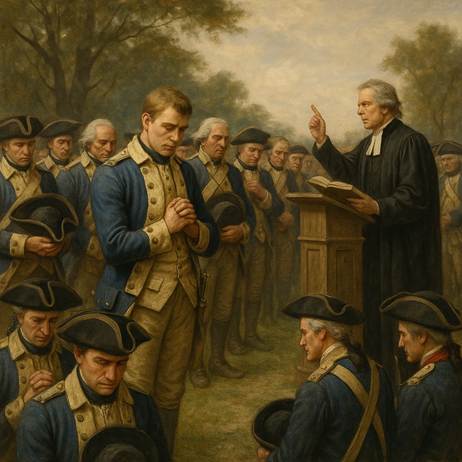
The Continental Army that fought for American independence from 1775 to 1783 represented a cross-section of colonial religious life, bringing together men from diverse faith traditions under a common cause. The religious faith of both enlisted soldiers and officers reflected the broader religious landscape of colonial America, and their regional differences contributed to a complex tapestry of faith within the ranks.
The Continental Army drew from a population where religious diversity was already well-established, particularly when compared to European armies of the same period. Protestant denominations were the majority within the ranks, reflecting the colonial religious demographics.
The American Revolution was not only a political and military struggle but also a deeply religious experience for many Continental Army soldiers. Their faith shaped how they interpreted the war, coped with its hardships, and interacted with comrades from diverse backgrounds.
Enlisted soldiers often relied on providentialism, the belief that God directly intervened in daily life, to make sense of battlefield chaos and suffering. Diaries and letters reveal troops attributing survival in skirmishes, unexpected weather shifts, and even mundane events to divine will. For example, many saw the Continental Army’s unlikely battlefield victories as evidence of God’s favor toward their cause.
Diversity in the Ranks
Congregationalists from New England formed a significant portion of the army, bringing with them the Puritan theological tradition that emphasized divine providence and moral responsibility. Ministers in New England frequently preached that resistance to tyranny was a Christian duty and many soldiers viewed themselves as fighting against tyranny, much as their ancestors had fled religious persecution.
Presbyterian soldiers, many of Scots-Irish descent, comprised a substantial group. Concentrated heavily in the Middle Colonies and frontier areas, they tended toward evangelical and Presbyterian influences, regardless of their home colony . The challenging conditions of frontier life had already created a more individualistic and emotionally intense form of Christianity that adapted well to military service. These soldiers often brought a fatalistic acceptance of divine will combined with fierce determination.
Baptist and Methodist soldiers, though fewer in number, represented growing evangelical movements that would later transform American Christianity. German Reformed and Lutheran soldiers from Pennsylvania added to the religious diversity, while smaller numbers of Catholics, particularly from Maryland and Pennsylvania, served despite facing legal restrictions in many colonies. Even a few Jewish soldiers joined the cause, though their numbers were minimal given the tiny Jewish population in colonial America. The religious pluralism in regiments from the Middle Colonies created a more tolerant atmosphere that foreshadowed the religious diversity of the new nation.
Quakers were generally pacifists and avoided military service, however some “Free Quakers” broke from their tradition and joined the Patriot cause. Other pacifist religious groups, such as Mennonites, abstained from combat but occasionally provided non-combatant support.
Anglicans, ironically fighting against their own church’s mother country, served in significant numbers, particularly from the Southern colonies where the Church of England frequently had been established as a state supported church.
While religious diversity was generally a unifying force in the Continental Army, there were some instances of religious tension and while they were relatively limited, they were not entirely absent. One significant example occurred early in the war in November 1775, when some American troops planned to burn an effigy of the Pope on Guy Fawkes Day (also known as Pope’s Day in New England). General Washington strongly condemned this anti-Catholic action, denouncing it as indecent and lacking common sense.
Washington actively tried to prevent sectarianism from undermining unity in the ranks, whether between Protestants and Catholics or among different Protestant denominations. The overall trend was towards religious tolerance and unity, with religious diversity ultimately contributing positively to the army’s cohesion and morale.
Officer Corps and Religious Leadership
The officer corps of the Continental Army reflected a somewhat different religious profile than the enlisted ranks. Many officers came from the colonial elite and were often Anglican or belonged to more established denominations. However, the Revolution’s anti-episcopal sentiment led many Anglican officers to distance themselves from their church’s political connections while maintaining their basic Christian beliefs. The relationship between the soldiers and the established Church of England became increasingly strained as the Revolution progressed.
George Washington himself exemplified this complex relationship with religion. Though nominally Anglican, Washington never wrote about his personal faith. He was likely influenced by Deist philosophy, then popular among Enlightenment thinkers including Jefferson and possibly Franklin. Deism holds that reason and observation of the natural world are sufficient to determine the existence of a Creator, but that this Creator does not intervene in the universe after its creation.
Washington regularly invoked divine providence in his correspondence and orders, understanding the importance of religious sentiment in maintaining morale, even while his personal beliefs remained ambiguous. His famous directive that “the blessing and protection of Heaven are at all times necessary but especially so in times of public distress and danger” reflected his understanding of religion’s role in military leadership.
Other prominent officers brought their own religious convictions to their leadership. Nathanael Greene, the Southern theater commander, was raised as a Quaker but was expelled from the Society of Friends for his military service. Rev. Peter Muhlenberg, a Lutheran minister, left the pulpit and joined the Continental Army, rising to the rank of Major General. The Marquis de Lafayette, though Catholic, adapted to the predominantly Protestant environment of the American officer corps.
Officers, including Washington, viewed religion as a tool for discipline and unity. Washington mandated Sunday worship. He also appointed chaplains to every brigade, insisting they foster “obedience and subordination”.
Continental Army Chaplain Service
Recognizing the importance of religion to morale and discipline, the Continental Congress authorized the appointment of chaplains to serve with the army. The chaplain system evolved throughout the war, beginning with regimental chaplains and eventually expanding to include brigade and division chaplains for larger organizational units.
Continental Army chaplains faced unique challenges. Unlike European armies with established state churches, American chaplains served religiously diverse units. They needed to provide spiritual comfort to soldiers from different denominational backgrounds while avoiding sectarian conflicts that could undermine unit cohesion. Most chaplains were Protestant ministers, reflecting the army’s composition, but they were expected to serve all soldiers regardless of specific denominational affiliation.
The duties of Continental Army chaplains extended beyond conducting religious services. They often served as informal counselors, helped soldiers write letters home, provided basic education to illiterate soldiers, and sometimes even served as medical assistants. Their moral authority made them valuable in maintaining discipline, and many commanders relied on chaplains to address problems of desertion, drunkenness, and other behavioral issues.
Chaplains also played important roles in significant military events. They conducted prayers before major battles and led thanksgiving services after victories. They provided comfort to the dying and services for the dead.
The British recognized the importance of chaplains to the Continental Army and in some cases offered rewards for their capture.
The famous painting of “The Prayer at Valley Forge” with its image of Washington praying alone in the snow, whether historically accurate or not, represents the type of spiritual leadership chaplains were expected to provide during the army’s darkest moments.
Conclusion Religion in the Continental Army reflected both the differing and the common aspects of colonial American faith. While denominational variations existed, most soldiers shared basic Christian beliefs that provided comfort during hardship and meaning to their sacrifice. The army’s religious diversity foreshadowed the religious pluralism that would characterize the new American nation, while the chaplain service established precedents for military religious support that continue today. The Revolution’s success owed much to the spiritual resources that sustained these soldiers through eight years of difficult warfare, demonstrating religion’s crucial role in the founding of the American republic.
What Would Jefferson Think About Inserting Religion Into Public Education?
By John Turley
On January 13, 2025
In Commentary, History
Jefferson on Religion
Thomas Jefferson had strong views on the separation of church and state, and based on his writings, it’s likely that he would have opposed any attempt to inject religion into public education. Jefferson’s views on religion were deeply influenced by Enlightenment principles, particularly the era’s emphasis on reason, skepticism of traditional authority, and commitment to individual liberty.
While Jefferson respected personal religious beliefs, he believed religion should remain a private matter, free from government influence. His 1786 Virginia Statute for Religious Freedom declared it immoral to compel anyone to support or participate in religious activities, emphasizing individual choice in matters of faith. This stance guided his actions, including the disestablishment of the Anglican Church as the official church of Virginia after the Revolution.
He famously wrote about the need for a “wall of separation between Church & State” in his 1802 letter to the Danbury Baptist Association. This idea became one of the foundational principles behind the First Amendment’s protection of religious liberty.
Although Jefferson was not opposed to religious belief, he supported individual freedom of conscience and he was adamant that religion should be a personal matter, not one enforced, promoted, or influenced by the government.
Religion in Education
When it came to education, Jefferson was passionate about public schooling and saw it as essential to maintaining a democratic society. He believed in the importance of a secular education system that promoted knowledge and reasoning. Jefferson envisioned public education as a way to cultivate informed citizens who could participate in self-governance.
Jefferson’s University of Virginia reflected these ideals, excluding religious instruction and ensuring a secular educational environment. He insisted that religion be studied alongside philosophy and ethics, rather than as a doctrinal subject.
If Jefferson were to assess attempts to inject religion into public education today, it’s reasonable to assume he would view such efforts as a violation of the principles of religious freedom he worked to establish. Jefferson would likely argue that public education, funded by taxpayer dollars and serving people of diverse religious backgrounds, should remain secular to respect the individual rights of all citizens. For him, blending government and religion risked infringing on personal freedoms and undermining the equality of all citizens under the law.
He would probably agree with later interpretations of the Constitution, such as Supreme Court rulings that have affirmed the separation of church and state in the context of public schools. These decisions typically uphold the principle that government institutions, including public schools, should not promote or endorse any particular religion.
Thomas Jefferson’s views on religious freedom, the separation of church and state, and public education suggest that he would strongly oppose any attempt to inject religion into public education. He believed that the role of public schools was to educate citizens in a way that fosters critical thinking, civic engagement, and respect for individual liberties, including the right to practice any religion or none at all. For Jefferson, keeping religion out of public institutions was essential to preserving a free and diverse society.
Jefferson’s unwavering commitment to individual liberty and reason over dogma continues to resonate, emphasizing the enduring value of secular education in fostering democratic principles.