
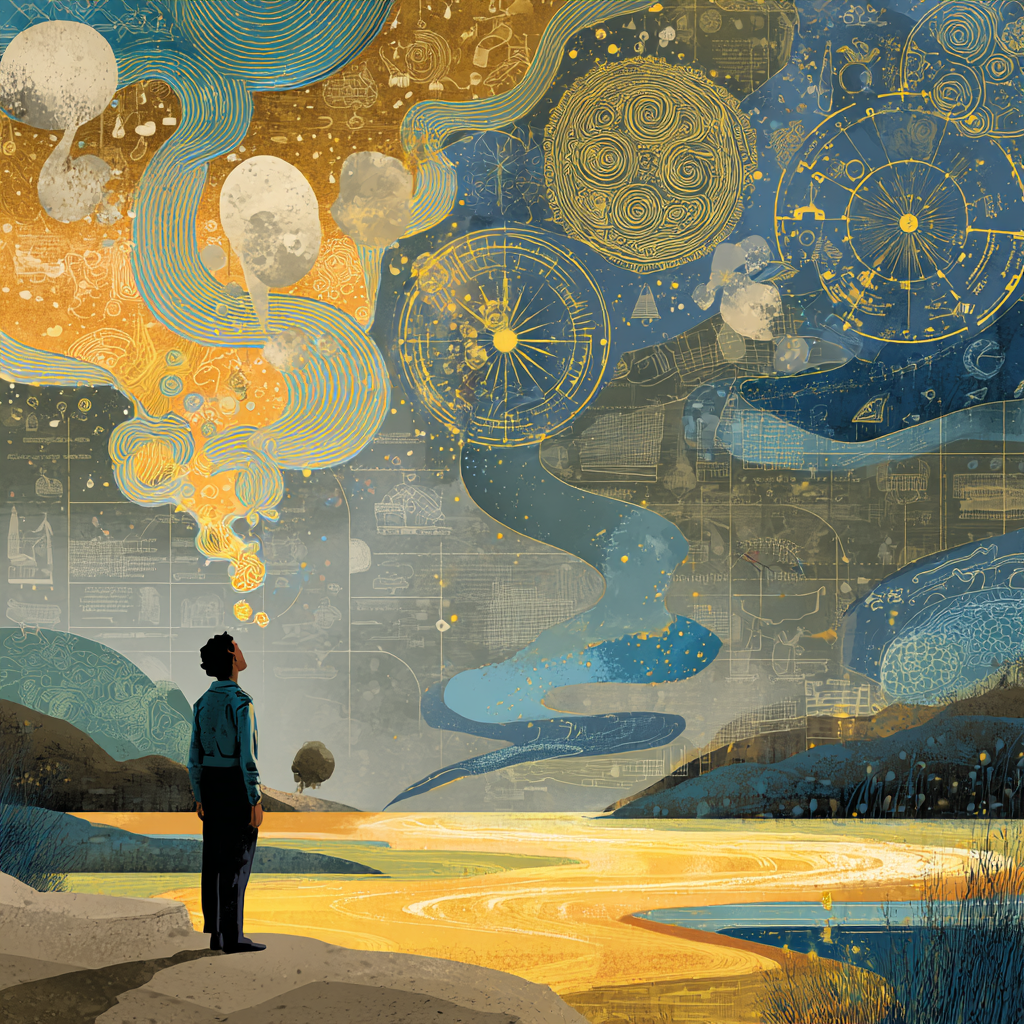
Have you ever been talking to someone when you started to think, “How in the world can they believe that?” They may have been engaging in magical thinking. But don’t feel too superior because most likely you have been guilty of the same thing.
Magical thinking is one of those fascinating quirks of human psychology that shows up everywhere—from your friend who won’t talk about their job interview until it’s over, to major political movements that shape our world. At its core, it’s the belief that our thoughts, words, or actions can influence events in ways that completely ignore standard cause-and-effect logic.
What We’re Really Talking About
Magical thinking isn’t new. Our ancestors practiced animism, believing spirits lived in everything around them. They created rituals to appease these spirits or tap into their power. Fast forward to today, and despite all our scientific advances, these patterns of thinking haven’t gone anywhere—they’ve just evolved.
It’s essentially a cognitive bias where we connect events that aren’t truly linked. This typically happens when we’re facing uncertainty, stress, or situations where we feel powerless. The thinking pattern gives us a psychological safety net—a feeling that we’re in control.
How It Shows Up in Daily Life
Superstitions and Rituals
Knocking on wood to prevent bad luck is a universal example. There’s zero logical connection between rapping your knuckles on a wooden surface and your future, but people do it anyway because it feels like taking action against uncertainty.
Athletes are notorious for this. That “lucky” jersey, the pre-game meal eaten in exactly the same order, the specific warm-up routine—these rituals don’t really affect performance, but they can boost confidence and calm nerves, which indirectly helps.
Lucky Charms and Talismans
Rabbit’s feet, four-leaf clovers, special coins—lots of people carry objects they believe bring good fortune. These beliefs come from cultural traditions and personal experiences. While there’s no scientific backing for their power, the comfort they provide is genuinely real.
The Jinx Effect
Ever avoided talking about something good that might happen because you didn’t want to “jinx” it? I worked in emergency rooms for many years, and no one would ever use the word “quiet” for fear that that would cause a sudden rush of ambulances. That’s magical thinking connecting your words to external outcomes in a totally irrational way.
Health Decisions
This gets more serious when magical thinking influences medical choices. Some people strongly believe in homeopathic remedies or alternative therapies that lack scientific validation. Interestingly, the placebo effect demonstrates how powerful belief can be—people sometimes experience limited health improvements simply because they believe a treatment works, although these effects are most common in relief of mild to moderate pain.
Gambling Behaviors
Casinos thrive on magical thinking. Blowing on dice, wearing lucky clothes, or believing you’re “due” for a win after several losses—these are all examples of the illusion of control. Gamblers think they can influence random outcomes through specific actions, which can fuel persistent gambling even when they’re losing money.
When Magical Thinking Enters Politics
Here’s where things get more complex and consequential. Magical thinking doesn’t just affect personal decisions—it shapes entire political movements and policy debates.
Conspiracy Theories
QAnon represents one of the most striking modern examples. Followers believe a secret group of powerful figures runs a global operation, and that certain political leaders possess almost supernatural abilities to fight against it. Despite zero credible evidence, this belief system has attracted significant followings, demonstrating how magical thinking can create entire alternate realities in the political sphere.
Pandemic Responses
COVID-19 brought magical thinking into sharp relief. Some people blamed 5G technology for causing the virus, leading to actual attacks on cell towers in multiple countries. Others promoted unproven treatments as miracle cures, despite scientific evidence showing they didn’t work and in some cases were harmful. The desire for simple answers to a complicated crisis made people vulnerable to these beliefs.
Vaccine denial—another pandemic related example of magical thinking—is attributing harmful effects to vaccines despite extensive scientific evidence to the contrary, while simultaneously believing that alternative approaches (like “natural immunity” alone) possess special protective powers.
Economic Policies
“Trickle-down economics”—the idea that tax cuts for wealthy individuals automatically generate economic growth and increased government revenue—often functions as magical thinking in policy debates. This theory simplifies incredibly complex economic dynamics and, according to multiple economic analyses, lacks consistent empirical support. Critics point out it ignores the nuances of fiscal policy and income distribution.
Climate Change
Despite overwhelming scientific consensus, some political movements deny climate change reality. This sometimes involves believing that natural cycles alone explain everything, or that technological solutions will magically appear without significant policy intervention. This type of thinking often protects existing economic interests or ideological positions.
Why Our Brains Do This
Pattern Recognition
Humans are pattern-seeking machines. We’re wired to spot connections, even when they don’t exist—a tendency called apophenia. This helped our ancestors survive—better to assume that rustling bush is a tiger than to ignore it—but it also leads us to form superstitions and magical beliefs.
The Comfort Factor
When life feels uncertain or stressful, magical thinking offers psychological comfort. Rituals and lucky charms reduce anxiety and give us a sense of agency, even if that control is illusory.
Cultural Transmission
Many superstitions and magical beliefs get passed down through generations, becoming woven into cultural norms. When we see others engaging in these behaviors, it reinforces them. Social acceptance is powerful.
Political Advantages
In politics specifically, magical thinking persists because it:
- Simplifies complex issues into digestible narratives
- Strengthens group identity and belonging
- Can be exploited by politicians and interest groups to mobilize support
- Provides psychological certainty in a chaotic political landscape
Finding the Balance
Here’s the thing: magical thinking isn’t purely negative. It serves real psychological functions—helping us cope with uncertainty, reducing anxiety, and giving us a sense of control when the world feels chaotic.
The problem comes when we rely on it too heavily. Avoiding medical treatment for unproven remedies can have serious health consequences. Basing policy decisions on magical thinking rather than evidence can affect millions of people. The key is balance.
The Takeaway
Magical thinking connects us to our shared human history, from ancient animistic beliefs to modern political movements. It reveals how our minds constantly work to make sense of an unpredictable world. By understanding these cognitive patterns, we can appreciate their psychological benefits while staying alert to their limitations.
Whether we’re knocking on wood or evaluating political claims, recognizing magical thinking helps us become more critical consumers of information. We can honor the comfort these beliefs provide while still grounding important decisions in evidence and rational analysis.
The enchantment isn’t going anywhere—it’s part of being human. But awareness of it? That’s our best tool for navigating between the rational and the magical in both our personal lives and our shared political reality.
The Strange Tale of Spontaneous Human Combustion
By John Turley
On January 19, 2026
In Commentary, History
Did you ever run into an idea so strange that you can’t quite understand how anyone ever took it seriously? Recently, while reading about historical curiosities in Pseudoscience by Kang and Pederson, I was reminded of one of the most enduring examples: spontaneous human combustion.
The classic image is always the same. Someone enters a room and finds a small pile of ashes where a person once sat. The body is nearly destroyed, yet the chair beneath it is barely scorched and the rest of the room looks strangely untouched. For centuries, this baffling scene was explained by a dramatic idea—that a person could suddenly burst into flames from the inside, without any external fire at all.
It sounds like something lifted straight from a gothic novel, but belief in spontaneous human combustion stretches back to at least the seventeenth century and reached its peak in the Victorian era. To understand why it gained such traction, it helps to look at the social attitudes of the time, the cases that convinced people it was real, and what modern forensic science eventually uncovered.
Much of the early belief rested on moral judgment rather than evidence. In the nineteenth century, spontaneous human combustion was widely accepted as a kind of divine punishment. Many of the alleged victims were described as heavy drinkers, often elderly, overweight, or socially isolated, and women were frequently overrepresented in the reports. To Victorian minds, this pattern felt meaningful. Alcohol was flammable, after all, and it seemed reasonable—at least then—to assume that a body saturated with spirits might somehow ignite. Sensational newspaper reporting amplified the mystery, presenting lurid details while glossing over inconvenient facts.
The idea gained intellectual credibility in 1746 when Paul Rolli, a Fellow of the Royal Society, formally used the term “spontaneous human combustion” while describing the death of Countess Cornelia Zangari Bandi. The involvement of a respected scientific figure gave the concept legitimacy that lingered for generations.
Several cases became canonical. Countess Bandi’s death in 1731 was described as leaving little more than ashes and partially intact legs, still clothed in stockings. In 1966, John Irving Bentley of Pennsylvania was found almost completely burned except for one leg, with his pipe discovered intact nearby. Mary Reeser, known as the “Cinder Woman,” died in Florida in 1951, leaving behind melted fat embedded in the rug near where she had been sitting. As recently as 2010, an Irish coroner ruled that spontaneous human combustion caused the death of Michael Faherty, whose body was found badly burned near a fireplace in a room that showed little fire damage. Over roughly three centuries, about two hundred such cases have been cited worldwide.
Believers proposed explanations that ranged from the scientific-sounding to the overtly theological. Alcoholism was the most popular theory, with some physicians genuinely arguing that chronic drinking made the human body combustible. Earlier medical thinking leaned on imbalances of bodily humors, while later writers speculated about unknown chemical reactions producing internal heat. Religious interpretations framed these deaths as punishment for sin. Even in modern times, a few proponents have suggested that acetone buildup in people with alcoholism, diabetes, or extreme diets could somehow trigger combustion.
The idea was so culturally embedded that Charles Dickens famously killed off the alcoholic character Mr. Krook by spontaneous combustion in Bleak House. When critics objected, Dickens defended the plot choice by citing what he believed were credible historical and medical sources.
The illusion of the supernatural persisted because the circumstances were almost perfectly misleading. Victims were typically alone, elderly, or physically impaired, unable to respond quickly to a smoldering fire. The localized damage looked impossible to the untrained eye. Potential ignition sources were often destroyed in the fire itself. And dramatic storytelling filled in the gaps left by incomplete investigations.
What actually happens in these cases is far less mystical and far more unsettling. Modern forensic science points to an explanation known as the “wick effect.” In this scenario, there is always an external ignition source—often a cigarette, candle, lamp, or fireplace ember. Once clothing catches fire, heat melts the person’s body fat. That liquefied fat soaks into the clothing, which then behaves like a candle wick. The fire burns slowly and steadily, sometimes for hours, consuming much of the body while leaving nearby objects relatively unscathed.
This effect has been demonstrated experimentally. In the 1960s, researchers at Leeds University showed that cloth soaked in human fat could sustain a slow burn for extended periods once ignited. In 1998, forensic scientist John de Haan famously replicated the effect for the BBC by burning a pig carcass wrapped in a blanket. The result closely matched classic spontaneous combustion scenes: severe destruction of the body, with extremities left behind and limited damage to the surrounding room.
The reason these fires don’t usually engulf the entire space is simple physics. Flames rise more easily than they spread sideways, and the heat output of a wick-effect fire is relatively localized. It’s similar to standing near a campfire—you can be close without catching fire yourself.
Investigators Joe Nickell and John F. Fischer examined dozens of historical cases and found that every one involved a plausible ignition source, details that earlier accounts often ignored or downplayed. When these factors are restored to the narrative, the mystery largely disappears.
As science writer Benjamin Radford has pointed out, if spontaneous human combustion were truly spontaneous, we would expect it to occur randomly and frequently, in public places as well as private ones. Instead, it consistently appears in situations involving isolation and an external heat source.
The bottom line is straightforward. There is no credible scientific evidence that humans can burst into flames without an external ignition source. What has been labeled spontaneous human combustion is better understood as a tragic combination of accidental fire and the wick effect. The myth endured because it blended moral judgment, fear, and incomplete science into a compelling story. Today, forensic investigation has replaced superstition with explanation, even if the results remain unsettling.
Spontaneous human combustion survives as a reminder of how easily mystery fills the space where evidence is thin—and how patiently applied science eventually closes that gap.
Sources and Further Reading
Peer-reviewed forensic and medical analyses are available through the National Center for Biotechnology Information, including “So-called Spontaneous Human Combustion” in the Journal of Forensic Sciences (https://pubmed.ncbi.nlm.nih.gov/21392004/) and Koljonen and Kluger’s 2012 review, “Spontaneous human combustion in the light of the 21st century,” published in the Journal of Burn Care & Research (https://pubmed.ncbi.nlm.nih.gov/22269823/).
General scientific and historical overviews can be found in Encyclopædia Britannica’s article “Is Spontaneous Human Combustion Real?” (https://www.britannica.com/story/is-spontaneous-human-combustion-real), Scientific American’s discussion of the wick effect (https://www.scientificamerican.com/blog/cocktail-party-physics/burn-baby-burn-understanding-the-wick-effect/), and Live Science’s summary of facts and theories (https://www.livescience.com/42080-spontaneous-human-combustion.html).
Accessible explanatory pieces are also available from HowStuffWorks (https://science.howstuffworks.com/science-vs-myth/unexplained-phenomena/shc.htm), History.com (https://www.history.com/articles/is-spontaneous-human-combustion-real), Mental Floss (https://www.mentalfloss.com/article/22236/quick-7-seven-cases-spontaneous-human-combustion), and All That’s Interesting (https://allthatsinteresting.com/spontaneous-human-combustion). Wikipedia’s entries on spontaneous human combustion and the wick effect provide comprehensive background and references at https://en.wikipedia.org/wiki/Spontaneous_human_combustion and https://en.wikipedia.org/wiki/Wick_effect.