
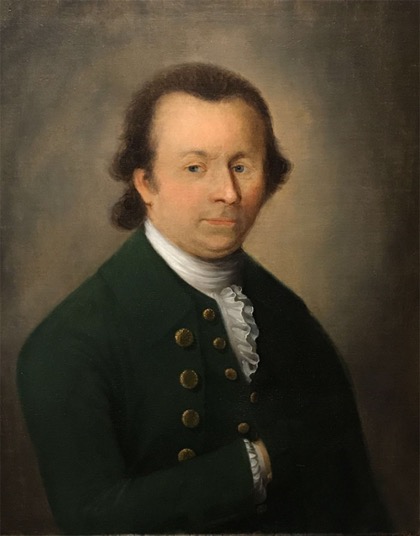
An Almost Forgotten Signer of the Declaration of Independence
History is full of people both little known and unknown who were present at important events. They may have participated, or they may simply have been observers. Understanding them, their lives and their involvement can help us to understand the human aspect of historical events. This is what I love most about history, the stories of average people.
Not long ago, I was looking at a copy of a broadside of the Declaration of Independence when I noticed an intriguing signature — Button Gwinnett. He is one of the lesser-known signers of the Declaration of Independence, yet he played a significant role in the early political landscape of Georgia. His life was a blend of ambition and political maneuvering. His dramatic rise and fall remain intriguing to historians. Even though Gwinnett is little remembered today, his story offers a glimpse into the turbulent period of America’s founding.
Early Life and Migration to America
Button Gwinnett was born in 1735 in Down Hatherley, Gloucestershire, England. He was the son of an Anglican vicar and was named after his mother’s cousin Barbara Button who was also his godmother.
While details about his early education are scarce, it is believed that he received a basic education typical of the English gentry. Gwinnett’s early adulthood was marked by modest success as a merchant. In the 1760s, facing limited opportunities in England and the promise of economic prosperity in the American colonies, Gwinnett and his wife, Ann, emigrated to the New World.
Initially, Gwinnett settled in Charleston, South Carolina, where he engaged in trade. However, he struggled financially, and by 1765, he had relocated to Savannah, Georgia. This move marked not only the beginning of his political career, but also a period of fluctuating fortune. Gwinnett purchased St. Catherine’s Island off the coast of Georgia, hoping to become a successful plantation owner. Unfortunately, he overextended himself financially, and his attempts to establish a profitable business met with failure. Despite his financial setbacks, Gwinnett’s status as a landowner and merchant allowed him to enter the local political scene.
Rise in Politics and Revolutionary Activity
Gwinnett’s involvement in politics grew as tensions between the American colonies and Britain escalated. By the early 1770s, he had become aligned with the growing revolutionary sentiment. In 1775, he was elected to Georgia’s Provincial Congress, where he quickly rose to prominence due to his vocal support for independence from British rule. Although Georgia had initially shown less enthusiasm for independence than colonies like Massachusetts or Virginia, a growing faction of Georgia patriots, including Gwinnett, began advocating for stronger opposition to British rule. By 1776, Gwinnett had become a delegate to the Second Continental Congress.
Continental Congress and the Declaration
On January 20, 1776, Gwinnett left Georgia for Philadelphia to represent the colony in Congress. This appointment marked the pinnacle of his political career and placed him at the center of the deliberations for American independence. His journey to Philadelphia came at a crucial moment when the Continental Congress was moving toward a formal declaration of independence.
Gwinnett voted for independence on July 2, voted to approve the declaration on July 4, and signed his name to the parchment of the Declaration of Independence on August 2. Out of the 56 delegates who signed the Declaration, Button was one of only 8 who were born in Britain. His British birth added a unique perspective to his role as a Founding Father, representing the immigrant experience that was central to colonial American society.
His signing of the Declaration of Independence would later make his signature one of the most valuable autographs in American history. Gwinnett is known chiefly because his autographs are extremely rare and collectors have paid dearly to obtain one. (In 2001 one of his 36 known autographs sold at public auction for $110,000. Since then, several others have been documented.)
Conflict and Power Struggles in Georgia
Back in Georgia, Gwinnett became embroiled in a power struggle with General Lachlan McIntosh, a prominent figure in the colony’s revolutionary army. The conflict between Gwinnett and McIntosh was fueled by political rivalry and personal animosity. Gwinnett aspired to leadership positions within Georgia’s government and military, and in March 1777, he became acting president of Georgia’s Revolutionary Council after the sudden death of Governor Archibald Bulloch.
During his brief tenure as acting council president, Gwinnett’s leadership was controversial. He proposed a bold military expedition against British-controlled East Florida, intending to bolster his political standing and secure Georgia’s borders. However, the campaign was poorly executed, and it ended in failure. This debacle intensified the feud between Gwinnett and McIntosh, with each blaming the other for the military defeat.
Gwinnett’s promising political career was cut short by an ongoing personal conflict that became intertwined with the honor culture of the American South. The rivalry between Gwinnett and McIntosh reached its climax in May 1777. After a series of public insults—McIntosh called Gwinnett a “scoundrel and lying rascal,” Gwinnett responded by challenging him to a duel. Dueling, though technically illegal, was still a common way to resolve disputes among gentlemen of the period. On May 16, 1777, the two men faced each other with pistols in a pasture near Savannah. Both were wounded, but only Gwinnett’s injuries proved fatal. He died three days later, at age 42, and was buried in Savannah’s Colonial Park Cemetery, though the exact location of his grave is still unknown.
Legacy and Historical Significance
Gwinnett’s legacy is visible in his namesake Gwinnett County, one of Georgia’s most populous counties, a tribute to his contributions to the state’s early political history.
In recent decades, historians have taken a renewed interest in Button Gwinnett, examining his role beyond the narrow context of his duel and signature. While he lacked the fame of other founding fathers, Gwinnett’s political maneuvering and his role during the revolutionary period highlight the complexities of early American politics. His rivalry with McIntosh reflects the deep divisions and regional conflicts that existed even among those who supported independence.
Gwinnett’s life also underscores the risks faced by those who ventured into the revolutionary cause. Unlike many of his contemporaries who enjoyed long, celebrated careers, Gwinnett’s story is one of a meteoric rise and abrupt fall. His legacy, while overshadowed by more prominent figures, is a reminder of the many lesser-known men and women who played vital roles in America’s fight for independence.
Button Gwinnett’s life was marked by ambition, conflict, and an untimely death that left him as one of the more obscure figures of the American Revolution. His contributions to the independence movement in Georgia were significant, even if his political career was cut short. Today, Gwinnett’s name lives on in Georgia’s geography, and his autograph serves as a rare artifact of a fleeting yet impactful moment in history.
Sources:
· National Archives: Declaration of Independence Signers – https://www.archives.gov/founding-docs/signers
· The Georgia Historical Society: Biography of Button Gwinnett – https://georgiahistory.com
· Smithsonian Magazine: The Rare Autograph of Button Gwinnett – https://www.smithsonianmag.com
· Library of Congress: Early American Biographies – https://www.loc.gov
Leave a Reply