
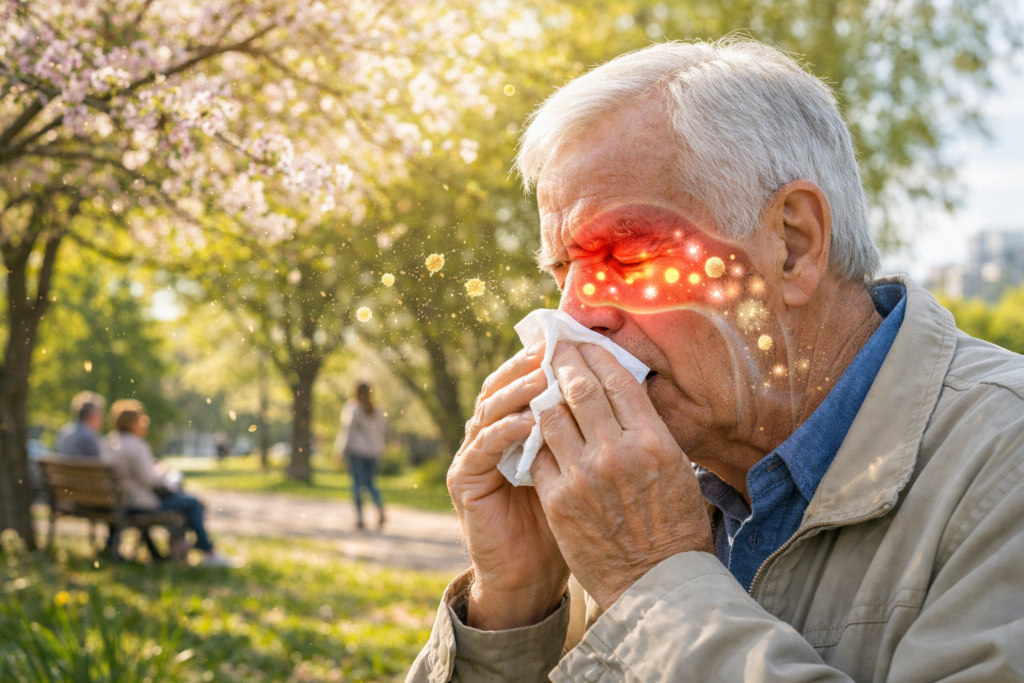
Let’s get one thing out of the way up front: hay fever has almost nothing to do with hay, and it doesn’t cause a fever. The name stuck after a popular 19th-century theory that the smell of summer hay was making people sick. Turns out, the culprit is invisible and far more pervasive — tiny airborne particles that your immune system, for reasons we can’t entirely explain, decides to treat like the enemy. The official medical term is allergic rhinitis, but most of us just call it hay fever, seasonal allergies, or, in the depths of pollen season, I call it a personal nightmare.
If you’ve ever spent a spring morning sneezing your way through a box of tissues or rubbed your eyes until they looked like you’d been crying all night, you already know what this feels like. What you might not know is why it happens, what exactly sets it off, and — most importantly — what you can do about it. Let’s dig in.
What Is Hay Fever, Exactly?
Hay fever is, at its core, an overreaction by your immune system. When you breathe in certain particles — pollen, dust, animal dander — your body may misidentify them as a threat. In response, it releases a chemical called histamine, which is supposed to help fight off invaders but instead triggers a cascade of miserable symptoms: sneezing, congestion, a runny nose, itchy eyes, and general stuffiness. None of this is actually doing anything useful. Your immune system is essentially deploying the cavalry against a dandelion.
According to the Cleveland Clinic, roughly 20% of Americans have allergic rhinitis, and a 2021 study found that more than 81 million people reported seasonal allergy symptoms that year alone. So, if you’re one of us, you are not alone.
Hay fever comes in two main varieties. Seasonal allergic rhinitis is what most people picture — the spring sneezing, the summer eye-rubbing, the early fall misery. Perennial allergic rhinitis, on the other hand, is the year-round version, driven by indoor allergens that don’t take the winter off. Either way, the underlying mechanism is the same: your immune system picking a fight with something that poses no real danger.
What Triggers It?
The list of potential triggers is longer than you might expect, but they fall into a few main categories.
Pollen is the classic offender and the one most associated with the “hay fever” label. But not all pollen is created equal. According to the American College of Allergy, Asthma and Immunology (ACAAI), seasonal hay fever is most commonly triggered by wind-carried pollen from trees, grasses, and weeds. Crucially, it’s not flower pollen — those heavy, colorful grains are carried by insects and never make it into your airway. The sneaky offenders are the plain-looking plants whose lightweight pollen drifts for miles. Tree pollens tend to peak in spring, grasses in early summer, and ragweed in late summer through early fall.
Hot, dry, and windy days are the worst for pollen exposure. A cool, rainy day provides some relief — rain washes pollen out of the air, at least temporarily. As noted by MedlinePlus (National Library of Medicine), pollen counts are highest during those breezy, sunny mornings when everything is blooming.
Beyond pollen, a range of indoor allergens can trigger perennial symptoms year-round. Dust mites — microscopic creatures that live in bedding, carpets, and upholstered furniture — are among the most common. Pet dander (the tiny flecks of skin that cats, dogs, and other animals shed) is another major culprit. Mold spores, which thrive in damp environments, can trigger symptoms both indoors and outdoors. And unpleasantly, cockroach droppings and saliva are also recognized as allergens. The ACAAI notes that perennial symptoms tend to worsen in winter, when people spend more time indoors with windows closed and allergens concentrated.
You may also notice that some non‑allergic irritants make things worse, such as cigarette smoke, strong perfumes, cleaning sprays or exhaust fumes. They do not cause hay fever on their own, but they can irritate already sensitive noses and eyes.
There’s also a lesser-known category: occupational rhinitis. If your symptoms are worse at work and better on weekends, you might be reacting to something in your workplace environment — cleaning chemicals, dust, fumes, or other irritants. This is worth discussing with a doctor if you notice a pattern.
The so-called “hygiene hypothesis” suggests that overly clean environments may predispose the immune system to overreact when you do come in contact with a trigger. This point remains debatable, but it’s widely discussed in immunology literature.
How Does It Feel?
The symptoms of hay fever overlap enough with the common cold that it can be genuinely hard to tell the two apart at first. The key difference is that hay fever is not contagious, doesn’t come with a true fever, and tends to linger as long as you’re exposed to the trigger rather than resolving in a week or two like a cold.
Typical symptoms include sneezing (sometimes in rapid-fire bursts), a runny or stuffed-up nose, itchy and watery eyes, an itchy throat or roof of the mouth, and post-nasal drip. More severe cases can cause fatigue, reduced concentration, and disrupted sleep. According to Harvard Health Publishing, the congestion can also lead to secondary complications like sinus infections or ear infections, since swelling can block the passages that normally drain those areas.
For people with asthma, hay fever can be an especially unwelcome companion. The same inflammation that irritates the nasal passages can travel through the airways and worsen breathing problems. The NCBI/InformedHealth.org notes that hay fever symptoms can sometimes “move down” into the lungs and develop into allergic asthma over time — one more reason to take persistent symptoms seriously.
What Can You Do About It?
The good news is that hay fever is manageable, even if it isn’t curable. Treatment generally falls into three strategies: avoidance, medication, and — for more serious cases — immunotherapy.
Avoidance sounds obvious but is easier said than done and takes some planning. Staying indoors on high-pollen days (especially in the morning when counts peak), keeping windows closed, using air conditioning instead of window fans, and showering after being outside can all reduce your exposure. For dust mite allergies, encasing pillows and mattresses in allergen-blocking covers and washing bedding in hot water regularly can make a noticeable difference. The ACAAI also suggests wearing wraparound sunglasses outdoors to limit the amount of pollen that reaches your eyes.
Medications are the backbone of hay fever treatment for most people. Antihistamines work by blocking the histamine response — they’re widely available over the counter and work well for mild-to-moderate symptoms. Older antihistamines (like diphenhydramine, the active ingredient in Benadryl) can cause drowsiness; newer ones like cetirizine (Zyrtec) and loratadine (Claritin) are much less sedating for most people. These make life tolerable for me in the fall and spring. When I was younger, there were days when I wouldn’t venture outside because of the unpleasant symptoms.
Nasal corticosteroid sprays are considered the most effective single treatment for allergic rhinitis by most clinical guidelines. According to MedlinePlus, they work best when used consistently rather than just on symptom days, and many brands — including fluticasone (Flonase) and budesonide (Rhinocort) — are now available without a prescription. Harvard Health advises starting these sprays a week or two before your expected allergy season begins for maximum effectiveness.
Decongestants can help with nasal stuffiness, but nasal spray decongestants (like oxymetazoline) should not be used for more than three days in a row, as they can cause a rebound effect that makes congestion worse. Oral decongestants don’t carry that risk but can raise blood pressure and heart rate, so they’re not appropriate for everyone.
Leukotriene inhibitors — most commonly montelukast (Singulair) — offer another option. These prescription medications work differently from antihistamines and steroids, blocking a different arm of the allergic response. They’re less effective than corticosteroid sprays on their own but can be useful in combination. Antihistamine eye drops are also available for people whose main complaint is itchy, watery eyes.
For people with persistent or severe symptoms that don’t respond well to medications, allergen immunotherapy may be the answer. This is the long game: regular, gradually increasing doses of the allergen itself, either through allergy shots (subcutaneous immunotherapy) or sublingual tablets and drops placed under the tongue. According to the Australasian Society of Clinical Immunology and Allergy (ASCIA), treatment typically runs three to five years and should be overseen by an allergy specialist. It doesn’t cure the allergy, but it can meaningfully reduce the severity of symptoms and lower your dependence on daily medications.
Finally, simple saline nasal rinses are worth mentioning. They’re not glamorous, but rinsing the nasal passages with saltwater (using a neti pot or squeeze bottle) can physically flush out allergens and thin mucus. They’re safe, inexpensive, and effective enough that clinical guidelines recommend them as a complementary strategy. Personally, I’ve found them unpleasant to use though many of my patients swear by them.
A Final Word
Hay fever is one of those conditions that can feel like a minor inconvenience until it’s not — until it’s disrupting your sleep, tanking your productivity, and making you dread the most beautiful days of the year. The encouraging news is that modern medicine has a pretty good toolkit for managing it. If over-the-counter antihistamines and nasal sprays aren’t cutting it, that’s worth a conversation with your doctor. Allergy testing can pinpoint your specific triggers, and from there, a targeted treatment plan can make a real difference.
There’s something ironic about hay fever: the very environments we associate with health—fresh air, blooming trees, green landscapes—can provoke the body into a defensive overreaction. Understanding that paradox is the first step toward managing it effectively.
In the meantime, maybe check the pollen count before you plan that picnic.
As always, this article is for information only. Consult your health care provider regarding your individual care.
Illustration generated by the author using ChatGPT.
Sources
Cleveland Clinic: Allergic Rhinitis (Hay Fever) — https://my.clevelandclinic.org/health/diseases/8622-allergic-rhinitis-hay-fever
American College of Allergy, Asthma & Immunology (ACAAI): Hay Fever — https://acaai.org/allergies/allergic-conditions/hay-fever/
MedlinePlus (National Library of Medicine): Allergic Rhinitis — https://medlineplus.gov/ency/article/000813.htm
Harvard Health Publishing: Hay Fever (Allergic Rhinitis) — https://www.health.harvard.edu/a_to_z/hay-fever-allergic-rhinitis-a-to-z
NCBI / InformedHealth.org: Overview of Hay Fever — https://www.ncbi.nlm.nih.gov/books/NBK279488/
Australasian Society of Clinical Immunology and Allergy (ASCIA): Allergic Rhinitis — https://www.allergy.org.au/patients/allergic-rhinitis-hay-fever-and-sinusitis/allergic-rhinitis-or-hay-fever