
Did you ever run into an idea so strange that you can’t quite understand how anyone ever took it seriously? Recently, while reading about historical curiosities in Pseudoscience by Kang and Pederson, I was reminded of one of the most enduring examples: spontaneous human combustion.
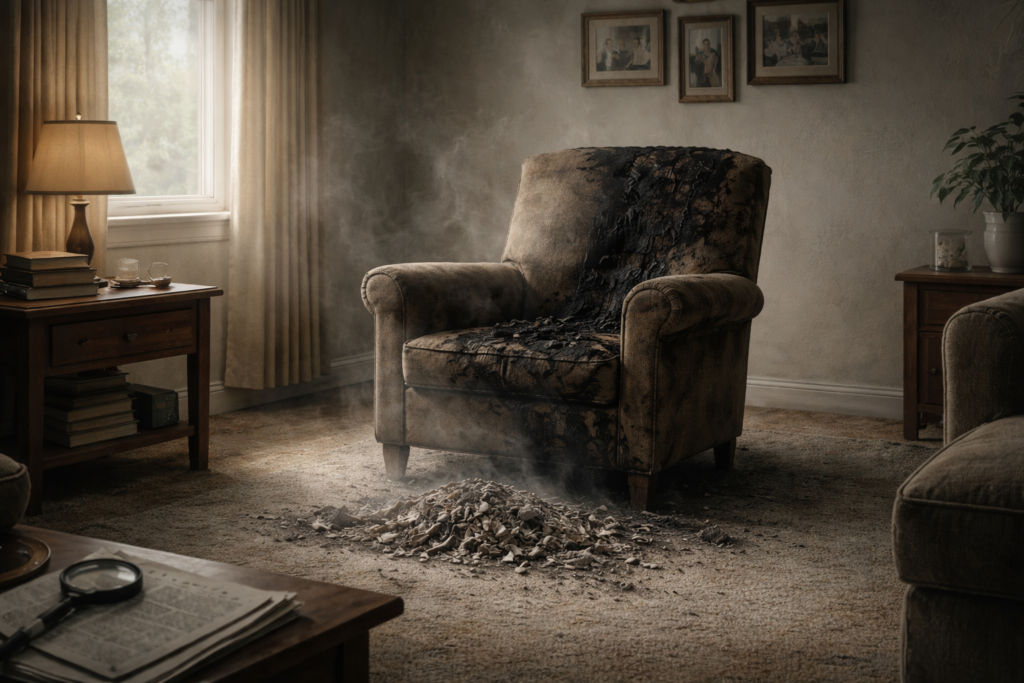
The classic image is always the same. Someone enters a room and finds a small pile of ashes where a person once sat. The body is nearly destroyed, yet the chair beneath it is barely scorched and the rest of the room looks strangely untouched. For centuries, this baffling scene was explained by a dramatic idea—that a person could suddenly burst into flames from the inside, without any external fire at all.
It sounds like something lifted straight from a gothic novel, but belief in spontaneous human combustion stretches back to at least the seventeenth century and reached its peak in the Victorian era. To understand why it gained such traction, it helps to look at the social attitudes of the time, the cases that convinced people it was real, and what modern forensic science eventually uncovered.
Much of the early belief rested on moral judgment rather than evidence. In the nineteenth century, spontaneous human combustion was widely accepted as a kind of divine punishment. Many of the alleged victims were described as heavy drinkers, often elderly, overweight, or socially isolated, and women were frequently overrepresented in the reports. To Victorian minds, this pattern felt meaningful. Alcohol was flammable, after all, and it seemed reasonable—at least then—to assume that a body saturated with spirits might somehow ignite. Sensational newspaper reporting amplified the mystery, presenting lurid details while glossing over inconvenient facts.
The idea gained intellectual credibility in 1746 when Paul Rolli, a Fellow of the Royal Society, formally used the term “spontaneous human combustion” while describing the death of Countess Cornelia Zangari Bandi. The involvement of a respected scientific figure gave the concept legitimacy that lingered for generations.
Several cases became canonical. Countess Bandi’s death in 1731 was described as leaving little more than ashes and partially intact legs, still clothed in stockings. In 1966, John Irving Bentley of Pennsylvania was found almost completely burned except for one leg, with his pipe discovered intact nearby. Mary Reeser, known as the “Cinder Woman,” died in Florida in 1951, leaving behind melted fat embedded in the rug near where she had been sitting. As recently as 2010, an Irish coroner ruled that spontaneous human combustion caused the death of Michael Faherty, whose body was found badly burned near a fireplace in a room that showed little fire damage. Over roughly three centuries, about two hundred such cases have been cited worldwide.
Believers proposed explanations that ranged from the scientific-sounding to the overtly theological. Alcoholism was the most popular theory, with some physicians genuinely arguing that chronic drinking made the human body combustible. Earlier medical thinking leaned on imbalances of bodily humors, while later writers speculated about unknown chemical reactions producing internal heat. Religious interpretations framed these deaths as punishment for sin. Even in modern times, a few proponents have suggested that acetone buildup in people with alcoholism, diabetes, or extreme diets could somehow trigger combustion.
The idea was so culturally embedded that Charles Dickens famously killed off the alcoholic character Mr. Krook by spontaneous combustion in Bleak House. When critics objected, Dickens defended the plot choice by citing what he believed were credible historical and medical sources.
The illusion of the supernatural persisted because the circumstances were almost perfectly misleading. Victims were typically alone, elderly, or physically impaired, unable to respond quickly to a smoldering fire. The localized damage looked impossible to the untrained eye. Potential ignition sources were often destroyed in the fire itself. And dramatic storytelling filled in the gaps left by incomplete investigations.
What actually happens in these cases is far less mystical and far more unsettling. Modern forensic science points to an explanation known as the “wick effect.” In this scenario, there is always an external ignition source—often a cigarette, candle, lamp, or fireplace ember. Once clothing catches fire, heat melts the person’s body fat. That liquefied fat soaks into the clothing, which then behaves like a candle wick. The fire burns slowly and steadily, sometimes for hours, consuming much of the body while leaving nearby objects relatively unscathed.
This effect has been demonstrated experimentally. In the 1960s, researchers at Leeds University showed that cloth soaked in human fat could sustain a slow burn for extended periods once ignited. In 1998, forensic scientist John de Haan famously replicated the effect for the BBC by burning a pig carcass wrapped in a blanket. The result closely matched classic spontaneous combustion scenes: severe destruction of the body, with extremities left behind and limited damage to the surrounding room.
The reason these fires don’t usually engulf the entire space is simple physics. Flames rise more easily than they spread sideways, and the heat output of a wick-effect fire is relatively localized. It’s similar to standing near a campfire—you can be close without catching fire yourself.
Investigators Joe Nickell and John F. Fischer examined dozens of historical cases and found that every one involved a plausible ignition source, details that earlier accounts often ignored or downplayed. When these factors are restored to the narrative, the mystery largely disappears.
As science writer Benjamin Radford has pointed out, if spontaneous human combustion were truly spontaneous, we would expect it to occur randomly and frequently, in public places as well as private ones. Instead, it consistently appears in situations involving isolation and an external heat source.
The bottom line is straightforward. There is no credible scientific evidence that humans can burst into flames without an external ignition source. What has been labeled spontaneous human combustion is better understood as a tragic combination of accidental fire and the wick effect. The myth endured because it blended moral judgment, fear, and incomplete science into a compelling story. Today, forensic investigation has replaced superstition with explanation, even if the results remain unsettling.
Spontaneous human combustion survives as a reminder of how easily mystery fills the space where evidence is thin—and how patiently applied science eventually closes that gap.
Sources and Further Reading
Peer-reviewed forensic and medical analyses are available through the National Center for Biotechnology Information, including “So-called Spontaneous Human Combustion” in the Journal of Forensic Sciences (https://pubmed.ncbi.nlm.nih.gov/21392004/) and Koljonen and Kluger’s 2012 review, “Spontaneous human combustion in the light of the 21st century,” published in the Journal of Burn Care & Research (https://pubmed.ncbi.nlm.nih.gov/22269823/).
General scientific and historical overviews can be found in Encyclopædia Britannica’s article “Is Spontaneous Human Combustion Real?” (https://www.britannica.com/story/is-spontaneous-human-combustion-real), Scientific American’s discussion of the wick effect (https://www.scientificamerican.com/blog/cocktail-party-physics/burn-baby-burn-understanding-the-wick-effect/), and Live Science’s summary of facts and theories (https://www.livescience.com/42080-spontaneous-human-combustion.html).
Accessible explanatory pieces are also available from HowStuffWorks (https://science.howstuffworks.com/science-vs-myth/unexplained-phenomena/shc.htm), History.com (https://www.history.com/articles/is-spontaneous-human-combustion-real), Mental Floss (https://www.mentalfloss.com/article/22236/quick-7-seven-cases-spontaneous-human-combustion), and All That’s Interesting (https://allthatsinteresting.com/spontaneous-human-combustion). Wikipedia’s entries on spontaneous human combustion and the wick effect provide comprehensive background and references at https://en.wikipedia.org/wiki/Spontaneous_human_combustion and https://en.wikipedia.org/wiki/Wick_effect.
Leave a Reply