
A Clearer Look at the Chemistry of Health and Aging
Introduction: The Invisible Chemistry Inside Your Body
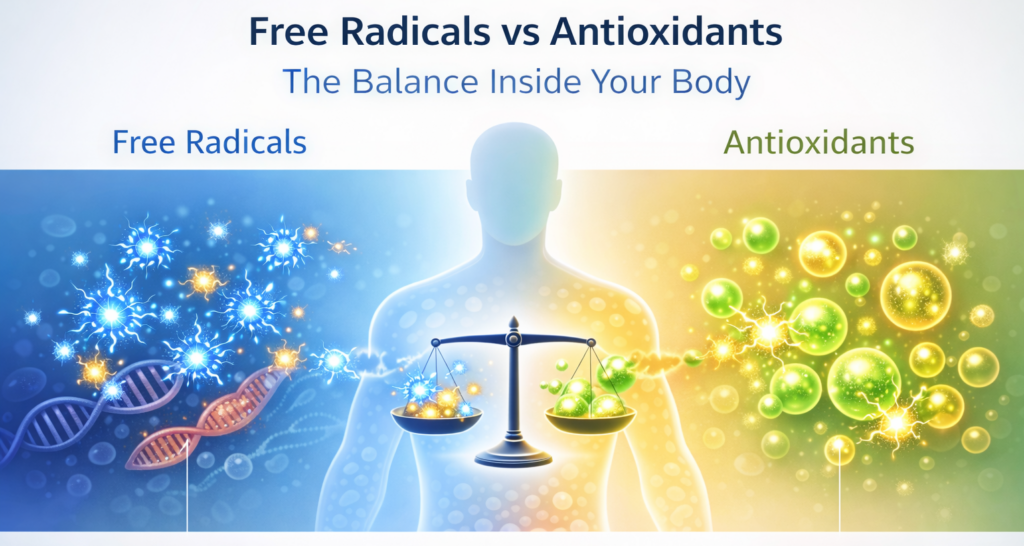
At this very moment, a quiet chemical battle is taking place inside every cell of your body. On one side are free radicals—unstable molecules that react aggressively with nearby cells. On the other side are antioxidants, compounds that neutralize those unstable molecules before they cause damage.
When these two forces stay in balance, the body functions normally. But when free radicals outnumber the body’s defenses, the result is oxidative stress. Scientists increasingly believe oxidative stress contributes to aging and many chronic diseases.
Understanding this process does not require a chemistry degree. But knowing the basics can help explain why lifestyle choices such as diet, smoking, sun exposure, and exercise affect long-term health.
What Are Free Radicals?
Free radicals are simply unstable molecules. They are unstable because they contain an unpaired electron, which makes them highly reactive.
To stabilize themselves, free radicals attempt to steal electrons from nearby molecules. When they do this, they may damage the structure of cells, proteins, or DNA.
The most common free radicals in the body are forms of oxygen and nitrogen known as reactiveoxygen species (ROS) and reactive nitrogen species (RNS). Examples include superoxide, hydrogen peroxide, and hydroxyl radicals. Although these names sound intimidating, the basic idea is straightforward: they are oxygen-based molecules that react easily with other parts of the cell.
According to the National Cancer Institute, free radicals form when atoms or molecules gain or lose electrons during normal metabolic processes.
How Free Radicals Are Produced
Free radicals arise from both normal body processes and environmental exposures.
Internal Sources
The most important source is the body’s energy production system. Cells convert food into energy inside tiny structures called mitochondria. During this process, small numbers of free radicals are produced as natural by-products.
In addition, the immune system intentionally generates free radicals when fighting infections. Certain white blood cells release bursts of reactive oxygen molecules that help destroy bacteria and viruses.
Free radical production can also increase during inflammation, psychological stress, and intense physical exertion. In short, some degree of free radical production is unavoidable because it is a normal part of life’s chemistry.
External Sources
Environmental exposures can significantly increase free radical production. Cigarette smoke is one of the most powerful sources of oxidative chemicals. Air pollution, alcohol consumption, and excessive exposure to sunlight—particularly ultraviolet radiation—can also generate large numbers of reactive molecules. In addition, exposure to pesticides, industrial chemicals, and certain types of radiation may contribute to oxidative reactions inside the body.
These exposures can push free radical production beyond what the body’s natural defenses can easily manage.
The Surprisingly Useful Side of Free Radicals
Free radicals are often portrayed as purely harmful, but that description is incomplete. In moderate amounts they serve several useful functions.
One of the immune system’s most effective weapons is the oxidative burst. When immune cells encounter bacteria, they release a wave of free radicals that chemically attack and destroy the invading organisms. Without this response, the body would have far greater difficulty controlling infections.
Small amounts of reactive molecules also function as cellular signaling agents, helping regulate processes such as cell growth, repair, and programmed cell death. Programmed cell death is especially important because it allows the body to remove damaged or potentially dangerous cells.
Nitric oxide provides another example. Although it technically qualifies as a free radical, it plays an important role in controlling blood vessel relaxation and maintaining healthy blood pressure.
Exercise also temporarily increases free radical production. Surprisingly, this mild oxidative stress appears to stimulate beneficial adaptations. The body responds by strengthening its natural antioxidant defenses, which may partly explain why regular physical activity improves long-term health. Some researchers have suggested that very large doses of antioxidant supplements taken around workouts could reduce some of these benefits, although this remains an area of ongoing research.
When Free Radicals Cause Damage
Problems begin when free radical production exceeds the body’s ability to neutralize them.
Because free radicals steal electrons from other molecules, they can trigger chain reactions that damage important cellular structures.
One major target is the cell membrane. Cell membranes are composed largely of fats, and free radicals can attack these fats in a process called lipid peroxidation. When this happens, the membrane becomes weaker and less able to control what enters or leaves the cell.
Proteins are another common target. Proteins carry out much of the body’s work, including thousands of chemical reactions controlled by enzymes. When free radicals alter the structure of proteins, those proteins may lose their normal function.
Perhaps the most concerning effect involves DNA damage. Free radicals can alter the genetic material inside cells, creating mutations. If the body’s repair systems cannot correct these changes, the mutations may contribute to the development of cancer.
The body does possess repair mechanisms that fix much of this damage. However, these systems can be overwhelmed when oxidative stress persists for long periods.
Free Radicals and Chronic Disease
Researchers have found a strong association between oxidative stress and chronic diseases. Although the exact relationships are still being studied, the evidence suggests that oxidative damage contributes to several major health conditions.
Cardiovascular disease provides one of the clearest examples. Oxidative stress appears to play an important role in atherosclerosis, the process that leads to heart attacks and strokes. Free radicals can chemically modify LDL cholesterol, making it more likely to accumulate in artery walls and trigger plaque formation.
Cancer is also linked to oxidative DNA damage. When free radicals alter genetic material, they may activate genes that promote uncontrolled cell growth or disable genes that normally suppress tumors.
Interestingly, cancer cells themselves often produce large amounts of free radicals because of their rapid metabolism. Some cancer therapies take advantage of this by pushing tumor cells beyond their ability to tolerate oxidative stress.
Neurodegenerative diseases such as Alzheimer’s disease and Parkinson’s disease are also associated with oxidative damage. The brain may be particularly vulnerable because it consumes large amounts of oxygen and contains fats that are easily oxidized.
Other conditions linked to oxidative stress include diabetes, cataracts, rheumatoid arthritis, chronic kidney disease, and inflammatory bowel disease. Aging itself may partly reflect the gradual accumulation of oxidative damage over time, a concept sometimes referred to as the free radical theory of aging.
Antioxidants: The Body’s Defense System
The body is not defenseless against free radicals. It maintains an extensive network of protective molecules known as antioxidants. They stabilize free radicals by donating an electron without becoming unstable themselves. This process stops the damaging chain reaction. The body relies on both internally produced antioxidants and antioxidants obtained from food.
Antioxidants Produced by the Body
Several powerful antioxidant enzyme systems operate inside cells. They work together to convert highly reactive molecules into less harmful substances, eventually producing water or oxygen.
A key molecule is glutathione, sometimes described as the body’s “master antioxidant.” Produced largely in the liver, glutathione plays an important role in neutralizing free radicals and assisting in detoxification processes.
However, the body’s ability to produce some antioxidants may decline with age, which could partly explain increased vulnerability to oxidative damage later in life.
Antioxidants from Food
Diet provides a wide variety of antioxidant compounds that support the body’s defenses.
Vitamin C is a water-soluble antioxidant commonly found in citrus fruits, strawberries, bell peppers, and broccoli. Vitamin E, a fat-soluble antioxidant that helps protect cell membranes, is abundant in nuts, seeds, and vegetable oils.
Plant pigments known as carotenoids also have antioxidant activity. Beta-carotene in carrots and sweet potatoes, lycopene in tomatoes, and lutein in leafy green vegetables are well-known examples. Plants also produce thousands of protective compounds called polyphenols. These substances occur in foods such as berries, tea, apples, onions, dark chocolate, and olive oil.
Because different plant foods contain different protective chemicals, nutrition scientists often recommend eating a variety of colorful fruits and vegetables.
The Antioxidant Supplement Puzzle
For many years, antioxidant supplements were promoted as a simple way to prevent disease. However, large clinical studies have produced mixed results. Several major trials found that high-dose antioxidant supplements did not provide the expected benefits. In some cases they were even associated with harm. For example, studies showed that high dose beta-carotene supplements increased lung cancer risk in smokers.
One possible explanation is that antioxidants behave differently when taken in very large doses. Under certain conditions they may act as pro-oxidants, potentially increasing oxidative reactions instead of preventing them.
Another concern involves cancer treatment. Some therapies work by generating oxidative damage that destroys cancer cells. High doses of antioxidant supplements might interfere with this mechanism.
Because of these uncertainties, many experts recommend obtaining antioxidants primarily from whole foods rather than supplements.
Oxidative Stress: When the Balance Is Lost
Oxidative stress occurs when free radical production exceeds the body’s ability to neutralize them. At the cellular level, oxidative stress can weaken membranes, disrupt protein function, and damage DNA. At the tissue level, it can trigger chronic inflammation, which in turn generates additional free radicals and perpetuates the cycle of damage.
Because free radicals exist only briefly, scientists usually measure oxidative stress indirectly by detecting chemical by-products that remain after oxidative reactions occur.
Lifestyle Factors That Influence Oxidative Stress
Many everyday habits influence the balance between free radicals and antioxidants.
Smoking, heavy alcohol consumption, air pollution exposure, chronic psychological stress, diets high in processed foods, obesity, and poorly controlled diabetes all increase oxidative stress.
In contrast, regular moderate exercise, diets rich in fruits and vegetables, maintaining a healthy weight, avoiding smoking, and managing stress help maintain a healthier balance between free radicals and antioxidants.
Conclusion: Balance Is Everything
The story of free radicals, antioxidants, and oxidative stress is ultimately about balance.
Free radicals are not simply destructive molecules. In appropriate amounts they help the immune system fight infection, regulate cellular communication, and assist the body in adapting to exercise. The damage occurs when these reactive molecules accumulate faster than the body can control them.
Antioxidants are an important part of the defense system, but they are not magic solutions. The best strategy appears to be supporting the body’s natural balance through healthy lifestyle choices. A diet rich in plant foods, regular physical activity, avoiding smoking, and minimizing harmful exposures all help maintain that balance.
Despite decades of marketing by the supplement industry, scientific evidence continues to suggest that the complex chemistry of whole foods works better than isolated antioxidant pills.
In many ways, modern science has simply confirmed an old piece of advice: eat plenty of fruits and vegetables, stay active, and take care of your body.
Sources:
Cleveland Clinic – Oxidative Stress
PMC – Free Radicals, Antioxidants in Disease and Health (2013)
Nature Cell Death Discovery – Free Radicals and Their Impact on Health (2025)
Frontiers in Chemistry – Oxidative Stress and Antioxidants (2023)
PMC – Oxidative Stress Crosstalk in Human Diseases (2023)
PMC – Free Radicals, Antioxidants and Functional Foods
MD Anderson Cancer Center – What Are Free Radicals?
Medical News Today – Free Radicals: How Do They Affect the Body?
Cleveland Clinic Health – What Are Free Radicals?
Top of Form
Bottom of Form
Leave a Reply