
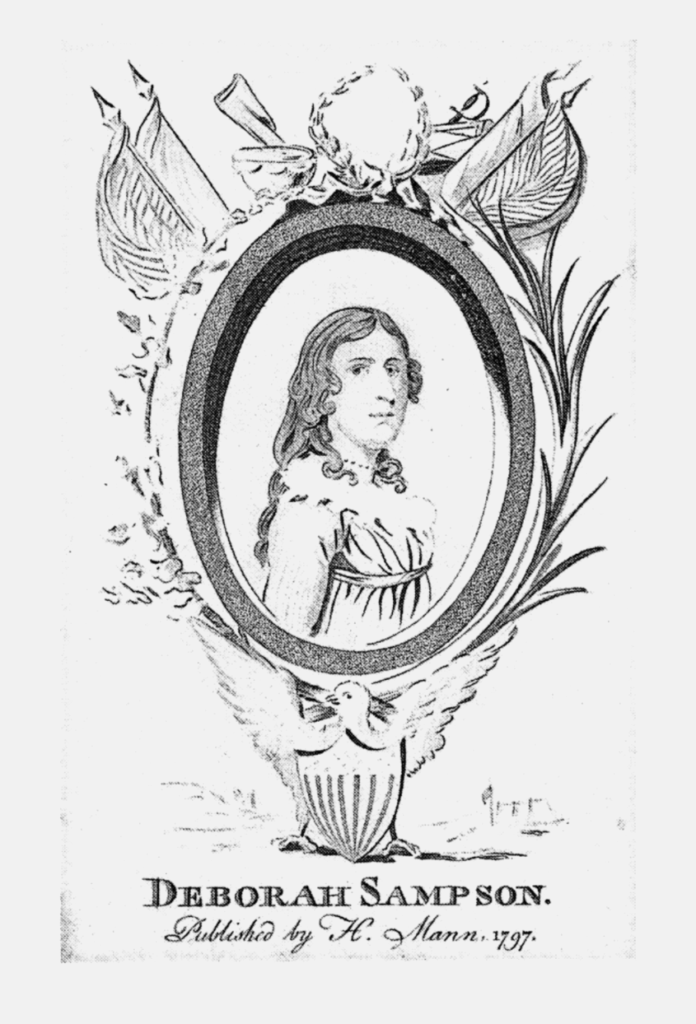
In the story of the American Revolution, the names most often remembered are those of the Founding Fathers and battlefield generals. Yet woven through the familiar narrative are lesser known but extraordinary individuals whose actions defied the norms of their time. One of the most remarkable among them was Deborah Sampson, a Massachusetts woman who disguised herself as a man and served for nearly two years in the Continental Army. Her life reflects not only courage and patriotism, but also the complexity of gender roles in Revolutionary America
A Difficult Early Life
Deborah Sampson was born in Plympton, Massachusetts, in 1760 as the eldest of seven children in a family with deep Pilgrim roots, tracing lineage to Myles Standish and Governor William Bradford. Despite this heritage, her family struggled financially, and she grew up with poverty and abandonment. Her father deserted the family when she was young, leaving her mother with limited resources to care for their children. It was initially thought that he had died at sea, but they later discovered he had actually moved to Maine where he married and raised a second family.
Deborah was still young when her mother died and she was sent to live with a widow, Mary Price Thatcher, then in her 80s. Deborah likely learned to read while living with her. After Widow Thatcher died, Deborah was bound out as an indentured servant to the Thomas family in Middleborough, Massachusetts, where she worked until she turned 18. This experience exposed her to hard physical labor and taught her skills typically associated with men’s work, including farming and carpentry. During this time, she educated herself and developed a keen intellect that would prove invaluable throughout her life.
When her term of indenture ended in 1782, Sampson found herself in a precarious position as a young, unmarried woman with few economic opportunities. She intermittently supported herself as a teacher in the summers and a weaver in the winters.
Enlisting in the Army
The Revolutionary War was still raging, and the Continental Army desperately needed recruits. Motivated by both patriotic fervor and economic necessity, Sampson made the audacious decision to enlist in the army disguised as a man. She initially enlisted in 1782 under the name Timothy Taylor and collected a cash enlistment bounty but she failed to report for duty with her company. She was later recognized as being Taylor and was required to repay what she had not already spent from her enlistment bounty. No further punishment was made by the civil authorities; however, the Baptist Church withdrew its fellowship until she apologized and asked for forgiveness.
She later made a second enlistment, adopting the name Robert Shurtleff (sometimes spelled Shurtlieff or Shirtliff). This time she followed through and reported for duty.
She bound her chest, cut her hair, and donned men’s clothing to complete her transformation. Sampson’s physical appearance aided her deception. She was tall for a woman of her era, standing nearly six feet, with a lean build and strong constitution developed through years of manual labor. Her lack of facial hair was not unusual among young male recruits, and she successfully passed the initial examination to join the 4th Massachusetts Regiment in May 1782.
The challenge of maintaining her disguise while living in close quarters with other soldiers required constant vigilance. Sampson developed strategies to protect her secret, including volunteering for guard duty to avoid sleeping arrangements that might expose her, and finding private moments to tend to personal needs. She also had to manage the physical demands of military life while dealing with the unique challenges of being a woman in a male-dominated environment.
Sampson’s military career nearly ended when she was wounded during a skirmish. She received a sword cut to her head and was shot in the thigh. Fearing that medical treatment would reveal her true identity, she initially treated her wounds herself, even digging a musket ball out of her own leg with a knife. Some of the shot remained too deep to remove, leaving her with a lifelong disability.
During her military service, Sampson demonstrated exceptional courage and skill as a soldier. She participated in several skirmishes and battles, including engagements near New York City and in Westchester County. Her fellow soldiers respected her for her dedication, marksmanship, and willingness to volunteer for dangerous scouting missions. She proved herself particularly adept at reconnaissance work, using her intelligence and observational skills to gather valuable information about enemy positions and movements.
Discovery and Discharge
During an epidemic in Philadelphia, she fell seriously ill with a fever and was taken to a hospital, where a physician discovered her secret while treating her. Fortunately, the doctor, Barnabas Binney, chose to protect Sampson rather than expose her. He treated her quietly and helped facilitate her honorable discharge from the army in October 1783. Her commanding officer, General John Paterson, reportedly handled the situation with discretion and respect, recognizing her valuable service to the cause of independence. Eventually she was discharged by General Henry Knox on October 25, 1783, and was given funds to return home and a Note of Advice, similar to modern discharge papers.
Life After the War
After the war, Sampson returned to Massachusetts, where she married Benjamin Gannet in 1785 and had three children. But like many veterans, she struggled financially and had difficulty obtaining the military pay and benefits she had earned. In 1792, with the help of prominent supporters—including Paul Revere—she successfully petitioned the Massachusetts legislature for back pay and a modest state pension and she later received a pension from the federal government.
Her story didn’t end with domestic life. She became one of the first women in America to go on a speaking tour, traveling throughout New England and New York to share her experiences. Wearing her military uniform, she delivered a combination of storytelling, dramatic performance of military drills, and patriotic appeal. These lectures, which began in 1802, were groundbreaking for their time, as respectable women rarely spoke publicly before mixed audiences.
A Lasting Legacy
Deborah Sampson’s legacy extends far beyond her military service. She challenged rigid gender roles and demonstrated that women could serve their country with the same valor and effectiveness as men. Her story inspired future generations of women who sought to break barriers and serve in traditionally male-dominated fields.
After she died in 1827, her story continued to gain recognition. In 1838, her husband was awarded a widow’s pension, possibly the first instance in U.S. history that the benefit was granted to a man based on his wife’s military service.
She left behind a legacy of courage, determination, and pioneering spirit that continues to resonate today. In 1983, she was declared the Official Heroine of the Commonwealth of Massachusetts, and in 2020, the U.S. House of Representatives passed the Deborah Sampson Act, expanding healthcare and benefits for female veterans. Statues and memorials, including her gravesite in Sharon, Massachusetts, commemorate her contributions. Her wartime exploits have been the subject of books, plays, and scholarly research and her story continues to inspire generations as a symbol of courage and the ongoing struggle for gender equality in military service.
While she was not the only woman to disguise herself and enlist—others like Margaret Corbin and Anna Maria Lane also took up arms—Sampson is among the best documented and celebrated.
Her life represents a crucial chapter in both military history and women’s history, illustrating the complex ways in which the American Revolution created opportunities for individuals to transcend social conventions in service of the greater cause of independence. Deborah’s journey from indentured servant to Continental Army soldier and national lecturer is a testament to her extraordinary courage and determination. By stepping into a role forbidden to women and excelling under the harshest conditions, she challenged the boundaries of her time and set a precedent for future generations.
Though it is possible that her wartime activities may have been exaggerated—a common practice in biographies of the time—her life remains a powerful reminder of the contributions women have made, often unrecognized, in the shaping of American history.
The illustration at the beginning of this post is from The Female Review: Life of Deborah Sampson, the Female Soldier in the War of Revolution (1916), a reprint of the 1797 biography by Herman Mann.
Leigh Shepherd
Fascinating. Are other female fighters considered by historians?