
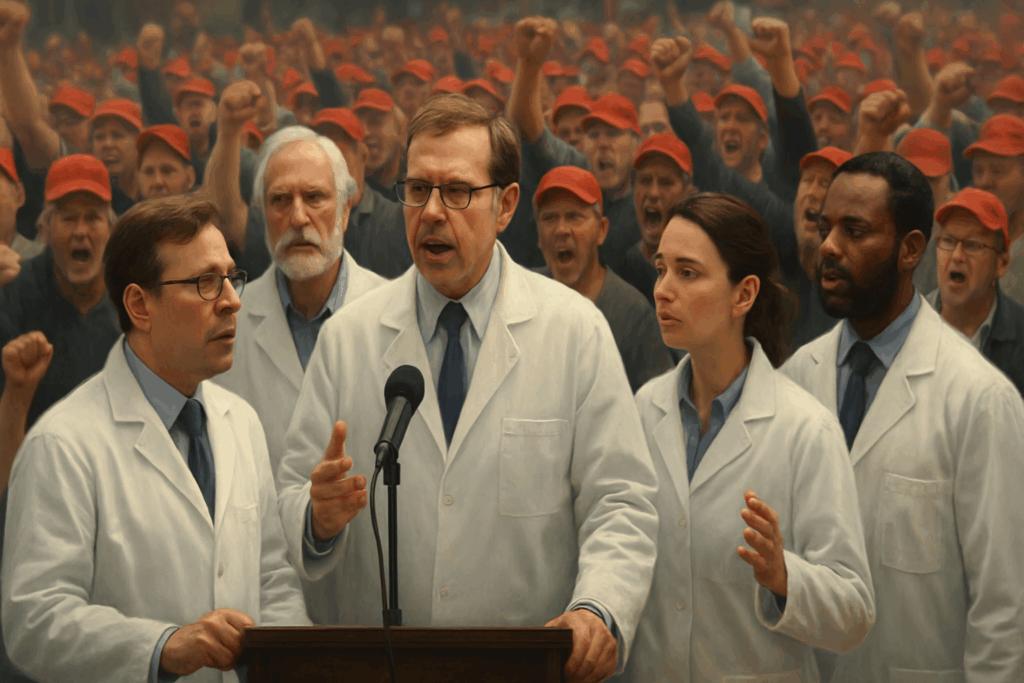
While I would never call myself a scientist, as a physician my whole professional life is built on the belief in and the trust of science. I am distressed that so many people have chosen to disregard trust in science in favor of misinformation.
Throughout history, scientific discovery has been humanity’s most reliable guide to progress. From the germ theory of disease to space exploration, science has reshaped how we live and what we believe possible. Yet in recent years, the very foundation of this methodical pursuit—evidence, observation, and experimentation—has come under sustained political, cultural, and economic attack. This struggle is often described as “the war on science,” a phrase that captures how debates once rooted in policy have shifted into battles over truth itself.
The numbers tell a stark story. The National Science Foundation has terminated roughly 1,040 grants that would have awarded $739 million to researchers and has awarded only 52 undergraduate research grants in 2025, compared to about 200 annually since 2015. The proposed cuts are staggering. Trump will request a $4 billion budget for the NSF in fiscal year 2026, a 55% reduction from what Congress appropriated for 2025.
At the heart of the conflict lies mistrust. Science requires patience since answers evolve as new data emerge. But in a world driven by instant communication and ideological certainties, that evolving nature is often cast as contradiction or weakness. Critics dismiss changing conclusions not as hallmarks of rigorous inquiry, but as evidence of unreliability. The result is a dangerous fracture; science depends on trust in evidence, while many segments of society increasingly place trust in ideology or anecdote or even outright falsehoods.
Climate change is one of the most visible fronts in this battle. Virtually every major scientific body worldwide affirms that human activities are driving global warming. Yet climate scientists are routinely accused of bias or conspiracy, their data questioned, and their motives impugned. What is often overlooked in the controversy is not the complexity of climate systems—scientists have long acknowledged uncertainties—but the political and economic interests threatened by the solutions science prescribes. When climate scientists publish evidence of global warming, their research doesn’t just describe weather patterns—it challenges powerful industries built on fossil fuels.
Public health provides another stark example. During the COVID-19 pandemic, scientific guidance became subject to fierce political polarization. Masking policies, vaccine safety, and even simple social distancing rules morphed into partisan symbols rather than matters of medical evidence. Scientists found themselves vilified, their professional debates distorted into talking points. The losers in this exchange were not the scientists themselves but the broader public, denied clear trust in institutions that are dedicated to safeguarding health.
Underlying these conflicts are powerful currents. Some industries resist regulation by casting doubt on findings that threaten profit. Certain political movements thrive on skepticism of expertise, channeling populist distrust of “elites” toward scientists. And in the swirl of social media, misinformation spreads more rapidly than peer-reviewed studies, eroding the influence of evidence before consensus can take hold.
What makes this particularly concerning is the timing. America’s main scientific and technological rivals are rising fast. In terms of federal Research and Development funding as a percentage of GDP, U.S. investment has dropped for decades, and the lead that the U.S. enjoyed over China’s R&D expenditure has largely been erased.
While the war on science is often treated as a distinctly modern dilemma, born of political polarization, mass media, and cultural distrust of expertise, its roots stretch back centuries. Galileo was silenced for challenging religious dogma. Early physicians were scorned when they argued that invisible germs, not miasmas or curses, caused disease. During the Enlightenment of the 17th and 18th centuries, thinkers faced their own version of this struggle—a battle between dogma and reason, authority and evidence, tradition and discovery. In every case, vested interests—whether theological, cultural, or economic—feared the disruption that scientific truth carried. Understanding those earlier conflicts provides valuable context for our challenges today.
The stakes today, however, feel higher. Our era’s challenges—climate change, pandemics, artificial intelligence, genetic engineering—demand unprecedented reliance on scientific understanding. To wage war on science is, in effect, to wage war on our own best chance for survival and responsible progress. If truth becomes negotiable, then evidence loses meaning, and with it, the possibility of reasoned self-government. That is why the war on science cannot be dismissed as a technical squabble—it is a philosophical contest echoing the Enlightenment battles that shaped modern civilization.
Ultimately, the struggle is less about data than about values. Do we commit to curiosity, openness, and the willingness to change our minds? Or do we cling to certainties that soothe but endanger us in the end? The war on science will not be won by scientists alone. It can only be resolved if society restores trust in evidence as the most reliable compass we have—however unsettling the direction it may point. There may be alternative opinions but there are no alternative facts.
Leave a Reply