
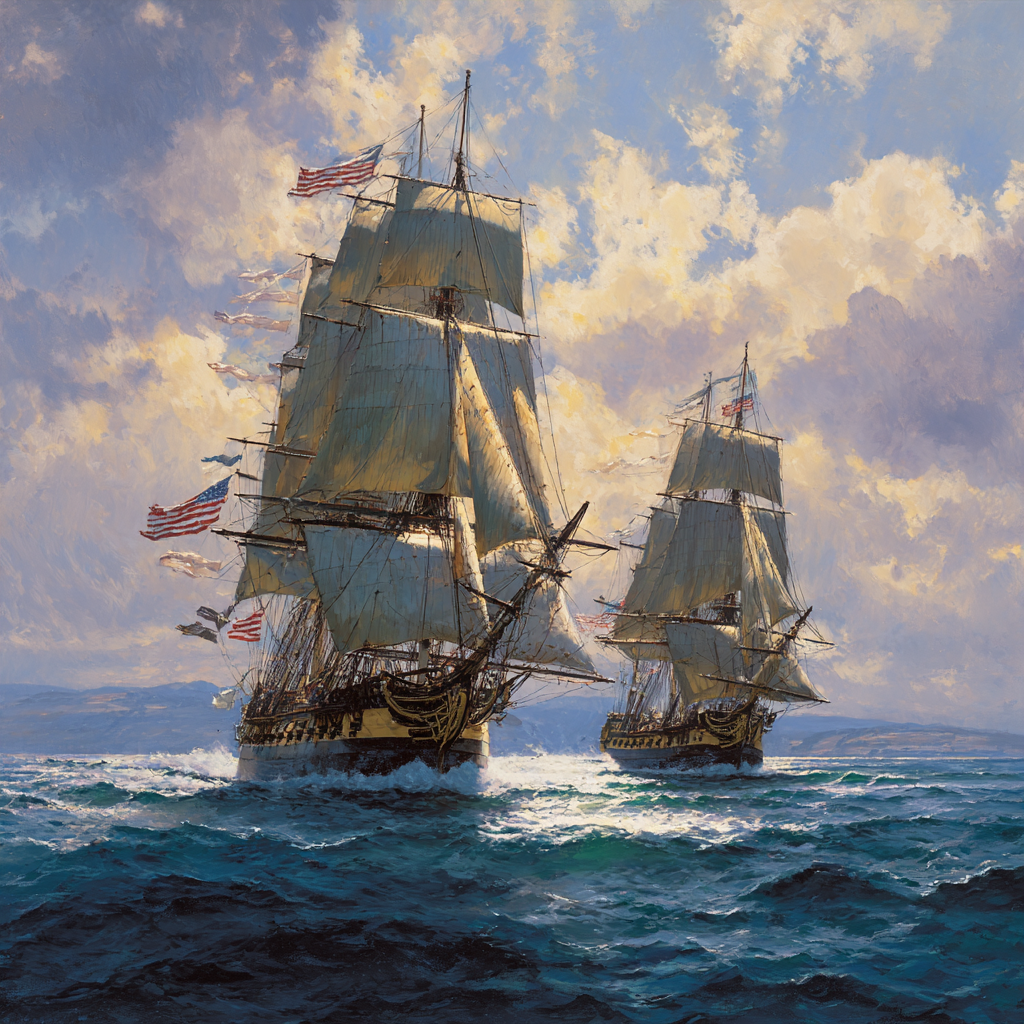
The Continental Navy, established during the American Revolution, represented the colonies’ first organized attempt to challenge British naval supremacy. Though vastly outnumbered and outgunned by the Royal Navy, this fledgling force played a crucial role in securing American independence through daring raids, strategic disruption of British supply lines, and pivotal battles that helped turn the tide of war.
Congressional Acts and Political Support
The Continental Navy’s creation stemmed from military necessity rather than long-term naval planning. On October 13, 1775, the Continental Congress passed the first naval legislation, authorizing the fitting out of two vessels to intercept British supply ships carrying munitions to loyalist forces. This modest beginning expanded rapidly when Congress passed additional acts on October 30, 1775, calling for the construction of thirteen frigates and establishing the foundation of American naval power.
The Navy’s primary champions in Congress came from maritime colonies that understood sea power’s importance. John Adams of Massachusetts emerged as the Navy’s most vocal advocate, arguing that naval forces were essential for protecting American commerce and challenging British control of coastal waters. Recognizing that their states’ economic survival depended on maintaining sea access Samuel Chase of Maryland and Christopher Gadsden of South Carolina (designer of the Gadsden Flag) also provided crucial support. Rhode Island’s Stephen Hopkins, whose state had a rich maritime tradition, consistently voted for naval appropriations and expansion.
Opposition came primarily from other southern agricultural colonies that viewed naval expenditures as wasteful diversions from land-based military needs. Virginia’s delegates, despite their state’s extensive coastline, often questioned the wisdom of directly challenging Britain’s naval supremacy. These political divisions reflected deeper disagreements about military strategy and resource allocation during the war.
Ship Acquisition and Fleet Development
The Continental Navy acquired vessels through multiple methods, reflecting the revolution’s improvisational nature. Congress initially authorized the purchase and conversion of merchant ships, transforming trading vessels into warships through the addition of cannons and other military equipment. The frigates Cabot and Andrew Doria began as merchant vessels before receiving naval modifications.
New construction was the Navy’s most ambitious undertaking. The thirteen frigates authorized in 1775 were built in shipyards from New Hampshire to Georgia, spreading construction contracts across multiple colonies to ensure political support and reduce vulnerability to British attacks. These ships, including the Hancock and Randolph—named after prominent patriots to increase support—varied in size from 24 to 32 guns and represented state-of-the-art naval architecture.
Captured British vessels were also added to the fleet. American naval forces seized numerous enemy ships during the war, with some converted to Continental Navy service. The most famous capture occurred when John Paul Jones took HMS Serapis during his epic battle aboard Bonhomme Richard, though ironically, his own ship sank shortly after the victory.
Private vessels operating under letters of marque also supplemented the official navy. These privateers, while not technically part of the Continental Navy, operated under congressional authorization and contributed significantly to disrupting British commerce. Although, many considered privateers to be little more than questionably legal piracy.
Officer and Sailor Recruitment
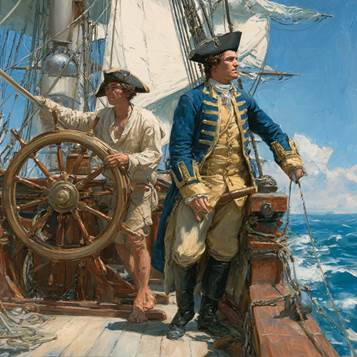
Recruiting qualified officers proved challenging for a nation lacking naval traditions. Congress appointed many officers based on political connections and regional representation rather than solely on maritime experience. However, several appointees possessed substantial seafaring backgrounds. John Paul Jones, a Scottish-born merchant captain, brought extensive seafaring experience. Esek Hopkins, the Navy’s first commander-in-chief, had commanded privateers during the French and Indian War.
Other members of the officer corps reflected colonial society’s diversity. Captains came from various backgrounds, including merchant marine service, privateering, and even some Royal Navy officers. Congress attempted to maintain geographic balance in appointments, ensuring that all colonies felt represented in the naval leadership.
Sailor recruitment proved more difficult. The Continental Navy competed with privateers, merchant ships, and the army for manpower. Privateering offered potentially greater financial rewards through prize money, making it difficult to attract sailors to regular naval service. The navy relied on bounties, promises of prize shares, and appeals to patriotism to fill crew rosters.
Many sailors were drawn from coastal communities with maritime traditions. New England provided the largest contingent, given its extensive fishing and merchant fleets. However, the navy also recruited inland farmers, artisans, and even some former British naval personnel who had deserted or been captured.
The Continental Navy rarely resorted to impressment which was little more than kidnapping, though the few sailors who were impressed were paid and usually were released after completion of a single voyage.
Major Naval Battles and Strategic Impact
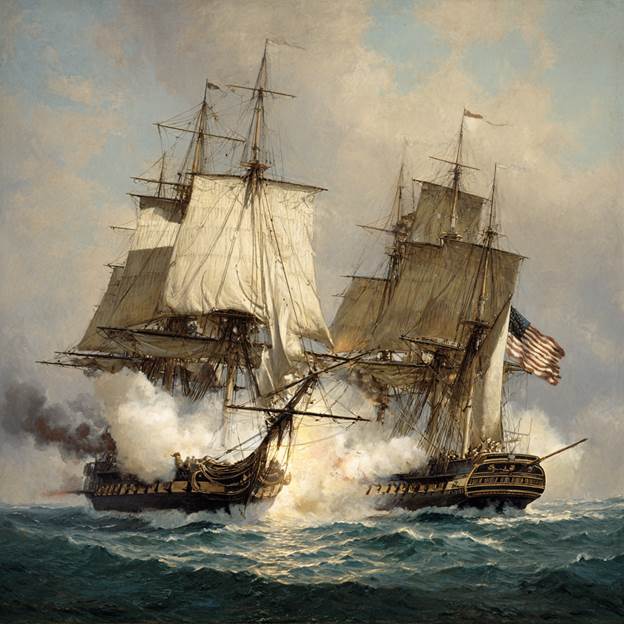
The Continental Navy’s most famous engagement occurred on September 23, 1779, when John Paul Jones commanding the Bonhomme Richard fought the HMS Serapis off the English coast. During this brutal three-and-a-half-hour battle the British called upon Jones to surrender and he reportedly replied, “I have not yet begun to fight!” His eventual victory provided a massive morale boost and international recognition of American naval capabilities.
The capture of New Providence in the Bahamas during March 1776 marked the navy’s first major operation. Esek Hopkins led a fleet of eight vessels in this successful raid, seizing gunpowder and military supplies desperately needed by Washington’s army. This victory demonstrated the navy’s potential for strategic operations beyond American coastal waters.
Naval battles along the American coast proved equally significant. The Delaware River battles of 1777 saw Continental Navy vessels attempting to prevent British naval forces from supporting the occupation of Philadelphia. Though ultimately unsuccessful, these engagements delayed British operations and demonstrated American willingness to contest enemy naval movements.
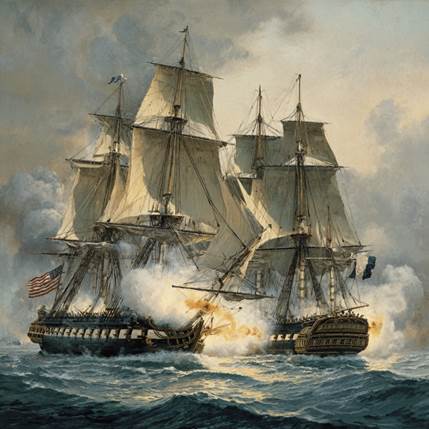
The most strategically important naval operations involved disrupting British supply lines and commerce. Continental Navy vessels captured hundreds of British merchant ships, depriving the enemy of supplies while providing America with desperately needed materials. These operations forced Britain to divert warships from other duties to provide convoy protection, reducing pressure on American forces ashore.
The Continental Navy also operated in partnership with French forces after the 1778 alliance. Joint operations extended American reach and contributed to key turning points in the war. French naval victories, especially at the Battle of the Chesapeake in 1781, indirectly sealed the fate of Cornwallis’s army at Yorktown by cutting off British reinforcements. Although this victory was French, it fulfilled the strategic vision the Continental Congress had first imagined in 1775—a sea power capable of shaping the war’s outcome.
Great Lakes Naval Operations
During the Revolution, both sides recognized the Great Lakes’ strategic importance for controlling the northwestern frontier. The British maintained naval superiority on these waters through their base at Detroit and control of key shipbuilding facilities. American forces attempted to challenge this dominance through the construction of small naval vessels on Lake Champlain and other waterways.
The most significant Revolutionary War naval action on inland waters occurred on Lake Champlain in October 1776. Benedict Arnold, commanding a small American fleet built on site, engaged a superior British force in a desperate delaying action. Though Arnold’s fleet was largely destroyed, the battle forced the British to postpone their invasion plans until the following year, providing crucial time for Americans to consolidate defenses and contributing to the American victory at Saratoga.
Trials and Transformations
Despite its courage, the Continental Navy faced constant hardship. Its ships were outgunned, its officers underpaid, and its crews plagued by desertion and disease. Many vessels were captured or scuttled to avoid seizure. The Alfred, the Navy’s first flagship, was taken by the British in 1778; others, like the Reprisal and Lexington, were lost at sea.
After the Treaty of Paris (1783), Congress was burdened by debt and saw no need for a standing blue-water navy. The last remaining ship, USS Alliance, was sold on August 1, 1785, marking the formal end of the Continental Navy, two years after the Revolutionary War ended.
It was not long before increasing attacks on American merchant ships by Barbary corsairs pushed Congress to pass the 1794 Naval Act, authorizing construction of six frigates. This was the first step in rebuilding the naval force, though it wasn’t yet a fully independent service.
On April 30, 1798, Congress created the Department of the Navy, taking naval affairs out of the War Department and officially re-establishing the United States Navy as a separate, permanent institution.
Legacy and Impact on Revolutionary Success
The Continental Navy’s impact on the Revolutionary War extended far beyond what its modest size might suggest. By challenging British naval supremacy, even unsuccessfully at times, the Continental Navy forced Britain to maintain large fleet deployments in American waters, reducing British naval availability for operations elsewhere and increasing the war’s cost.
More importantly, Continental Navy operations helped secure the French alliance that proved decisive in achieving independence. French officials were impressed by American naval courage and potential, viewing the Navy as evidence of serious commitment to independence. Naval victories like Jones’s triumph over HMS Serapis provided powerful propaganda tools for American diplomats seeking European support.
The Continental Navy also established important precedents for American naval development. The officer corps trained during the Revolution provided leadership for subsequent naval expansion. Naval yards and facilities developed during the war became foundations for future fleet construction.
Despite its relatively small size and limited resources, the Continental Navy demonstrated that determined naval forces could challenge even the world’s most powerful fleet. Through courage, innovation, and strategic thinking, America’s first navy helped secure the independence that made possible the nation’s eventual emergence as a global naval power. The lessons learned and traditions established during these formative years continued to influence American naval development long after the Revolution’s end.
Leave a Reply