
If you’re a history buff like me, you’ve probably run across fascinating but obscure characters who played a large role in a small region in distant history. I recently came across one of those people who was only referenced on a single page of a book I was reading. But the description of her was enough to get me interested in finding out more.
History has a habit of forgetting women who shaped it, especially women from Africa. But Amanirenas, the warrior queen of the ancient empire of Meroë, pulled off something that almost no one else in the ancient world ever managed. She fought Rome to a standstill and walked away with her kingdom’s independence intact. That alone makes her story remarkable.
A Kingdom You Have Never Heard Of
To understand Amanirenas, you first need to understand Meroë, and most western history classes have completely skipped it. Meroë was the capital of the Kingdom of Kush in what is now northern Sudan. It was a sophisticated, wealthy empire and was a major power in northeastern Africa for over 1000 years. The Egyptians called it Nubia “Ta-Seti”, the Land of Bows, as a tribute to the extraordinary skill of Kushite archers.
Meroë was one of the most important trading hubs of the ancient world. It sat at a natural crossroads between the Mediterranean world and sub-Saharan Africa. Ivory, gold, iron, grains, and livestock all flowed through the city. The Egyptians depended heavily on this trade, giving Meroë’s rulers extraordinary power.
Unlike much of the ancient world, Kush had a long tradition of powerful female leaders known as the kandakes. They commanded armies, negotiated treaties, and governed with the same authority as a male king.
Amanirenas was one of these kandakes. Her full title in the Meroitic language was “Amanirenas qore li kdwe li” meaning she held both the “qore” (king) and “kandake” (queen) titles simultaneously. It was a clear signal that she was the sole independent ruler of Kush.
Rome Moves In
Kush had profited handsomely from trade with Ptolemaic Egypt for generations. Around 30 BCE, Augustus Caesar defeated Cleopatra and Mark Antony and folded Egypt into the Roman Empire. Rome was a different kind of neighbor; it was hungrier, more aggressive, and believed in its divine right to expand. Roman tax collectors and administrators moved into lower Nubia, imposing heavy levies on the people of Meroë. Rome wasn’t interested in just trading; it was extracting tribute.
Amanirenas ruled alongside her husband, King Teriteqas, until he died in battle around 27 BCE, leaving her in sole command of the Kingdom and its army. She was a widow, a queen, and increasingly, a general, and she faced the most powerful military machine in the world.
The One-Eyed Queen Strikes First
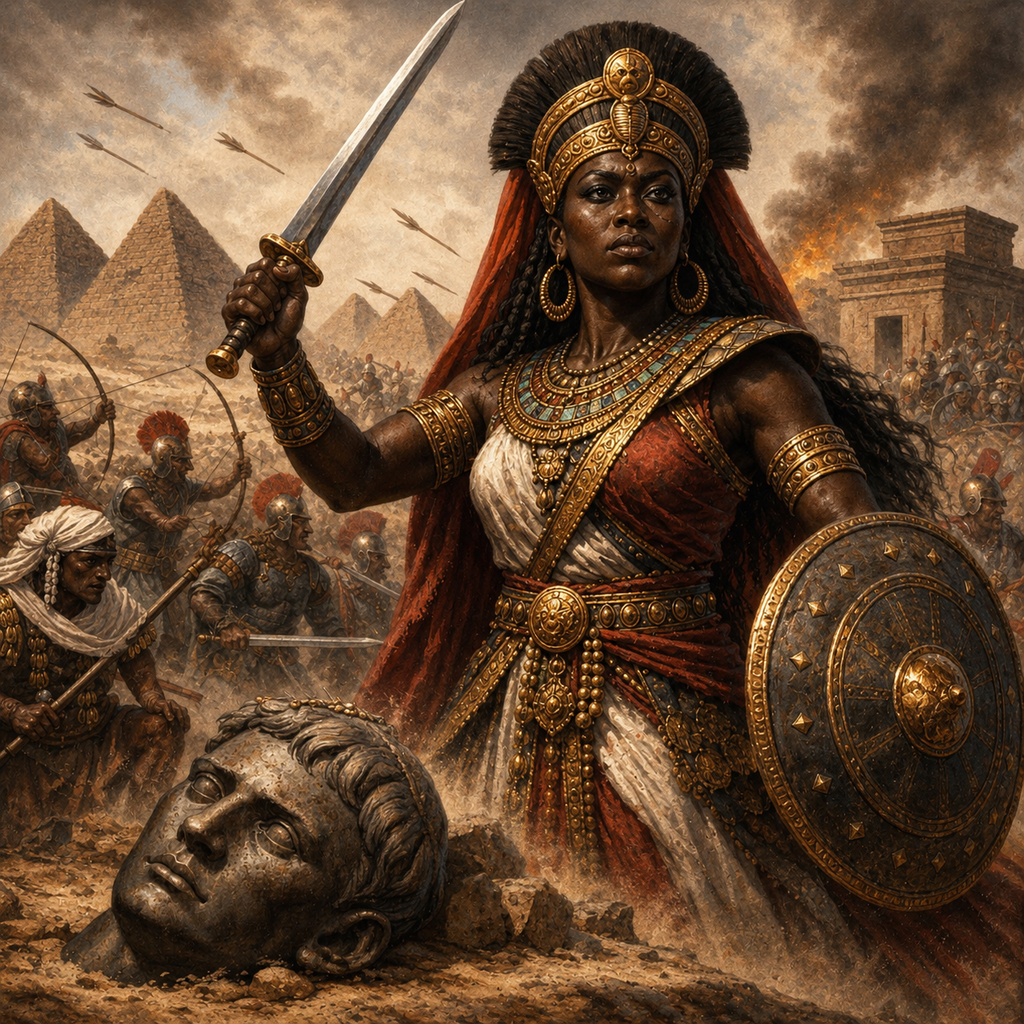
Amanirenas grew tired of being exploited by Rome. When Roman forces were pulled back for a campaign in Arabia, she acted quickly. Around 24 BCE, she led her army of some 30,000 soldiers into Roman occupied territory. Her forces captured three major Roman held cities, Syene (modern Aswan), Philae, and Elephantine. They enslaved Roman citizens and plundered the cities. In a particularly pointed act of defiance, her warriors tore down statues of Caesar Augustus throughout the captured territory.
The severed bronze head of Augustus was carried back to Meroë as a trophy. Amanirenas had it buried under the steps of a temple dedicated the victory, so that her people could walk over the face of the Roman emperor every day. This artifact, now known as the Meroë head, was rediscovered by archaeologists in the early 20th century and is on display at the British Museum.
The Greek historian Strabo, writing around 21 BCE, described Amanirenas as “a masculine sort of woman, and blind in one eye.” Strabo clearly did not mean this as a compliment and today it stands as grudging acknowledgment that this was not a queen to be taken lightly.
Rome Pushes Back and Meets Its Match
Rome predictably was not going to accept this without responding. Augustus dispatched his prefect Petronius with a veteran Roman army. The ensuing campaign pushed Kushite forces back, recapturing the occupied cities and pressing deep into Kush. Petronius sacked Napta, a city sacred to the Kushites.
But Rome found it couldn’t hold the territory it was taking. Logistics were brutal. The harsh desert environment, the long supply lines from Egypt, and Amanirenas’ aggressive guerrilla tactics all wore down Rome’s ability to sustain its army.
Amanirenas counter attacked repeatedly, keeping Roman forces off balance. Historical accounts mention her using war elephants, a weapon that would have been unnerving to even experienced Roman soldiers. The war ground on for years. Eventually, Petronius recognized he could not achieve a decisive victory and urged negotiations.
When Amanirenas’ envoys finally met with Augustus at Samos, they acted formally, not as a defeated foe. According to historian Dr. Robert Stephen Bianchi, this is believed to be the first recorded instance of Black African diplomats traveling to Europe to negotiate a peace treaty on behalf of an independent African ruler. Amanirenas sent representatives rather than going herself as a deliberate signal that she considered herself Rome’s equal, not a supplicant.
A Peace Deal That Rewrote The Map
The resulting Treaty of Samos, signed around 20 or 21 BCE, was an extraordinary diplomatic victory for Kush. Rome agreed to exempt Kush from all tribute payments, withdrawal from disputed territories and recognized Kushite sovereignty in lower Nubia. Rome’s southern border in Africa was essentially fixed, and Meroë remained fully independent. The treaty held for nearly 300 years.
Amanirenas then turned her attention to rebuilding her kingdom. The last decade of her reign, from around 21 to 10 BCE, is described as one of the most prosperous periods in Kushite history. It was the golden age of monument building, culture, and trade. The peace with Rome opened new commercial opportunities and increased the wealth of Kush.
Amanirenas never remarried. She died around 10 BCE and was buried at Jabel Barkal in Sudan. A wall painting in a pyramid chapel at Meroë commemorates her legacy, depicting her holding a bow, arrows and a spear, with seven Roman captives tethered at her feet.
Why Her Story Matters
Amanirenas checks almost every box that typically earns someone a place in the mainstream history books: military genius, savvy diplomat, resilient under fire, and a Kingdom that flourished under her leadership. Yet most people have never heard her name. Part of that is a legacy of colonial era scholarship which systematically undervalued African history. Part of it is the Meroitic language problem. Because the language still is largely undeciphered the story is told mostly through Roman and Greek eyes, with all the bias that implies.
What is clear, even from those biased sources, is that she did something extraordinary. She took on Rome, the same Rome that crushed Carthage, absorbed Egypt, and eventually swallowed up most of the known world, and she proved herself their equal. She proved that the Roman Empire had limits and she did it as a one-eyed widow, commanding an army in the field, in a desert, against the most formidable military force of the ancient world.
History, as it turns out, has a lot of catching up to do.
Image generated by the author using ChatGPT.
References
1. Wikipedia — Amanirenas: https://en.wikipedia.org/wiki/Amanirenas
2. HISTORY.com — The Nubian Queen Who Fought Back Caesar’s Army: https://www.history.com/articles/nubian-queen-amanirenas-roman-army
3. Narratively — The One-Eyed African Queen Who Defeated the Roman Empire: https://www.narratively.com/p/the-one-eyed-african-queen-who-defeated-the-roman-empire
4. Ancient Origins — The One-Eyed African Queen Who Defeated the Roman Empire: Amanirenas: https://www.ancient-origins.net/history-famous-people/queen-amanirenas-0018872
5. African History Extra — The Meroitic Empire, Queen Amanirenas and the Candaces of Kush: https://www.africanhistoryextra.com/p/the-meroitic-empire-queen-amanirenas
6. History Is Now Magazine — The Kingdom of Kush & the 27-22 BC War with Rome: http://www.historyisnowmagazine.com/blog/2023/9/18/the-kingdom-of-kush-amp-the-27-22-bc-war-with-rome
7. All That’s Interesting — The Shocking Story of Queen Amanirenas: https://allthatsinteresting.com/amanirenas
8. History Heroines — Amanirenas: One-Eyed Warrior Queen: http://historyheroines.com/2020/02/28/amanirenas/
9. Rejected Princesses — Amanirenas: The One-Eyed Queen Who Fought Rome Tooth and Nail: https://www.rejectedprincesses.com/princesses/amanirenas
10. Google Arts & Culture — Queen Amanirenas: The Story of the White Nile Nubi Archeress: https://artsandculture.google.com/story/queen-amanirenas-the-story-of-the-white-nile-nubi-archeress/bALSN3WTK_YEJA










Military Purges and Democratic Stability: Why History Still Matters
By John Turley
On November 19, 2025
In Commentary, Politics
When political power is on the line, history shows that the military often becomes the make-or-break institution. Authoritarian leaders—from Hitler to Erdogan—have long understood that a professional military answers to the state, not to any one person. That independence can be inconvenient for leaders who want fewer limits to their power. So, the classic move is simple: replace seasoned, independent officers with people whose primary loyalty is personal rather than constitutional.
This isn’t speculation; it’s a familiar historical pattern.
How Authoritarians Reshape Militaries
Professional militaries promote based on experience, training, and merit. They’re built to resist illegal orders and to stay out of domestic politics. For an authoritarian-leaning leader, military professionalism is a potential obstacle. Purges serve a purpose: clear out officers who take institutional norms seriously, and elevate those who won’t push back.
Two cases illustrate how this works.
Hitler and the German Army
After consolidating political power, Hitler moved aggressively to dominate the military. In 1934, the army was pressured to swear a personal oath of loyalty to him—not to the state or constitution.
By 1938 he removed two top commanders, Werner von Blomberg and Werner von Fritsch, through trumped-up scandals after they questioned his rush toward war. Dozens of senior generals were pushed out soon after.
The goal was not efficiency—it was control.
Turkey After the 2016 Coup Attempt
Following the failed coup, President Erdogan launched the largest purge in modern Turkish history. Tens of thousands across the military, police, and judiciary were arrested or fired, including nearly half of Turkey’s generals.
Later reporting showed that many dismissed officers had no link to the coup at all; they were targeted for being politically unreliable or pro-Western.
These cases differ in scale and context, but the pattern is strikingly similar: the professional military is reshaped to serve the leader.
What Healthy Civil–Military Relations Look Like
In stable democracies, civilian leaders set policy, but the military retains professional autonomy. Officers swear loyalty to the constitution. Promotions are merit-based. And there’s a bright line between national service and political allegiance.
One important safeguard: every member of the U.S. military is obligated to refuse unlawful orders and swears an oath to do so. It’s not optional—it’s core to American military ethics.
Research consistently shows that professional, apolitical militaries strengthen democracies, while politically entangled militaries make coups and repression more likely.
The Current U.S. Debate
Since early 2025, Defense Secretary Pete Hegseth’s removal or sidelining of more than two dozen generals and admirals has raised alarms within the military and among lawmakers. It includes the unprecedented firing of a sitting Chairman of the Joint Chiefs of Staff and significant cuts to senior officer billets.
Hegseth has framed these moves as reforms—streamlining, eliminating “woke politicization,” and aligning leadership with the administration’s national-security priorities.
Many inside the services describe the environment as unpredictable and politically charged. Officers report confusion about why certain leaders are removed and others promoted, and some say the secretary’s rhetoric has alienated the very institution he’s trying to lead. Public reporting describes an “atmosphere of uncertainty and fear” inside the officer corps.
Similarities and Differences to Classic Purges
Where patterns overlap
Where the U.S. still differs
Why This Matters
Institutional Readiness
Purges can weaken the military by removing seasoned leaders and creating gaps in institutional memory.
Professionalism
If officers think advancement depends on political alignment instead of performance, the talent pipeline changes. Some of the best people simply leave.
Civil–Military Trust
The relationship between elected leaders and the military rests on mutual respect. Reports of intimidation or political litmus tests damage that trust.
Democratic Stability
Democracies depend on militaries that stay out of politics. History shows that once political loyalty becomes the main metric for advancement, the slope toward politicization—and eventually erosion of democratic norms—gets much steeper.
The Real Question
It’s not whether current events equal Turkey in 2016 or Germany in 1938. They don’t.
The real question is much simpler:
Will we maintain a military that is professional, apolitical, and loyal to the Constitution—or move toward a military where career survival depends on political loyalty?
That direction matters far more than any single personnel decision.
Bottom Line
History shows that authoritarianism doesn’t arrive all at once; it arrives incrementally. One of the clearest patterns is reshaping the military to reward personal loyalty over constitutional loyalty.
The United States still has strong guardrails: congressional oversight, rule of law, open media, and a military culture steeped in constitutional commitment. But those guardrails only work if they’re maintained—by political leaders, by officers, and by citizens paying attention. Many are concerned that the deployment of military forces in American cities and their use to destroy purported drug traffickers is a way to acclimate senior officers to following questionable orders.
Watching these trends isn’t alarmist. It’s simply responsible. It’s our duty as citizens