
Who Am I?
Two of my favorite subjects are American history and trivia. When Margie and I first got married one of our favorite ways to spend time with friends was to play the then popular game Trivial Pursuit. That’s when I discovered that I am the master of useless information, the repository of all things that will never earn me any money. But it’s still fun and when I can combine my love of trivia with my love of American history, so much the better. This is the first of what I hope will be a series of posts about American history trivia. We’ll start with the presidents. A subject that most of us know a fair amount about but maybe not as much as we think.
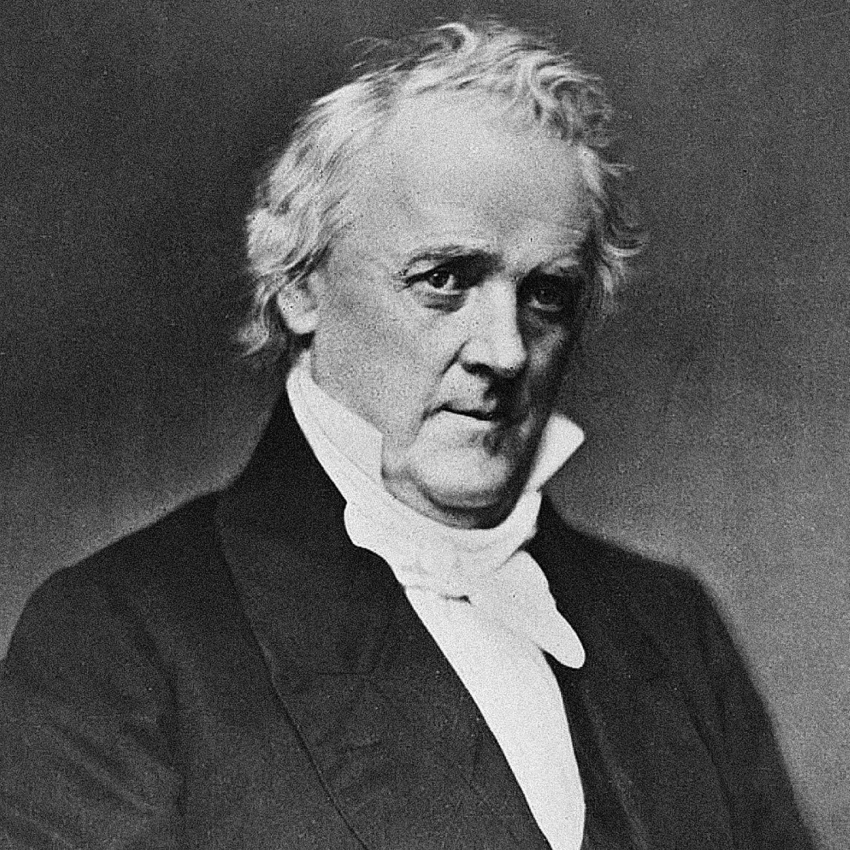
Before I go into the questions, we’ll start with the mystery man above. That’s James Buchanan, the 15th president of the United States. Now The Grumpy Doc must admit that he did recognized this fellow. If you did, bonus points for you. However, no prize for beating The Grumpy Doc beyond a sense of satisfaction that comes from besting the master. Did I mention that not only am I grumpy, but I’m also cheap?
The first question should be an easy one.
- Who was the first president to have a full beard while in office?
- Who was the last president to have a full beard while in office?
- What president had the first telephone installed in the White House?
- What two presidents had only a letter for a middle name?
- What president established the first National Park?
- Who was the first president to serve in the Navy?
- Who was the first president to write a best seller?
- Who was the only president to remain a bachelor throughout his life?
- Who was the first divorced president? (Should be another easy one.)
- What president had the most children?
- Who was the first president to ascend to the presidency from the vice presidency upon the death of the president?
- Who was the first president to have impeachment charges filed against him?
- Who was the only president to commit treason against the United States?
- And now, a question of great national significance. What president installed the first bathtub in the White House?
- Who was the first president born in a hospital?
- What presidents attended military academies?
- Who was the last president not to have a college degree?
- A final question with significance to current events. Who was the only president to have completely paid off the national debt during a period of his administration. I don’t mean balance the budget; I mean zero national debt.
ANSWERS
- Abraham Lincoln was the first president to have a full beard while in office.
- Benjamin Harrison was the last president to have a full beard throughout his term of office. However, there is a slight trick to this question. Harry Truman, during a vacation in 1948, briefly sported a goatee. However, it was gone by the time he returned to Washington.
- Rutherford B. Hayes had the first telephone installed in the White House. Not only did he have it installed, he was so fascinated by it he frequently answered it himself.
- Both Ulysses S. Grant and Harry S. Truman had S for a middle name. However, the story behind the S is significantly different. Grant was born Hiram Ulysses Grant. The congressman who signed his recommendation for West Point mistakenly listed his name as Ulysses S. Grant. Grant never disputed it and retained the S throughout his life. Biographers have reported that this was because he did not like the initials that spelled HUG. The rumor spread that the S stood for Simpson, his mother’s maiden name, but it never really stood for anything. Harry Truman’s middle name at birth was S. Both his maternal and paternal grandfathers had names that began with S and a significant family conflict arose about who he would be named after. The compromise was the initial.
- Although it is widely believed that Teddy Roosevelt established the first National Park, it was Ulysses S. Grant who signed the legislation creating Yellowstone. The National Park Service was created by legislation signed by Woodrow Wilson.
- The first US president to serve in the Navy was John F. Kennedy. Interestingly, the next four presidents also served in the Navy, three of them in World War Two.
- Teddy Roosevelt was a best-selling author before he became president. He wrote histories, biographies, essays, and memoirs. His books were widely distributed and very popular. And this was in the era before presidents “wrote” their memoirs as a way of supplementing their post presidential income.
- This was our mystery man, James Buchanan who never married.
- The first man elected president who had previously been divorced was Ronald Reagan.
- John Tyler had 15 children with two wives.
- Once again, John Tyler. He was elected as vice president with William Henry Harrison. He became president when Harrison died shortly after assuming office. At the time, no one was sure if the vice president would become president or simply assume the duties. Tyler solved the problem by quickly having himself administered the oath of office. Tyler was never popular with his party and was referred to as “His Accidency”. He was not nominated for an independent term of office and left after his first term.
- This is one The Grumpy Doc missed. I thought it would be Andrew Johnson. But, once again it was John Tyler. The charges were not successful, although surprisingly they were brought by his own party, and he completed the term.
- You may have noticed a trend here; this was our old friend John Tyler. He was elected to the Confederate House of Representatives but died before actually taking office.
- The first permanently installed bathtub was during the administration of Millard Fillmore. This may be the most significant thing that happened during the administration of this otherwise undistinguished president.
- Jimmy Carter, born in 1924, was the first president born in a hospital.
- Both President Grant and President Eisenhower graduated from the U. S. Military Academy at West Point and President Carter graduated from the U. S. Naval Academy at Annapolis.
- President Truman was the last president without a college degree. He attended business school and law school but did not graduate from either. At that time, it was possible to attend law school without an undergraduate degree.
- Andrew Jackson achieved his campaign promise of completely paying off the national debt on January 8th, 1835. However, this proved not to be a good thing. The practices he implemented to pay off the debt led directly to the panic of 1837, one of the worst recessions in U.S. history and a significant increase in national debt.
There is a lot more presidential trivia, but this is enough for our first go around. Please send me comments about your success in answering these questions. My score was right around 70%. Hopefully some of you can do better. But of course, if you do, The Grumpy Doc will never admit to having been beaten.
“America at 250: A Revolution Remembered… or Forgotten?”
By John Turley
On May 10, 2025
In Commentary, History
I’m old enough to remember the 200th anniversary of the American Revolution. Bicentennial symbols were everywhere. Liberty Bells, eagles, and the ubiquitous Bicentennial logo of the red, white and blue stylized five-point star. They could be found on hats, T-shirts, socks, soft drink cups, beer cans, and even a special “Spirit of ‘76” edition of the Ford Mustang II. Commemorative events and celebrations were being planned everywhere and people had “bicentennial fever”.
But the 250th anniversary is not attracting that same kind of attention or interest. I wonder why that is. Perhaps it’s that the name for a 250th anniversary, Semiquincentennial, doesn’t seem to roll off the tongue the way Bicentennial does. But I suspect it’s far more than just a tongue twisting name.
The Bicentennial came after a decade of national trauma. The Vietnam War, Watergate, and the civil rights struggles had all roiled the country. By 1976, most Americans wanted to feel good about the country again. It became a giant, colorful celebration of “American resilience.”
While the 250th anniversary of the American Revolution is being marked by numerous events, commemorations, and official proclamations, most are local, and it has not yet captured widespread public attention or generated the scale of national excitement seen during previous milestone anniversaries.
The anniversary arrives at a time of deep political polarization, which has complicated celebration plans. There is an ongoing debate within the group tasked with planning the celebration, the U.S. Semiquincentennial Commission, about how to present American history. Some members advocate for a traditional, celebratory approach focusing on the Founding Fathers and patriotic themes. Others push for a more inclusive narrative that acknowledges the complexities of American history, including the experiences of women, enslaved people, Indigenous communities, and other marginalized groups
Beyond the commission itself, some historians note that the “history wars”—ongoing disputes throughout society over how U.S. history should be taught and remembered—have made it harder to generate broad, enthusiastic buy-in for the anniversary among the general public.
Commemorations in places like Lexington and Concord have seen anti-Trump protesters carrying signs such as “Resist Like It’s 1775” and “No Kings,” explicitly drawing parallels between opposition to King George III and contemporary resistance to what they perceive as autocratic tendencies in current leadership. At the reenactment of Patrick Henry’s “Give Me Liberty or Give Me Death” speech, Virginia Governor Glenn Youngkin was met with boos and protest chants, highlighting how the Revolution’s legacy is being invoked in current political struggles.
While some organizers and historians hope the anniversary can serve as a unifying moment—emphasizing that “patriotism should not be a partisan issue”—the reality is that commemorations have often become forums for expressing contemporary political grievances and anxieties. The presence of both celebratory and dissenting voices at these events reflects the enduring debate over what it means to be American and who gets to define that identity. The complexity and messiness of American history, combined with current societal tensions, may dampen the celebratory mood and make it harder for people to connect emotionally with the anniversary.
Even the 250th logo has become a source of dispute, although it is one of the few areas of disagreement that is nonpartisan and tends to be about stylistic and artistic merits of the logo. Proponents of the new logo appreciate its modern and inclusive design emphasizing that the flowing ribbon represents “unity, cooperation, and harmony,” and reflects the nation’s aspirations as it commemorates this milestone. Detractors are concerned about the legibility of the “250” and the lack of traditional American symbols, such as stars, which could have reinforced its patriotic theme.
Surveys by history related organizations suggest that most Americans are not yet thinking about the 250th anniversary. The run-up to 2026 may see increased attention, but as of now, the anniversary has not broken through as a major topic of national conversation. If the anniversary continues to be viewed as a contentious partisan undertaking, it may never gain widespread popularity, and the general public may choose to stay away.
A friend who is a member of the West Virginia 250th committee told me that they had an initial meeting at which nothing was accomplished, and they have had no meeting since. It seems to me, this is up to us, the citizens, to ensure that the 250th anniversary of the American Revolution is appropriately remembered. We don’t have to live in an area where a Revolutionary War event occurred for us to recognize its events. Here in West Virginia, in October of 2024 we commemorated the 250th anniversary of the battle of Point Pleasant which many consider a precursor to the American Revolution. This event was not organized by any state or national group. It was the result of efforts on the part of the City of Point Pleasant and the West Virginia Sons of the American Revolution.
We do not need to depend on the government; we the people can hold local commemorations of revolutionary events that occurred in other areas. We can hold commemorations of the Battle of Bunker Hill, the signing of the Declaration of Independence, the Battle of Saratoga and many other events. It will take the initiative of local people to organize these events.
It will be our great shame if we allow this the commemoration of an event so significant in both American and world history to be turned into something that divides us rather unites us and strengthens our common bond.