
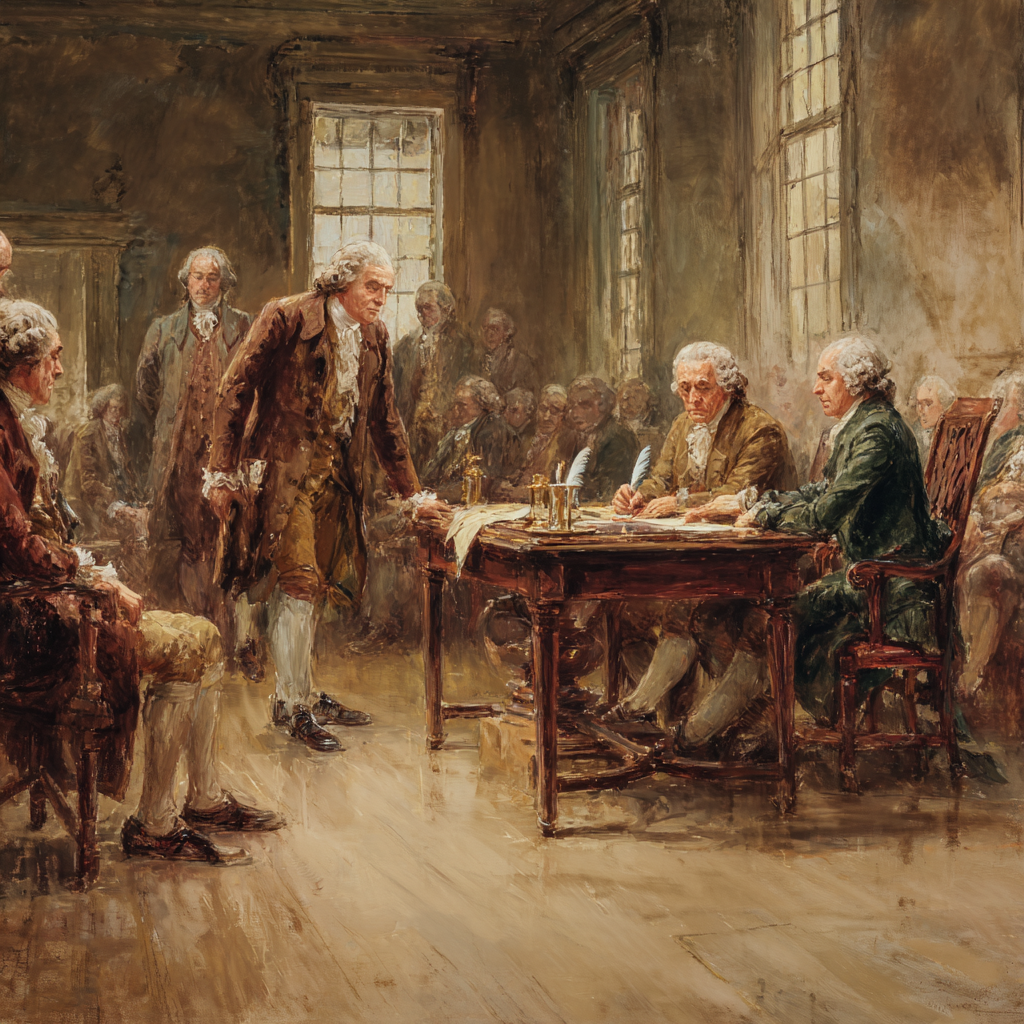
When fifty-five delegates gathered in Philadelphia during the sweltering summer of 1787, they faced a challenge that would haunt American politics for the next eight decades. The question wasn’t whether slavery was morally right—many delegates privately acknowledged its evil—but whether a unified nation could exist with slavery as a part of it. That summer, the institution of slavery nearly killed the Constitution before it was born.
The Battle Lines
The convention revealed a stark divide. On one side stood delegates who spoke forcefully against slavery, though they represented a minority voice. Gouverneur Morris of Pennsylvania delivered some of the most scathing condemnations, calling slavery a “nefarious institution” and “the curse of heaven on the states where it prevailed.” According to James Madison’s notes, Morris argued passionately that counting enslaved people for representation would mean that someone “who goes to the Coast of Africa, and in defiance of the most sacred laws of humanity tears away his fellow creatures from their dearest connections & damns them to the most cruel bondages, shall have more votes in a Government instituted for protection of the rights of mankind.”
Luther Martin of Maryland, himself a slaveholder, joined Morris in opposition. He declared the slave trade “inconsistent with the principles of the revolution and dishonorable to the American character.”. Even George Mason of Virginia, who owned over 200 enslaved people, denounced slavery at the convention, warning that “every master of slaves is born a petty tyrant” and that it would bring “the judgment of heaven on a country.”
The Southern Coalition
Facing these critics stood delegates from the Deep South—primarily South Carolina and Georgia—who made it abundantly clear that protecting slavery was non-negotiable. The South Carolina delegation was particularly unified and aggressive in defending the institution. All four of their delegates—John Rutledge, Charles Pinckney, Charles Cotesworth Pinckney, and Pierce Butler—owned slaves, and they spoke with one voice.
Charles Cotesworth Pinckney stated bluntly: “South Carolina and Georgia cannot do without slaves.” John Rutledge framed it even more starkly: “The true question at present is, whether the Southern States shall or shall not be parties to the Union.” The message was unmistakable—attempt to restrict slavery, and there would be no Constitution and perhaps no United States.
The Southern states didn’t just defend slavery; they threatened to walk out repeatedly. When debates over the slave trade heated up on August 22, delegates from North Carolina, South Carolina, and Georgia stated they would “never be such fools as to give up” their right to import enslaved Africans. These weren’t idle threats—they were credible enough to force compromise.
The Three-Fifths Compromise
The central flashpoint came over representation in Congress. The new Constitution would base representation on population, but should enslaved people count? Southern states wanted every enslaved person counted fully, which would dramatically increase their congressional power. Northern states argued that enslaved people—who had no rights and couldn’t vote—shouldn’t count at all.
The three-fifths ratio had actually been debated before. Back in 1783, Congress had considered using it to calculate state tax obligations under the Articles of Confederation, though that proposal failed. James Wilson of Pennsylvania resurrected the idea at the Constitutional Convention, suggesting that representation be based on the free population plus three-fifths of “all other persons”—the euphemism they used to avoid writing the word “slave” in the Constitution.
The compromise passed eight states to two. New Jersey and Delaware are generally identified as the states voting against the compromise, New Hampshire is not listed as taking part in the vote. Rhode Island did not send a delegation to the convention and by the time of the vote New York no longer had a functioning delegation.
Though the South ultimately accepted the compromise, it wasn’t what they wanted. Southern delegates had pushed to count enslaved people equally with free persons—but otherwise ignored on all issues of human rights. The three-fifths ratio was a reduction from their demands—a limitation on slave state power, though it still gave them substantial advantage. With about 93% of the nation’s enslaved population concentrated in just five southern states, this compromise increased the South’s congressional delegation by 42%.
James Madison later recognized the compromise’s significance. He wrote after the convention: “It seems now to be pretty well understood that the real difference of interests lies not between the large and small but between the northern and southern states. The institution of slavery and its consequences form the line of discrimination.”
Could the Constitution Have Happened Without It?
Here’s where I need to speculate, but I’m fairly confident in this assessment: no, the Constitution would not have been ratified without the three-fifths compromise and related concessions on slavery.
The evidence is overwhelming. South Carolina and Georgia delegates stated explicitly and repeatedly that they would not join any union that restricted slavery. Alexander Hamilton himself later acknowledged that “no union could possibly have been formed” without the three-fifths compromise. Even delegates who despised slavery, like Roger Sherman of Connecticut, argued it was “better to let the Southern States import slaves than to part with them.”
The convention negotiated three major slavery compromises, all linked. Beyond the three-fifths clause, they agreed Congress couldn’t ban the international slave trade until 1808, and they included the Fugitive Slave Clause requiring the return of escaped enslaved people even from free states. These deals were struck together on August 29, 1787, in what Madison’s notes reveal was a package negotiation between northern and southern delegates.
Without these compromises, the convention would likely have collapsed. The alternative wouldn’t have been a better Constitution—it would have been no Constitution at all, potentially leaving the thirteen states as separate nations or weak confederations. Whether that would have been preferable is a profound counterfactual question that historians still debate.
The Impact on Early American Politics
The three-fifths compromise didn’t just affect one document—it shaped American politics for decades. Its effects were immediate and substantial.
The most famous early example came in the presidential election of 1800. Thomas Jefferson defeated John Adams in what’s often called the “Revolution of 1800″—the first peaceful transfer of power between opposing political parties. But Jefferson’s victory owed directly to the three-fifths compromise. Virginia’s enslaved population gave the state extra electoral votes that proved decisive. Historian Garry Wills has speculated that without these additional slave-state votes, Jefferson would have lost. Pennsylvania had a free population 10% larger than Virginia’s, yet received 20% fewer electoral votes because Virginia’s numbers were inflated by the compromise.
The impact extended far beyond that single election. Research shows the three-fifths clause changed the outcome of over 55% of legislative votes in the Sixth Congress (1799-1801). (The additional southern representatives—about 18 more than their free population warranted—gave the South what became known as the “Slave Power” in Congress.
This power influenced major legislation throughout the antebellum period. The Indian Removal Act of 1830, which forcibly relocated Native Americans to open land for plantation agriculture, passed because of margins provided by these extra southern representatives. The Missouri Compromise, the Kansas-Nebraska Act, and numerous other slavery-related measures bore the fingerprints of this constitutional imbalance.
The compromise also affected Supreme Court appointments and federal patronage. Southern-dominated Congresses ensured pro-slavery justices and policies that protected the institution. The sectional tensions it created led directly to later compromises—the Missouri Compromise of 1820, the Compromise of 1850—each one a temporary bandage on a wound that wouldn’t heal.
By the 1850s, the artificial political power granted to slave states had become intolerable to many northerners. When Abraham Lincoln won the presidency in 1860 without carrying a single southern state, southern political leaders recognized they had lost control of the federal government. Senator Louis Wigfall of Texas complained that non-slaveholding states now controlled Congress and the Electoral College. Ten southern states seceded in large part because they believed the three-fifths compromise no longer protected their interests.
The Bitter Legacy
The framers consciously avoided using the words “slave” or “slavery” in the Constitution, recognizing it would “sully the document.” But the euphemisms fooled no one. They had built slavery into the structure of American government, trading moral principles for political union.
The Civil War finally resolved what the Constitutional Convention had delayed. The Thirteenth Amendment abolished slavery in 1865, but not until 1868 did the Fourteenth Amendment finally strike the three-fifths clause from the Constitution, requiring that representation be based on counting the “whole number of persons” in each state.
Was it worth it? That’s ultimately a question of values. The Constitution created a stronger national government that eventually abolished slavery, but it took 78 years and a war that killed over 600,000 Americans. As Thurgood Marshall noted on the Constitution’s bicentennial, the framers “consented to a document which laid a foundation for the tragic events which were to follow.”
The convention delegates knew what they were doing. They chose union over justice, pragmatism over principle. Whether that choice was necessary, wise, or moral remains one of the most contested questions in American history.
____________________________________________________
Sources
- https://www.battlefields.org/learn/articles/slavery-and-constitution
- https://en.wikipedia.org/wiki/Luther_Martin
- https://schistorynewsletter.substack.com/p/7-october-2024
- https://www.americanacorner.com/blog/constitutional-convention-slavery
- https://www.nps.gov/articles/000/constitutionalconvention-august22.htm
- https://en.wikipedia.org/wiki/Three-fifths_Compromise
- https://www.brennancenter.org/our-work/analysis-opinion/electoral-colleges-racist-origins
- https://www.gilderlehrman.org/history-resources/teaching-resource/historical-context-constitution-and-slavery
- https://www.nps.gov/articles/000/constitutionalconvention-august29.htm
- https://www.lwv.org/blog/three-fifths-compromise-and-electoral-college
- https://www.aaihs.org/a-compact-for-the-good-of-america-slavery-and-the-three-fifths-compromise-part-ii/
The Best President Ever
By John Turley
On May 16, 2023
In Commentary, History
As we get closer to the upcoming presidential election, I’m looking forward to the latest round of articles about “the best president ever”. These lists usually include Abraham Lincoln, FDR and Thomas Jefferson somewhere in the top three or four depending on where in the cycle of historic popularity their reputations happen to be. Other presidents such as Teddy Roosevelt, Wilson, Truman, Eisenhower and Reagan will go on and off the list depending on the whims and the political orientations of the list makers. JFK has occasionally been on the list of best presidents since shortly after his assassination. The more recent a president, the more likely he is to show up on these lists. This is due partly to the fact that we tend to give higher regard to those things about which we have firsthand knowledge. Any list done over the last 15 to 20 years may include Clinton or Obama or Trump, although, given the polarization of the political process today it’s unlikely that all three would be on the same list.
But what exactly does “best president” mean? How would you come up with quantitative measures that can be used to grade presidents and create a reproducible list? Of course, being “best “ largely depends on the severity of the problems faced by the president and the success of his solutions. It also seems to me that all such lists must be subjective and influenced by the political ideology, social position, financial status, education, and region of the country of the list maker. Personally, I don’t know how to even begin to rate a best president.
While I may not know who the best president was, I strongly believe I can tell you who the most important president was and always will be, that is George Washington. To borrow a phrase from historian James Flexner, Washington was the indispensable man. He had the combination of experience, strength and dignity that was necessary to guide this country through those first critical years. Without his initial leadership it’s possible that the country may have disintegrated it into several smaller bickering independent states that likely would have been annexed by the European powers. George Washington is the man who turned These United States with an emphasis on States into The United States with an emphasis on United.
George Washington’s importance began before there was a presidency or even a formal government. Without his leadership as the commanding general of the Continental Army there likely never would have been a United States at all.
Washington was never a great tactical general. He had very few battlefield victories, although his victories at Trenton and Princeton came at an important time for the fledgling revolution. They might even be considered strategic victories and it was his role as a strategic general that led to eventual victory.
Washington recognized that he did not have to win on the battlefield but only had to maintain the Continental Army as a field force and outlast the British will to conduct an overseas war. At a time when others were urging him to meet the British in a large European style battle, he recognized that losing decisively on a battlefield may have been enough to shatter the Continental Army and with it the entire Revolution. If you are not familiar with the many attempts early in the Revolutionary War to oust Washington from command, it will be well worth your time to read more about it.
At the end of the Revolution, Washington returned his Commission to the Continental Congress and retired to Mount Vernon. He expected to spend the rest of his days managing his estates. But his country was not yet done with him.
After the Revolution, the country was governed under the Articles of Confederation, a document that Washington called …” a rope of sand.” Multiple attempts were made to revise the articles, including a failed convention in Annapolis in 1786, to which only five states sent representatives.
When another convention was called in Philadelphia in 1787, Washington initially declined to participate, believing it would be no more successful than the Annapolis convention had been. Finally, James Madison and Henry Knox persuaded him to attend.
Washington arrived in Philadelphia and was promptly elected president of the convention. It was his presence that largely influenced every state except Rhode Island to send delegates. His presence also emboldened the delegates to embark on the creation of a new Constitution, rather than a simple revision of the articles as they had been tasked by their states.
As president of the convention, Washington maintained a non-partisan role. He seldom participated in debate and generally joined in the voting without comment. He felt it was his role to maintain the decorum of the convention, something he could do only by remaining above the fray.
Currently, there is much debate about the three-fifths clause and the role of slavery in the shaping of the Constitution. At the time, this was not the only contentious issue being debated. The role of a chief executive had the potential to be equally divisive.
Having just fought a revolution against a monarchy, many of the delegates had a strong distrust of centralized power. An initial proposal was to place executive power in a three man board. Prolonged discussion revolved around how to choose the board and how it would function. As it became clear that Washington could be the first president under a new constitution, support solidified behind the single chief executive. Without his presence, there may never have been a presidency at all.
Much has been made about the role of the Federalist Papers in the ratification of the Constitution. While they undoubtedly influenced the wealthy and the well-educated, the knowledge that Washington supported the Constitution and would be, without doubt, the first president was more important to the average citizen.
Washington was so popular at the time that some even suggested he be made “King of America”; an idea he would never even acknowledge.
In sum, even before he took the oath of office, George Washington was indeed our most important president.
Further reading:
Washington: A Life, Ron Chernow.
George Washington: The Political Rise of America’s Founding Father, David O. Stewart.
Washington: The Indispensable Man, James Thomas Flexnor.
George Washington’s Journey: The President Forges a New Nation, T. H. Breen.
The Summer of 1787: The Men Who Invented the Constitution, David O. Stewart.
George Washington: A Biography, Douglas Southall Freeman. This seven-volume set is the gold standard of Washington biographies.