Grumpy opinions about everything.

Tag: culture

Ramps: The Pungent Pride of Appalachian Spring

It’s time for my annual column about ramps.

Every spring, something remarkable happens on the forest floors of the eastern United States. Before most of the world has shaken off its winter coat, before the first wildflowers have dared to show their faces, a small, broad-leafed plant quietly pushes up through the leaf litter and announces that the season has changed. That plant is the ramp — and if you’ve never heard of it, you probably don’t live in Appalachia, where its annual arrival is something close to a religious event.

What Are Ramps?

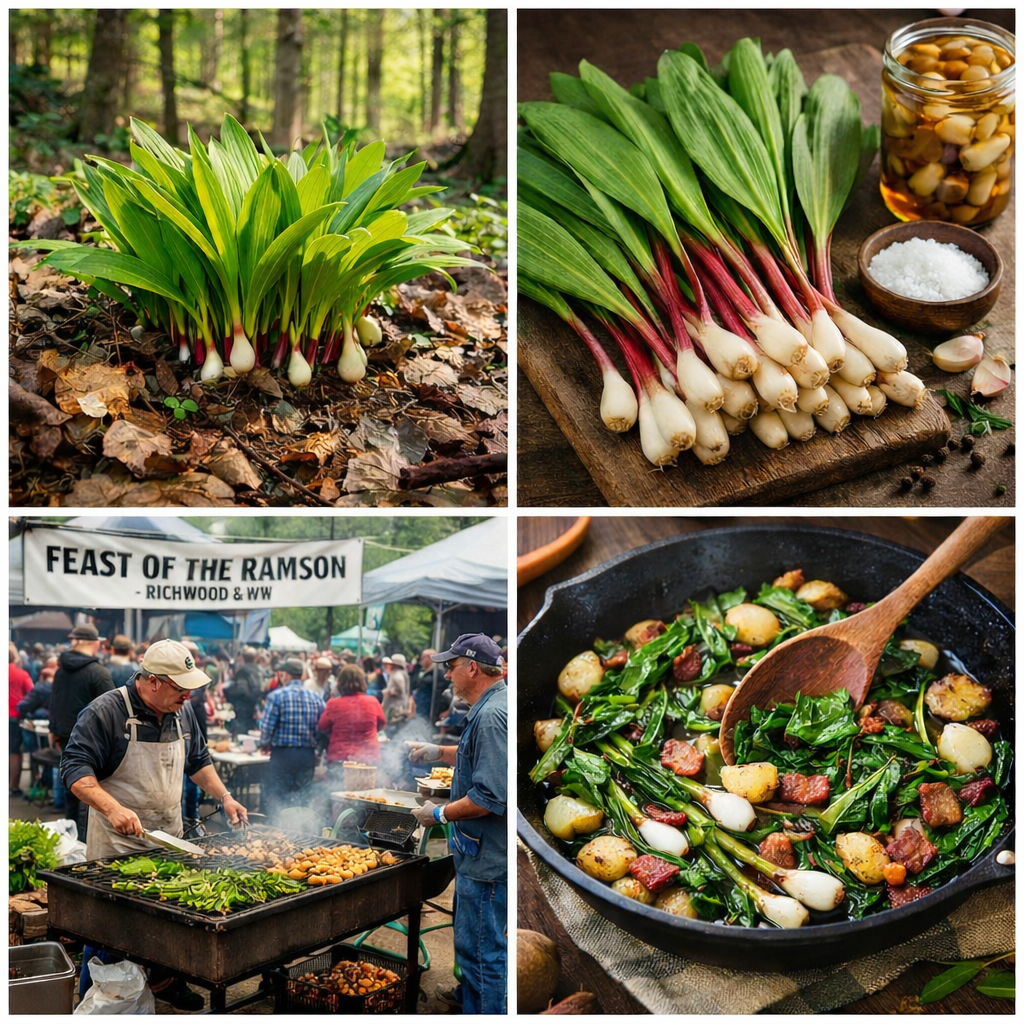
Ramps (Allium tricoccum) are a wild, perennial plant belonging to the same family as onions, garlic, and leeks — the Amaryllidaceae, or amaryllis family. Botanically speaking, they’re sometimes called wild leeks or wood leeks, and they share the pungent, sulfur-driven flavor profile of their cultivated cousins. But ramps carry something extra: a garlicky wallop layered on top of the onion bite, bold enough to clear a room. The plant produces two or three broad, smooth, bright green leaves in spring, growing 8 to 12 inches long, attached to a slender stalk that narrows into a small white bulb underground. By late spring, the leaves die back and a flower stalk emerges, producing small white blossoms.

From a nutritional standpoint, ramps belong firmly in the vegetable category — specifically among the allium vegetables — and are genuinely impressive in what they deliver. They’re low in calories (around 30 per 4 ounces) but rich in vitamins A, C, and K, along with minerals including selenium, chromium, iron, and folate. A single cup provides about 30% of the daily recommended value of vitamin A and roughly 18% of the daily value of vitamin C. They also contain sulfur compounds like kaempferol and allicin — the same bioactive chemicals found in garlic — that are associated with cardiovascular health, anti-inflammatory effects, and even some cancer-protective properties.

Historically, ramps also carried a reputation as a kind of folk remedy. After months of limited fresh produce, their arrival was thought to “cleanse the blood” and restore vitality—a belief rooted more in tradition than modern science but not entirely disconnected from their nutritional value.

Where and How They Grow

Ramps have an enormous native range, stretching from Nova Scotia down through Georgia and west to Iowa and Minnesota. But they’re most densely concentrated — and most enthusiastically celebrated — in the Appalachian Mountain corridor. They thrive in rich, moist, well-drained soil under the shade of deciduous trees: maple, beech, poplar, and birch are favorite neighbors. You’re most likely to find them carpeting the floor of a hardwood forest near a stream or on a hillside slope that holds moisture.

The timing of their emergence is part of what makes ramps so culturally charged. They’re spring ephemerals — plants that exploit the brief window between winter’s end and the closing of the forest canopy, when sunlight still reaches the ground in quantity. The leaves typically appear in early April and last only through mid-May before yellowing and dying back. That’s it. A few weeks. You either catch them or you wait another year.

Growing ramps from scratch is not a project for the impatient. Seeds can take 6 to 18 months to germinate and require both a warm moist period and then a cold period to break dormancy. The plants themselves take 5 to 7 years to mature. This slow reproductive cycle is one reason that overharvesting has become a serious concern. The Smoky Mountains National Park banned ramp harvesting entirely in 2002, citing studies showing that ramp populations need years to recover from even a single harvest. Some parts of Canada now limit foragers to 50 bulbs per person.

Many enthusiasts now recommend not harvesting the bulb at all and picking only a single leaf from the plant to allow continued growth.

How They’re Prepared

Ramps are famously versatile — every edible part of the plant can be used. The leaves are milder and wilt down beautifully when cooked. The stalks carry more punch. The bulbs are the most potent part, with an intensity that can outlast the meal and the evening— and sometimes days. That lingering quality, by the way, is a significant part of ramp lore. Eating them raw is a commitment. Even cooking them doesn’t fully tame the aftermath.

The classic Appalachian preparation is almost aggressively simple: fry them in butter or bacon fat alongside sliced potatoes and scrambled eggs. That combination — earthy, fatty, pungent, satisfying — is the dish most associated with the tradition. But ramps also appear in soups, pancakes, and hamburgers. Modern chefs have expanded the repertoire considerably, featuring ramp pesto, ramp butter, pickled ramps, ramp-infused oils, and even ramps on pizza. High-end restaurants began showcasing them in the late 1990s and early 2000s, turning a humble Appalachian forage vegetable into a coveted seasonal ingredient.

Pickling is a popular preservation method, extending the ramp season well beyond the brief spring window. Pickled ramps retain a pleasant tang and a gentler bite than raw ones, making them an easy addition to charcuterie boards or grain bowls. Ramps can also be blanched and frozen for up to six months, though freezing softens the texture.

Cultural Significance in Appalachia

To understand what ramps mean to Appalachia, you have to appreciate what they meant historically. For communities in the mountains that went months without access to fresh vegetables, ramps were among the first green things to appear after winter. They weren’t just food — they were a signal that the hard season was ending. Native American groups including the Cherokee, Iroquois, and Chippewa had long used them as both food and medicine—treating colds, earaches, intestinal parasites —and as a springtime tonic. European settlers learned from those traditions and wove ramps into their own seasonal pattern.

The word “ramp” itself has deep roots. Botanist Earl L. Core of West Virginia University traced the term to the Old English word “ramson,” a dialectical variant used across the southern Appalachian region in contrast to the “wild leek” terminology used elsewhere. That linguistic distinction is itself a marker of regional identity — ramps aren’t just what you call the plant, they’re a signal of where you’re from.

In Appalachia, ramps are far more than an ingredient—they are a tradition. For generations, families have ventured into the woods each spring to gather them, often returning to prepare communal meals that celebrate the end of winter. These gatherings, commonly known as ramp feeds or ramp festivals, remain a fixture in many communities.

Ramp festivals have anchored spring calendars in Appalachian communities for a century. The ramp festival in Haywood County, North Carolina has drawn as many as 4,000 participants per year since around 1925. Richwood, West Virginia — whose newspaper editor once famously mixed ramp juice into the printer’s ink as a prank, drawing the wrath of the U.S. Postmaster General — hosts one of the most well-known celebrations. True confession, as teenagers, a friend and I twice visited the Richwood festival because the street vendors would sell us beer without checking to see if we were 18 yet. Flag Pond, Tennessee holds its annual festival on the second Saturday each May. Whitetop, Virginia does the same the third weekend of May, complete with live music from local legends and a ramp-eating contest for children and adults. Huntington, West Virginia hosts what it calls the Stink Fest, organized by an indoor farmers’ market called The Wild Ramp.

These festivals aren’t just excuses to eat pungent vegetables (and drink beer). They’re expressions of place and belonging. Academic researchers who’ve studied ramp culture describe the plant as “an important symbol of Appalachian regional identity, providing rural mountain communities with a sense of place.” The ramp’s reputation for extreme smell — the kind that follows you out of the room and through the next day — has become something worn with pride rather than embarrassment. It’s the badge of someone who knows the land, who grew up digging bulbs out of a hillside with a grandparent, who understands that the best things have seasons.  Their strong odor lingers on the breath and skin, creating a shared experience that borders on communal initiation. In some Appalachian communities, it has long been joked that eating ramps together ensures that no one notices the smell—because everyone smells the same. And, if you were lucky, it might get you sent home from school the next day.

The ramp’s recent rise in fine dining circles has introduced a complicated tension into that identity. National demand has strained wild populations, raised prices (sometimes to $20 per pound or more at specialty markets), and prompted genuine concern about sustainability. There’s a real question about whether the ramp can remain a community food when it becomes a luxury ingredient. For now, those spring festivals still draw crowds who know the difference between a ramp pulled from familiar woods and one that traveled a thousand miles to appear on a white-tablecloth menu.

 The ramp is, in the end, a small plant carrying an outsized story. It’s a vegetable, yes — a nutritious allium with impressive micronutrient credentials. But it’s also a calendar marker, a community ritual, a flavor memory, and a contested symbol of who gets to claim a landscape as their own. If you ever get the chance to try them fresh in April, take it. Just don’t plan anything important for the next 24 hours.

Illustration generated by author using ChatGPT.

Sources

Botany, Natural History & Range

1. Wikipedia. “Allium tricoccum.” Wikimedia Foundation. https://en.wikipedia.org/wiki/Allium_tricoccum     Botanical overview, common names, Appalachian cultural history, ramp festivals.

3. Conzit. “The Allure of Ramps: A Culinary Springtime Delight.” https://conzit.com/post/the-allure-of-ramps-a-culinary-springtime-delight     Seasonal availability, native range, sustainability concerns, and culinary significance.

7. Davis, Jeanine M. and Jacqulyn Greenfield. “Cultivating Ramps: Wild Leeks of Appalachia.” Purdue University New Crops & New Uses, 2002. https://hort.purdue.edu/newcrop/ncnu02/v5-449.html     Definitive agricultural source on ramp cultivation, seed germination, growing conditions, festival traditions, and the Smoky Mountains harvesting ban.

8. WildEdible.com. “Ramps: How to Forage & Eat Wild Leeks.” March 2022. https://www.wildedible.com/blog/foraging-ramps     Foraging identification, historical role as a spring tonic, preparation methods, and seed propagation advice.

11. American Indian Health & Diet Project. “Ramps.” University of Kansas. https://aihd.ku.edu/foods/Ramps.html     Native American uses of ramps (Cherokee, Iroquois, Chippewa), etymology of the word ‘ramp,’ and historical range.

Nutrition & Health

12. SnapCalorie. “Ramps Nutrition.” https://www.snapcalorie.com/nutrition/ramps_nutrition.html     Nutritional overview: vitamins A and C, iron, magnesium, caloric content.

13. Facts.net. “20 Ramps Nutrition Facts.” October 2024. https://facts.net/lifestyle/food/20-ramps-nutrition-facts/     Detailed micronutrient breakdown including vitamins A, C, E, K, folate, potassium, calcium, and anti-inflammatory compounds.

14. Precision Nutrition. “Ramps Recipe & Nutrition.” Encyclopedia of Food. https://www.precisionnutrition.com/encyclopedia/food/ramps     Nutritional analysis, beta-carotene and selenium content, culinary preparation techniques, and storage guidelines.

15. Eat This Much. “Melissa’s Ramps Nutrition Facts.” https://www.eatthismuch.com/food/nutrition/ramps,139795/     Macronutrient breakdown per cup serving; vitamin A as 30% of daily value.

16. Specialty Produce. “Ramps Information and Facts.” https://specialtyproduce.com/produce/Ramps_775.php     Comprehensive botanical and culinary profile; vitamins A, C, K; selenium, chromium, iron, folate content.

17. Instacart. “Ramps – All You Need to Know.” February 2022. https://www.instacart.com/company/ideas/ramps-all-you-need-to-know     Seasonal availability, storage, Canadian foraging limits, and commercial market pricing.

18. Healthline. “10 Health and Nutrition Benefits of Leeks and Wild Ramps.” June 2019. https://www.healthline.com/nutrition/leek-benefits     Peer-reviewed nutritional analysis; kaempferol, allicin, thiosulfinates, vitamin C concentration versus oranges, cardiovascular and cancer-protective properties.

19. HealthierSteps. “Health Benefits Of Wild Ramps And Leeks.” February 2023. https://healthiersteps.com/health-benefits-of-wild-ramps-and-leeks/     Vitamin B6, manganese, folate, potassium and blood pressure; kaempferol and cancer risk reduction.

20. Healthfully. “Nutritional Benefits of Ramps.” January 2021. https://healthfully.com/257269-nutritional-benefits-of-ramps.html     Detailed vitamin A and C daily value percentages; selenium and chromium content; cites Eric Block’s ‘Garlic and Other Alliums: The Lore and the Science.’

Appalachian Culture, Identity & Foraging Tradition

2. Sachdeva, N. et al. “Pungent Provisions: The Ramp and Appalachian Identity.” Academia.edu. https://www.academia.edu/22223522/Pungent_Provisions_The_Ramp_and_Appalachian_Identity     Peer-reviewed qualitative research on ramp culture, identity, and the tension between regional tradition and national culinary demand.

4. Jordan, M. et al. “Ramps (Allium tricoccum Aiton) as a Wild Food in Northern Appalachia.” Society & Natural Resources. Taylor & Francis Online, 2025. https://www.tandfonline.com/doi/full/10.1080/08941920.2025.2512536     Peer-reviewed mixed-methods study on ramp harvesting, commercial trade, conservation, and Appalachian regional identity.

5. Appalachian Memories. “The Love of Wild Ramps in the Appalachian Mountains.” EchoesofAppalachia.org, October 2024. https://appalachianmemories.org/2024/10/25/the-love-of-wild-ramps-in-the-appalachian-mountains/     First-person Appalachian foraging traditions, preparation methods, and sustainable harvesting practices.

6. Serra, Janet. “Discovering Ramps: Spring’s Wild Culinary Treasure.” JanetSerra.com, May 2025. https://janetserra.com/2025/05/16/discovering-ramps-springs-wild-culinary-treasure/     Spring ephemeral lifecycle, leaf emergence timing, sulfur compounds and cardiovascular health benefits.

9. OhMyFacts. “15 Facts About Ramps.” October 2024. https://ohmyfacts.com/food-beverage/vegetables/15-facts-about-ramps/     Cherokee culinary and medicinal traditions, nutritional profile summary, and harvest season.

10. ForageFinds.com. “Appalachian Foraging: Native Edible Plants Guide.” December 2024. https://www.foragefinds.com/foraging-by-region/central-appalachia-native-edible-plants/     Indigenous knowledge of ramps, European settler adoption, and role of ramps in contemporary Appalachian cuisine.

The Easter Bunny: A Surprisingly Serious History

How a German hare hopped its way into American Easter tradition

Every Easter morning, children across America hunt for eggs left by a rabbit. It’s a charming ritual—and a deeply strange one, when you stop to think about it. Rabbits don’t lay eggs. They don’t carry baskets. Yet here we are, every spring, maintaining the fiction with great enthusiasm. Where did this tradition come from? The answer turns out to be a lot more interesting than you might expect.

The story starts in Germany. The earliest documented reference to an Easter Hare—called the “Osterhase” in German—appears in 1678, in a medical text by the physician Georg Franck von Franckenau. In the German tradition, the Osterhase was specifically a hare, not a rabbit, and its job was straightforward: deliver colored eggs to well-behaved children. Naughty children got nothing. This moral dimension—gift delivery tied to good behavior—should sound familiar. The Easter Bunny was, in a sense, an early version of Santa Claus.

The tradition crossed the Atlantic in the 1700s, carried by German Protestant immigrants who settled in Pennsylvania. Their children knew the Osterhase (sometimes rendered as “Oschter Haws” in Pennsylvania Dutch dialect) and kept up the custom of leaving out nests—made from caps and bonnets—for the hare to fill with eggs. Over time, the nests became baskets, the simple colored eggs became candy and chocolate, and the moral judgment quietly dropped away. By the 20th century, the Easter Bunny had transformed from selective gift-giver into universal children’s benefactor.

But why eggs at all? Eggs entered the Easter story long before Germany. For ancient Romans, they symbolized new life and fertility, and the custom of giving dyed eggs as spring gifts predates Christianity. The Christian tradition added another layer: during the Lenten fasting period eggs were a forbidden food. By Easter Sunday, the people were ready to use the accumulated eggs and were ready to celebrate.  They cooked, decorated, and shared them. The emergence from the shell became a visual metaphor for resurrection, and the symbolism stuck.

Rabbits and hares had their own long history as symbols of fertility and springtime. Some writers have linked the Easter Bunny to an ancient Anglo-Saxon goddess named Eostre—from whose name we may get the word “Easter”—and they claim the hare was her sacred animal. It’s a compelling story. It’s also largely unsupported by evidence. The Oxford Dictionary of English Folklore notes that the only historical source mentioning Eostre is the medieval scholar Bede, and Bede says nothing about hares. The goddess-and-hare connection appears to be modern folklore dressed up as ancient tradition.

What is better documented is that hares held symbolic significance across many early cultures. Neolithic burial sites in Europe include hares interred alongside humans, suggesting ritual importance. Hares are conspicuous breeders—they produce multiple litters each year and nest above ground, making their reproductive activity visible in a way that rabbits’ underground burrows do not. For pre-modern peoples marking the return of spring, the hare was a living advertisement for new life.

The combination of egg symbolism and hare symbolism wasn’t a deliberate design decision by any single culture or institution. It was a gradual collision—two powerful images of renewal fusing together over centuries of seasonal celebration. The church absorbed local spring customs rather than eliminating them, allowing pagan associations with fertility and rebirth to persist beneath a Christian overlay. The result is the hybrid tradition we have today.

Today’s Easter Bunny is genuinely a global figure, though not always a rabbit. In Australia, the role is played by the Easter Bilby, an endangered marsupial that conservationists have promoted as a local alternative since the 1990s. Switzerland has an Easter Cuckoo. Parts of Germany have an Easter Fox. Each region adapted the basic concept of a spring gift-bringer to fit its own wildlife and folklore.

The commercial Easter Bunny we know—the chocolate molded figure, the pastel basket, the branded plush toy—is largely a product of the late 19th and 20th centuries, shaped by the same forces that turned Saint Nicholas into Santa Claus. Candy manufacturers, greeting card companies, and department stores found in Easter a spring counterpart to the Christmas retail season, and the Easter Bunny was the obvious mascot.

None of that diminishes what the tradition actually does. The Easter Bunny survived precisely because its meaning kept evolving. It began as a moral enforcer in 17th-century Germany, became a community ritual for immigrant families in Pennsylvania, and eventually became a child’s-eye-view celebration of spring available to secular and religious families alike. The rabbit never needed to make logical sense. It only needed to mark the moment the world turns green again—and every civilization, it seems, finds a way to celebrate that.

Illustration generated by author using ChatGPT.

Sources:

  • Bede, De Temporum Ratione (8th century)
    https://sourcebooks.fordham.edu/basis/bede-reckoning.asp
  • Encyclopaedia Britannica — Easter holiday origins
    https://www.britannica.com/topic/Easter-holiday
  • Catholic Encyclopedia — Lent and fasting traditions
    https://www.newadvent.org/cathen/09152a.htm
  • Smithsonian Magazine — History of Easter Eggs
    https://www.smithsonianmag.com/arts-culture/the-history-of-the-easter-egg-180971982/
  • History.com — Easter Symbols and Traditions
    https://www.history.com/topics/holidays/easter-symbols
  • Library of Congress — Easter traditions in early America
    https://blogs.loc.gov/folklife/2016/03/easter-on-the-farm/
  • National Geographic — Where Did the Easter Bunny Come From?
    https://www.nationalgeographic.com/history/article/easter-bunny-origins
  • American Folklife Center, Library of Congress
    https://www.loc.gov/folklife/
  • National Confectioners Association — Easter candy statistics
    https://www.nationalconfectioners.org/blog/seasonal-easter-candy-data/
  • Smithsonian — How holidays became commercial traditions
    https://www.smithsonianmag.com/history/the-surprising-history-of-holiday-shopping-180964949/
  • Oxford Companion to the Year — Ronald Hutton
    https://global.oup.com/academic/product/the-stations-of-the-sun-9780192854483
  • University of Pennsylvania Religious Studies overview of seasonal festivals
    https://www.penn.museum/sites/expedition/easter/

What Is This Thing Called Love?

Every February 14th, we’re reminded that we’re supposed to understand love well enough to celebrate it with cards, chocolates, and carefully chosen gifts. Yet if you ask a hundred people to define love, you’ll get a hundred different answers—and most of them will involve a lot of hand-waving and phrases like “you just know.”

So, what is love? After thousands of years of poetry, philosophy, and now neuroscience, we still don’t have a tidy answer. But we do know more than we used to about how it works, why it matters, and what makes it one of the most powerful forces in human experience.

The Chemistry of Connection

Let’s start with the brain, because love—for all its mystery—has a biological basis we can measure. When you’re falling in love, your brain lights up like a Christmas tree in very specific ways. The caudate nucleus and ventral tegmental area, both parts of the brain’s reward system, show intense activity when people look at photos of their romantic partners. These are the same regions that activate when you’re anticipating a reward or experiencing pleasure. Your brain is essentially treating your beloved like the best possible prize.

The neurochemistry is equally dramatic. Dopamine floods your system, creating that giddy, can’t-eat, can’t-sleep sensation of new love. Norepinephrine heightens attention and memory—which is why you remember every detail of your early dates. Meanwhile, serotonin levels actually drop, which creates the obsessive thinking patterns familiar to anyone who’s ever fallen hard for someone. It’s not unlike the neurochemistry of obsessive-compulsive disorder, which explains why new love can feel so all-consuming.

But here’s where it gets interesting: long-term love shows different neural patterns than early infatuation. In established relationships, the brain’s attachment systems become more active, involving oxytocin and vasopressin—hormones that promote bonding and trust. The frenzy calms, but a different kind of connection deepens.

More Than Just Romance

Our cultural obsession with Valentine’s Day focuses almost exclusively on romantic love, but we experience love in multiple forms that are equally powerful. The ancient Greeks understood this—they had several words for different types of love.

There’s eros, the passionate romantic love we celebrate on Valentine’s Day. But there’s also philia, the deep friendship love that bonds us to chosen family and lifelong companions. Storge describes familial love, the affection between parents and children or siblings. Agape is selfless, universal love—the kind that drives people to help strangers or dedicate their lives to causes. And pragma is the mature, enduring love that develops in long partnerships built on compatibility and mutual respect.

Research on attachment theory, pioneered by psychologist John Bowlby, shows that our capacity for all these forms of love develops from our earliest relationships. The bonds we form with caregivers in infancy create templates that influence how we connect with others throughout life. Those early experiences shape whether we tend toward secure, anxious, or avoidant attachment patterns in adult relationships.

The Meaning We Make

So, what does love mean to us? The answer seems to be almost everything.

Love is fundamentally about connection in a species that evolved to be deeply social. We’re not built to survive alone. Anthropological evidence suggests that cooperation and bonding have been essential to human survival for hundreds of thousands of years. Love—in its various forms—is the emotional mechanism that makes us want to stay together, protect each other, and invest in relationships that extend beyond immediate self-interest.

Psychological research backs this up. Studies consistently show that strong social connections are among the most reliable predictors of happiness and wellbeing. A famous Harvard study that followed people for over 75 years found that close relationships—more than money, fame, or achievement—were what kept people happy throughout their lives. The quality of our relationships influences everything from our physical health to our resilience in facing life’s challenges.

Love also gives us a sense of meaning and purpose. Philosopher Martin Buber wrote about “I-Thou” relationships—moments when we genuinely see and are seen by another person, not as objects to be used but as complete beings. These connections, he argued, are where we find authentic existence. Whether or not you buy the full philosophical framework, there’s something to the idea that being truly known and still loved is profoundly meaningful to us

How We Describe the Indescribable

The challenge with love is that it’s simultaneously a biological process, a psychological state, a social bond, and a subjective experience. It’s a feeling, but also a choice. It involves chemistry but transcends chemistry. It’s universal, but manifests differently across cultures and individuals.

When people try to describe love, they often resort to metaphors: it’s a journey, a flame, a force of nature, a home. These metaphors capture something real—that love is dynamic (a journey), consuming (a flame), powerful beyond our control (a force), and provides security (a home). Each metaphor reveals an individual facet of love but is incomplete in itself.

Psychologists sometimes describe love through its components. Robert Sternberg’s triangular theory proposes that love involves intimacy (closeness and connection), passion (physical attraction and arousal), and commitment (the decision to maintain the relationship). Different combinations create different experiences: romance without commitment is infatuation; commitment without passion is companionship; all three together create what he calls “consummate love”.

But even these frameworks feel incomplete because love is also characterized by paradoxes. It makes us feel both euphoric and vulnerable. It’s intensely focused on one person yet can expand our capacity for compassion generally. It’s simultaneously selfish (wanting the beloved) and selfless (wanting their happiness above our own). It’s stable and changing, rational and irrational, simple and impossibly complex.

What We Know, and What We Don’t

Here’s my honest assessment of our understanding: We’re fairly confident about love’s neurological basis and its importance for human wellbeing. The research on attachment, bonding hormones, and the psychological benefit of connection is solid and replicated across many studies.

We’re less certain about the boundaries between types of love or whether our categories reflect universal realities or cultural constructs. The line between deep friendship and romantic love can be fuzzy. What Western culture calls romantic love may be experienced or expressed differently in cultures with arranged marriages or different social structures.

And we really don’t know how to explain why one person falls for this particular person and not that one, why some relationships endure while others fade, or how exactly the alchemy of genuine connection works. We can identify correlates and patterns, but the lived experience of love retains its mystery.

The Point of It All

Maybe the reason love resists simple definition is that it’s less like a thing and more like a capacity—the human ability to extend beyond our individual boundaries and form bonds that transcend pure self-interest. It’s what allows parents to sacrifice for children, friends to show up in crises, partners to build lives together, and strangers to feel compassion for people they’ll never meet.

Valentine’s Day, for all its commercial trappings, is trying to celebrate something genuinely important: our ability to connect, to care, to find meaning in each other. Whether you’re celebrating romantic love, friendship, family bonds, or simply the human capacity for affection, you’re acknowledging one of the most fundamental aspects of what makes us human.

Love might be indefinable, but that doesn’t make it any less real or necessary. It’s the force that pulls us out of isolation and reminds us we’re part of something larger than ourselves. And maybe that’s enough of a definition to work with.

Sources

Cole Porter – What’s This Thing Called Love? Lyrics, 1929

Scientific American – The Neuroscience of Love https://www.scientificamerican.com/article/the-neuroscience-of-love/

Greater Good Science Center, UC Berkeley – The New Science of Love https://greatergood.berkeley.edu/article/item/the_new_science_of_love

Simply Psychology – Bowlby’s Attachment Theory https://www.simplypsychology.org/bowlby.html

Harvard Gazette – Harvard Study on Adult Development https://news.harvard.edu/gazette/story/2017/04/over-nearly-80-years-harvard-study-has-been-showing-how-to-live-a-healthy-and-happy-life/

Verywell Mind – Sternberg’s Triangular Theory of Love https://www.verywellmind.com/triangular-theory-of-love-2795884

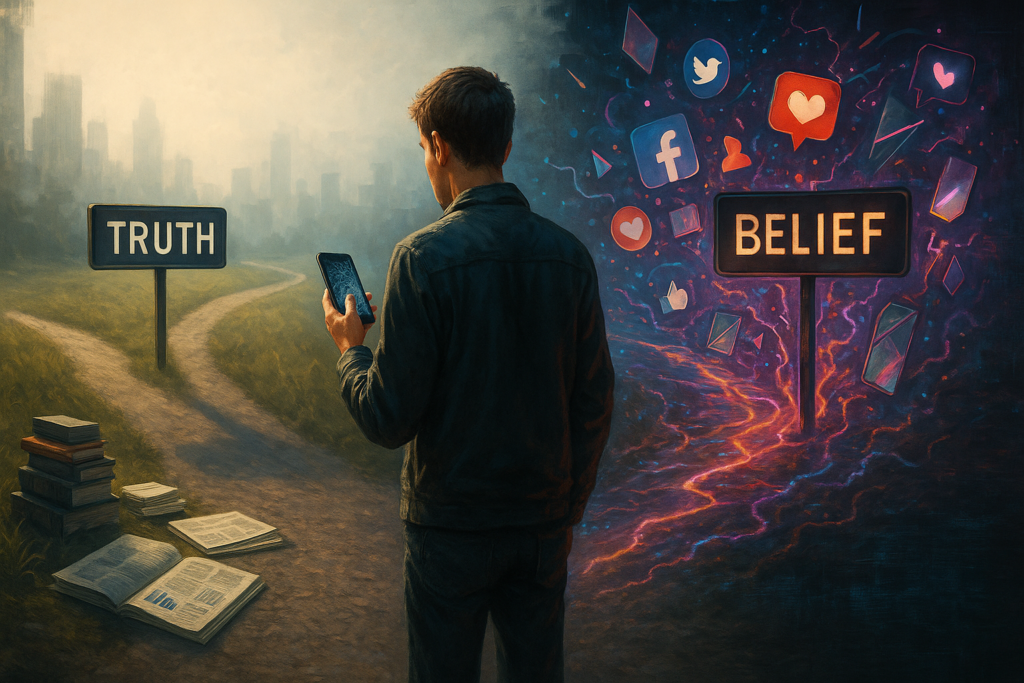
Illustration generated by author using ChatGPT.

Truth at a Crossroads: How Trust, Identity, and Information Shape What We Believe

When Oxford Dictionaries declared “post-truth” its word of the year in 2016, it crystallized something many people had been feeling: that we’d entered a strange new era where objective facts seemed less influential in shaping public opinion than appeals to emotion and personal belief. The term exploded in usage that year, becoming shorthand for a troubling shift in how we process information. But have we really entered uncharted territory, or is this just the latest chapter in a very old story?

The short answer is: it’s complicated. The phenomenon itself isn’t new, but the scale and speed at which misinformation spreads certainly is. We are in a new world where the boundary between truth and untruth is blurred, institutions that once arbitrated facts are losing authority, and politics are running on “truthiness” and spectacle more than evidence.

The Psychology of Believing What We Want to Believe

To understand why people increasingly seem to choose sources over facts, we need to dive into how our minds actually work. People now seem to routinely sort themselves into information camps, each with its own “truth,” trusted voices, and shared worldview. But why is this and why does it seem to be getting worse?

Psychologists have spent decades studying something called confirmation bias—essentially, the tendency to seek out information that supports our existing beliefs while avoiding or dismissing information that contradicts them. This isn’t just about being stubborn. Research shows we actively sample more information from sources that align with what we already believe, and the higher our confidence in our initial beliefs, the more biased our information gathering becomes.

But there’s something even more powerful at play called motivated reasoning. While confirmation bias is about seeking information that confirms our beliefs, motivated reasoning is about protecting ideological beliefs by selectively crediting or discrediting facts to fit our identity-defining group’s position. In other words, we don’t just want to be right—we want to belong.

This matters because humans are fundamentally tribal creatures. When we form attachments to groups like political parties or ideological movements, we develop strong motivations to advance the group’s relative status and experience emotions like pride, shame, and anger on behalf of the group. Information processing becomes less about truth-seeking and more about identity protection.

Why Source Trumps Fact

So why do people trust a source they identify with over objective facts that contradict their worldview? Research points to several interconnected reasons.

First, there’s the practical matter of cognitive shortcuts. We’re bombarded with information daily, and people judge the reliability of evidence by using mental shortcuts called heuristics, such as how readily a particular idea comes to mind. If someone we trust says something, that’s an easier mental pathway than laboriously fact-checking every claim. This reliance becomes problematic when “trusted” means ideologically comfortable rather than factually reliable.

Analysts of the post‑truth phenomenon also highlight declining trust in traditional “truth tellers” such as mainstream media, scientific institutions, and government agencies. As these institutions lose authority, counter‑elites or influencers can present alternative narratives that followers treat as at least as plausible as established facts

Second, and more importantly, is the issue of identity. When individuals engage in identity-protective thinking, their processing of information more likely guides them to positions that are congruent with their membership in ideologically or culturally defined groups than to ones that reflect the best available scientific evidence. Being wrong about a fact might sting for a moment, but being cast out of your social group could have real consequences for your emotional support, social standing, and sense of self.

Third, there’s a feedback loop at work. In social media, confirmation bias is amplified by filter bubbles and algorithmic editing, which display to individuals only information they’re likely to agree with while excluding opposing views. The more we’re exposed only to sources that confirm our beliefs, the more alien and untrustworthy contradictory information appears.

Interestingly, being smarter doesn’t necessarily protect you from these biases. Some research suggests that people who are adept at using effortful, analytical modes of information processing may actually be even better at fitting their beliefs to their group identities, using their intelligence to construct more sophisticated justifications for what they already want to believe.

The Historical Echo Chamber

Despite the way it feels, this isn’t the first time truth has had competition. History is full of eras when myth, rumor, propaganda, and identity overshadowed facts.

During The Reformation of the1500s, misinformation was spread on both sides of the catholic-protestant divide.  Pamphlets—many of them highly distorted or outright fabricated—spread rapidly thanks to the printing press. Propaganda became a political weapon. Ordinary people suddenly had access to arguments they weren’t equipped to verify.  People were ostracized and some even executed based on little more than rumors or lies.  We might have hoped for better from religious leaders.

 The French Revolution (1780s–1790s) was awash in claims and counterclaims, many of them—if not most—had little basis in fact.Competing newspapers told wildly different stories about the same events. Rumors fueled paranoia, purges, and violence. Truth became secondary to whichever faction controlled the narrative.

Following the Civil War and Reconstruction, the “Lost Cause” narrative became a powerful example of source-driven myth making. Despite historical evidence, generations accepted a version of events shaped by postwar Southern elites, not by facts. Echoes of it still reverberate today, driving much of the opposition to the civil rights movement.

Fast forward to the 1890s, and we see something remarkably familiar. Yellow journalism, characterized by sensationalism and manipulated facts, emerged from the circulation war between Joseph Pulitzer’s New York World and William Randolph Hearst’s New York Journal. These papers used exaggerated headlines, unverified claims, faked interviews, misleading headlines, and pseudoscience to boost sales.

As early as 1898, a publication for the newspaper industry wrote that “the public is becoming heartily sick of fake news and fake extras”—sound familiar?

During the 20th-century propaganda states, typified by both fascist and communist regimes perfected source-based truth. The leader or the party defined reality, and disagreement was literally dangerous. In these systems, truth wasn’t debated—it was assigned.

What Makes Now Different?

While the psychological mechanisms and even the tactics aren’t new, several factors make our current moment distinct. The speed and scale of information spread is unprecedented. A false claim can circle the globe in hours. Studies show that people are bombarded by fake information online, leading the distinction between facts and fiction to become increasingly blurred as blogs, social media, and citizen journalism are awarded similar or greater credibility than other information sources.

We’re also experiencing a fragmentation of trusted authorities. Where once a handful of major newspapers and broadcast networks served as gatekeepers, now the fragmentation of centralized mass media gatekeepers has fundamentally altered information seeking, including ways of knowing, shared authorities, and trust in institutions.

So Are We in a Post-Truth Era?

Yes and no. The term “post-truth” captures something real about our current moment—the scale, speed, and sophistication of misinformation is unprecedented. But calling it “post-truth” suggests we’ve crossed some bright line into entirely new territory.  I’d argue we’re not quite there—but we are navigating a world where truth is sometimes lost in the collision of ancient human tendencies and modern technology

The data clearly show that confirmation bias, motivated reasoning, and identity-protective cognition are real and powerful forces. Historical evidence demonstrates that propaganda, misinformation, and the choice of tribal loyalty over objective fact have been with us for millennia. What’s changed is our information ecosystem driven by the technology that allows false information to spread faster than ever, and the by the fragmentation of shared sources of authority that once helped create common ground.

Perhaps a better framing would be that we’re in an era of “turbo-charged tribal epistemology”—where our very human tendency to trust our tribe’s narrative over contradicting evidence has been supercharged by algorithms that feed us what we want to hear and isolate us from alternative perspectives.  (I wish I could take credit for the term turbo-charged tribal epistemology. I really like it, but I read it somewhere, I just can’t remember where.) 

The question isn’t really whether we’re in a post-truth society. The question is whether we can develop the individual and collective skills to navigate an information environment that exploits every cognitive bias we have. The environment has changed, but the task remains the same: finding ways to establish shared facts despite our deep-seated tendency to believe what we want to believe.

Sources:

The Fascinating Journey of Christmas Cards: From Victorian Innovation to Global Tradition

Have you ever wondered how the tradition of sending Christmas cards got started? It’s a story that combines busy social calendars, a new postal system, and one clever solution that became a worldwide phenomenon.

Before Christmas Cards: The Early Messengers

Long before anyone thought to mass-produce holiday greetings, people were already experimenting with seasonal messages. In fifteenth-century Germany, the “Andachtsbilder” appeared—proto-greeting cards with religious imagery, usually depicting baby Jesus, accompanied by the inscription “Ein gut selig jar” (A good and radiant year) that were presented as gifts during the Christmas season. Additionally, handwritten letters wishing “Merry Christmas” date from as early as 1534.These weren’t Christmas cards as we know them, but they laid the groundwork.

The first known Christmas card was sent in 1611 by Michael Maier, a German physician, to King James I of England and his son, with an elaborate greeting celebrating “the birthday of the Sacred King”.  This, however, was an ornate document rather than a mass-produced card. The true breakthrough came much later.

In late 1700s, British schoolchildren were creating their own versions. They would take large sheets of decorated writing paper and pen messages like “Love to Dearest Mummy at the Christmas Season” to show their parents how much their handwriting had improved over the year. It was part homework assignment, part holiday greeting—definitely more practical than sentimental!

Also during the latter part of the 18th century wealthy British families adopted a more personal variant: handwritten holiday letters. These were carefully composed greetings expressing seasonal good will and family updates, often decorated with small flourishes or illustrations. A forerunner of the much maligned Christmas letter.  In Victorian England—where social correspondence was almost an art form—sending letters for Christmas and New Year became fashionable among the middle class. The combination of widespread literacy and improvements in the postal system laid the groundwork for something new: a printed, affordable Christmas greeting.

The Birth of the Modern Christmas Card

The real game-changer came in 1843, thanks to a social problem that sounds remarkably modern: too many people to keep in touch with and not enough time. Henry Cole, a prominent civil servant, helped establish the Penny Post postal system—named after the cost of posting a letter.  He found himself with unanswered mail piling up during the busy Christmas season. His solution? Why not create one design that could be sent to everyone?

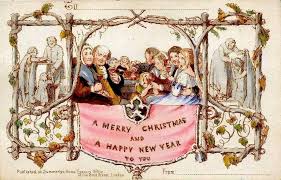
Cole commissioned his friend, artist John Callcott Horsley, to design what would become the world’s first commercial Christmas card. The design featured three generations of the Cole family raising a toast in celebration, surrounded by scenes depicting acts of charity. The message was simple: “A Merry Christmas and a Happy New Year to You.”

About 2,050 cards were printed in two versions—a black and white version for sixpence and a hand-colored version for one shilling. Interestingly, the card caused some controversy. The image showed young children enjoying glasses of wine with their family, which upset the Victorian temperance movement.

The Penny Post, introduced in 1840, made mailing affordable and accessible. What started as Cole’s time-saving solution quickly caught on among his friends and acquaintances, though it took a few decades for the tradition to really explode in popularity.

Crossing the Atlantic

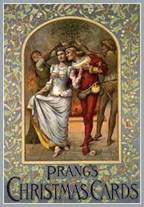
Christmas cards made their way to America in the late 1840s, but they were expensive luxuries at first. In 1875, Louis Prang, a German-born printer who had worked on early cards in England, began mass-producing cards in America. He made them affordable for average families. His first cards featured flowers, plants, and children. By the 1880s, Prang was producing over five million cards annually.

 Christmas cards spread rapidly with improvements in both postal systems and printing. Victorian cards often featured sentimental, elaborate images—sometimes anthropomorphic animals or unexpected motifs. The Hall Brothers Company (later Hallmark) shifted the format to folded cards in envelopes rather than postcards, allowing for more personal written messages—setting the standard still seen today.

The 20th century brought both industrialization and personalization to the Christmas card. Advances in color printing, photography, and mass marketing meant that cards became cheaper and more varied. In the 1920s and 1930s, families began sending cards featuring their own photographs, a tradition that gained momentum after World War II with the rise of suburban life and inexpensive cameras. By the 1950s and 1960s, Christmas cards had become a fixture of middle-class life. Designs reflected changing tastes—from sentimental Victorian nostalgia to sleek mid-century modernism.  Surprisingly, the first known Christmas card with a personal photo was sent by Annie Oakley in 1891using a photo taken during a visit to Scotland.

Christmas Cards Around the World Today

Fast forward to today, and Christmas card traditions vary wildly depending on where you are. In Great Britian and US, sending cards remains a major tradition. British people send around 55 cards per year on average, with Christmas cards accounting for almost half of all greeting card sales

But the tradition looks quite different in other parts of the world. In Japan, where only about 1.5% of the population is Christian, Christmas is celebrated as a secular, romantic holiday rather than a religious one. Christmas Eve is treated similarly to Valentine’s Day, with couples exchanging gifts. While many people observe the Western custom of sending cards, these are nengajo—New Year’s cards—sent to friends, family, and business associates, expressing wishes for a happy and prosperous year.

In the Philippines, one of Asia’s most Christian nations, Christmas is celebrated with incredible enthusiasm starting as early as September, with the season officially beginning with nine days of dawn masses on December 16. Cards are part of the celebration, but they’re just one element of an extended, community-focused holiday.

In Australia, the tradition of sending handwritten Christmas cards remains popular despite the summer heat.  Australian cards often feature unique imagery—Santa in shorts and sandals, or kangaroos instead of reindeer, adapting the tradition to local culture.

The Digital Shift

Today, while e-cards and social media posts have certainly cut into traditional card sales, many people still cherish the ritual of sending and receiving physical cards. There’s something irreplaceable about finding a thoughtful card in your mailbox among the bills and advertisements.

What started as Henry Cole’s practical solution to a busy social calendar has evolved into a diverse global tradition, adapted and reimagined by different cultures worldwide. Whether you’re mailing elaborate family photo cards, sending quick e-greetings, or exchanging romantic messages in Tokyo, you’re participating in a tradition that’s over 200 years old.

Banned, Blessed, and Brewed

How Coffee Conquered the World

I don’t know about you, but I can’t get moving in the morning without a cup of coffee—or, if I’m honest, about three. Coffee has been a faithful companion through late nights and early mornings for most of my adult life.

I’ve written about it before, but there’s one story I’ve never shared—the time coffee actually sent me to the hospital.

A Pain in the Chest (and a Lesson Learned)

It happened not long before I turned forty. Back then, forty felt ancient. I started getting chest pains bad enough to send me to a cardiologist. After a battery of expensive tests, he said, “I don’t know what’s causing your pain, but it’s not your heart. Go see your family doctor.”

Problem was, I didn’t have one. (This was before I thought seriously about medical school.) So, I found a doctor, went in for a full workup, and after all the poking and prodding he casually asked, “How much coffee do you drink?”

“About eight cups a day,” I told him.

He raised an eyebrow. “You need to stop that.”

I asked if he really thought that was the problem. He didn’t hesitate—“Absolutely.”

This was before anyone talked much about reflux, at least not the way we do now. But I quit coffee cold turkey, and just like that, the chest pain disappeared.

These days I’ve learned my limit: three cups in the morning, and that’s it. Any more and the reflux reminds me who’s in charge.

It’s funny how something so simple can be both a comfort and a curse. Still, for all its quirks, I wouldn’t trade that first morning cup for anything.

From Goats to Global Obsession

My little coffee story fits neatly into a much older one. For centuries, coffee has stirred passion and controversy in equal measures. Its history is full of smuggling, religion, politics—and even the occasional threat of beheading.

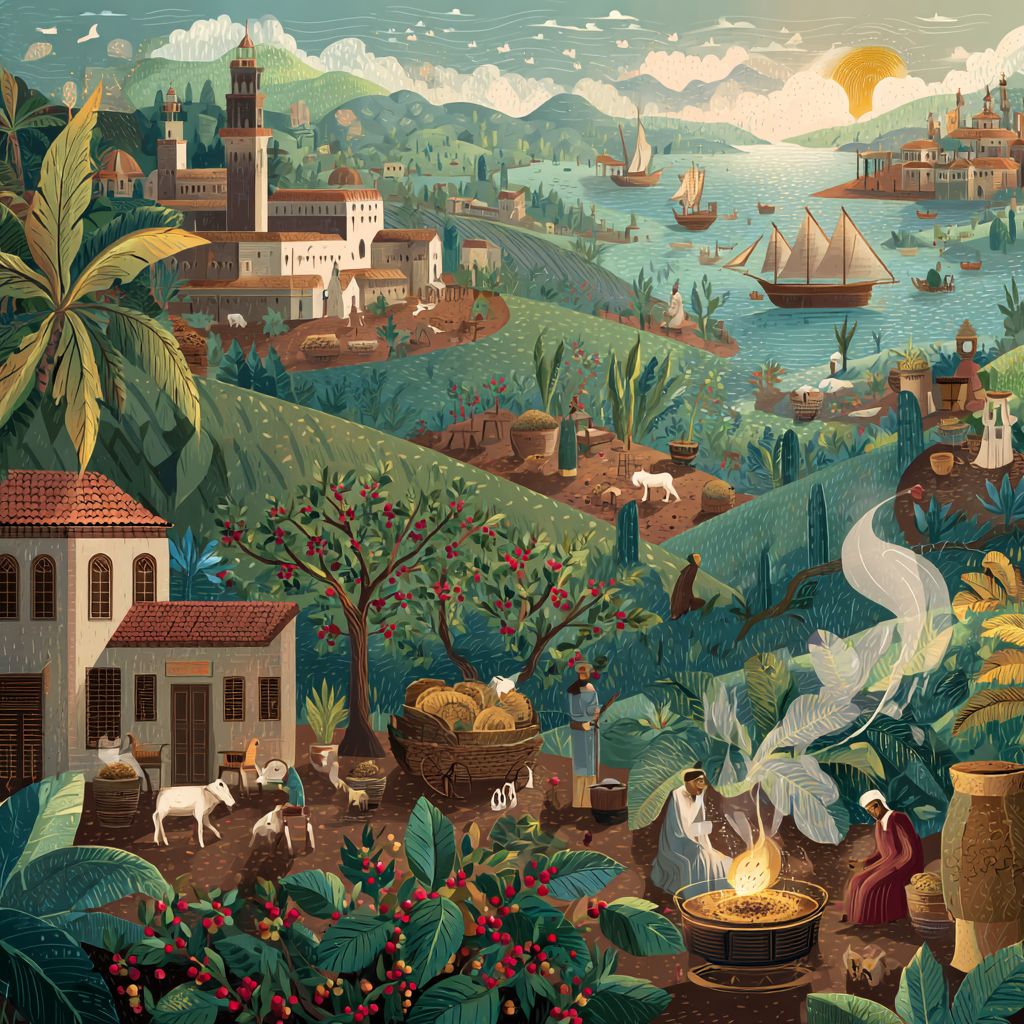
The story begins in the Ethiopian highlands, in a region called Kaffa—possibly the origin of the word coffee. Wild Coffea arabica plants grew there long before anyone thought to roast their seeds.

According to legend, around 850 CE a goat herder named Kaldi noticed his goats acting wildly energetic after eating the red berries. We will never know if Kaldi was real or just a great marketing story.

By the 1400s Yemeni traders brought coffee plants from Ethiopia across the Red Sea to Yemen.  The first recorded coffee drinker was Sheikh Jamal-al-Din al-Dhabhani of Aden, around 1454. He and other Sufi mystics used the brew to stay alert during long nights of prayer—a kind of early spiritual espresso shot.

Coffee and the Muslim World

By 1514, coffee had reached Mecca and through the early 1500s it spread across Egypt and North Africa, beginning in the Yemeni port of Mocha (yes, that Mocha). Coffeehouses—qahveh khaneh—sprang up everywhere. They were the original social networks: lively centers for news, politics, debate, and gossip, often called “Schools of the Wise.”

Coffee also had its critics. Some Muslim scholars debated whether it was halal, arguing that its stimulating effect made it suspiciously close to an intoxicant.

The governor of Mecca banned coffee altogether, calling coffeehouses hotbeds of sedition. Thirteen years later the Ottoman sultan lifted the ban, recognizing that you can’t outlaw people’s favorite drink. Similar bans came and went—including one by Sultan Murad IV in the 1600s, who reportedly made drinking coffee a capital crime. It didn’t work. Coffee had already conquered the Middle East.

Europe’s Complicated Love Affair

When coffee reached Europe—most likely through Venetian traders—it faced new suspicion. To many Europeans, coffee was “the drink of the infidel,” something foreign and threatening.

Some Catholic priests went so far as to call it “the bitter invention of Satan” or “the wine of Araby”.  The issue was both secular and theology—wine played a central role in Christian ritual and Muslims, forbidden to drink wine, had elevated coffee to their own social centerpiece.

Then around 1600 Pope Clement VIII joined the debate. Instead of banning coffee, he decided to try it first. The story goes that he found it so delicious he “baptized” it, declaring it too good to leave to the infidels.

True or not, coffee won papal approval—and from there, Europe was hooked. Coffeehouses spread like wildfire.

In England, they were called “penny universities” because for the price of a penny (the cost of a cup), you could join conversations on politics, science, and philosophy. Coffeehouses became the fuel of the Enlightenment—an alternative to taverns and alehouses. King Charles II tried to ban them in 1675, fearing they encouraged sedition, but public outrage forced him to back down.

The Global Takeover

For a long time, Yemen held a monopoly on coffee exports, carefully boiling or roasting beans to prevent anyone from planting them elsewhere. But where there’s money there’s smuggling.

The Dutch managed to steal a few live plants and in 1616 and began to grow them in Ceylon and Java—hence the nickname “java.” The French followed suit, planting coffee across the Caribbean. One French officer famously smuggled a single seedling to Martinique in 1723; within fifty years, it had produced over 18 million trees.

Brazil entered the scene in 1727 when Francisco de Melo Palheta snuck seeds out of French Guiana. Brazil’s climate proved perfect, and before long, it became the world’s coffee superpower.

The Bitter Truth

Coffee’s global spread had a dark side. Its plantations across the Caribbean and Latin America were built on enslaved labor. The beverage that fueled Enlightenment discussion in Europe was produced through brutality and exploitation in the colonies.

That’s the paradox of coffee—it has always been both a social leveler and a symbol of inequality.

Why It Still Matters

From Ethiopia’s wild forests to Ottoman coffeehouses, from Parisian salons to Brazilian plantations, coffee’s story mirrors the forces that shaped our modern world—trade, religion, colonization, and globalization.

That cup you’re sipping this morning connects you to centuries of human ingenuity, faith, conflict, and resilience.

Your latte isn’t just caffeine—it’s history in a cup.

Powered by WordPress & Theme by Anders Norén