
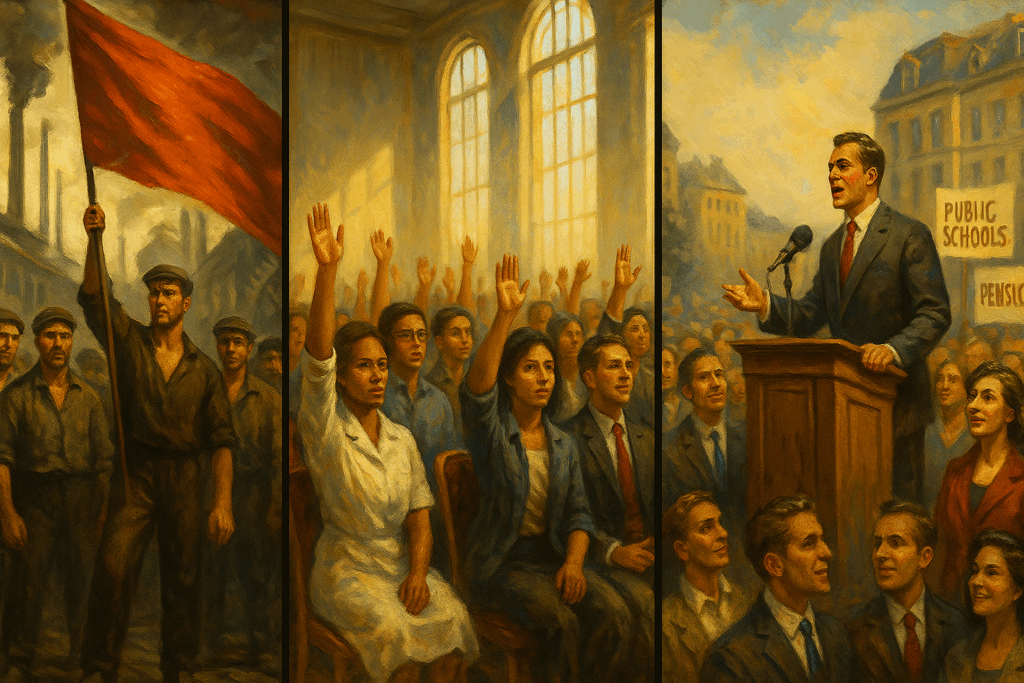
Understanding Classical Socialism, Democratic Socialism, and Social Democracy in Today’s America
If you’ve ever wondered what politicians really mean when they throw around words like “socialism” or “social democracy,” you’re not alone. These ideas used to live mostly in political theory textbooks. Now they show up in campaign speeches and social media debates. With figures like Bernie Sanders and groups like the Democratic Socialists of America bringing these ideas into the mainstream, it’s worth sorting out what each actually means.
Even though classical socialism, democratic socialism, and social democracy all claim to focus on fairness and reducing inequality, they take very different routes to get there. Understanding those differences helps make sense of what’s really being argued about in American politics today.
Classical Socialism: The Original Blueprint
Classical socialism came out of the 19th century, when industrial capitalism was grinding workers down and a couple of guys named Karl Marx and Friedrich Engels thought they had the fix. Their idea: workers should collectively own and control the means of production — factories, land, and major industries.
This wasn’t just about taxing the rich. It was about redesigning the whole system from the ground up, through violent revolution if necessary. In theory, private property creates exploitation; collective ownership ends it. In practice, that often means top-down control by the state, with economies planned from above — as seen in the Soviet Union or Maoist China.
The central ideas of classical socialism are collective ownership of big industries and central or cooperative planning instead of market competition. Production is aimed at meeting needs, not profits with the eventual goal of a classless, stateless society. Classical socialism accepts that revolution will most likely be necessary for implementation.
In theory, classical socialism wipes out worker exploitation and wealth extremes. Its central tenant is that production serves human needs, not corporate profit. In practice, it often leads to authoritarian governments, clumsy economic planning, and little room for innovation or dissent.
Would it work in America?
Probably not. The U.S. has deep cultural roots in individualism and private enterprise. Replacing markets with centralized planning would clash hard with both our Constitution and national temperament.
The Siblings of Socialism
In the real world, classical socialism has produced two offsprings, the confusingly named democratic socialism and social democracy. While they share many similarities, the major difference is that democratic socialism aims to replace capitalism while social democracy has the objective of reforming capitalism and making it more humane.
Democratic socialism
Democratic socialism shares many of classical socialism’s goals but emphasizes getting there through elections — not revolution. It aims to establish central control of key parts of the economy while protecting some political freedom and most civil rights.
The vision of Democratic Socialism is collective (public) ownership of major industries like energy, transportation, manufacturing, and communications. The economy would be directed and managed by the government, but the government would be elected and it would not be an authoritarian state. It proposes that within individual industries there would be worker self-management and workplace democracy. It also proposes that there would be private sector businesses allowed on a small scale—think Mom and Pop retail. It supposes gradual reform, not a violent upheaval, while maintaining democracy and civil liberties.
There are several major drawbacks to democratic socialism. Progress can be slow, easily reversed, and still subject to bureaucratic inefficiencies. Competing globally with capitalist economies might also prove tough. To me the major drawback is how major corporations, financial institutions, and wealthy businesspeople can be convinced to peacefully hand over control of major portions of the economy to a “people’s collective”.
How it fits in the U.S.:
Democratic Socialism has grown in popularity, especially among younger voters; although, it seems that many younger people seem to believe that this means making things more fair rather than supporting the reality of Democratic Socialism.
Bernie Sanders and Alexandria Ocasio-Cortez wear the label proudly. Still, the idea of government control of a significant portion of the economy faces serious resistance here. Realistically, it’s more a movement that nudges policy leftward than a model ready for prime time.
Social Democracy: Capitalism with Guardrails
Social democracy takes a different track. It doesn’t want to abolish capitalism — it wants to civilize it. Think Scandinavia: private ownership, strong markets, but also universal healthcare, paid leave, and free college.
The central elements of Social Democracy are a mixed economy with both public and private sector control. In some models, there is direct government management of such public services as healthcare, energy and transportation. In other models, there remains private control of these services with a strong regulation on the part of the government.
Regardless of the chosen model, a Social Democracy is a strong welfare state with universal benefits. The definition of welfare in this context is a way of providing earned support for hard working citizens Perhaps it should be called an earned benefits state as the term welfare has a pejorative implication for some.
There is strong market regulation to prevent unfair competition, price gouging, and monopolies that are detrimental to public good. There is a progressive tax program designed to reward productivity while heavily taxing passive or nonproductive income. These taxes are used to fund generous public services.
The government remains elective and responsive to the public. It’s proven to work. Nordic countries show that capitalism can coexist with equality and innovation. While it is expensive, and high taxes can be a political lightning rod, it leaves capitalism’s basic structure intact. There is a constant risk that inequality can creep back if protection weaken.
In the U.S. context:
Social democracy may be the most realistic option. As social scientist Lane Kenworthy puts it, America already is a social democracy — just not a particularly generous one. We’ve got Medicare, Social Security, public education — we just underfund them compared to our European cousins. The reality is that income lost to increased taxation is regained through decreases in insurance premiums, healthcare costs, education expenses and retirement expenses.
With Elon Musk on the cusp of becoming the world’s first trillionaire we have to ask: “How much is enough before they accept their social responsibility to the working people that made their wealth possible?” The bottom line is that when the ultra-wealthy are required to pay their fair share of taxes, public services become affordable. We should be supporting people, not yachts.
What’s Realistically Possible Here?
Culturally, Americans value freedom, competition, and property rights. Yet polls show younger voters are warming up to “socialism,” even if most don’t seem to be clear about the specifics. Institutionally, the U.S. political system makes sweeping change tough. Our winner-take-all elections favor a two-party system that leaves little room for socialist parties to grow independently.
Democratic Socialism may continue to shape the conversation, but full socialism — especially the classic Marxist kind — is not likely to take hold here. From my perspective, the most realistic option, Social Democracy is too often overlooked in these discussions.
Given that, the path of least resistance looks like expanded Social Democracy: things like a revised and equitable tax code, universal healthcare, free or subsidized higher education, paid family leave, stronger labor laws, and public investment in infrastructure and green energy.
Social Democracy looks like the most attainable path — not a revolution, but an evolution toward a fairer society. Only time will tell.
Supply-Side Economics and Trickle-Down: What Actually Happened?
By John Turley
On January 12, 2026
In Commentary, Politics
The Basic Question
You’ve probably heard politicians arguing about tax cuts—some promising they’ll supercharge the economy, others dismissing them as giveaways to the rich. These debates usually involve two terms that get thrown around like political footballs: “supply-side economics” and “trickle-down economics.” But what do these terms actually mean, and more importantly, do they work? After four decades of real-world experiments, we finally have enough data to answer that question.
Understanding Supply-Side Economics
Supply-side economics is a legitimate economic theory that emerged in the 1970s when the U.S. economy was struggling with both high inflation and high unemployment—a combination that traditional economic theories said shouldn’t happen. The core idea is straightforward: economic growth comes from producing more goods and services (the “supply” side), not just from boosting consumer demand.
The theory rests on three main pillars. First, lower taxes—the thinking is that if people and businesses keep more of their money, they’ll work harder, invest more, and create jobs. According to economist Arthur Laffer’s famous curve, there’s supposedly a sweet spot where lower tax rates can actually generate more government revenue because the economy grows so much. Second, less regulation removes government restrictions so businesses can innovate and operate more efficiently. Third, smart monetary policy keeps inflation in check while maintaining enough money in the economy to fuel growth.
All of this sounds reasonable in theory. After all, who wouldn’t work harder if they kept more of their paycheck?
The Political Rebranding: Enter “Trickle-Down”
Here’s where economic theory meets political messaging. “Trickle-down economics” isn’t an academic term—it’s essentially a catchphrase, and not a complimentary one. Critics use it to describe supply-side policies when those policies mainly benefit wealthy people and corporations. The idea behind the name: give tax breaks to rich people and big companies, and the benefits will eventually “trickle down” to everyone else through job creation, higher wages, and economic growth.
Here’s the interesting part: no economist actually calls their theory “trickle-down economics.” Even David Stockman, President Reagan’s own budget director, later admitted that “supply-side” was basically a rebranding of “trickle-down” to make tax cuts for the wealthy easier to sell politically. So while they’re not identical concepts, they’re two sides of the same coin.
The Reagan Revolution: Testing the Theory
Ronald Reagan became president in 1981 and implemented the biggest supply-side experiment in U.S. history. He slashed the top tax rate from 70% down to 50%, and eventually to just 28%, arguing this would unleash economic growth that would lift all boats.
The results were genuinely mixed. On one hand, the economy created about 20 million jobs during Reagan’s presidency, unemployment fell from 7.6% to 5.5%, and the economy grew by 26% over eight years. Those aren’t small achievements.
But the picture gets more complicated when you look deeper. The tax cuts didn’t pay for themselves as promised—they reduced government revenue by about 9% initially. Reagan had to backtrack and raise taxes multiple times in 1982, 1983, 1984, and 1987 to address the mounting deficit problem. Income inequality increased significantly during this period, and surprisingly, the poverty rate at the end of Reagan’s term was essentially the same as when he started. Perhaps most telling, government debt more than doubled as a percentage of the economy.
There’s another wrinkle worth mentioning: much of the economic recovery happened because Federal Reserve Chairman Paul Volcker had already broken the back of inflation through tight monetary policy before Reagan’s tax cuts took effect. Disentangling how much credit Reagan’s policies deserve versus Volcker’s groundwork is genuinely difficult.
The Pattern Repeats
The story didn’t end with Reagan. George W. Bush enacted major tax cuts in 2001 and 2003, especially benefiting wealthy Americans. The result? Economic growth remained sluggish, deficits ballooned, and income inequality continued its upward march.
Then there’s Bill Clinton—the plot twist in this story. In 1993, Clinton actually raised taxes on the wealthy, pushing the top rate from 31% back up to 39.6%. Conservative economists predicted economic disaster. Instead, the economy boomed with what was then the longest sustained growth period in U.S. history, creating 22.7 million jobs. Even more remarkably, the government ran a budget surplus for the first time in decades.
Donald Trump’s 2017 tax cuts, focused heavily on corporations, showed minimal wage growth for workers while generating significant stock buybacks that primarily benefited shareholders—and yes, larger deficits. Trump’s subsequent economic policies in his second term have been characterized by such volatility that reasonable long-term assessments remain difficult.
The Kansas Experiment: A Modern Test Case
At the state level, Kansas Governor Sam Brownback implemented one of the boldest modern experiments in supply-side policy between 2012 and 2017, dramatically slashing income taxes especially for businesses. Proponents called it a “real live experiment” that would demonstrate supply-side principles in action.
Instead of unleashing growth, Kansas faced severe budget shortfalls that forced cuts to education and infrastructure. Economic growth actually lagged behind neighboring states that didn’t implement such aggressive cuts, and the state legislature eventually reversed many of the tax reductions. This case has become a frequently cited cautionary tale for critics of supply-side policies.
What Does Half a Century of Data Show?
After 50 years of real-world experiments, researchers finally have enough data to move beyond political rhetoric. A comprehensive study analyzed tax policy changes across 18 developed countries over five decades, looking at what actually happened after major tax cuts for the wealthy.
The findings are remarkably consistent. Tax cuts for the rich reliably increase income inequality—no surprise there. But they show no significant effect on overall economic growth rates and no significant effect on unemployment. Perhaps most damaging to the theory, they don’t “pay for themselves” through increased growth. At best, about one-third of lost revenue gets recovered through expanded economic activity.
In simpler terms: when you cut taxes for wealthy people, wealthy people get wealthier. The promised broader benefits largely fail to materialize. The 2022 World Inequality Report reinforced these conclusions, finding that the world’s richest 10% continue capturing the vast majority of all economic gains, while the bottom half of the population holds just 2% of all wealth.
Why the Theory Doesn’t Match Reality
When you think about it logically, the disconnect makes sense. If you give a tax cut to someone who’s already wealthy, they’ll probably save or invest most of it—they were already buying what they wanted and needed. Their daily spending habits don’t change much. But if you give money to someone who’s struggling to pay bills or afford necessities, they’ll spend it immediately, directly stimulating economic activity.
Economists call this concept “marginal propensity to consume,” and it explains why giving tax breaks to working and middle-class people actually does more to boost the economy than supply-side cuts focused on the wealthy. A dollar in the hands of someone who needs to spend it has more immediate economic impact than a dollar added to an already-substantial investment portfolio.
The Bottom Line
After 40-plus years of repeated experiments, the pattern is clear. Supply-side policies and trickle-down approaches consistently increase deficits, widen inequality, and fail to significantly boost overall economic growth or create more jobs than alternative policies. Meanwhile, periods with higher taxes on the wealthy, like the Clinton years, saw strong growth, robust job creation, and balanced budgets.
The Nuance Worth Keeping
None of this means all tax cuts are bad or that high taxes are always good—economics is rarely that simple. The critical questions are: who receives the tax cuts, and what outcomes do you realistically expect? Targeted tax cuts for working families, small businesses, or specific industries facing genuine challenges can serve as effective policy tools. Child tax credits, research and development incentives, or relief for struggling sectors might accomplish specific goals.
But the evidence accumulated over four decades is clear: broad tax cuts focused primarily on the wealthy and large corporations don’t deliver the promised economic benefits for everyone else. The benefits don’t trickle down in any meaningful way.
You’ll keep hearing these arguments for years to come. Politicians will continue promising that tax cuts for businesses and the wealthy will boost the entire economy. Now you know what the actual evidence shows, and you can judge those promises accordingly.
Sources: