
Here’s a sobering statistic to kick things off: fewer than 15% of people ages 65 and older meet the federal Physical Activity Guidelines. That’s despite the mountain of evidence showing that regular movement is one of the most powerful tools we have for aging well. Physical activity helps prevent and manage chronic diseases like heart disease, diabetes, and obesity, and for older adults specifically, it reduces the risk of falling, supports more years of independent living, and improves brain health.
The good news? It’s never too late to start, and even modest improvements make a real difference. This guide breaks down what exercise should look like at different stages of older adulthood — beginning with a starter plan for newcomers and building into a long-term maintenance approach.
The Foundation: What Every Senior Needs
Before diving into age-specific details, it helps to understand the three pillars of senior fitness. To get substantial health benefits, older adults need three types of activity each week: moderate- or vigorous-intensity aerobic exercise, muscle-strengthening activities, and balance training.
The target, according to both the WHO and CDC, is 150 minutes of moderate-intensity aerobic activity combined with 2–3 days of strength training per week, along with balance and flexibility exercises.
That said, these numbers aren’t a cliff — they’re a destination. For someone who hasn’t exercised in years, starting with 10 minutes of walking three times a week is a legitimate and meaningful beginning.
The Beginning Plan: Weeks 1–12
The biggest mistake new exercisers make at any age is doing too much too soon. For seniors, that’s not just discouraging — it can lead to injury. The goal of the first three months is to build a habit and establish a safe baseline, not to hit peak performance.
Week 1–4: Getting Moving
Start with walking. It’s free, low-impact, and one of the most studied forms of exercise in older adults. Aim for 10–15 minutes of brisk walking (meaning you can talk but not sing) on three days per week. Pair this with two days of very light strength work — seated leg raises, wall push-ups, and chair-assisted squats are all good options. On the same days as strength work, spend 5–10 minutes on gentle stretching and simple balance exercises like standing on one foot while holding a chair. This isn’t glamorous, but it works.
Week 5–8: Building Consistency
Extend walking sessions to 20–25 minutes and add a fourth day if possible. For strength training, begin using light resistance bands or small hand weights. Aim for 8 to 12 repetitions per exercise, which counts as one set, and try to do at least one set of muscle-strengthening activities — working up to two or three sets for more benefit. Continue balance work daily if possible, even if just 5 minutes of standing on one foot near a wall.
Week 9–12: Progressing Toward the Target
By the end of this phase, the goal is to be walking 30 minutes on most days, doing strength training twice a week, and building some basic balance confidence. Many people find water aerobics or a beginner yoga class fits well here — these are what researchers call “multicomponent” activities that hit aerobic fitness, strength, and balance simultaneously.
The Maintenance Plan
Once the habit is established, the goal shifts to consistency and gradual improvement. The maintenance plan is simply a sustainable version of the full guidelines, adapted to fit daily life.
A solid maintenance week might look like: three to four days of 30-minute brisk walks or light cycling, two days of resistance training targeting the major muscle groups (legs, back, core, and arms), and daily balance work woven into ordinary activities — standing on one foot while brushing teeth, walking heel-to-toe down a hallway. If you take a break due to illness or travel, start again at a lower level and slowly work back up.
Age 65: The “Just Starting” Window
At 65, most people are either newly retired or approaching it. Energy levels are generally still high, and the body is still reasonably responsive to new exercise demands.
The primary goals at 65 are cardiovascular health, maintaining muscle mass, and establishing the exercise habit before age-related decline accelerates. Strength training is especially important here because muscle loss (called sarcopenia) begins in earnest in the 60s. Weight-bearing activities like walking and resistance training also help preserve bone density.
At 65, most people can follow the full beginning plan above without major modification. Joint pain, if present, is best addressed by switching to low-impact options (pool walking, cycling, elliptical) rather than skipping exercise altogether. This is also an excellent time to get a checkup and mention your exercise plans to a doctor, particularly if you have any chronic conditions.
Age 70: Prioritizing Balance and Flexibility
By 70, the picture shifts somewhat. Muscle and bone loss continue, and reaction time begins to slow — which is why fall prevention becomes a central focus. One-third of older adults aged 65 and over fall each year, and 50% of those fall repeatedly. The risk rises significantly with each passing decade.
The research is clear on this point: balance training works. Balance measures in intervention studies showed improvements between 16% and 42% compared to baseline assessments. Activities like Tai Chi are particularly effective — Tai Chi interventions were associated with approximately 31–58% reductions in falls, the Otago Exercise Program with 23–40% reductions, and multimodal strength-balance training with 20–45% reductions.
At 70, the aerobic goal remains 150 minutes per week, but it’s smart to reduce session intensity slightly if needed and focus more time on balance and flexibility work. Yoga, Tai Chi, and water fitness classes are excellent choices. Strength training should continue, but with a greater emphasis on functional movements — exercises that mimic everyday activities like getting up from a chair or reaching overhead.
Age 75: Adapting Without Stopping
At 75, the conversation shifts from maximizing performance to protecting function and independence. The goal isn’t to work out like a 50-year-old — it’s to maintain the ability to live on your own terms.
Research suggests that neuromuscular impairments tend to worsen progressively with age, particularly in adults over 70, as natural age-related declines accelerate deterioration in reaction time, proprioception, and coordination. This makes structured balance training non-negotiable at this age.
Aerobic exercise may need to shift toward lower-impact formats: water aerobics, recumbent cycling, or simply slower, more deliberate walking. Strength training should continue at least twice a week, using lighter resistance with higher repetitions if heavy weights cause joint discomfort. Chair-based exercise programs are a reasonable option for those with limited mobility. Recovery time between sessions also gets longer with age, so spacing workouts out more evenly through the week becomes important.
One addition that becomes more relevant at 75: flexibility and mobility work. Spending 10–15 minutes on gentle stretching after every workout helps maintain the range of motion needed for daily activities like dressing, driving, and navigating stairs.
Age 80 and Above: Function First
At 80 and beyond, the fitness calculus is almost entirely about maintaining the ability to perform daily tasks safely and independently. That means the exercises themselves may look very different from what a 65-year-old does — and that’s perfectly appropriate.
The core principles don’t change: move every day, do some resistance work, and train your balance. But intensity drops, rest increases, and safety becomes the top priority. Chair-based strength exercises — seated leg lifts, ankle rotations, seated marching, resistance band pulls — are highly effective and much lower-risk than standing exercises for many people at this stage.
Balance work at 80+ should be done near a sturdy support surface. Even holding a chair while practicing a small weight shift from foot to foot provides meaningful benefit. Interventions with a total weekly dose of three or more hours that included balance and functional exercises were particularly effective, with a 42% reduction in the rate of falls compared to control.
Walking remains the single best aerobic exercise for this age group if mobility allows, even if sessions are shorter — 10 to 15 minutes, a few times a day, can accumulate to meaningful totals. Water-based exercise is especially valuable because buoyancy reduces joint stress while still providing resistance.
It’s worth noting that the emotional and social aspects of exercise become increasingly important at 80+. Group classes — whether at a senior center, community pool, or gym — provide motivation, accountability, and social connection alongside the physical benefits.
A Note on Medical Clearance
This guide is based on well-established public health guidelines, but individual health conditions vary enormously. Before starting any new exercise program, especially after 70, a conversation with a doctor or physical therapist is strongly recommended. That’s especially true if you’re managing heart disease, diabetes, severe arthritis, osteoporosis, or recent surgery.
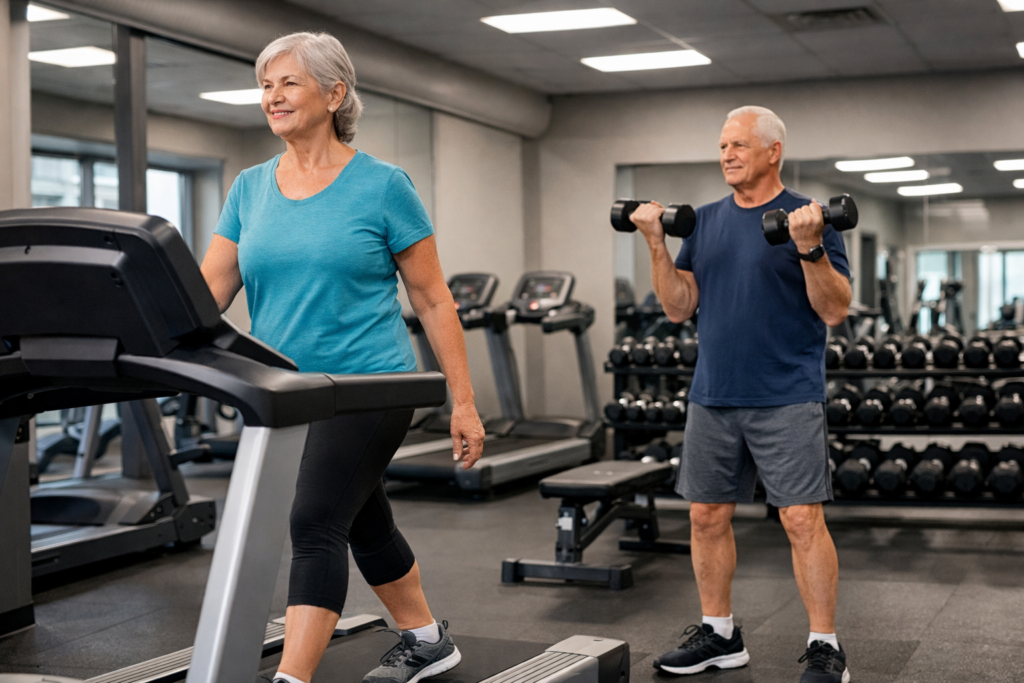
Illustration generated by author using ChatGPT
Sources:
CDC Physical Activity for Older Adults: https://www.cdc.gov/physical-activity-basics/guidelines/older-adults.html
CDC: What Counts as Physical Activity for Older Adults: https://www.cdc.gov/physical-activity-basics/adding-older-adults/what-counts.html
ACSM Physical Activity Guidelines: https://acsm.org/education-resources/trending-topics-resources/physical-activity-guidelines/
Fall Prevention Exercise Effectiveness (PMC): https://pmc.ncbi.nlm.nih.gov/articles/PMC10435089/
Falls Prevention Systematic Review (MDPI): https://www.mdpi.com/2075-1729/16/1/41
WHO-informed Falls Evidence (IJBNPA): https://ijbnpa.biomedcentral.com/articles/10.1186/s12966-020-01041-3
Physical Activity in Older Adults (PMC): https://pmc.ncbi.nlm.nih.gov/articles/PMC11562269/
Balance and Physical Activity Programs (PMC): https://pmc.ncbi.nlm.nih.gov/articles/PMC6635278/
The One True Gospel of Wellness
By John Turley
On April 23, 2026
In Commentary, Medicine
Why Every Guru Thinks They’ve Found the Only Path to Health
There’s a peculiar affliction that seems to strike fitness influencers, biohackers, homeopathic healers, and wellness gurus with near-universal consistency — the unshakeable conviction that they, and only they, have cracked the code on human health. Whether it’s cold plunges at 4 a.m., microdosing mushrooms, coffee enemas, or whatever supplement stack is trending this week, every one of these prophets arrives at the same conclusion: their method is the path, the others are at best misguided, and mainstream medicine is a corrupt temple worth burning down.
Psychologists have a name for part of what’s happening here. It’s called the Dunning-Kruger effect — the tendency for people with limited knowledge in a domain to overestimate their own competence. But that’s only part of the story. Many of these figures are genuinely smart, sometimes even credentialed. What really drives the zealotry is something closer to what researchers call “belief perseverance” — the tendency to hold tightly to a conclusion even when contradicting evidence rolls in. Once someone has built an identity, a brand, and an income stream around a single idea, the psychological and financial cost of admitting nuance becomes enormous.
Take the biohacking community as a prime example. Some influencers — like the self-proclaimed “father of biohacking” — have built empires on the premise that optimizing the body is a matter of finding the right levers and pulling them correctly. They have championed everything from Bulletproof Coffee to infrared saunas to testosterone replacement, positioning each as a revelation that conventional medicine is too slow or too corrupted to acknowledge. The problem isn’t that all of these interventions lack merit — some have legitimate science behind them. The problem is the rhetorical framework: the idea that skeptics aren’t just wrong, they’re complicit. That’s not science; that’s a revival meeting.
Homeopathy sits at a different extreme but runs on the same engine. Developed in the late 18th century by Samuel Hahnemann, homeopathy is based on the idea that substances that cause symptoms in healthy people can cure those symptoms in the sick — and that extreme dilution actually strengthens a remedy’s potency. The scientific consensus is unambiguous: systematic reviews and meta-analyses have repeatedly found homeopathic remedies perform no better than placebo. And yet its advocates don’t merely disagree with this consensus — they dismiss the entire evidentiary framework, arguing that conventional research methods simply can’t measure what homeopathy does. It’s an airtight position: no evidence can ever count against it.
The fitness world runs its own version of this dogmatism on a perpetual loop. CrossFit devotees insist that anything other than functional high-intensity training is a waste of time. Carnivore diet advocates declare that vegetables are quietly poisoning you with antinutrients. Yoga instructors sometimes slide into the claim that breath control and mindfulness can substitute for actual medical care. Each subculture has its orthodoxy, its apostles, and its convenient explanations for why people who don’t follow the program are sick, lazy, or deceived. The irony is that many of these systems contain genuinely useful elements. Resistance training really does build muscle and bone density. Mindfulness really does reduce cortisol. Dietary quality really does matter enormously. But the insistence on one method to the exclusion of all others transforms useful practices into something closer to religious doctrine.
What’s lost in all the noise is the most important truth in medicine: human bodies are wildly heterogeneous. What works beautifully for one person may be ineffective or even harmful for another. This isn’t a flaw in the science — it is the science. Precision medicine, one of the most promising frontiers in modern healthcare, is built entirely on this recognition. The dream of a single universal protocol for human health isn’t just unrealized — it’s probably unrealizable. Yet that’s precisely what every wellness guru is selling.
There’s also a social dimension worth naming. The wellness industry is, in the most literal sense, an industry. It generated an estimated $5.6 trillion globally in 2022, according to the Global Wellness Institute, and that number continues to climb. When someone’s livelihood depends on their particular system being not just good but uniquely correct, objectivity becomes a luxury they can’t easily afford. Dismissing alternatives isn’t just tribalism — it’s good business.
None of this is to say that skepticism toward mainstream medicine is always misplaced. Conventional healthcare has real blind spots — in chronic disease management, in nutrition research, in the treatment of pain, and in its historical tendency to dismiss patient experience. The gurus often fill genuine gaps that the system has left open. But filling a gap is different from claiming you have the only map to the entire territory. The honest answer in health and fitness, as in most complex domains, is that we know a good deal, we don’t know quite enough, and anyone who tells you they’ve figured it all out probably hasn’t.
The next time someone tells you they’ve discovered the only way — whether it’s a supplement protocol, a spiritual practice, or a morning routine — it might be worth asking the simplest question in science: compared to what? If the answer is a dismissive wave at everything else, you probably have your answer.
Illustration generated by author using ChatGPT.
Sources
Global Wellness Institute — Global Wellness Economy Monitor: https://globalwellnessinstitute.org/industry-research/
Ernst E. — Homeopathy: The Undiluted Facts (Springer, 2016): https://link.springer.com/book/10.1007/978-3-319-43592-3
Dunning D. — The Dunning-Kruger Effect, Advances in Experimental Social Psychology: https://www.sciencedirect.com/science/article/pii/S0065260111440024
National Institutes of Health — Precision Medicine Initiative: https://www.nih.gov/research-training/allofus-research-program
Medical Disclaimer
The information provided in this article is intended for general educational and informational purposes only and does not constitute medical advice. It should not be used as a substitute for professional medical advice, diagnosis, or treatment.
Always seek the guidance of a qualified healthcare provider with any questions you may have regarding a medical condition or treatment. Never disregard professional medical advice or delay seeking it because of something you have read here.
If you are experiencing a medical emergency, call 911 or your local emergency number immediately.
The author of this article is a licensed physician, but the views expressed here are solely those of the author and do not represent the official position of any hospital, health system, or medical organization with which the author may be affiliated.