
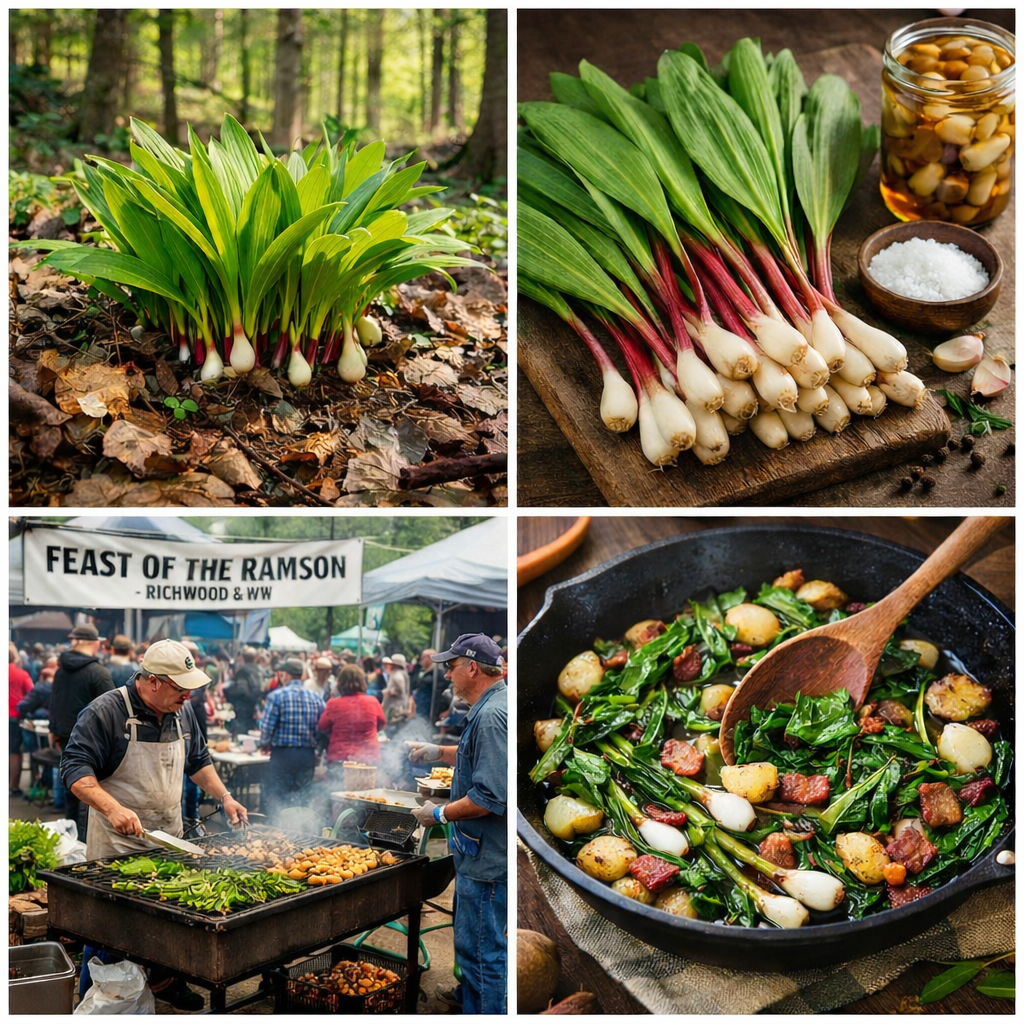
It’s time for my annual column about ramps.
Every spring, something remarkable happens on the forest floors of the eastern United States. Before most of the world has shaken off its winter coat, before the first wildflowers have dared to show their faces, a small, broad-leafed plant quietly pushes up through the leaf litter and announces that the season has changed. That plant is the ramp — and if you’ve never heard of it, you probably don’t live in Appalachia, where its annual arrival is something close to a religious event.
What Are Ramps?
Ramps (Allium tricoccum) are a wild, perennial plant belonging to the same family as onions, garlic, and leeks — the Amaryllidaceae, or amaryllis family. Botanically speaking, they’re sometimes called wild leeks or wood leeks, and they share the pungent, sulfur-driven flavor profile of their cultivated cousins. But ramps carry something extra: a garlicky wallop layered on top of the onion bite, bold enough to clear a room. The plant produces two or three broad, smooth, bright green leaves in spring, growing 8 to 12 inches long, attached to a slender stalk that narrows into a small white bulb underground. By late spring, the leaves die back and a flower stalk emerges, producing small white blossoms.
From a nutritional standpoint, ramps belong firmly in the vegetable category — specifically among the allium vegetables — and are genuinely impressive in what they deliver. They’re low in calories (around 30 per 4 ounces) but rich in vitamins A, C, and K, along with minerals including selenium, chromium, iron, and folate. A single cup provides about 30% of the daily recommended value of vitamin A and roughly 18% of the daily value of vitamin C. They also contain sulfur compounds like kaempferol and allicin — the same bioactive chemicals found in garlic — that are associated with cardiovascular health, anti-inflammatory effects, and even some cancer-protective properties.
Historically, ramps also carried a reputation as a kind of folk remedy. After months of limited fresh produce, their arrival was thought to “cleanse the blood” and restore vitality—a belief rooted more in tradition than modern science but not entirely disconnected from their nutritional value.
Where and How They Grow
Ramps have an enormous native range, stretching from Nova Scotia down through Georgia and west to Iowa and Minnesota. But they’re most densely concentrated — and most enthusiastically celebrated — in the Appalachian Mountain corridor. They thrive in rich, moist, well-drained soil under the shade of deciduous trees: maple, beech, poplar, and birch are favorite neighbors. You’re most likely to find them carpeting the floor of a hardwood forest near a stream or on a hillside slope that holds moisture.
The timing of their emergence is part of what makes ramps so culturally charged. They’re spring ephemerals — plants that exploit the brief window between winter’s end and the closing of the forest canopy, when sunlight still reaches the ground in quantity. The leaves typically appear in early April and last only through mid-May before yellowing and dying back. That’s it. A few weeks. You either catch them or you wait another year.
Growing ramps from scratch is not a project for the impatient. Seeds can take 6 to 18 months to germinate and require both a warm moist period and then a cold period to break dormancy. The plants themselves take 5 to 7 years to mature. This slow reproductive cycle is one reason that overharvesting has become a serious concern. The Smoky Mountains National Park banned ramp harvesting entirely in 2002, citing studies showing that ramp populations need years to recover from even a single harvest. Some parts of Canada now limit foragers to 50 bulbs per person.
Many enthusiasts now recommend not harvesting the bulb at all and picking only a single leaf from the plant to allow continued growth.
How They’re Prepared
Ramps are famously versatile — every edible part of the plant can be used. The leaves are milder and wilt down beautifully when cooked. The stalks carry more punch. The bulbs are the most potent part, with an intensity that can outlast the meal and the evening— and sometimes days. That lingering quality, by the way, is a significant part of ramp lore. Eating them raw is a commitment. Even cooking them doesn’t fully tame the aftermath.
The classic Appalachian preparation is almost aggressively simple: fry them in butter or bacon fat alongside sliced potatoes and scrambled eggs. That combination — earthy, fatty, pungent, satisfying — is the dish most associated with the tradition. But ramps also appear in soups, pancakes, and hamburgers. Modern chefs have expanded the repertoire considerably, featuring ramp pesto, ramp butter, pickled ramps, ramp-infused oils, and even ramps on pizza. High-end restaurants began showcasing them in the late 1990s and early 2000s, turning a humble Appalachian forage vegetable into a coveted seasonal ingredient.
Pickling is a popular preservation method, extending the ramp season well beyond the brief spring window. Pickled ramps retain a pleasant tang and a gentler bite than raw ones, making them an easy addition to charcuterie boards or grain bowls. Ramps can also be blanched and frozen for up to six months, though freezing softens the texture.
Cultural Significance in Appalachia
To understand what ramps mean to Appalachia, you have to appreciate what they meant historically. For communities in the mountains that went months without access to fresh vegetables, ramps were among the first green things to appear after winter. They weren’t just food — they were a signal that the hard season was ending. Native American groups including the Cherokee, Iroquois, and Chippewa had long used them as both food and medicine—treating colds, earaches, intestinal parasites —and as a springtime tonic. European settlers learned from those traditions and wove ramps into their own seasonal pattern.
The word “ramp” itself has deep roots. Botanist Earl L. Core of West Virginia University traced the term to the Old English word “ramson,” a dialectical variant used across the southern Appalachian region in contrast to the “wild leek” terminology used elsewhere. That linguistic distinction is itself a marker of regional identity — ramps aren’t just what you call the plant, they’re a signal of where you’re from.
In Appalachia, ramps are far more than an ingredient—they are a tradition. For generations, families have ventured into the woods each spring to gather them, often returning to prepare communal meals that celebrate the end of winter. These gatherings, commonly known as ramp feeds or ramp festivals, remain a fixture in many communities.
Ramp festivals have anchored spring calendars in Appalachian communities for a century. The ramp festival in Haywood County, North Carolina has drawn as many as 4,000 participants per year since around 1925. Richwood, West Virginia — whose newspaper editor once famously mixed ramp juice into the printer’s ink as a prank, drawing the wrath of the U.S. Postmaster General — hosts one of the most well-known celebrations. True confession, as teenagers, a friend and I twice visited the Richwood festival because the street vendors would sell us beer without checking to see if we were 18 yet. Flag Pond, Tennessee holds its annual festival on the second Saturday each May. Whitetop, Virginia does the same the third weekend of May, complete with live music from local legends and a ramp-eating contest for children and adults. Huntington, West Virginia hosts what it calls the Stink Fest, organized by an indoor farmers’ market called The Wild Ramp.
These festivals aren’t just excuses to eat pungent vegetables (and drink beer). They’re expressions of place and belonging. Academic researchers who’ve studied ramp culture describe the plant as “an important symbol of Appalachian regional identity, providing rural mountain communities with a sense of place.” The ramp’s reputation for extreme smell — the kind that follows you out of the room and through the next day — has become something worn with pride rather than embarrassment. It’s the badge of someone who knows the land, who grew up digging bulbs out of a hillside with a grandparent, who understands that the best things have seasons. Their strong odor lingers on the breath and skin, creating a shared experience that borders on communal initiation. In some Appalachian communities, it has long been joked that eating ramps together ensures that no one notices the smell—because everyone smells the same. And, if you were lucky, it might get you sent home from school the next day.
The ramp’s recent rise in fine dining circles has introduced a complicated tension into that identity. National demand has strained wild populations, raised prices (sometimes to $20 per pound or more at specialty markets), and prompted genuine concern about sustainability. There’s a real question about whether the ramp can remain a community food when it becomes a luxury ingredient. For now, those spring festivals still draw crowds who know the difference between a ramp pulled from familiar woods and one that traveled a thousand miles to appear on a white-tablecloth menu.
The ramp is, in the end, a small plant carrying an outsized story. It’s a vegetable, yes — a nutritious allium with impressive micronutrient credentials. But it’s also a calendar marker, a community ritual, a flavor memory, and a contested symbol of who gets to claim a landscape as their own. If you ever get the chance to try them fresh in April, take it. Just don’t plan anything important for the next 24 hours.
Illustration generated by author using ChatGPT.
Sources
Botany, Natural History & Range
1. Wikipedia. “Allium tricoccum.” Wikimedia Foundation. https://en.wikipedia.org/wiki/Allium_tricoccum Botanical overview, common names, Appalachian cultural history, ramp festivals.
3. Conzit. “The Allure of Ramps: A Culinary Springtime Delight.” https://conzit.com/post/the-allure-of-ramps-a-culinary-springtime-delight Seasonal availability, native range, sustainability concerns, and culinary significance.
7. Davis, Jeanine M. and Jacqulyn Greenfield. “Cultivating Ramps: Wild Leeks of Appalachia.” Purdue University New Crops & New Uses, 2002. https://hort.purdue.edu/newcrop/ncnu02/v5-449.html Definitive agricultural source on ramp cultivation, seed germination, growing conditions, festival traditions, and the Smoky Mountains harvesting ban.
8. WildEdible.com. “Ramps: How to Forage & Eat Wild Leeks.” March 2022. https://www.wildedible.com/blog/foraging-ramps Foraging identification, historical role as a spring tonic, preparation methods, and seed propagation advice.
11. American Indian Health & Diet Project. “Ramps.” University of Kansas. https://aihd.ku.edu/foods/Ramps.html Native American uses of ramps (Cherokee, Iroquois, Chippewa), etymology of the word ‘ramp,’ and historical range.
Nutrition & Health
12. SnapCalorie. “Ramps Nutrition.” https://www.snapcalorie.com/nutrition/ramps_nutrition.html Nutritional overview: vitamins A and C, iron, magnesium, caloric content.
13. Facts.net. “20 Ramps Nutrition Facts.” October 2024. https://facts.net/lifestyle/food/20-ramps-nutrition-facts/ Detailed micronutrient breakdown including vitamins A, C, E, K, folate, potassium, calcium, and anti-inflammatory compounds.
14. Precision Nutrition. “Ramps Recipe & Nutrition.” Encyclopedia of Food. https://www.precisionnutrition.com/encyclopedia/food/ramps Nutritional analysis, beta-carotene and selenium content, culinary preparation techniques, and storage guidelines.
15. Eat This Much. “Melissa’s Ramps Nutrition Facts.” https://www.eatthismuch.com/food/nutrition/ramps,139795/ Macronutrient breakdown per cup serving; vitamin A as 30% of daily value.
16. Specialty Produce. “Ramps Information and Facts.” https://specialtyproduce.com/produce/Ramps_775.php Comprehensive botanical and culinary profile; vitamins A, C, K; selenium, chromium, iron, folate content.
17. Instacart. “Ramps – All You Need to Know.” February 2022. https://www.instacart.com/company/ideas/ramps-all-you-need-to-know Seasonal availability, storage, Canadian foraging limits, and commercial market pricing.
18. Healthline. “10 Health and Nutrition Benefits of Leeks and Wild Ramps.” June 2019. https://www.healthline.com/nutrition/leek-benefits Peer-reviewed nutritional analysis; kaempferol, allicin, thiosulfinates, vitamin C concentration versus oranges, cardiovascular and cancer-protective properties.
19. HealthierSteps. “Health Benefits Of Wild Ramps And Leeks.” February 2023. https://healthiersteps.com/health-benefits-of-wild-ramps-and-leeks/ Vitamin B6, manganese, folate, potassium and blood pressure; kaempferol and cancer risk reduction.
20. Healthfully. “Nutritional Benefits of Ramps.” January 2021. https://healthfully.com/257269-nutritional-benefits-of-ramps.html Detailed vitamin A and C daily value percentages; selenium and chromium content; cites Eric Block’s ‘Garlic and Other Alliums: The Lore and the Science.’
Appalachian Culture, Identity & Foraging Tradition
2. Sachdeva, N. et al. “Pungent Provisions: The Ramp and Appalachian Identity.” Academia.edu. https://www.academia.edu/22223522/Pungent_Provisions_The_Ramp_and_Appalachian_Identity Peer-reviewed qualitative research on ramp culture, identity, and the tension between regional tradition and national culinary demand.
4. Jordan, M. et al. “Ramps (Allium tricoccum Aiton) as a Wild Food in Northern Appalachia.” Society & Natural Resources. Taylor & Francis Online, 2025. https://www.tandfonline.com/doi/full/10.1080/08941920.2025.2512536 Peer-reviewed mixed-methods study on ramp harvesting, commercial trade, conservation, and Appalachian regional identity.
5. Appalachian Memories. “The Love of Wild Ramps in the Appalachian Mountains.” EchoesofAppalachia.org, October 2024. https://appalachianmemories.org/2024/10/25/the-love-of-wild-ramps-in-the-appalachian-mountains/ First-person Appalachian foraging traditions, preparation methods, and sustainable harvesting practices.
6. Serra, Janet. “Discovering Ramps: Spring’s Wild Culinary Treasure.” JanetSerra.com, May 2025. https://janetserra.com/2025/05/16/discovering-ramps-springs-wild-culinary-treasure/ Spring ephemeral lifecycle, leaf emergence timing, sulfur compounds and cardiovascular health benefits.
9. OhMyFacts. “15 Facts About Ramps.” October 2024. https://ohmyfacts.com/food-beverage/vegetables/15-facts-about-ramps/ Cherokee culinary and medicinal traditions, nutritional profile summary, and harvest season.
10. ForageFinds.com. “Appalachian Foraging: Native Edible Plants Guide.” December 2024. https://www.foragefinds.com/foraging-by-region/central-appalachia-native-edible-plants/ Indigenous knowledge of ramps, European settler adoption, and role of ramps in contemporary Appalachian cuisine.