
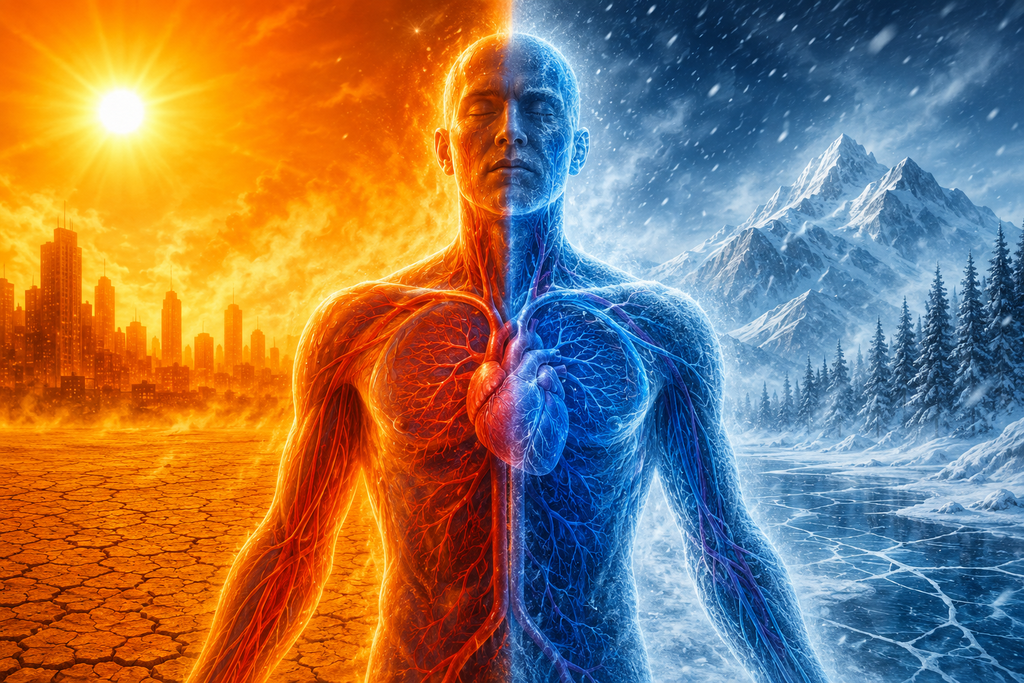
Mammals have evolved with an internal thermostat that does a remarkably good job maintaining a consistent body temperature. We humans evolved in a warm climate, so we are physiologically more adapted for shedding heat than for retaining it. Our body runs best when we maintain an internal (core) temperature between 97°F and 99°F.
Our internal thermostat adjusts blood flow, metabolism, sweating, and muscle activity to maintain our internal temperature balance, also known as homeostasis. When we’re exposed to high heat the blood vessels near the skin expand, allowing heat to escape. Sweating increases to cool the body. When we’re exposed to extreme cold, blood vessels narrow to conserve our body heat and we start to shiver to generate additional heat.
Extreme heat or cold can overwhelm the ability of our thermostats to regulate our internal temperature and we begin to experience discomfort, confusion and eventually organ injury, unconsciousness, and even death.
Extreme Heat
Our body’s main defense against extreme heat is sweating. It’s not so much the sweat itself as it is evaporation that cools us. Sweat evaporates efficiently on a hot dry day, but when the air is saturated with moisture, sweating is much less effective. A temperature that would be tolerable in a dry environment can rapidly become unbearable in a humid one. As it turns out, those people who have always said, “it’s the humidity not the temperature“ were at least partially correct.
Sweating works fine for a while, but in extreme heat, it can quickly lead to dehydration. While your body struggles to keep you cool, blood flow shifts towards the skin to give up additional heat. This causes more stress on the heart and the circulatory system. People with underlying heart disease, vascular disease, lung disease, or even diabetes, and kidney disease can be under significant stress from heat. Heat can also affect the brain’s functioning and potentially worsen mental illnesses such as anxiety and schizophrenia.
As a body’s internal temperature increases, it can lead to confusion which can cause accidents and impaired judgment. When the temperature passes 104°F it can even lead to loss of consciousness. This isn’t just a bad day in the sun; it’s a true medical emergency.
I covered specific heat injuries, including their symptoms, diagnosis, prevention, and treatment in my post “When the Sun Bites Back“.
Extreme Cold
Extreme cold presents a different problem. As our body begins to lose heat faster than it can generate it, our internal thermostat works to retain heat rather than shed it. The primary goal becomes preserving internal body temperature. Blood flow shifts to the core, often sacrificing the extremities to protect vital organs.
The initial response is constricting blood vessels near the surface of the skin to reduce heat loss. We then began shivering, involuntary, rapid contractions that can generate considerable heat in the short run. But shivering requires energy and can soon deplete our reserves.
It’s not just the temperature that causes problems. Wind increases heat loss from exposed skin, giving us the well known wind-chill. Water exposure, whether from heavy rain, melting snow, or direct immersion increases heat loss dramatically.
Excessive cold creates symptoms similar to heat, confusion, poor judgment, and slowed thinking set in initially, making it difficult for most people to recognize that they are in the midst of a medical emergency.
The heart is especially vulnerable to extreme cold. As our core body temperature drops, the heart’s electrical conduction system becomes increasingly unstable. This increases the risk of dangerous arrhythmias. The potential for cardiac arrest raises considerably when core body temperature falls below 90°F. What most people think of as “freezing to death” is caused primarily by cardiac arrest.
I will be covering specific cold injuries, including their diagnosis, symptoms, treatments, and prevention in a future post.
Which Is More Dangerous?
Extreme heat seems to get the most notice; a heat wave never fails to make the news. But epidemiological studies tell a different story. Two large-scale studies in Europe in the last twenty years have found deaths from cold to be between nine and seventeen times greater than those from heat. We are less aware of cold deaths because they are spread out over time and location, rather than being the result of a single weather event.
The future may tell a different story. As the climate warms, the rate of heat- related deaths is increasing compared to cold. This is significant because heat waves kill quickly and in large numbers; a 2003 European heat wave is estimated to have caused at least 70,000 excess deaths.
Who Is At Greatest Risk?
Interestingly, the risk factors for heat and cold related injuries and death are almost identical. Obviously, people with significant environmental exposure, outdoor workers, emergency responders, and farmers, are at increased risk.
Age is common risk factor. Infants have limited ability to regulate their internal temperature, and young children heat up and cool off faster than adults. Older adults have a spectrum of problems that increase their risk. As we age, the body can lose its ability to adapt to temperature changes. Cardiovascular reserve can lessen, reducing the ability to respond to the stress of extreme temperatures. Many older people are taking medications that may alter hydration or temperature regulation. Additionally, many older adults have mobility problems or lack reliable transportation or social support to enable them to escape temperature extremes.
Use of drugs or alcohol can contribute to dehydration and heat loss. They also can impair judgement or mentation, increasing the susceptibility to temperature extremes.
Our Human Thermostat
We have evolved with an amazing ability to regulate our internal temperature, but the range is surprisingly narrow. Our adaptability can give us a false sense of security. As our thermostat begins to fail, our judgement and mental status become altered, leaving us even more valuable.
Awareness, planning and prevention are the most important parts of preventing temperature related injuries.
Illustration generated by author using ChatGPT.
Sources
1. Harvard Health Publishing, “Heat Stroke (Hyperthermia).” https://www.health.harvard.edu/preventive-care/heat-stroke-hyperthermia-a-to-z
2. Cleveland Clinic, “Heat Stroke.” https://my.clevelandclinic.org/health/diseases/21812-heatstroke
3. “Impact of hyper- and hypothermia on cellular and whole-body physiology,” PMC. https://www.ncbi.nlm.nih.gov/pmc/articles/PMC11727703/
4. “Heat stroke: Pathogenesis, diagnosis, and current treatment,” ScienceDirect. https://www.sciencedirect.com/science/article/abs/pii/S1568163724002277
5. American Academy of Family Physicians, “Hypothermia and Cold Weather Injuries.” https://www.aafp.org/pubs/afp/issues/2019/1201/p680.html
6. “Out of the cold: management of hypothermia and frostbite,” PMC (CMAJ). https://pmc.ncbi.nlm.nih.gov/articles/PMC140473/
7. Connecticut Department of Public Health, “Frostbite and Hypothermia.” https://portal.ct.gov/dph/communications/crisis-and-emergency-risk-communication/frostbite-and-hypothermia
8. Gasparrini A, et al., “Mortality risk attributable to high and low ambient temperature: a multicountry observational study,” The Lancet, 2015. https://www.ncbi.nlm.nih.gov/pmc/articles/PMC4521077/
9. Zhao Q, et al., “Global, regional, and national burden of mortality associated with non-optimal ambient temperatures from 2000 to 2019,” The Lancet Planetary Health, 2021. https://www.thelancet.com/journals/lanplh/article/PIIS2542-5196(21)00081-4/fulltext
10. “Are there more cold deaths than heat deaths?” The Lancet Planetary Health, 2025. https://www.thelancet.com/journals/lanplh/article/PIIS2542-5196(25)00054-3/fulltext
11. ScienceDaily, “Cold weather kills far more people than hot weather.” https://www.sciencedaily.com/releases/2015/05/150520193831.htm