
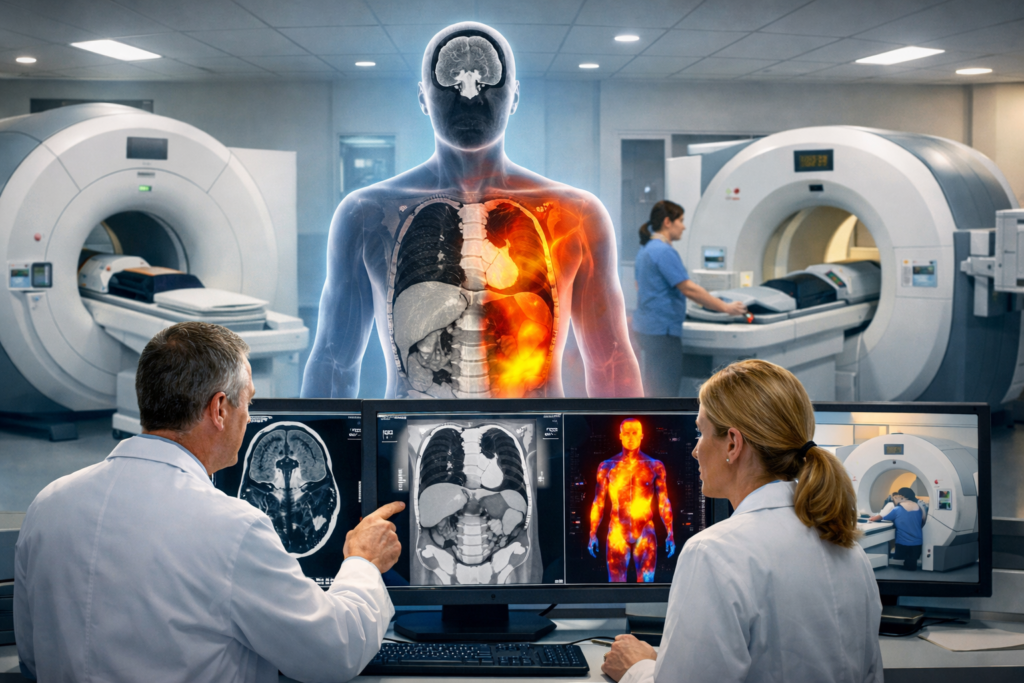
Not so long ago, if a doctor needed to know what was happening inside your body, the options were limited — a basic X-ray, an exploratory surgery, or educated guesswork. Today, a radiologist can map your brain’s blood vessels, detect a cancer smaller than a pea, or watch your heart metabolizing sugar in near real time — all without making a single incision.
The first medical X-ray appeared in 1895. For decades, imaging largely meant detecting fractures or large abnormalities. Today, radiology guides emergency care, cancer treatment, stroke therapy, cardiac management, and preventive medicine. Modern diagnostic imaging has transformed medicine in ways that would have seemed like science fiction to physicians just a few generations ago.
Modern imaging falls into three broad categories: structural imaging — what tissues look like, vascular imaging — how blood flows, and functional imaging — how cells behave metabolically. Here’s a plain-language guide to the big three: MRI/MRA, CT/CTA, and PET scans — what they are, how they work, and why they matter.
MRI and MRA: Magnets and Radio Waves
The MRI — magnetic resonance imaging — is one of the most versatile tools in modern medicine, and it works without a single ray of radiation. An MRI passes an electric current through coiled wires to create a temporary magnetic field in your body. A transmitter and receiver then send and receive radio waves, and a computer uses those signals to construct detailed digital images of whatever area is being scanned. Think of it as a very sophisticated tuning fork: it causes hydrogen atoms in your body’s water molecules to briefly align, then releases them — and the energy they emit on the way back creates the image. Because different tissues relax at different rates, MRI can distinguish gray matter from white matter in the brain, normal from inflamed or cancerous tissue, and ligament from muscle with impressive contrast.
The result is exceptional detail, especially for soft tissue. MRI scans take much clearer pictures of your brain, spinal cord, nerves, muscles, ligaments, and tendons than regular X-rays and CT scans. That’s why your orthopedic surgeon orders one when your knee goes sideways, and why neurologists reach for it when they suspect a stroke or multiple sclerosis.
MRA — magnetic resonance angiography — is MRI’s cousin, using the same magnetic technology but focused specifically on blood vessels. It lets physicians map arteries and veins in remarkable detail, identifying narrowing (stenosis), bulges (aneurysms), or blockages (occlusions) without the need for invasive catheterization. If your doctor suspects a blockage in the blood vessels feeding your brain or kidneys, an MRA can reveal it clearly. A contrast dye is sometimes injected to make vessels stand out even more sharply.
The main trade-offs with MRI are time and noise — scans generally take between 30 to 50 minutes, and the machine produces the kind of clanging racket that makes earplugs standard issue. People with certain metal implants or severe claustrophobia can’t always use it, which is where CT steps in.
CT and CTA: X-Rays, Upgraded
The CT scan — computed tomography — takes the familiar chest X-ray and turns it into something far more powerful. A CT scan takes multiple X-ray images from different angles rotating around the body, separates them by depth then processes them by computer to create cross-sectional views — essentially a detailed 3D picture rather than a flat 2D image. Think of slicing a loaf of bread: instead of seeing only the crust, you can examine every slice.
A CT shows more detail than a standard X-ray and is used to diagnose cancer, heart disease, injuries from trauma, and musculoskeletal disorders — it’s one of the most common imaging tests used today. Emergency departments rely on CT heavily because it’s fast, often completed in 10 to 15 minutes, and can quickly identify life-threatening conditions like internal bleeding or pulmonary embolism.
CTA — CT angiography — adds an injected contrast dye to the mix, allowing physicians to see blood vessels with high clarity. Contrasting agents help show various structures of the body more clearly, making CTA the go-to test for evaluating coronary arteries, aortic aneurysms, and vascular disease throughout the body. Unlike MRA, it’s faster and more widely available, though it does involve a dose of radiation — something physicians weigh carefully against the diagnostic benefit.
PET Scan: When Function Matters More Than Form
If MRI and CT show you the structure of the body, the PET scan — positron emission tomography — shows you what’s happening inside it. This is a fundamentally different question, and the technology reflects that.
A PET scan is used to see metabolism and chemical activity within your body. It can detect abnormal changes before structural changes occur — meaning it can detect cancer before a tumor is large enough to be seen on a CT or MRI. That’s a remarkable capability. The scan works by injecting a small amount of a radioactive tracer — most commonly a form of glucose — into your bloodstream. Diseased cells, particularly cancer cells, absorb more of the radiotracer than healthy ones do. Active cells consume glucose. Cancer cells, inflamed tissue, and active brain regions often use more glucose than surrounding tissue. These are called “hot spots,” and the PET scanner detects this radiation to produce images of affected tissue.
Beyond cancer, PET scans are invaluable in cardiology — showing whether heart muscle is still alive after a heart attack — and in neurology, helping diagnose Alzheimer’s disease, epilepsy, and brain tumors by revealing abnormal patterns of brain activity.
The trade-off is resolution. The image resolution of nuclear medicine images may not be as high as that of CT or MRI, which is why PET is rarely used alone today. Combined PET/CT scanners perform almost all PET scans today , marrying metabolic information with anatomical precision. Hybrid PET/MRI scanners are also emerging though not yet in widespread use. They are particularly valuable for soft-tissue cancers of the brain, liver, and pelvis.
How They Compare — and Why It Matters
The simplest way to think about these three technologies is this: CT shows shape and structure quickly, with emphasis on bone and dense tissue; MRI shows soft tissue in extraordinary detail without radiation; and PET shows function and cellular activity that neither of the others can see directly.
A patient with suspected cancer might undergo a CT scan to identify the location of a mass, followed by a PET to determine its metabolic activity, and then an MRI to map its relationship to critical soft tissues. Used together, these tools give physicians a picture of disease that is more complete than any single test could provide.
The value to modern medicine is difficult to overstate. These technologies allow doctors to diagnose conditions earlier, stage cancers more accurately, guide surgical planning, and monitor how well treatments are working — all without exploratory surgery. Survival rates for many cancers have improved substantially in part because imaging lets us find disease when it’s still manageable.
The era when medicine was largely guesswork about what lay beneath the skin is over. Today, radiologists are, in a very real sense, reading the body like an open book.
Illustration generated by author using ChatGPT.
Sources:
UNC Health Appalachian — MRI, CT, and PET Scan Comparison: https://www.unchealthappalachian.org/blog/2024/comparing-mri-ct-and-pet-scans-how-they-work-and-when-theyre-use/
WashU Mallinckrodt Institute of Radiology — Differences Between CT, MRI, and PET: https://www.mir.wustl.edu/do-you-know-the-differences-between-a-ct-mri-and-pet-scan/
Cleveland Clinic — PET Scan Overview: https://my.clevelandclinic.org/health/diagnostics/10123-pet-scan
RadiologyInfo.org — PET/CT: https://www.radiologyinfo.org/en/info/pet
Open MedScience — CT, MRI, and PET Differences: https://openmedscience.com/ct-mri-and-pet-scanners-unravelling-the-differences-in-modern-medical-imaging/
Healthline — MRI vs. PET Scan: https://www.healthline.com/health/mri-vs-pet-scan
Revere Health — MRI, CT, and PET Explained: https://reverehealth.com/live-better/mri-ct-pet/