
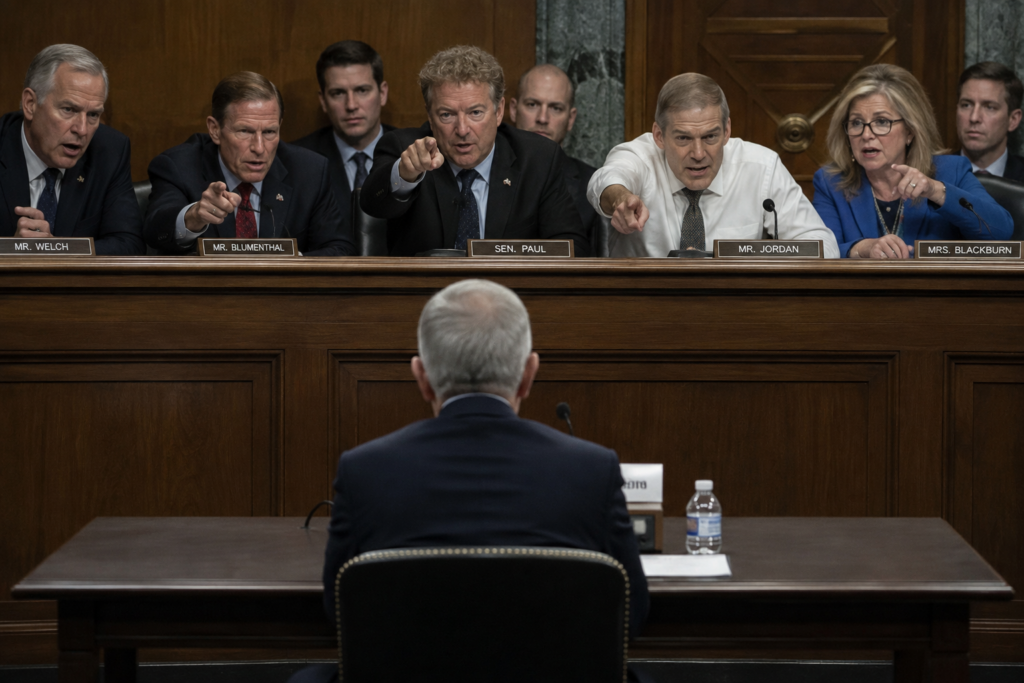
Last week, an 85-year-old physician sat before a Senate committee and, for the first time in more than 250 congressional appearances spanning five decades of public service, declined to answer. Dr. Anthony Fauci invoked his Fifth Amendment right against self-incrimination over one hundred times, telling the panel that its chairman’s “evident obsession with calling for my prosecution” left him with no other reasonable choice. He was invoking his Fifth Amendment right against self-incrimination, not because he believed he had committed a crime, but because he no longer trusted that anything he said would be treated as testimony rather than ammunition. It was a stunning scene, and it should trouble anyone who cares about how this country treats its public servants once the politics of a crisis outlast the crisis itself.
Fauci’s career is, by any fair measure, one of the most consequential in the history of American medicine. He joined the National Institutes of Health in 1968 and led the National Institute of Allergy and Infectious Diseases from 1984 until his retirement in 2022, advising seven presidents from Reagan to Biden. He was, for two decades, among the most cited scientists on earth. He helped transform HIV/AIDS from a near-certain death sentence into a manageable chronic condition, and his work undergirded PEPFAR, the President’s Emergency Plan for AIDS Relief, which is credited with saving more than 25 million lives worldwide. For that work, President George W. Bush — a Republican — awarded him the Presidential Medal of Freedom in 2008. Doctor Francis S. Collins, former director of the National Institutes of Health, has called Dr. Fauci “a national treasure” and has stated that “Dr Fauci is the most dedicated public servant I have ever known. His contributions have saved countless lives from HIV/AIDS, Ebola and SARS-CoV-2, and will stand as a profoundly significant gift to humanity.” None of that is in dispute even by his fiercest critics.
What is in dispute is his conduct during COVID-19, when he became the public face of a federal response that asked Americans to accept school closures, business shutdowns, masking, and eventually vaccine mandates. Senator Rand Paul, who now chairs the Senate committee investigating him, has spent years arguing that the National Institutes of Health funded research in Wuhan China contributed to the virus’s emergence, and that Fauci misled Congress about it under oath.
Ahead of last week’s hearing, Paul released more than 1,100 pages of Fauci’s pandemic-era diary entries, obtained after an eight-month search led by Health and Human Services Secretary Robert F. Kennedy Jr. Paul argued that what Fauci wrote privately differs from what he told the public. Paul has now pledged to seek a contempt-of-Congress vote, which he says could open the door to Justice Department prosecution. Neither Paul nor Kennedy seems to understand that a diary entry is a statement fixed in time and may involve personal musing and speculation and that opinion and public statements can evolve as new knowledge becomes available. Or perhaps they don’t care.
Reasonable people can criticize specific decisions made during the pandemic. Some restrictions may have lasted too long. Officials could have communicated uncertainty more clearly. Public health agencies sometimes failed to explain why recommendations changed, allowing confusion and mistrust to spread. The shifting public health guidance that so many Americans remember as evidence of dishonesty is, to most working scientists, simply what science looks like in real time: recommendations changed because the evidence changed, not because anyone was hiding the truth. But that is not to say those criticisms don’t deserve serious discussion.
What deserves equal recognition, however, is the unprecedented uncertainty confronting public health officials. They faced a rapidly evolving virus, incomplete data, overloaded hospitals, political polarization, and an information environment saturated with misinformation. Perfect decisions were impossible.
The main issue in contention is Senator Paul’s accusation that Dr. Fauci falsely testified that NIH never funded gain-of-function research at the Wuhan virology lab. The element of funding is a technical issue. NIH did not directly fund research at the Wuhan lab; they provided a grant to a group known as EchoHealth who in turn funded research at Wuhan. The second element requires a brief explanation of gain-of-function research.
Gain-of-function is laboratory research that deliberately alters a virus or other pathogen to give it new or enhanced biological properties—such as increased transmissibility, infectivity, or the ability to infect a new host—in order to better understand disease mechanisms, improve surveillance, or develop vaccines and treatments. Senator Paul contends that the research did meet the gain-of-function definition while Dr. Fauci contends that it did not meet the federal guidelines in effect at that time and further that the research was not conducted on the SARS-CoV-2 virus and did not result in COVID-19. He continues to maintain that his testimony accurately reflected NIH policy and definitions. Federal reviews, including one commissioned by the National Institutes of Health, have concluded that the specific EcoHealth-funded research did not meet the technical definition of gain-of-function in place at the time, a conclusion Fauci’s critics dispute but have not conclusively rebutted.
As these hearings have pointed out, there is not a single definition of gain-of-function among virologists or microbiologists. Some argue for a tighter definition while others do not. To further add confusion to the question, the American Society for Microbiology has called for a more precise, evidence-based definition of the term gain-of-function.
It is worth being precise about what has and has not been shown. No evidence has emerged that the coronavirus was engineered or leaked from a laboratory; the scientific consensus still points toward a natural spillover event from a wild source.
The elements of perjury require two things: the person knowingly gave false testimony and did so with intention to deceive. Testifying to something that is believed to be true but is later proven to be false does not make the previous testimony perjury. Because the underlying definitions in this charge are under intense debate in the scientific community, the basis for a perjury charge is extremely weak. But we know from recent experience with the reflecting pool that the lack of evidence does not stop the Trump administration from making unfounded criminal charges.
The perjury allegations remain only allegations, litigated in hearing rooms, press conferences, and cable news segments rather than in courts. And Fauci already received a preemptive pardon from President Biden before leaving office specifically to protect him from prosecution over pandemic-era statements — a fact Paul acknowledged, raising the question of exactly what additional legal jeopardy this pursuit is meant to produce.
That question points toward the real story here, which is less about virology than about power. Since President Trump’s return to the White House, several of Fauci’s most vocal critics — Kennedy chief among them — occupy positions from which they can direct the machinery of government at a single retired scientist. A congressional hearing that features senators trying to provoke Fauci by asking about tie colors and the day of the week, his attorney forcibly removed from the room, and a gallery of Trump-aligned activists standing by to testify about vaccine mandates is not a forum for discovering facts.
It is a stage for finishing an old argument by other means. They are attempting to turn a pandemic that killed more than a million Americans, into the fault of one man rather than a shared national failure, much of which occurred on Trump’s watch. And part of it may be personal, given how frequently Fauci found himself publicly correcting a president who does not forget being corrected.
This seems to me to be a case of selective persecution and part of the Trump revenge program.
Fauci may have been an imperfect messenger, and reasonable people can fault his early missteps on masking guidance or his sometimes brusque certainty in front of cameras. But there is a meaningful difference between legitimate oversight of pandemic policy — which Congress should absolutely conduct — and a years-long campaign whose stated goal, in Fauci’s own paraphrase of his chief antagonist, is to see him “behind bars.” When a senator with subpoena power spends a hearing pursuing a scientist’s diary rather than debating the substance of research policy, the effort looks less like accountability and more like retribution dressed up as investigation. It is incredible to me that any reasonable person would believe that a man who spent his entire professional career trying to protect the American public from viral diseases would suddenly and intentionally try to trick them into wearing face masks and closing schools.
The American public deserves a legitimate, evidence-based scrutiny of pandemic-era policies . What the country has gotten instead, at least in the current hearings, looks less like accountability than theater, and neither a scientist’s record nor the public’s understanding of what actually happened is served by a proceeding that produced a great deal of heat and, by most independent accounts, no new facts.
Public servants who make consequential decisions under uncertain conditions deserve scrutiny, not immunity from criticism. But they also deserve a process that seeks truth rather than a scalp. A man who spent fifty years fighting AIDS, Ebola, and a novel coronavirus should not have to plead the Fifth to protect himself from the country he served. That he felt compelled to do so says less about Anthony Fauci than it does about the politics that have consumed the men now pursuing him. This is just one more in a string of embarrassments caused by the Trump administration that have brought shame to the American people in the eyes of the world.
Image generated by author using ChatGPT.
Sources:
1. NBC News, “Anthony Fauci invokes Fifth Amendment right not to answer questions at GOP-led Covid hearing” (July 29, 2026): https://www.nbcnews.com/politics/congress/anthony-fauci-5th-amendment-testify-covid-hearing-rand-paul-rcna589793
2. NewsNation, “Republican COVID-19 allegations against Dr. Anthony Fauci explained”: https://www.newsnationnow.com/health/what-fauci-is-accused-of/
3. The Washington Post, “Fauci’s critics have power. They’re coming after his pandemic record.” (August 2, 2026): https://www.washingtonpost.com/politics/2026/08/02/faucis-critics-have-power-theyre-coming-after-his-pandemic-record/
4. TIME, “Fauci Pleads the Fifth at Senate Hearing on COVID, Escalating Long-Running Clash With Republicans” (July 29, 2026): https://time.com/article/2026/07/29/fauci-fifth-amendment-senate-hearing-covid-rand-paul-republicans/
5. The Washington Post, “Rand Paul threatens to hold Fauci in contempt after he declines to answer questions” (July 29, 2026): https://www.washingtonpost.com/politics/2026/07/29/fauci-set-face-rand-paul-senate-gop-after-release-his-covid-diary/
6. AOL News, “Republicans ramp up attacks on Fauci”: https://aol.com/republicans-ramp-attacks-fauci-100000419.html
7. NIH MedlinePlus Magazine, “Meet Anthony S. Fauci, M.D., former Director of NIAID”: https://magazine.medlineplus.gov/article/meet-anthony-s-fauci-m.d-former-director-of-the-national-institute-of-allergy-and-infectious-diseases
8. Academy of Achievement, “Anthony S. Fauci, M.D.” (career timeline): https://achievement.org/achiever/anthony-s-fauci-m-d/
9. PBS American Masters, “Anthony Fauci biography and career timeline”: https://www.pbs.org/wnet/americanmasters/anthony-fauci-biography-and-career-timeline/26116
10. Encyclopaedia Britannica, “Anthony Fauci”: https://www.britannica.com/biography/Anthony-Fauci


Russel Vought and the War on the Environment
By John Turley
On February 16, 2026
In Commentary, History, Politics, Science
Recently, there’s been a a lot of attention given to RFK Jr. and his war on vaccines. More potentially devastating than that is Russel Vought and his war on environmental science.
Russell Vought hasn’t exactly been working in the shadows. As the director of the Office of Management and Budget since February 2025, he’s been methodically implementing what he outlined years earlier in Project 2025—a blueprint that treats climate science not as settled fact, but as what he calls “climate fanaticism.” The result is undeniably the most aggressive dismantling of environmental protections in American history.
The Man Behind the Plan
Vought’s resume tells you everything you need to know about his approach. He served as OMB director during Trump’s first term, wrote a key chapter of Project 2025 focusing on consolidating presidential power, and has openly stated his goal is to make federal bureaucrats feel “traumatized” when they come to work. His philosophy on climate policy specifically? He’s called climate change a side effect of building the modern world—something to manage through deregulation rather than prevention.
Attacking the Foundation: The Endangerment Finding
The centerpiece of Vought’s climate strategy targets what EPA Administrator Lee Zeldin has called “the holy grail of the climate change religion”—the 2009 Endangerment Finding. This Obama-era scientific determination concluded that six greenhouse gases (carbon dioxide, methane, nitrous oxide, hydrofluorocarbons, perfluorocarbons, and sulfur hexafluoride) endanger public health and welfare. It sounds technical, but it’s the legal foundation for virtually every federal climate regulation enacted over the past fifteen years.
Just last week EPA Administrator Zeldin announced that the Trump administration has repealed this finding. This action strips EPA’s authority to regulate greenhouse gas emissions under the Clean Air Act—meaning no more federal limits on power plant emissions, no vehicle fuel economy standards tied to climate concerns, and no requirement for industries to measure or report their emissions. White House press secretary Karoline Leavitt said this action “will be the largest deregulatory action in American history.”
More than 1,000 scientists warned Zeldin not to take this step, and the Environmental Protection Network cautioned last year that repealing the finding would cause “tens of thousands of additional premature deaths due to pollution exposure” and would spark “accelerated climate destabilization.” Abigail Dillen president of the nonprofit law firm Earthjustice said “there is no way to reconcile EPA’s decision with the law, the science and the reality of the disasters that are hitting us harder every year.” She further said they expect to see the Trump administration in court. Obviously, the science is less important to Trump, Zeldin and Vought than the politics.
The Thirty-One Targets
In March 2025, Zeldin announced what he proudly called “the greatest day of deregulation in American history”—a plan to roll back or reconsider 31 key environmental rules covering everything from clean air to water quality. The list reads like a regulatory hit parade, including vehicle emission standards (designed to encourage electric vehicles), power plant pollution limits, methane regulations for oil and gas operations, and even particulate matter standards that protect against respiratory disease.
The vehicle standards are particularly revealing. The transportation sector is America’s largest source of greenhouse gas emissions, and the Biden-era rules were crafted to nudge automakers toward producing more electric vehicles. At Vought’s direction, the EPA is now reconsidering these, with Zeldin arguing they “regulate out of existence” segments of the economy and cost Americans “a lot of money.”
Gutting the Science Infrastructure
Vought’s agenda extends beyond specific regulations to the institutions that produce climate science itself. In Project 2025, he proposed abolishing the Office of Domestic Climate Policy and suggested the president should refuse to accept federal scientific research like the U.S. National Climate Assessment (NCA). The NCA, published every few years, involves hundreds of scientists examining how climate change is transforming the United States—research that informs everything from building codes to insurance policies.
According to reporting from E&E News in January, Vought wants the White House to exert tighter control over the next NCA, potentially elevating perspectives from climate deniers and industry representatives while excluding contributions made during the Biden administration. This is a plan that has been in the works for years. Vought reportedly participated in a White House meeting during Trump’s first term where officials discussed firing the scientists working on the assessment.
The National Oceanic and Atmospheric Administration (NOAA) has also been targeted. In February 2025, about 800 NOAA employees—responsible for weather forecasting, climate monitoring, fisheries management, and marine research were fired. Project 2025 had proposed breaking up NOAA entirely, and concerned staff members have already begun a scramble to preserve massive amounts of climate data in case the agency is dismantled.
Budget Cuts as Policy
Vought’s Center for Renewing America has proposed eliminating the Department of Energy’s Office of Energy Efficiency and Renewable Energy, the EPA’s environmental justice fund, and the Low Income Home Energy Assistance Program. During the first Trump administration, Vought oversaw budgets proposing EPA cuts as steep as 31%—reducing the agency to funding levels not seen in decades. In a 2023 speech, he explained the logic bluntly: “We want their funding to be shut down so that the EPA can’t do all of the rules against our energy industry because they have no bandwidth financially to do so.”
This isn’t just about climate, it is also about fairness and the recognition that environmental policies have had a predominately negative effect on low income areas. EPA has cancelled 400 environmental justice grants, closed environmental justice offices at all 10 regional offices, and put the director of the $27 billion Greenhouse Gas Reduction Fund on administrative leave. The fund had been financing local economic development projects aimed at lowering energy prices and reducing emissions.
Eliminating Climate Considerations from Government
Perhaps more insidious than the high-profile rollbacks are the procedural changes that make climate considerations disappear from federal decision-making. In February, Jeffrey Clark—acting administrator of the Office of Information and Regulatory Affairs (OIRA) under Vought’s OMB—directed federal agencies to stop using the “social cost of carbon” in their analyses. This metric calculates the dollar value of damage caused by one ton of carbon pollution, allowing agencies to accurately assess whether regulations produce net benefits or defects for society.
Vought has also directed agencies to establish sunset dates for environmental regulations—essentially automatic expiration dates after which rules stop being enforced unless renewed. For existing regulations, the sunset comes after one year; for new ones, within five years. The stated goal is forcing agencies to continuously justify their rules, but the practical effect is creating a perpetual cycle of regulatory uncertainty.
The Real-World Stakes
The timing of these rollbacks offers a grim irony. As Vought was pushing to weaken the National Climate Assessment in January 2025, the Eaton and Palisades fires were devastating Los Angeles—exactly the type of climate-intensified disaster the assessment is designed to help communities prepare for. The administration’s response? Energy Secretary Chris Wright described climate change as “a side effect of building the modern world” at an industry conference.
An analysis by Energy Innovation, a nonpartisan think tank, found that Project 2025’s proposals to gut federal policies encouraging renewable electricity and electric vehicles would increase U.S. household spending on fuel and utilities by about $240 per year over the next five years. That’s before accounting for the health costs of increased air pollution or the economic damage from unmitigated climate change.
Environmental groups have vowed to challenge these changes in court, and the legal battles will likely stretch on for years. The D.C. Circuit Court of Appeals will hear many cases initially, though the Supreme Court will probably issue final decisions. Legal experts note that while Trump’s EPA moved with unprecedented speed on proposals in 2025, finalizing these rules through the required regulatory process will take much longer. As of December, none of the major climate rule repeals had been submitted to OMB for final review, partly due to what EPA called a 43-day government shutdown (which EPA blamed on Democrats, though the characterization is widely disputed).
What Makes This Different
Previous administrations have certainly rolled back environmental regulations, but Vought’s approach differs in both scope and philosophy. Rather than tweaking specific rules or relaxing enforcement, he’s systematically attacking the scientific and legal foundations that make climate regulation possible. It’s the difference between turning down the thermostat and ripping out the entire heating system.
The Environmental Defense Fund, which rarely comments on political appointees, strongly opposed Vought’s confirmation, with Executive Director Amanda Leland stating: “Russ Vought has made clear his contempt for the people working every day to ensure their fellow Americans have clean air, clean water and a safer climate.”
Looking Forward
Whether Vought’s vision becomes permanent depends largely on how courts rule on these changes. The 2007 Supreme Court decision in Massachusetts v. EPA established that the agency has authority to regulate greenhouse gases as air pollutants under the Clean Air Act—the very authority Vought is now trying to eliminate. Overturning established precedent is difficult, though the current Supreme Court’s composition makes the outcome possible, if not likely.
What we’re witnessing is essentially a test of whether one administration can permanently disable the federal government’s capacity to address climate change, or if these changes represent a temporary setback that future administrations can reverse. The stakes couldn’t be higher: atmospheric CO2 concentrations continue rising, global temperatures are breaking records, and climate-related disasters are becoming more frequent and severe. Nothing less than the future of our way of life is at stake. We must take action now.
Full disclosure: my undergraduate degree is in meteorology, but I would never call myself a meteorologist since I have never worked in the field. But I still maintain an interest, from both a meteorological and a medical perspective. The Grump Doc is never lacking in opinions.
Illustration generated by author using Midjourney.
Sources:
Lisa Friedman and Maxine Joselow, “Trump Allies Near ‘Total Victory’ in Wiping Out U.S. Climate Regulation,” New York Times, Feb. 9, 2026.[nytimes +1]
Lisa Friedman, “The Conservative Activists Behind One of Trump’s Biggest Climate Moves,” New York Times, Feb. 10, 2026.[nytimes +1]
Bob Sussman, “The Anti-Climate Fanaticism of the Second Trump Term (Part 1: The Purge of Climate from All Federal Programs),” Environmental Law Institute, May 7, 2025.[eli]
U.S. Environmental Protection Agency, “Trump EPA Kicks Off Formal Reconsideration of Endangerment Finding,” EPA News Release, Mar. 13, 2025.[epa]
Trump’s Climate and Clean Energy Rollback Tracker, Act On Climate/NRDC coalition, updated Jan. 11, 2026.[actonclimate]
“Trump to Repeal Landmark Climate Finding in Huge Regulatory Rollback,” Wall Street Journal, Feb. 9, 2026.[wsj]
Valerie Volcovici, “Trump Set to Repeal Landmark Climate Finding in Huge Regulatory Rollback,” Reuters, Feb. 9, 2026.[reuters]
Alex Guillén, “Trump EPA to Take Its Biggest Swing Yet Against Climate Change Rules,” Politico, Feb. 10, 2026.[politico]
“EPA Urges White House to Strike Down Landmark Climate Finding,” Washington Post, Feb. 26, 2025.[washingtonpost]
“Trump Allies Near ‘Total Victory’ in Wiping Out U.S. Climate Regulation,” Seattle Times reprint, Feb. 10, 2026.[seattletimes]
“Trump Wants to Dismantle Key Climate Research Hub in Colorado,” Earth.org, Dec. 17, 2025.[earth]
“Vought Says National Science Foundation to Break Up Federal Climate Research Center,” The Hill, Dec. 17, 2025.[thehill]
Rachel Cleetus, “One Year of the Trump Administration’s All-Out Assault on Climate and Clean Energy,” Union of Concerned Scientists, Jan. 13, 2026.[ucs]
Environmental Protection Network, “Environmental Protection Network Speaks Out Against Vought Cabinet Consideration,” Nov. 20, 2024.[environmentalprotectionnetwork]
“From Disavowal to Delivery: The Trump Administration’s Rapid Implementation of Project 2025 on Public Lands,” Center for Western Priorities, Jan. 28, 2026.[westernpriorities]
“Russ Vought Nominated for Office of Management and Budget Director,” Environmental Defense Fund statement, Mar. 6, 2025.[edf]
“Project 2025,” Heritage Foundation/Project 2025 backgrounder (as summarized in the Project 2025 Wikipedia entry).[wikipedia]
“EPA to repeal finding that serves as basis for climate change,” The Associated Press, Matthew Daly
https://vitalsigns.edf.org/story/trump-nominee-and-project-2025-architect-russell-vought-has-drastic-plans-reshape-america
https://en.wikipedia.org/wiki/Russell_Vought
https://www.commondreams.org/news/warnings-of-permanent-damage-to-people-and-planet-as-trump-epa-set-to-repeal-key-climate-rule
https://www.eenews.net/articles/trump-team-takes-aim-at-crown-jewel-of-us-climate-research/
https://www.epa.gov/newsreleases/epa-launches-biggest-deregulatory-action-us-history
https://www.pbs.org/newshour/nation/trump-administration-moves-to-repeal-epa-rule-that-allows-climate-regulation
https://www.scientificamerican.com/article/trump-epa-unveils-aggressive-plans-to-dismantle-climate-regulation/
https://www.bloomberg.com/news/articles/2026-02-10/trump-s-epa-to-scrap-landmark-emissions-policy-in-major-rollback