

Did you know that there once an independent republic in the farthest reaches of northern New Hampshire, where the dense forests blend into the Canadian wilderness? Neither did I until I came across it in a fascinating book titled A Brief History of the World in 47 Boarders by John Elledge.
It was a short-lived but remarkable experiment in self-government. For three years in the 1830s, the settlers of a disputed border region declared themselves citizens of an independent republic—complete with their own constitution, legislature, and militia. They called it the Republic of Indian Stream, a name that today sounds almost mythical, yet it was a genuine, functioning democracy. Their story blends frontier improvisation, international diplomacy, and Yankee self-reliance—and it leaves us with a curious artifact: a constitution written not by statesmen in Philadelphia, but by farmers, loggers, and merchants caught between two competing nations.
A Territory in Limbo
The roots of the Indian Stream story go back to the Treaty of Paris (1783), which ended the American Revolution. The treaty defined the U.S.–Canada border but used vague geographic language—particularly the phrase “the northwesternmost head of the Connecticut River.” No one could agree which of several small tributaries the treaty meant.
The ambiguity created a slice of wilderness—about 200 square miles—claimed by both the United States and British Lower Canada (now Quebec). For decades, the region existed in a gray zone. Both countries sent tax collectors and law officers, both demanded military service, and neither provided clear legal protection. Residents couldn’t vote, hold secure property titles, or rely on either government’s courts. To make matters worse, they were sometimes forced to pay taxes twice—once to New Hampshire and once to Canada.
Origins of the Republic
By the late 1820s, frustration had reached a boiling point. Attempts to resolve the border dispute were unsuccessful—including arbitration by the King of the Netherlands in 1827 that failed when the United States rejected his decision that favored Great Britain.
With both sides still pressing their claims, the settlers decided they’d had enough of outside interference. On July 9, 1832, they convened a local meeting and declared independence, forming the Republic of Indian Stream. Their constitution—modeled on American state constitutions—began with a simple premise: authority rested with “the citizens inhabiting the territory.”
This wasn’t an act of rebellion but one of survival. The settlers wanted peace, order, and local control. Their goal was to withdrawal from ambiguous regulation and to create a government that could function until the border question was finally settled.
The Constitution of Indian Stream
The constitution of the Republic, adopted the same day they declared sovereignty, was an impressively crafted document for a community of barely 300 people. It reflected the settlers’ familiarity with republican ideals and their determination to govern themselves fairly.
Key features included:
- Democratic foundation: All authority stemmed from the citizens.
- Annual elections: A single House of Representatives made the laws, and a magistrate acted as both executive and judge.
- Judicial simplicity: Local justices of the peace handled disputes—there were no elaborate court hierarchies.
- Individual rights: Residents enjoyed protections derived from U.S. constitutions—trial by jury, due process, and freedom from arbitrary arrest.
- Defense and civic duty: Citizens pledged to defend their independence and assist one another in emergencies.
Despite its modest scale, the system worked. The republic passed laws, issued warrants, collected taxes, and even mustered a small militia to maintain order.
Life on the Frontier
Life in Indian Stream resembled that of many frontier communities: logging, farming, hunting, and trading. The land was rough, winters long, and access to distant markets limited. Yet the people thrived through cooperation and self-reliance. Trade with both Canadian and New Hampshire merchants continued—proof that practicality often trumped politics on the frontier.
The republic’s remote location provided a degree of safety from interference, but not immunity. Both British and American agents continued to assert claims, and occasional arrests or skirmishes kept tensions high.
The End of the Republic
The experiment in independence lasted only three years. In 1835, a dispute between an Indian Stream constable and a Canadian deputy sheriff triggered a diplomatic crisis. Canada sent troops to assert control, prompting New Hampshire’s governor to respond in kind.
Realizing they were caught between two competing governments, the citizens voted in April 1836 to accept New Hampshire’s jurisdiction. Indian Stream became part of the town of Pittsburg, and peace was restored.
The larger boundary issue wasn’t fully settled until the Webster–Ashburton Treaty of 1842, which formally placed Indian Stream within the United States.
Legacy of a Lost Republic
Today, little remains of the Republic of Indian Stream except New Hampshire Historical Marker #1 and a scattering of homesteads near the Connecticut Lakes.
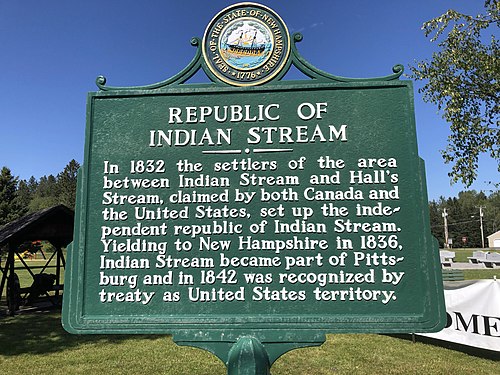
Yet its legacy is profound. It may have lasted only three years, but its story reflects the broader American frontier experience: independence, inventive, and determination to live free from arbitrary rule. In an era defined by rigid borders and powerful states, the memory of Indian Stream reminds us that freedom once depended, not on lines on a map, but on the courage of people willing to draw their own lines.
The story also illustrates the complexities of nation-building in the early American period when borders remained fluid and communities sometimes had to forge their own path toward self-governance. While the republic was short lived, it stands as a testament to the ingenuity and determination of America’s frontier settlers, who refused to accept statelessness and instead chose to create their own nation in the wilderness.
The Indian Stream constitution reminds us that political order is not always imposed from above; sometimes, out of necessity, it is created from below. The settlers were neither revolutionaries nor idealists—they simply wanted clear rules, fair courts, and predictable taxes. Ordinary citizens, faced with legal chaos and neglect, designed a functioning democracy grounded in fairness and mutual responsibility.
That such a tiny community would craft its own constitution speaks to the enduring appeal of constitutional government in the early 19th century. Even on the edge of two empires, far from capitals and legislatures, these settlers turned to a familiar American solution: write it down, elect your leaders, and hold them accountable every year. Hopefully we will be able to keep their spirit and live up to the example of Indian Stream.
From Reagan Conservative to Social Democrat: A Political Evolution
By John Turley
On December 30, 2025
In Commentary, Politics, Uncategorized
Political beliefs rarely change overnight. Mine certainly didn’t. My journey from Reagan-era conservatism to social democracy unfolded slowly, shaped less by ideology than by lived experience and an accumulating body of evidence about what actually works.
Morning in America
Like many Americans of my generation, my political awakening came during the Reagan years. The message was optimistic and reassuring: limited government, free markets, individual responsibility, and a strong national defense would restore American greatness. Reagan’s charisma made complex economic ideas feel like common sense. Lower taxes would spur growth. Deregulation would unleash innovation. Markets would reward effort and discipline.
That worldview was personally affirming. Success was earned. Failure reflected poor choices. Government’s role should be narrow—defense, public order, and little else. Social programs, we were told, fostered dependency rather than opportunity. It was a coherent framework, and for a time, it seemed to fit the facts.
Cracks in the Foundation
By the 1990s, inconsistencies began to surface. Economic growth continued, but inequality widened. Entire industrial communities collapsed despite residents working hard and playing by the rules. The benefits of “trickle-down” economics were not trickling very far.
Personal experiences made the abstractions impossible to ignore. Families lost health insurance because of pre-existing conditions. Medical bills pushed insured households into bankruptcy. These outcomes weren’t failures of character; they were failures of systems.
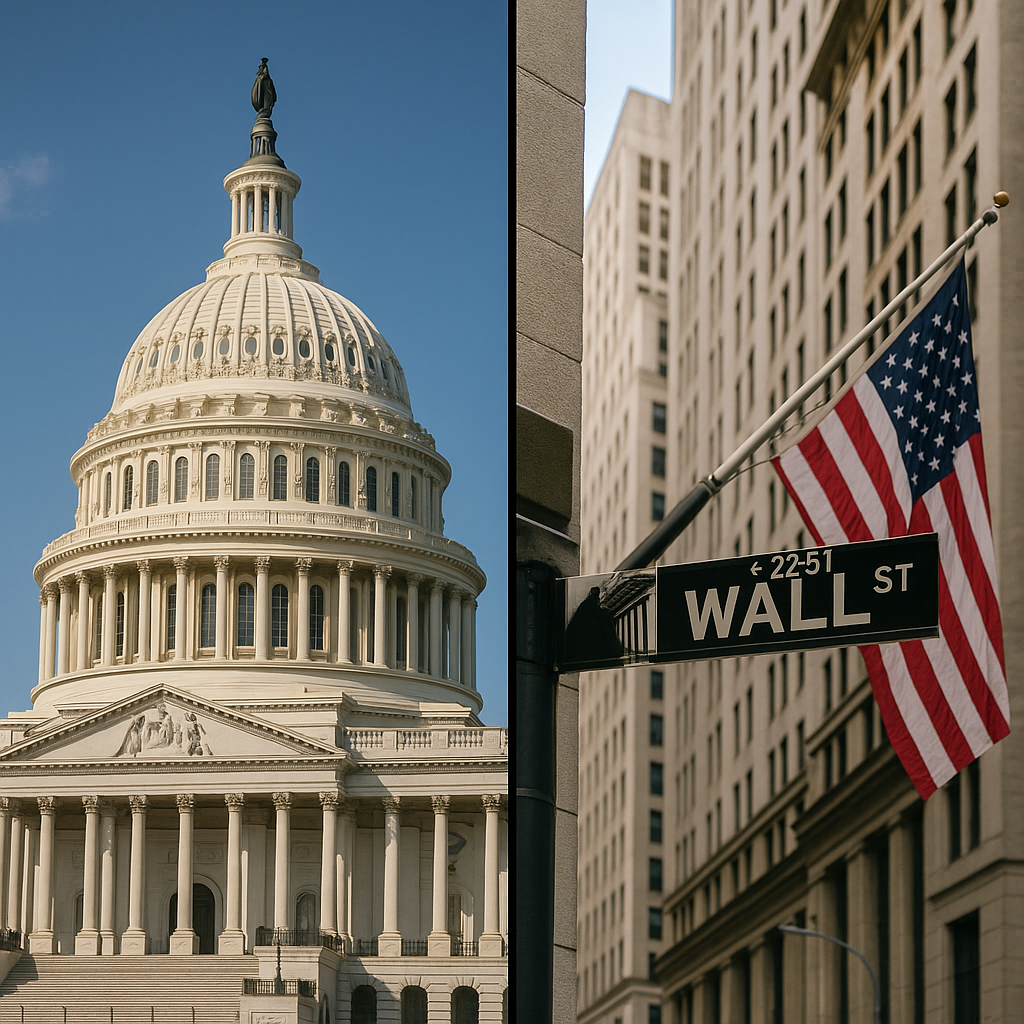
The 2008 financial crisis shattered whatever illusions remained. Financial institutions that preached personal responsibility engaged in reckless speculation, then received massive government bailouts, while homeowners were left to face foreclosure. Like millions of others, I lost nearly half of my retirement savings. The contradiction was glaring: socialism for the wealthy, harsh market discipline for everyone else. Individual responsibility meant little when systemic risk brought down the entire economy.
A Turning Point
Job loss during the Great Recession completed the lesson. Despite qualifications and work history, employment opportunities vanished. Unemployment benefits—once easy to dismiss in theory as handouts—became essential in practice. The bootstrap mythology doesn’t hold up when the floor is pulled away.
This period also exposed the fragility of employer-based healthcare and retirement systems. COBRA coverage was unaffordable. 401(k)s evaporated. The safety net that once seemed excessive suddenly looked inadequate. Meanwhile, countries with stronger social protections weathered the recession better than the United States.
Seeing Other Models
Travel and research broadened my perspective further. Nations like Germany, Denmark, France, and Sweden paired market economies with robust social programs—and consistently outperformed the U.S. on measures of health, social mobility, and life satisfaction.
These were not stagnant, overregulated societies. They were thriving capitalist democracies that simply made different choices about public investment and risk-sharing.
Writers like Joseph Stiglitz and Thomas Piketty documented how concentrated wealth undermines both democracy and long-term growth. Historical evidence showed that America’s most prosperous era—the post-World War II boom—coincided with high marginal tax rates, strong unions, and major public investment.
Healthcare Changed Everything
Healthcare ultimately crystallized my shift. The U.S. spends far more per capita than any other nation yet produces worse outcomes on many basic measures.
As a physician, I watched patients struggle with insurance denials, opaque pricing, and medical debt. Healthcare markets don’t function like normal markets. You can’t comparison shop during a heart attack. When insurers profit by denying care, the system aligns against patients. Medical bankruptcy is virtually unknown in countries with universal coverage—for a reason. We have a system where the major goal of health insurance companies is making a profit for their investors—not providing affordable healthcare to their subscribers.
Climate and Collective Action
Climate change further exposed the limits of market fundamentalism. Individualism and laissez-faire policies have failed to account for shared environmental costs and long-term consequences. Markets alone cannot price long-term environmental harm or coordinate collective action at the necessary scale. Addressing climate risk requires regulation, public investment, and democratic planning.
What Social Democracy Is—and Isn’t
Social democracy is not the rejection of capitalism. It is regulated capitalism with guardrails—markets where they work well, public systems where markets fail. Healthcare, education, infrastructure, and basic income security perform better with strong public involvement.
This differs from democratic socialism, a distinction I’ve explored elsewhere. Social democracy embraces entrepreneurship and competition while preventing monopoly power, protecting workers, and taxing fairly to fund shared prosperity.
As sociologist Lane Kenworthy notes, the U.S. already has elements of social democracy—Social Security, Medicare, public education—we simply underfund them compared to European nations.
A Pragmatic Conclusion
My evolution wasn’t ideological betrayal; it was pragmatic learning. I adjusted my beliefs based on outcomes, not slogans. Countries with strong social democracies routinely outperform the U.S. on health, mobility, education, and even business competitiveness.
True prosperity requires both entrepreneurial freedom and collective investment. The choice isn’t markets or government—it’s how to balance them intelligently. This lesson took me decades to learn, but the evidence now feels hard to ignore.
References
Overview of causes, systemic failures, and economic consequences of the 2007–2009 financial crisis.
https://www.federalreservehistory.org/essays/great-recession
Comparative data on how countries with stronger social safety nets performed during economic downturns.
https://www.oecd.org/economy
Cross-national comparisons of well-being, social trust, and economic security.
https://worldhappiness.report
Analysis of how income concentration undermines long-term economic performance and democracy.
https://www.imf.org/en/Publications/fandd/issues/2019/09/inequality-and-economic-growth-stiglitz
Historical evidence on wealth concentration and taxation in advanced economies.
https://wid.world
U.S. tax rate history showing high marginal rates during the post-war economic boom.
https://www.taxpolicycenter.org/statistics/historical-highest-marginal-income-tax-rates
Comparative analysis of health spending, outcomes, and access across developed nations.
https://www.commonwealthfund.org/publications/issue-briefs/2023/jan/us-health-care-global-perspective-2022
International comparisons of healthcare costs, outcomes, and system performance.
https://www.oecd.org/health/health-data.htm
Scientific consensus on climate change risks and the need for coordinated public action.
https://www.ipcc.ch/report/ar6/syr
Comparative research on social democracy, public investment, and economic performance.
https://lanekenworthy.net