If you’ve ever binge-watching The Crown, Ted Lasso, or any of the multitude of British mysteries, you’ve may have found yourself mimicking a British accent in the shower or casually saying “cheers” instead of “thanks.” You’re not alone — and you might be picking up more than just affectations. My wife and I are great fans of British mysteries, and I’ve been fascinated by the slang. “Ta”, “oi”, ” brilliant” and “no joy” are just a few of the terms I enjoy and all have equals in American slang. There is one small but useful word that has no direct American parallel and is starting to sneak across the Atlantic. It’s peckish, and it’s worth a closer look.
What does it actually mean?
At its simplest, peckish means mildly hungry — not famished, not starving, just that gentle mid-afternoon nagging sensation that tells you it’s time to root around for a biscuit (or, if you’re American, a cookie). Being peckish means you’re a tad hungry, not starving, but hungry enough to poke around the kitchen. Think of it as the polite, understated British cousin of “I could eat.”
There’s actually a second, older meaning too — irritable or peevish — though that sense has mostly faded from everyday use. Most modern speakers on both sides of the pond, when they use the word at all, use it strictly in the hunger sense.
Where does it come from?
The word dates to around 1785, built from the verb peck — as in what a bird does with its beak — combined with the suffix -ish, making it literally “disposed to peck.” It evolved from the notion of nibbling or picking at food, suggesting a hunger not strong enough to warrant a full meal but rather a desire for something small and light. The Oxford English Dictionary pushes the first documented use back even further, to the early 1700s.
All the pre-1988 OED citations for the word are British, which tells you something about how thoroughly it stayed home for nearly three centuries. One of the most celebrated uses comes from P.G. Wodehouse in 1936, where a character declares himself far beyond peckish — practically a homeless tapeworm. That’s the kind of comic understatement the British do so well, and it captures perfectly why the word is so appealing: it conveys hunger without any of the drama.
The Atlantic crossing
Here’s where streaming television enters the picture. Language-learning platform Babbel teamed up with Northern Arizona University researchers to measure cultural exchange between British and American English, analyzing millions of words and hours of speech — and found that British imports like bonkers, amongst, cheeky, and queue were among the fastest-growing British terms in American speech.
Peckish fits neatly into this trend. The March 2025 Netflix show Adolescence exposed American audiences to British slang and Generation Alpha online terminology that many of us had never encountered before, proving that a single binge-worthy hit can do more for vocabulary transfer than years of cultural proximity. Once Americans hear a word in context often enough — a character in Downton Abbey saying “I’m feeling rather peckish” before a garden party — the word starts to feel natural rather than foreign.
Why peckish, specifically, might stick
Not every British word makes the jump successfully. Some are too culturally specific (cheerio), some sound too pretentious (old chap), and others just don’t fill a gap that American English hasn’t already filled. Peckish, though, has a genuine advantage: it occupies a linguistic niche that American English handles clumsily. We have “hungry,” “starving,” and “famished” — all of which imply a more urgent need — and we have the clunky compound “I could use a snack.”
There’s also a certain aspirational quality at work. Borrowing British terms can feel like acquiring a touch of cosmopolitan polish, much the way earlier generations borrowed French culinary terms or Italian musical vocabulary. Saying “I’m a bit peckish” carries a different social flavor than “I’m kind of hungry.” It’s softer, less demanding, and perhaps a bit more amusing. For some speakers, that nuance is precisely the appeal.
At first glance you might think “munchies” would fill the gap. Both words describe mild, snack-worthy hunger rather than genuine meal-time starvation, but they diverge pretty sharply in tone and implication. Peckish is neutral and polite — the kind of word that fits comfortably in a country house or a BBC drama — while the munchies carries strong cultural baggage, most notably its well-documented association with cannabis use, and it implies something more compulsive and urgent than the genteel nibbling that peckish suggests. Same basic stomach situation, very different vibes.
What makes peckish particularly well-suited for adoption is its practicality. It names a common experience with precision and brevity. In an era when snacking has become a cultural norm—when meals blur into grazing—the need for a word that captures “not quite hungry, but getting there” is more relevant than ever. Peckish sits softly with a single, breezy word. It’s casual, it’s precise, and it has a pleasant sound. Words that fill empty conceptual slots tend to survive. American English may not have invented peckish, but it has room for it.
My prediction is that peckish will continue its quiet migration into American casual speech, particularly among younger, streaming-heavy audiences. It probably won’t replace “hungry” wholesale, but it could settle comfortably into the same type of informal usage that “hangry” now occupies — a colorful, specific alternative for a specific feeling. Language, after all, tends to absorb what’s useful and charming, and peckish is both.
In the meantime, if you find yourself three episodes deep into a British drama and muttering “I’m a bit peckish” while wandering toward the kitchen to grab a cuppa and a bag of crisps, congratulations — you’ve been linguistically colonized.
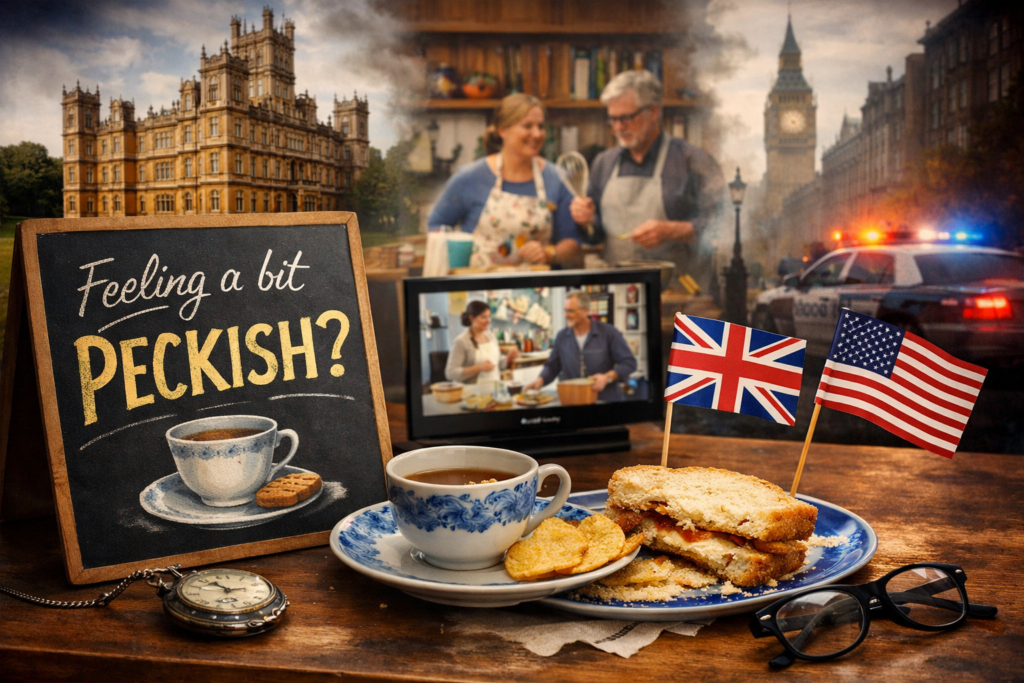
Image generated by author using ChatGPT.






“86” — A Little Number With a Big History
By John Turley
On May 2, 2026
In Commentary
Fifty some years ago when I was in the Marines, we used the term “86” to refer to something that should be ignored or discarded—in the colorful vernacular of the Corps, “shit canned”. That’s trashed to you civilians. The Marines have never been known as a peaceable lot and we had many colorful euphemisms for doing grievous bodily harm, but “86” was never among them.
So why is “86” suddenly everywhere in the news? Blame James Comey. The former FBI Director posted a beach photo on Instagram showing seashells arranged to spell out “86 47” — and the internet promptly exploded. Republicans argued it was a death threat against the 47th president. Comey said it simply meant he wanted Trump removed from office. That dispute has brought a piece of century-old American slang back into the spotlight, so it’s worth taking a look at what the term means and where it came from.
The Short Answer
Eighty-six is slang meaning “to throw out,” “to get rid of,” or “to refuse service to.” It most likely comes from 1930s soda-counter slang meaning that an item was sold out. This was part of a broader diner code that included: 13 “the boss is around,” 81 “glass of water,” and 95 “customer left without paying”. Over the decades it evolved from a kitchen noun into a verb with broader reach, and today it shows up everywhere from restaurant kitchens to Twitter and now worldwide headlines.
The Longer Answer
Here’s the honest answer: nobody knows for certain. Its etymology is unknown, but it seems to have been coined in the 1920s or 1930s. There are many theories about its origin — one article enumerates 18 possibilities, and another suggests there are “about 86 theories about 86.”
While the leading contender is the mundane diner option, there are several other more or less plausible and frequently more colorful options.
The most linguistically grounded explanation is that “86” is simply rhyming slang. The most common theory is that it is rhyming slang for “nix.” That’s the same “nix” meaning to reject or say no.
One of the more colorful stories involves a Prohibition-era speakeasy. Chumley’s, a bar with multiple entrances including one at 86 Bedford Street in New York. The story goes that the bar was supposedly warned by police before raids. Customers were told to “86 it” — meaning leave through the Bedford Street exit while cops came through the other door. It’s a great story, and if it’s not true it should be.
How It Evolved
First appearing in the early 1930s as a noun, it did not take long for the word to broaden its use beyond the realm of the soda counter. In the 1950s the word underwent some functional shift and began to be used as a verb — initially meaning “to refuse to serve a customer,” and later taking on the slightly extended meaning of “to get rid of; to throw out.”
It was quickly adopted and members of the military services who love slang, shortcuts, and inside terminology. It may just be a coincidence that Article 86 of the U.S. Uniform Code of Military Justice concerns Absence Without Leave, or AWOL.
By the 1970s it had moved well beyond the restaurant world. In the 1972 film The Candidate, a media adviser says to Robert Redford’s character, “OK, now, for starters, we got to cut your hair and eighty-six the sideburns.”
Where It Stands Today
These days, people use “86” when they cancel plans, dump something, or boot someone from a chat. Social media picked it up — Twitter and TikTok users will “86 a trend” or “86 a person” in a heartbeat.
In professional kitchens and bars, it remains “everyday lingo” — one hospitality industry veteran called it “probably the most overused word in hospitality.”
The Comey controversy also resurrected an older, arcane, and darker shade of the term. According to Cassell’s Dictionary of Slang, “to 86” can alternatively mean “to kill, to murder; to execute judicially.” That said, Merriam-Webster notes this use is infrequent, and they do not include this sense due to its relative recency and sparseness of use.
The bottom line is that “86” is one of those wonderfully slippery pieces of American slang that started in a noisy kitchen, picked up mythology along the way, and is now flexible enough to mean anything from “we’re out of the salmon” to a loaded political statement — depending entirely on who’s using it and who’s listening.
Or, perhaps this entire tempest is just the response of one thin skinned man to his pathologic fear of seashells.