
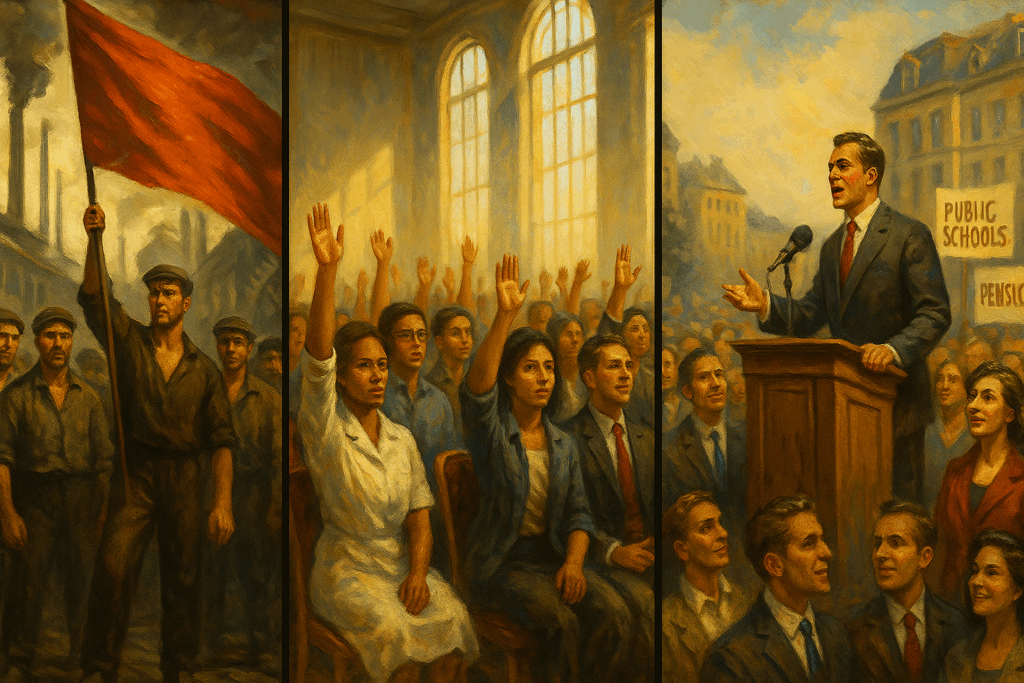
Understanding Classical Socialism, Democratic Socialism, and Social Democracy in Today’s America
If you’ve ever wondered what politicians really mean when they throw around words like “socialism” or “social democracy,” you’re not alone. These ideas used to live mostly in political theory textbooks. Now they show up in campaign speeches and social media debates. With figures like Bernie Sanders and groups like the Democratic Socialists of America bringing these ideas into the mainstream, it’s worth sorting out what each actually means.
Even though classical socialism, democratic socialism, and social democracy all claim to focus on fairness and reducing inequality, they take very different routes to get there. Understanding those differences helps make sense of what’s really being argued about in American politics today.
Classical Socialism: The Original Blueprint
Classical socialism came out of the 19th century, when industrial capitalism was grinding workers down and a couple of guys named Karl Marx and Friedrich Engels thought they had the fix. Their idea: workers should collectively own and control the means of production — factories, land, and major industries.
This wasn’t just about taxing the rich. It was about redesigning the whole system from the ground up, through violent revolution if necessary. In theory, private property creates exploitation; collective ownership ends it. In practice, that often means top-down control by the state, with economies planned from above — as seen in the Soviet Union or Maoist China.
The central ideas of classical socialism are collective ownership of big industries and central or cooperative planning instead of market competition. Production is aimed at meeting needs, not profits with the eventual goal of a classless, stateless society. Classical socialism accepts that revolution will most likely be necessary for implementation.
In theory, classical socialism wipes out worker exploitation and wealth extremes. Its central tenant is that production serves human needs, not corporate profit. In practice, it often leads to authoritarian governments, clumsy economic planning, and little room for innovation or dissent.
Would it work in America?
Probably not. The U.S. has deep cultural roots in individualism and private enterprise. Replacing markets with centralized planning would clash hard with both our Constitution and national temperament.
The Siblings of Socialism
In the real world, classical socialism has produced two offsprings, the confusingly named democratic socialism and social democracy. While they share many similarities, the major difference is that democratic socialism aims to replace capitalism while social democracy has the objective of reforming capitalism and making it more humane.
Democratic socialism
Democratic socialism shares many of classical socialism’s goals but emphasizes getting there through elections — not revolution. It aims to establish central control of key parts of the economy while protecting some political freedom and most civil rights.
The vision of Democratic Socialism is collective (public) ownership of major industries like energy, transportation, manufacturing, and communications. The economy would be directed and managed by the government, but the government would be elected and it would not be an authoritarian state. It proposes that within individual industries there would be worker self-management and workplace democracy. It also proposes that there would be private sector businesses allowed on a small scale—think Mom and Pop retail. It supposes gradual reform, not a violent upheaval, while maintaining democracy and civil liberties.
There are several major drawbacks to democratic socialism. Progress can be slow, easily reversed, and still subject to bureaucratic inefficiencies. Competing globally with capitalist economies might also prove tough. To me the major drawback is how major corporations, financial institutions, and wealthy businesspeople can be convinced to peacefully hand over control of major portions of the economy to a “people’s collective”.
How it fits in the U.S.:
Democratic Socialism has grown in popularity, especially among younger voters; although, it seems that many younger people seem to believe that this means making things more fair rather than supporting the reality of Democratic Socialism.
Bernie Sanders and Alexandria Ocasio-Cortez wear the label proudly. Still, the idea of government control of a significant portion of the economy faces serious resistance here. Realistically, it’s more a movement that nudges policy leftward than a model ready for prime time.
Social Democracy: Capitalism with Guardrails
Social democracy takes a different track. It doesn’t want to abolish capitalism — it wants to civilize it. Think Scandinavia: private ownership, strong markets, but also universal healthcare, paid leave, and free college.
The central elements of Social Democracy are a mixed economy with both public and private sector control. In some models, there is direct government management of such public services as healthcare, energy and transportation. In other models, there remains private control of these services with a strong regulation on the part of the government.
Regardless of the chosen model, a Social Democracy is a strong welfare state with universal benefits. The definition of welfare in this context is a way of providing earned support for hard working citizens Perhaps it should be called an earned benefits state as the term welfare has a pejorative implication for some.
There is strong market regulation to prevent unfair competition, price gouging, and monopolies that are detrimental to public good. There is a progressive tax program designed to reward productivity while heavily taxing passive or nonproductive income. These taxes are used to fund generous public services.
The government remains elective and responsive to the public. It’s proven to work. Nordic countries show that capitalism can coexist with equality and innovation. While it is expensive, and high taxes can be a political lightning rod, it leaves capitalism’s basic structure intact. There is a constant risk that inequality can creep back if protection weaken.
In the U.S. context:
Social democracy may be the most realistic option. As social scientist Lane Kenworthy puts it, America already is a social democracy — just not a particularly generous one. We’ve got Medicare, Social Security, public education — we just underfund them compared to our European cousins. The reality is that income lost to increased taxation is regained through decreases in insurance premiums, healthcare costs, education expenses and retirement expenses.
With Elon Musk on the cusp of becoming the world’s first trillionaire we have to ask: “How much is enough before they accept their social responsibility to the working people that made their wealth possible?” The bottom line is that when the ultra-wealthy are required to pay their fair share of taxes, public services become affordable. We should be supporting people, not yachts.
What’s Realistically Possible Here?
Culturally, Americans value freedom, competition, and property rights. Yet polls show younger voters are warming up to “socialism,” even if most don’t seem to be clear about the specifics. Institutionally, the U.S. political system makes sweeping change tough. Our winner-take-all elections favor a two-party system that leaves little room for socialist parties to grow independently.
Democratic Socialism may continue to shape the conversation, but full socialism — especially the classic Marxist kind — is not likely to take hold here. From my perspective, the most realistic option, Social Democracy is too often overlooked in these discussions.
Given that, the path of least resistance looks like expanded Social Democracy: things like a revised and equitable tax code, universal healthcare, free or subsidized higher education, paid family leave, stronger labor laws, and public investment in infrastructure and green energy.
Social Democracy looks like the most attainable path — not a revolution, but an evolution toward a fairer society. Only time will tell.
From Reagan Conservative to Social Democrat: A Political Evolution
By John Turley
On December 30, 2025
In Commentary, Politics, Uncategorized
Political beliefs rarely change overnight. Mine certainly didn’t. My journey from Reagan-era conservatism to social democracy unfolded slowly, shaped less by ideology than by lived experience and an accumulating body of evidence about what actually works.
Morning in America
Like many Americans of my generation, my political awakening came during the Reagan years. The message was optimistic and reassuring: limited government, free markets, individual responsibility, and a strong national defense would restore American greatness. Reagan’s charisma made complex economic ideas feel like common sense. Lower taxes would spur growth. Deregulation would unleash innovation. Markets would reward effort and discipline.
That worldview was personally affirming. Success was earned. Failure reflected poor choices. Government’s role should be narrow—defense, public order, and little else. Social programs, we were told, fostered dependency rather than opportunity. It was a coherent framework, and for a time, it seemed to fit the facts.
Cracks in the Foundation
By the 1990s, inconsistencies began to surface. Economic growth continued, but inequality widened. Entire industrial communities collapsed despite residents working hard and playing by the rules. The benefits of “trickle-down” economics were not trickling very far.
Personal experiences made the abstractions impossible to ignore. Families lost health insurance because of pre-existing conditions. Medical bills pushed insured households into bankruptcy. These outcomes weren’t failures of character; they were failures of systems.
The 2008 financial crisis shattered whatever illusions remained. Financial institutions that preached personal responsibility engaged in reckless speculation, then received massive government bailouts, while homeowners were left to face foreclosure. Like millions of others, I lost nearly half of my retirement savings. The contradiction was glaring: socialism for the wealthy, harsh market discipline for everyone else. Individual responsibility meant little when systemic risk brought down the entire economy.
A Turning Point
Job loss during the Great Recession completed the lesson. Despite qualifications and work history, employment opportunities vanished. Unemployment benefits—once easy to dismiss in theory as handouts—became essential in practice. The bootstrap mythology doesn’t hold up when the floor is pulled away.
This period also exposed the fragility of employer-based healthcare and retirement systems. COBRA coverage was unaffordable. 401(k)s evaporated. The safety net that once seemed excessive suddenly looked inadequate. Meanwhile, countries with stronger social protections weathered the recession better than the United States.
Seeing Other Models
Travel and research broadened my perspective further. Nations like Germany, Denmark, France, and Sweden paired market economies with robust social programs—and consistently outperformed the U.S. on measures of health, social mobility, and life satisfaction.
These were not stagnant, overregulated societies. They were thriving capitalist democracies that simply made different choices about public investment and risk-sharing.
Writers like Joseph Stiglitz and Thomas Piketty documented how concentrated wealth undermines both democracy and long-term growth. Historical evidence showed that America’s most prosperous era—the post-World War II boom—coincided with high marginal tax rates, strong unions, and major public investment.
Healthcare Changed Everything
Healthcare ultimately crystallized my shift. The U.S. spends far more per capita than any other nation yet produces worse outcomes on many basic measures.
As a physician, I watched patients struggle with insurance denials, opaque pricing, and medical debt. Healthcare markets don’t function like normal markets. You can’t comparison shop during a heart attack. When insurers profit by denying care, the system aligns against patients. Medical bankruptcy is virtually unknown in countries with universal coverage—for a reason. We have a system where the major goal of health insurance companies is making a profit for their investors—not providing affordable healthcare to their subscribers.
Climate and Collective Action
Climate change further exposed the limits of market fundamentalism. Individualism and laissez-faire policies have failed to account for shared environmental costs and long-term consequences. Markets alone cannot price long-term environmental harm or coordinate collective action at the necessary scale. Addressing climate risk requires regulation, public investment, and democratic planning.
What Social Democracy Is—and Isn’t
Social democracy is not the rejection of capitalism. It is regulated capitalism with guardrails—markets where they work well, public systems where markets fail. Healthcare, education, infrastructure, and basic income security perform better with strong public involvement.
This differs from democratic socialism, a distinction I’ve explored elsewhere. Social democracy embraces entrepreneurship and competition while preventing monopoly power, protecting workers, and taxing fairly to fund shared prosperity.
As sociologist Lane Kenworthy notes, the U.S. already has elements of social democracy—Social Security, Medicare, public education—we simply underfund them compared to European nations.
A Pragmatic Conclusion
My evolution wasn’t ideological betrayal; it was pragmatic learning. I adjusted my beliefs based on outcomes, not slogans. Countries with strong social democracies routinely outperform the U.S. on health, mobility, education, and even business competitiveness.
True prosperity requires both entrepreneurial freedom and collective investment. The choice isn’t markets or government—it’s how to balance them intelligently. This lesson took me decades to learn, but the evidence now feels hard to ignore.
References
Overview of causes, systemic failures, and economic consequences of the 2007–2009 financial crisis.
https://www.federalreservehistory.org/essays/great-recession
Comparative data on how countries with stronger social safety nets performed during economic downturns.
https://www.oecd.org/economy
Cross-national comparisons of well-being, social trust, and economic security.
https://worldhappiness.report
Analysis of how income concentration undermines long-term economic performance and democracy.
https://www.imf.org/en/Publications/fandd/issues/2019/09/inequality-and-economic-growth-stiglitz
Historical evidence on wealth concentration and taxation in advanced economies.
https://wid.world
U.S. tax rate history showing high marginal rates during the post-war economic boom.
https://www.taxpolicycenter.org/statistics/historical-highest-marginal-income-tax-rates
Comparative analysis of health spending, outcomes, and access across developed nations.
https://www.commonwealthfund.org/publications/issue-briefs/2023/jan/us-health-care-global-perspective-2022
International comparisons of healthcare costs, outcomes, and system performance.
https://www.oecd.org/health/health-data.htm
Scientific consensus on climate change risks and the need for coordinated public action.
https://www.ipcc.ch/report/ar6/syr
Comparative research on social democracy, public investment, and economic performance.
https://lanekenworthy.net