
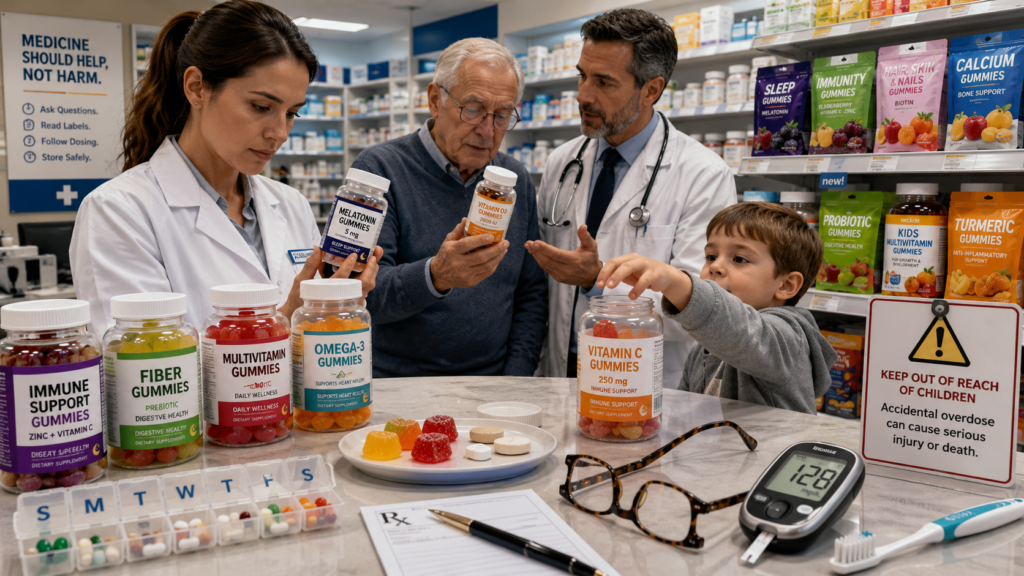
A plain-language look at gummy vitamins and medications — the good, the bad, and the sticky
Not Your Grandma’s Vitamin
Walk down the supplement aisle of any pharmacy or big-box store and you’ll find row after row of brightly colored bottles filled with gummy bears, worms, and rings that smell vaguely of fruit punch. Decades ago, vitamins came in white tablets that tasted like chalk and left you feeling vaguely like you’d swallowed a piece of sidewalk. Today, a not-insignificant share of the American supplement market looks and tastes a whole lot like candy. That shift didn’t happen by accident, and understanding what’s driving it — and what it costs — is worth your time.
Gummy formulations now cover everything from vitamin C and melatonin to prenatal multivitamins and, increasingly, actual prescription-adjacent medications. The format has clear appeal, especially for children who resist pills and adults who find swallowing large tablets unpleasant or outright difficult. But behind that chewy exterior lies a more complicated picture involving sugar, unreliable dosing, dental damage, and real safety risks that most consumers never think about.
The Appeal Is Real
Let’s give credit where it’s due: the biggest genuine advantage of gummy vitamins isn’t nutritional — it’s behavioral. According to University Hospitals, the primary benefit of gummies over traditional supplements is people will take them more consistently. A vitamin sitting in your cabinet because you hate the taste is worthless. A gummy you look forward to, however modest its nutritional profile, at least does something. That’s not a trivial point.
For parents of young children, this is often a decisive factor. Getting a five-year-old to swallow a pill can feel like an Olympic sport. Gummies sidestep the fight entirely. And for elderly patients managing complex medication regimens, or anyone with a swallowing disorder (called dysphagia), gummies and chewables offer a useful alternative to pills and capsules.
There’s also a psychological dimension. Taking a gummy feels like a small reward rather than a medical obligation, and that association can make adherence to a supplement routine more sustainable. That may sound trivial, but in the real world of patient behavior, it matters.
Gummies may be gentler on the stomach than some traditional tablets because they lack certain binding agents and can sometimes be taken without food or large volumes of water, reducing nausea for sensitive users.
The popularity of gummy medications reflects a broader shift in medicine toward consumer-friendly products. Yet the fact that a medication tastes like candy does not make it harmless.
What’s in the Gummy?
Here’s where things start to get complicated. A standard gummy vitamin isn’t just vitamins. Its base is a blend of gelatin or pectin, corn starch, water, and — almost always — sugar or some form of sweetener. UCLA Health reports that most gummy vitamins contain between 2 and 8 grams of sugar per serving. The American Heart Association recommends no more than 25 grams of added sugar per day for women and 36 grams for men. That is a meaningful slice of a daily sugar budget, especially for someone taking multiple gummies.
The presence of all those filler ingredients — coloring, flavoring, gelling agents — creates a real-world engineering problem for manufacturers: there’s only so much space in a gummy bear. That means there is less room for actual vitamins and minerals.
Many gummy multivitamins leave out key minerals such as iron or zinc, or include them only in small amounts, because certain minerals affect taste or texture or are harder to formulate in a palatable gummy. As a result, relying solely on gummies may leave gaps compared with a well‑formulated tablet or capsule. As Cleveland Clinic notes, gummy vitamins typically contain fewer vitamins and minerals than regular vitamins, and it can be difficult to determine exactly how much nutrition you’re getting.
Sugar-free versions aren’t automatically off the hook either. Many use sugar alcohols like sorbitol or maltitol, which can cause bloating, gas, and diarrhea when consumed in any significant quantity. Others rely on high-sugar fruit juice concentrates that, while technically “no added sugar,” still deliver a meaningful glycemic hit.
The Sugar Problem — Beyond Calories
Your Teeth Are Paying the Price
The sugar content of gummy vitamins isn’t just a caloric issue — it’s a dental one, and it may be more damaging than eating equivalent sugar in another form. The reason comes down to the gelatin matrix. Dental researchers at Tufts University School of Dental Medicine explain that gummies carry roughly the same cavity risk as candy because sticky substances with sugar create oral health problems by lingering against tooth enamel far longer than liquids or even hard candies do.
When you eat ordinary sugary food, your saliva, tongue, and cheeks gradually help clear it away. Gelatin disrupts that process. It’s adhesive by design, that’s what makes gummies chewy rather than crumbly and it holds sugar against tooth surfaces far longer than normal. Bacteria in the mouth metabolize sugar and produce acids, which attack enamel in a process called demineralization. The result: an elevated risk of cavities that many never see coming because they’re thinking of these as health products, not candy.
Most gummy vitamins also contain citric acid, added for flavor. Citric acid softens enamel directly, creating a one-two punch: first the acid weakens the enamel, then the bacteria exploit the weakened surface. Brushing too soon after eating gummies can make things worse, since brushing acid-softened enamel can mechanically remove tooth structure. Dentists recommend rinsing with water immediately after chewing a gummy and waiting at least 30 minutes before brushing.
This is not a hypothetical concern. Pediatric dentists report seeing increased cavity rates in children whose parents switched to gummy vitamins as a supposedly healthier treat alternative. The irony — giving a child a health supplement that damages their teeth — is both real and under appreciated.
Diabetics, Diabetic-Adjacent, and Anyone Watching Sugar
For patients managing type 2 diabetes, pre-diabetes, metabolic syndrome, or insulin resistance, the sugar content of gummy vitamins isn’t just a dental annoyance — it’s a medication management issue. Taking multiple gummies daily, across different supplement categories (vitamin D, omega-3, calcium, melatonin, a multivitamin), can add up to a meaningful daily sugar load that was never accounted for in a dietary plan. Most people don’t track gummy sugar content the way they track the sugar in a soda, but they should.
The Dosing Problem Is Bigger Than You Think
What the Label Says vs What’s in the Bottle
Here’s a fact that should give anyone pause: gummy vitamins have a shorter shelf life than traditional pills and tablets, and the vitamins inside them degrade over time. To compensate, manufacturers sometimes overfill gummies at the time of production, meaning a freshly manufactured product may contain significantly more of a given vitamin than the label states, while an older product approaching its expiration date may contain considerably less.
The label on a gummy vitamin is, at best, a rough approximation. You might be getting 150% of what’s stated, or 60% of what’s stated, depending on when the product was manufactured and how long it sat on the shelf or in your cabinet. For most vitamins, this imprecision is inconvenient but not dangerous. For fat-soluble vitamins — specifically A, D, E, and K — it can become a genuine safety concern.
Unlike water-soluble vitamins such as C or the B vitamins, fat-soluble vitamins accumulate in the body’s fat tissue and liver rather than being excreted in urine. Consuming significantly more than your body needs over time can lead to toxicity. Vitamin A toxicity (hypervitaminosis A) can cause liver damage, bone loss, and a range of neurological symptoms. Vitamin D toxicity, while less common, can cause dangerously elevated calcium levels. The gummy format’s inherent dosing imprecision is most concerning precisely for the vitamins where precision matters most.
The Candy Problem and Accidental Overdose
Gummy vitamins taste like candy. They look like candy. Children cannot reliably distinguish them from candy, and the packaging is often designed with cartoon characters and bright colors that actively appeal to children. The predictable result: accidental ingestion. Poison control centers in the U.S. receive reports of over 60,000 vitamin toxicity events every year, and children under six account for the majority of those.
The FDA has taken notice. In late 2023, the agency convened a meeting of experts specifically to discuss the risks of candy-like nonprescription drug products, including gummy vitamins and OTC sleep aids. Among the concerns raised: packaging that uses cartoon characters and gummy worm shapes that blur the line between supplement and treat. Historically, a documented 500% spike in pediatric overdoses occurred in the late 1940s and early 1950s when drug companies began marketing kid-friendly aspirin and that was a less appealing format than gummies. History, it seems, may be repeating.
For households with young children, the safety implication is straightforward: gummy vitamins — regardless of how benign they may seem — should be stored exactly as any medication would be, in child-resistant containers and out of reach. The pleasant taste is precisely what makes them dangerous when a toddler finds them.
Regulatory Gaps and Quality Control
Supplements Aren’t Drugs
Let’s be clear about the regulatory landscape, because it matters more than most people realize. The FDA classifies dietary supplements — including gummy vitamins — as food items, not drugs. That means manufacturers don’t have to demonstrate safety and efficacy before bringing a product to market the way pharmaceutical companies do. The burden of proof is essentially reversed: the FDA must demonstrate that a product is unsafe before it can be pulled from shelves.
The practical consequences are significant. A gummy vitamin that claims to support immune health doesn’t have to prove that it does. A study analyzing supplements marketed for brain health and cognitive performance found that 83% contained compounds not listed on the label. Some contained prescription drug compounds. Heavy metals including lead, arsenic, cadmium, and mercury have been detected in dietary supplement products. Third-party testing exists (look for seals from NSF International, USP, or ConsumerLab), but it’s voluntary, and most products on the market haven’t been independently verified.
This isn’t an argument against supplements across the board — it’s an argument for educated consumption. If you or your physician have identified a specific nutritional deficiency, a targeted, independently verified supplement in a traditional tablet or capsule form will almost always deliver more reliable dosing than its gummy equivalent.
What about Prescription Gummies?
A growing number of prescription medications are being formulated as gummies or gummy-like chewables. The pharmaceutical industry sees significant potential in these products for pediatric and geriatric populations. However, prescription medications introduce additional challenges because many drugs require extremely precise dosing and predictable absorption characteristics. Compounded prescription gummies prepared by specialty pharmacies are already being marketed for conditions such as erectile dysfunction, sleep disorders, hormonal therapy, and hair loss. These require very specific prescriptions and many of these are not FDA-approved as finished pharmaceutical products, even though the active ingredients themselves may be FDA-approved.
Consumers should be cautious about products marketed online as “prescription gummies,” especially for weight loss, sexual enhancement, bodybuilding, or “natural” performance enhancement. The FDA has found hidden prescription drugs inside some supposedly “herbal” gummies. Several products sold as sexual-enhancement gummies were found to contain non- documented tadalafil, the active ingredient in Cialis. This can be dangerous, especially in patients taking nitrates or cardiac medications.
A Balanced Bottom Line
Gummy vitamins occupy a genuine and useful niche. For children who won’t take pills, for adults with swallowing difficulties, for patients who simply need a behavioral nudge to take something they’d otherwise skip — the gummy format serves a real purpose. Compliance is a legitimate medical outcome, and if the gummy gets someone to take their vitamin D consistently when they otherwise wouldn’t, that has value.
But gummies should be approached with clear eyes. They contain sugar — often more than people realize — and that sugar can damage teeth, complicate blood sugar management, and add up when multiple supplements are taken daily. Their dosing is inherently less precise than traditional formulations, a problem that grows more serious with fat-soluble vitamins that can accumulate to toxic levels. They pose a real accidental overdose risk in homes with children. And they exist in a regulatory environment that places the burden of quality assurance squarely on the consumer.
If you’re going to use gummies, the practical advice is consistent across medical sources: choose brands that have been independently third-party tested, keep them locked away from children, rinse your mouth with water after taking them, don’t substitute them for a meaningful medical intervention without your doctor’s input, and be especially cautious with fat-soluble vitamin gummies where dosing precision matters most. And if you’re taking them alongside prescription medications, tell your doctor — interactions and supplement contamination are real, if underappreciated, risks.
The gummy revolution isn’t going anywhere. The market is too large and the convenience too appealing. But the best version of that revolution is one where consumers understand what they’re actually putting in their mouths.
Image generated by author using ChatGPT.
Sources
1. WebMD — Gummy Vitamins: What to Know. https://www.webmd.com/vitamins-and-supplements/what-to-know-about-gummy-vitamins
2. UCLA Health — Should You Take Gummy Vitamins? https://www.uclahealth.org/news/article/should-you-take-gummy-vitamins
3. University Hospitals — Are Gummy Vitamins as Good as the Real Thing? https://www.uhhospitals.org/blog/articles/2026/01/are-gummy-vitamins-as-good-as-the-real-thing
4. Cleveland Clinic — Do Gummy Vitamins Work as Well as Traditional Vitamins? https://health.clevelandclinic.org/do-gummy-vitamins-work-as-well-as-traditional-vitamins
5. Ochsner Health — Are Gummy Vitamins Effective or Just a Sweet Treat? https://blog.ochsner.org/articles/are-gummy-vitamins-healthy/
6. Scripps Health — Do Gummy Vitamins Really Work? https://www.scripps.org/news_items/7270-do-gummy-vitamins-really-work
7. Healthline — Are Gummy Vitamins Good or Bad? https://www.healthline.com/nutrition/gummy-vitamins
8. MedShadow Foundation — Dangers of Gummy, Patch, and Powder Vitamin Supplements. https://medshadow.org/integrative-health/non-drug-supplements/dangers-of-gummy-patch-and-powder-vitamin-supplements/
9. STAT News — The FDA Weighs the Risks of Candy-Like Nonprescription Drugs. https://www.statnews.com/2023/10/30/candy-like-drugs-gummies-fda-halloween-eve/
10. FDA — Dietary Supplements: Questions and Answers. https://www.fda.gov/consumers/consumer-updates/fda-101-dietary-supplements
11. Tufts University School of Dental Medicine — Something to Chew On Before You Sink Your Teeth into Those Gummy Vitamins. https://now.tufts.edu/2024/07/25/something-chew-you-sink-your-teeth-those-gummy-vitamins
12. SingleCare — What Happens If You Eat Too Many Gummy Vitamins? https://www.singlecare.com/blog/too-many-gummy-vitamins/
13. GoodRx — Can You Overdose on Vitamins? https://www.goodrx.com/well-being/supplements-herbs/overdose-on-vitamins
Medical Disclaimer
The information provided in this article is intended for general educational and informational purposes only and does not constitute medical advice. It should not be used as a substitute for professional medical advice, diagnosis, or treatment.
Always seek the guidance of a qualified healthcare provider with any questions you may have regarding a medical condition or treatment. Never disregard professional medical advice or delay seeking it because of something you have read here.
If you are experiencing a medical emergency, call 911 or your local emergency number immediately.
The author of this article is a licensed physician, but the views expressed here are solely those of the author and do not represent the official position of any hospital, health system, or medical organization with which the author may be affiliated.

Understanding Vitamins, Supplements, Herbal Preparations, Patent Medicines, and Homeopathic Medications
By John Turley
On October 4, 2024
In Commentary, Medicine
What you should know.
The cost of prescription medications is almost constantly in the news. It has even become a topic of debate in the current presidential elections. Americans spend over $500 billion annually on prescription medications. This includes drugs covered by insurance, and out of pocket costs and specialty drugs for chronic conditions.
But this is not the only expense Americans have for drug related health care items. Almost $90 billion a year is spent on nonprescription preparations.
The shelves of pharmacies, health food stores and convenience stores are lined with a vast array of vitamins, supplements, patent medicines, herbal preparations, and homeopathic medications. They are also available from hundreds of online sources, both reputable and of questionable origin.
Many people turn to these products in the hope of improving their health, boosting their immune systems, or addressing specific ailments. However, the development, testing, approval processes, and regulation of these products can be confusing, even for the most educated consumer. We will delve into each of these classes of health products, exploring how they are developed, tested, and regulated, and highlighting some potential drawbacks of which you should be aware.
Vitamins and Dietary Supplements
Development and Testing
Vitamins and dietary supplements include a broad range of products such as vitamins, minerals, amino acids, and other nutritional components. These products are typically developed through a combination of scientific research and commercial interest. Manufacturers may isolate nutrients from food sources or create them synthetically. Testing often involves ensuring that the products contain the stated ingredients in the correct amounts. However, unlike pharmaceuticals, these products are not usually subject to rigorous clinical trials to prove efficacy and safety before they are marketed.
Approval Process
In the United States, vitamins and dietary supplements are regulated by the Food and Drug Administration (FDA) under the Dietary Supplement Health and Education Act (DSHEA) of 1994. Under DSHEA, manufacturers are responsible for ensuring the safety and labeling of their products before they reach the market. However, the FDA does not approve dietary supplements before they are sold. Instead, the FDA can take action against any supplement that is found to be unsafe once it is on the market.
Drawbacks
One of the primary drawbacks of dietary supplements is the lack of pre-market approval, which means that the burden of proving safety is often on the consumer or the FDA post-market. This can lead to situations where unsafe or ineffective products remain on the market until sufficient adverse events are reported. Additionally, the quality of supplements can vary widely between manufacturers, and contamination with other substances is a known risk. Although, given the competitive nature of these products and the number of distributors, questionable products are usually forced out of the market early.
Herbal Preparations
Development and Testing
Herbal preparations include products made from plants or plant parts, used for their supposed medicinal or therapeutic properties. The development of these products is often rooted in traditional medicine practices, although modern herbal preparations may undergo some degree of scientific research. Testing for herbal preparations can vary widely; some are backed by clinical studies, while others rely on anecdotal evidence or traditional use.
Approval Process
The FDA considers herbal supplements as foods, not medicines. So, they are not subject to the same testing, manufacturing, and labeling standards and regulations as medicines.
This means they do not require pre-market approval by the FDA. However, in other parts of the world, such as Europe, herbal products may undergo more rigorous testing and regulation. All herbal products that display an intended use must be accompanied by a box warning stating: “These statements have not been evaluated by the Food and Drug Administration. This product is not intended to diagnosis, treat, cure or prevent any disease.”
Drawbacks
The primary concerns with herbal preparations are the variability in potency and the potential for contamination or adulteration with other substances. Additionally, the lack of standardization in the preparation of herbal products can lead to inconsistent effects. Herbal supplements, unlike medicines, do not need to be standardized to make sure of batch-to-batch consistency. Some herbs can also interact with prescription medications, leading to adverse effects.
Homeopathic Medications
Development and Testing
Homeopathic medications are based on the principle of “like cures like,” where substances that cause symptoms in a healthy person are believed to cure similar symptoms in a sick person when taken in highly diluted forms. The development of homeopathic remedies typically involves diluting a substance repeatedly until little to no trace of the original substance remains.
While counterintuitive, homeopaths believe that a homeopathic medicine is more powerful the more times the active ingredients have been diluted. A 6X potency indicates that the drug has been diluted at a ratio of 1 to 10 for a total of six times. A C potency means the dilution ratio is 1 to 100. The higher the numeral, the lower the concentration of active ingredients in the medicine.
Testing in homeopathy is controversial, as traditional scientific methods, such as randomized controlled trials, often find no evidence that homeopathic remedies are more effective than a placebo. Some supporters claim that homeopathic remedies are developed for a specific patient making general testing irrelevant.
Approval Process
In the U.S., homeopathic medications are subject to regulation by the FDA under a different framework compared to dietary supplements. Historically, these products were allowed to be sold without pre-market approval as long as they were prepared according to the guidelines of the Homeopathic Pharmacopeia of the United States (HPUS) and the FDA’s Good Manufacturing Practices. All products are required to be clearly marked as “homeopathic”. In recent years, the FDA has increased scrutiny of homeopathic products, particularly those marketed for serious conditions, or containing potentially harmful ingredients, as well as those for eye conditions, and all homeopathic injectables.
Drawbacks
The major drawback of homeopathic medications is the lack of scientific evidence supporting their efficacy. Most scientific reviews and clinical trials have found that homeopathic remedies do not perform better than placebos. Moreover, because homeopathic products are so highly diluted, they are generally considered safe, but they may delay patients from seeking effective medical treatments for serious conditions.
Patent Medicines
History and Evolution
Patent medicines have a colorful history. They began in the 19th century and were popular into the early 20th century before evolving into the over-the-counter industry that we now know. This class includes many modern over the counter medications produced by reputable drugs companies and also medications of dubious quality and effectiveness produced in garages and basements.
In the late 19th and early 20th centuries, medicine wagons and medicine shows became popular vehicles for the promotion and sale of patent medicines. These traveling shows often combined entertainment with health claims, featuring acts such as music, magic tricks, and even wild west performances. At the center of the spectacle, a charismatic “doctor” or salesman would tout the benefits of their patent medicine—a proprietary formula claimed to cure a wide range of ailments.
Patent medicines of this era were largely unregulated, and their ingredients were often a secret. Some contained alcohol, opium, or other stimulants, which provided temporary relief or a placebo effect. Because there were few laws governing their production and sale, these concoctions could be marketed without scientific proof of their efficacy or safety.
Medicine shows traveled to rural and urban areas alike, attracting customers who had little access to conventional medicine, particularly those in remote regions. Unfortunately, these products were often ineffective or even dangerous. The rise of the Pure Food and Drug Act of 1906, which required the labeling of ingredients and restricted misleading claims, signaled the decline of these shows and the broader patent medicine industry.
A few of the original patent medicines stayed on the market until the late 20th century. The most famous of these was Carter’s Little Liver Pills which was touted for curing headaches, constipation, dyspepsia and biliousness. Lydia Pinkham’s Vegetable Compound which was sold for “female complaints “, is still on the market though it has been significantly reformulated. A number of medications on the market now could be considered as the descendants of early patent medicines, perhaps the best known of these is Geritol
Approval Process
Modern patent medicines fall into the category of over the counter (OTC) drugs. Preparation of these medicines must either follow a monograph established by the FDA (essentially a recipe book) or undergo New Drug Application (NDA) process. All patent medicines must comply with strict labeling standards and include accurate ingredient lists, dosage instructions, and warnings. Any health claims must be supported by scientific evidence.
Drawbacks
There are several drawbacks to over the counter (patent) medications. There’s a significant risk that people may intentionally take more than the recommended doses. This is particularly dangerous with some medications such as Tylenol which can lead to liver damage. People may use medications for a longer than the recommended period. They may also be used in an attempt to treat conditions for which they are not intended. They may mask symptoms of a more serious condition leading to a delay in seeking appropriate medical care.
Conclusion
Vitamins, supplements, herbal preparations, patent medicines and homeopathic medications each occupy a unique space in the health and wellness industry. While they offer consumers more choices in managing their health, the differences in how these products are developed, tested, and regulated are significant. As a consumer, it’s essential to be informed about these differences to make safe and effective choices.
I’d like to thank my friend Steve Kaplan, a Registered Pharmacist, who is also my coauthor for this post.