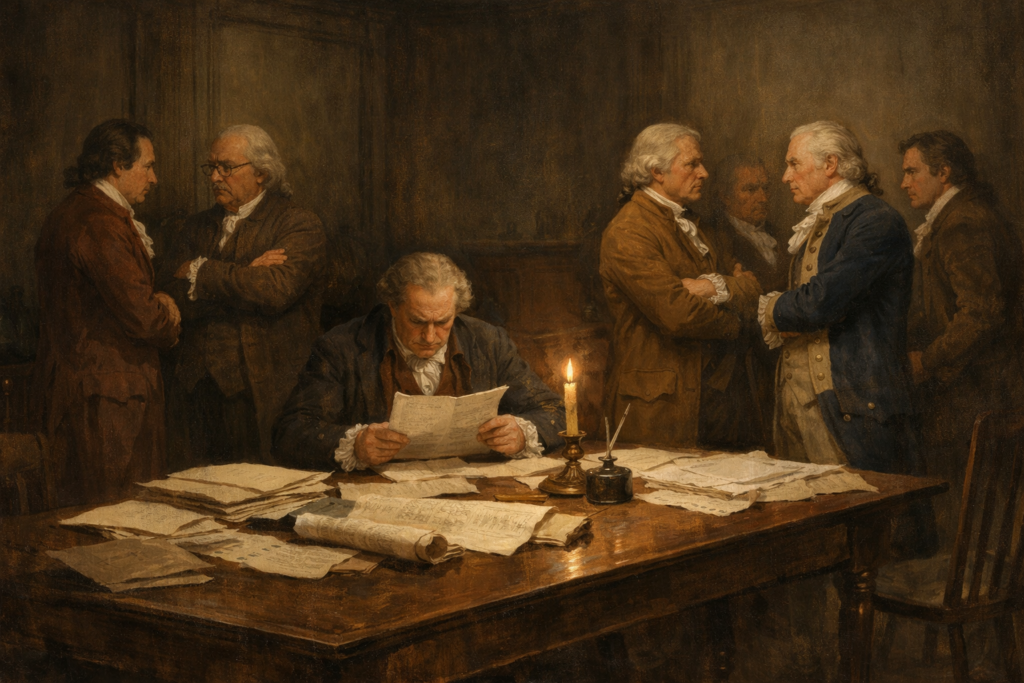
The mythology of the founding fathers often portrays them as a harmonious band of brothers united in noble purpose. The reality was far messier—these brilliant, ambitious men engaged in bitter personal feuds that sometimes threatened the very republic they were creating. In some ways, the American revolution was as much of a battle of egos as it was a war between King and colonists.
The Revolutionary War Years: Hancock, Adams, and Washington’s Critics
The tensions began even before independence was declared. John Hancock and Samuel Adams, both Massachusetts firebrands, developed a rivalry that simmered throughout the Revolution. Adams, the older political strategist, had been the dominant figure in Boston’s resistance movement. When Hancock—wealthy, vain, and eager for glory—was elected president of the Continental Congress in 1775, the austere Adams felt his protégé had grown too big for his britches. Hancock’s request for a leave of absence from the presidency of Congress in 1777 coupled with his desire for an honorific military escort home, struck Adams as a relapse into vanity. Adams even opposed a resolution of thanks for Hancock’s service, signaling open estrangement. Their relationship continued to deteriorate to the point where they barely spoke, with Adams privately mocking Hancock’s pretensions and Hancock using his position to undercut Adams politically.
The choice of Washington as commander sparked its own controversies. John Adams had nominated Washington, partly to unite the colonies by giving Virginia the top military role. Washington’s command was anything but universally admired and as the war dragged on with mixed results many critics emerged.
After the victory at Saratoga in 1777, General Horatio Gates became the focal point of what’s known as the Conway Cabal—a loose conspiracy aimed at having Gates replace Washington as commander-in-chief. General Thomas Conway wrote disparaging letters about Washington’s military abilities. Some members of Congress, including Samuel Adams, Thomas Mifflin, and Richard Henry Lee, questioned whether Washington’s defensive strategy was too cautious and if his battlefield performance was lacking. Gates himself played a duplicitous game, publicly supporting Washington while privately positioning himself as an alternative.
When Washington discovered the intrigue, his response was characteristically measured but firm. Rather than lobbying Congress or forming a counter-faction, Washington leaned heavily on reputation and restraint. He continued to communicate respectfully with Congress, emphasizing the army’s needs rather than defending his own position. Washington did not respond with denunciations or public accusations. Instead, he handled the situation largely behind the scenes. When he learned that Conway had written a critical letter praising Gates, Washington calmly informed him that he was aware of the letter—quoting it verbatim.
The conspiracy collapsed, in part because Washington’s personal reputation with the rank and file and with key political figures proved more resilient than his critics had anticipated. But the episode exposed deep fractures over strategy, leadership, and regional loyalties within the revolutionary coalition.
The Ideological Split: Hamilton vs. Jefferson and Madison
Perhaps the most consequential feud emerged in the 1790s between Alexander Hamilton and Thomas Jefferson, with James Madison eventually siding with Jefferson. This wasn’t just personal animosity—it represented a fundamental disagreement about America’s future.
Hamilton, Washington’s Treasury Secretary, envisioned an industrialized commercial nation with a strong central government, a national bank, and close ties to Britain. Jefferson, the Secretary of State, championed an agrarian republic of small farmers with minimal federal power and friendship with Revolutionary France. Their cabinet meetings became so contentious that Washington had to mediate. Hamilton accused Jefferson of being a dangerous radical who would destroy public credit. Jefferson called Hamilton a monarchist who wanted to recreate British aristocracy in America.
The conflict got personal. Hamilton leaked damaging information about Jefferson to friendly newspapers. Jefferson secretly funded a journalist, James Callender, to attack Hamilton in print. When Hamilton’s extramarital affair with Maria Reynolds became public in 1797, Jefferson’s allies savored every detail. The feud split the nation into the first political parties: Hamilton’s Federalists and Jefferson’s Democratic-Republicans. Madison, once Hamilton’s ally in promoting the Constitution, switched sides completely, becoming Jefferson’s closest political partner and Hamilton’s implacable foe.
The Adams-Jefferson Friendship, Rivalry, and Reconciliation
John Adams and Thomas Jefferson experienced one of history’s most remarkable personal relationships. They were close friends during the Revolution, working together in Congress and on the committee to draft the Declaration of Independence (though Jefferson did the actual writing). Both served diplomatic posts in Europe and developed deep mutual respect.
But the election of 1796 turned them into rivals. Adams won the presidency with Jefferson finishing second, making Jefferson vice president under the original constitutional system—imagine your closest competitor becoming your deputy. By the 1800 election, they were bitter enemies. The campaign was vicious, with Jefferson’s supporters calling Adams a “hideous hermaphroditical character” and Adams’s allies claiming Jefferson was an atheist who would destroy Christianity.
Jefferson won in 1800, and the two men didn’t speak for over a decade. Their relationship was so bitter that Adams left Washington early in the morning, before Jefferson’s inauguration. What makes their story extraordinary is the reconciliation. In 1812, mutual friends convinced them to resume correspondence. Their letters over the next fourteen years—158 of them—became one of the great intellectual exchanges in American history, discussing philosophy, politics, and their memories of the Revolution. Both men died on July 4, 1826, the fiftieth anniversary of the Declaration of Independence, with Adams’s last words reportedly being “Thomas Jefferson survives” (though Jefferson had actually died hours earlier).
Franklin vs. Adams: A Clash of Styles
In Paris, the relationship between Benjamin Franklin and John Adams was a tense blend of grudging professional reliance and deep personal irritation, rooted in radically different diplomatic styles and temperaments. Franklin, already a celebrated figure at Versailles, cultivated French support through charm, sociability, and patient maneuvering in salons and at court, a method that infuriated Adams. He equated such “nuances” with evasiveness and preferred direct argument, formal memorandums, and hard‑edged ultimatums. Sharing lodgings outside Paris only intensified Adams’s resentment as he watched Franklin rise late, receive endless visitors, and seemingly mix pleasure with business, leading Adams to complain that nothing would ever get done unless he did it himself, while Franklin privately judged Adams “always an honest man, often a wise one, but sometimes and in some things, absolutely out of his senses.” Their French ally, Foreign Minister Vergennes, reinforced the imbalance by insisting on dealing primarily with Franklin and effectively sidelining Adams in formal diplomacy. This deepened Adams’s sense that Franklin was both overindulged by the French and insufficiently assertive on America’s behalf. Yet despite their mutual loss of respect, the two ultimately cooperated—often uneasily—in the peace negotiations with Britain, and both signatures appear on the 1783 Treaty of Paris, a testament to the way personal feud and shared national purpose coexisted within the American diplomatic mission.
Hamilton and Burr: From Political Rivalry to Fatal Duel
The Hamilton-Burr feud ended in the most dramatic way possible: a duel at Weehawken, New Jersey, on July 11, 1804, where Hamilton was mortally wounded and Burr destroyed his own political career.
Their rivalry had been building for years. Both were New York lawyers and politicians, but Hamilton consistently blocked Burr’s ambitions. When Burr ran for governor of New York in 1804, Hamilton campaigned against him with particular venom, calling Burr dangerous and untrustworthy at a dinner party. When Burr read accounts of Hamilton’s remarks in a newspaper, he demanded an apology. Hamilton refused to apologize or deny the comments, leading to the duel challenge.
What made this especially tragic was that Hamilton’s oldest son, Philip, had been killed in a duel three years earlier defending his father’s honor. Hamilton reportedly planned to withhold his fire, but he either intentionally shot into the air or missed. Burr’s shot struck Hamilton in the abdomen, and he died the next day. Burr was charged with murder in both New York and New Jersey and fled to the South. Though he later returned to complete his term as vice president, his political career was finished.
Adams vs. Hamilton: The Federalist Crack-Up
One of the most destructive feuds happened within the same party. John Adams and Alexander Hamilton were both Federalists, but their relationship became poisonous during Adams’s presidency (1797-1801).
Hamilton, though not in government, tried to control Adams’s cabinet from behind the scenes. When Adams pursued peace negotiations with France (the “Quasi-War” with France was raging), Hamilton wanted war. Adams discovered that several of his cabinet members were more loyal to Hamilton than to him and fired them. In the 1800 election, Hamilton wrote a fifty-four-page pamphlet attacking Adams’s character and fitness for office—extraordinary since they were in the same party. The pamphlet was meant for limited circulation among Federalist leaders, but Jefferson’s allies got hold of it and published it widely, devastating both Adams’s re-election chances and Hamilton’s reputation. The feud helped Jefferson win and essentially destroyed the Federalist Party.
Washington and Jefferson: The Unacknowledged Tension
While Washington and Jefferson never had an open feud, their relationship cooled significantly during Washington’s presidency. Jefferson, as Secretary of State, increasingly opposed the administration’s policies, particularly Hamilton’s financial program. When Washington supported the Jay Treaty with Britain in 1795—which Jefferson saw as a betrayal of France and Republican principles—Jefferson became convinced Washington had fallen under Hamilton’s spell.
Jefferson resigned from the cabinet in 1793, partly from policy disagreements but also from discomfort with what he saw as Washington’s monarchical tendencies (the formal receptions and the ceremonial aspects of the presidency). Washington, in turn, came to view Jefferson as disloyal, especially when he learned Jefferson had been secretly funding attacks on the administration in opposition newspapers and had even put a leading critic on the federal payroll. By the time Washington delivered his Farewell Address in 1796, warning against political parties and foreign entanglements, many saw it as a rebuke of Jefferson’s philosophy. They maintained outward courtesy, but their warm relationship never recovered.
Why These Feuds Mattered
These weren’t just personal squabbles—they shaped American democracy in profound ways. The Hamilton-Jefferson rivalry created our two-party system (despite Washington’s warnings). The Adams-Hamilton split showed that parties could fracture from within. The Adams-Jefferson reconciliation demonstrated that political enemies could find common ground after leaving power.
The founding fathers were human, with all the ambition, pride, jealousy, and pettiness that entails. They fought over power, principles, and personal slights. What’s remarkable isn’t that they agreed on everything—they clearly didn’t—but that despite their bitter divisions, they created a system robust enough to survive their feuds. The Constitution itself, with its checks and balances, almost seems designed to accommodate such disagreements, ensuring that no single person or faction could dominate.
SOURCES
- National Archives – Founders Online
2. Massachusetts Historical Society – Adams-Jefferson Letters
https://www.masshist.org/publications/adams-jefferson
3. Founders Online – Hamilton’s Letter Concerning John Adams
https://founders.archives.gov/documents/Hamilton/01-25-02-0110
4. Gilder Lehrman Institute – Hamilton and Jefferson
5. National Park Service – The Conway Cabal
https://www.nps.gov/articles/000/the-conway-cabal.htm
6. American Battlefield Trust – Hamilton-Burr Duel
https://www.battlefields.org/learn/articles/hamilton-burr-duel
7. Mount Vernon – Thomas Jefferson
https://www.mountvernon.org/library/digitalhistory/digital-encyclopedia/article/thomas-jefferson
8. Monticello – Thomas Jefferson Encyclopedia
https://www.monticello.org/research-education/thomas-jefferson-encyclopedia
9. Library of Congress – John Adams Papers
https://www.loc.gov/collections/john-adams-papers
10. Joseph Ellis – “Founding Brothers: The Revolutionary Generation”
https://www.pulitzer.org/winners/joseph-j-ellis
Illustration generated by author using ChatGPT.


When They Knew: How the Fossil Fuel Industry Buried Its Own Climate Science
By John Turley
On February 9, 2026
In Commentary, Politics
The story begins not with climate deniers casting doubt on new science, but with something far more troubling: companies conducting rigorous research, understanding exactly what their products would do to the planet, and then spending decades lying to the public. They treated science as an internal planning tool and then deployed public relations, front groups, and “manufactured doubt” to delay regulation and protect profits.
The Oil Industry’s Own Scientists Saw It Coming
In 1977, a scientist named James Black stood before Exxon’s management committee with an uncomfortable message. According to internal documents later uncovered by investigative journalists, Black told executives that burning fossil fuels was increasing atmospheric carbon dioxide, and that continually rising CO2 levels would increase global temperatures by two to three degrees—a projection that is still consistent with today’s scientific consensus. He warned that we had a window of just five to ten years before “hard decisions regarding changes in energy strategies might become critical”.
What happened next is remarkable for its precision. Throughout the late 1970s and 1980s, Exxon assembled what one scientist called “a credible scientific team” to investigate the climate question. They launched ambitious projects, including outfitting a supertanker with custom instruments to measure how oceans absorbed CO2—one of the most pressing scientific questions of the era. A 2023 Harvard study analyzing Exxon’s internal climate projections from 1977 to 2003 found they predicted global warming with what researchers called “shocking skill and accuracy.” Specifically, the company projected 0.20 degrees Centigrade of warming per decade, with a margin of error of just 0.04 degrees—a forecast that has proven largely correct.
Exxon wasn’t alone. Shell produced a confidential 1988 report titled “The Greenhouse Effect” that warned of climate changes “larger than any that have occurred over the last 12,000 years,” including destructive floods and mass migrations. The report revealed Shell had been running an internal climate science program since 1981. In one striking document from 1986, Shell predicted that fossil fuel emissions would cause changes “the greatest in recorded history”.
Even industry groups understood what was coming. In 1980, the American Petroleum Institute (API) invited Stanford scientist John Laurmann to brief oil company representatives at its secret “CO2 and Climate Task Force”. His presentation, now public, warned that continued fossil fuel use would be “barely noticeable” by 2005 but by the 2060s would have “globally catastrophic effects.” That same year, the API called on governments to triple coal production worldwide, publicly insisting there would be no negative consequences.
The Coal Industry Knew Even Earlier
If anything, the coal industry understood the problem first. A 1966 article in the trade publication Mining Congress Journal by James Garvey, president of Bituminous Coal Research Inc., explicitly discussed how continued coal consumption would increase atmospheric temperatures and cause “vast changes in the climates of the earth.” A combustion engineer from Peabody Coal, now the world’s largest coal company, acknowledged in the same publication that the industry was “buying time” before air pollution regulations would force action.
This 1966 evidence is particularly damning because it predates widespread public awareness by decades. The coal industry didn’t stumble into climate denial—they entered it with full knowledge of what they were obscuring.
Major coal interests also had early awareness that carbon emissions posed regulatory and market risks, particularly for coal‑fired electricity, and they participated in joint industry research and strategy discussions about climate change in the 1980s and 1990s. At the same time, coal associations helped create public campaigns such as the Information Council for the Environment (ICE—even then a disturbing acronym), whose internal planning documents explicitly set an objective to “reposition global warming as theory (not fact)” and to target specific demographic groups with tailored doubt‑based messages.
According to a report from the Union of Concerned Scientists, these efforts often relied on “grassroots” fronts, advertising, and even forged constituent letters to legislators to undermine support for climate policy and to counter the conclusions of mainstream climate science, which even the companies’ own experts did not refute.
What They Said Publicly
The contrast between private knowledge and public statements is stark. While Exxon scientists were building sophisticated climate models internally, the company’s public messaging emphasized uncertainty. In a 1997 speech, Exxon CEO Lee Raymond told an audience at the World Petroleum Conference: “Let’s agree there’s a lot we really don’t know about how climate change will change in the 21st century and beyond”. They spread messaging that emphasized uncertainty, framed global warming as just a “theory,” and highlighted supposed flaws in climate models, even as their own scientists were using those models to make precise projections. The company and allied trade associations supported think tanks and advocacy groups such as Citizens For Sound Science, that questioned if human activity was responsible for warming and opposed binding limits on emissions, producing a stark discrepancy between internal scientific knowledge and external communication.
In 1989, Exxon helped create the Global Climate Coalition—despite its environmental sounding name, the organization worked to cast doubt on climate science and block clean energy legislation throughout the 1990s. Electric utilities and coal‑linked organizations joined this coalition to systematically attack climate scientists and lobby to weaken or stall international agreements like the Kyoto Protocol, despite internal recognition that greenhouse gases were driving warming.
Internal API documents from a 1998 meeting reveal an explicit strategy to “ensure that a majority of the American public… recognizes that significant uncertainties exist in climate science”.
In 1991, Shell produced a film, “Climate of Concern,” which stated that human driven—as opposed to greenhouse gas driven—climate change was happening “at a rate faster than at any time since the end of the ice age” and warned of extreme weather, flooding, famine, and climate refugees. They understood the science but tried to shift the blame.
According to a 2013 Drexel University study, between 2003 and 2010 alone, approximately $558 million was distributed to about 100 climate change denial organizations. Greenpeace reports that Exxon alone spent more than $30 million on think tanks promoting climate denial.
The Tobacco Playbook
The parallels to Big Tobacco’s strategy are not coincidental—they’re intentional. Research by the Center for International Environmental Law uncovered more than 100 documents from the Tobacco Industry Archives showing that oil and tobacco companies not only used the same PR firms and research institutes, but often the same individual researchers. The connection goes back to at least the 1950s. A report published in Scientific American suggests the oil and tobacco industries both hired the PR firm Hill & Knowlton Inc. as early as 1956.
A 1969 internal memo from R.J. Reynolds Tobacco Company stated plainly: “Doubt is our product since it is the best means of competing with the ‘body of fact’ that exists in the mind of the general public”. This became the template. Create uncertainty. Emphasize what isn’t known rather than what is. Fund research that casts doubt. Attack the credibility of independent scientists. They formed organizations with scientific-sounding names that existed primarily to muddy the waters.
In one particularly brazen example, a 2015 presentation by Cloud Peak Energy executive Richard Reavey titled “Survival Is Victory: Lessons From the Tobacco Wars,” explicitly coached coal executives on how to apply tobacco industry tactics.
What makes the fossil fuel case particularly egregious is the temporal dimension. These weren’t companies caught off-guard by emerging science. They funded the research. They understood the findings. Their own scientists urged action. A 1978 Exxon memo noted this could be “the kind of opportunity we are looking for to have Exxon technology, management and leadership resources put into the context of a project aimed at benefitting mankind”.
Instead, when oil prices collapsed in the mid-1980s, Exxon pivoted from conducting climate research to funding climate denial. By the late 1980s, according to reporting by InsideClimate News, Exxon “curtailed its carbon dioxide research” and “worked instead at the forefront of climate denial”.
Where We Stand Now
Across the oil, gas, and coal industries, there is not a genuine scientific dispute inside companies but a divergence between what in‑house experts knew and what corporate leaders chose to communicate to the public and policymakers. This divergence mirrors the tobacco industry’s long‑running use of organized doubt. In both arenas, industry actors treated early recognition of harm as a legal and political threat and responded by investing in campaigns to confuse, delay, and reframe the science rather than addressing the risks their own research had identified.
The evidence trail has led to legal action. More than 20 cities, counties, and states have filed lawsuits against fossil fuel companies for damages caused by climate change, arguing the industry knowingly deceived the public. The European Parliament held hearings in 2019 on climate denial by ExxonMobil and other actors. The hashtags #ExxonKnew, #ShellKnew, and #TotalKnew have become rallying cries for accountability.
Senator Sheldon Whitehouse has explicitly compared the fossil fuel industry’s actions to the tobacco racketeering case that ultimately held cigarette makers accountable. As he noted in a Senate speech, the elements of a civil racketeering case are straightforward: defendants conducted an enterprise with a pattern of racketeering activity.
The difference between the tobacco and fossil fuel cases may be one of scale. As researchers Naomi Oreskes and Erik Conway documented in their book Merchants of Doubt, both industries worked to obscure truth for profit. But while tobacco kills individuals, climate change threatens entire ecosystems and future generations. The time to act is now.
Sources:
Scientific American – “Exxon Knew about Climate Change Almost 40 Years Ago”
https://www.scientificamerican.com/article/exxon-knew-about-climate-change-almost-40-years-ago/
Harvard Gazette – Harvard-led analysis finds ExxonMobil internal research accurately predicted climate change
https://news.harvard.edu/gazette/story/2023/01/harvard-led-analysis-finds-exxonmobil-internal-research-accurately-predicted-climate-change/
InsideClimate News – Exxon’s Own Research Confirmed Fossil Fuels’ Role in Global Warming Decades Ago
https://insideclimatenews.org/news/02052024/from-the-archive-exxon-research-global-warming/
PBS Frontline – Investigation Finds Exxon Ignored Its Own Early Climate Change Warnings
https://www.pbs.org/wgbh/frontline/article/investigation-finds-exxon-ignored-its-own-early-climate-change-warnings/
NPR – Exxon climate predictions were accurate decades ago. Still it sowed doubt
https://www.npr.org/2023/01/12/1148376084/exxon-climate-predictions-were-accurate-decades-ago-still-it-sowed-doubt
Science (journal) – Assessing ExxonMobil’s global warming projections
https://www.science.org/doi/10.1126/science.abk0063
Climate Investigations Center – Shell Climate Documents
https://climateinvestigations.org/shell-oil-climate-documents/
The Conversation – What Big Oil knew about climate change, in its own words
https://theconversation.com/what-big-oil-knew-about-climate-change-in-its-own-words-170642
ScienceAlert – The Coal Industry Was Well Aware of Climate Change Predictions Over 50 Years Ago
https://www.sciencealert.com/coal-industry-knew-about-climate-change-in-the-60s-damning-revelations-show
The Intercept – A Major Coal Company Went Bust. Its Bankruptcy Filing Shows That It Was Funding Climate Change Denialism
https://theintercept.com/2019/05/16/coal-industry-climate-change-denial-cloud-peak-energy/
Center for International Environmental Law – Big Oil Denial Playbook Revealed by New Documents
https://www.ciel.org/news/oil-tobacco-denial-playbook/
Wikipedia – Tobacco industry playbook
https://en.wikipedia.org/wiki/Tobacco_industry_playbook
Scientific American – Tobacco and Oil Industries Used Same Researchers to Sway Public
https://www.scientificamerican.com/article/tobacco-and-oil-industries-used-same-researchers-to-sway-public1/
Environmental Health (journal) – The science of spin: targeted strategies to manufacture doubt with detrimental effects on environmental and public health
https://link.springer.com/article/10.1186/s12940-021-00723-0
Senator Sheldon Whitehouse – Time to Wake Up: Climate Denial Recalls Tobacco Racketeering
https://www.whitehouse.senate.gov/news/speeches/time-to-wake-up-climate-denial-recalls-tobacco-racketeering/
VICE News – Meet the ‘Merchants of Doubt’ Who Sow Confusion about Tobacco Smoke and Climate Change
https://www.vice.com/en/article/meet-the-merchants-of-doubt-who-sow-confusion-about-tobacco-smoke-and-climate-change/
Union of Concerned Scientists – The Climate Deception Dossiers
https://www.ucs.org/sites/default/files/attach/2015/07/The-Climate-Deception-Dossiers.pdf
Illustration generated by author using ChatGPT.