Cold plunge tubs are popping up everywhere — gyms, spas, suburban backyards, and increasingly in high-end wellness retreats. Influencers post videos of themselves lowering into icy water with overly dramatic grimaces. Podcasters talk enthusiastically about dopamine surges and mental clarity. Biohackers track immersion times with the seriousness of laboratory researchers.
I have always been skeptical of what I call “fad medicine,” but cold plunging has become so widespread that it warrants a closer, more careful look. The question most people want answered is a simple one: is any of this real, is it at least minimally beneficial, or is it just expensive discomfort dressed up in scientific language?
The most honest answer is that it is a mix of all three. Some of the claims are grounded in solid physiology. Some are intriguing but still preliminary. And some have clearly outpaced the available evidence.
Cold-water immersion, often abbreviated as CWI, does have some legitimate scientific literature behind it. That said, the body of research is smaller, more recent, and less definitive than popular wellness culture would suggest. What follows is an attempt to separate what is known from what is plausible, what remains largely speculative, and what may be downright dangerous.
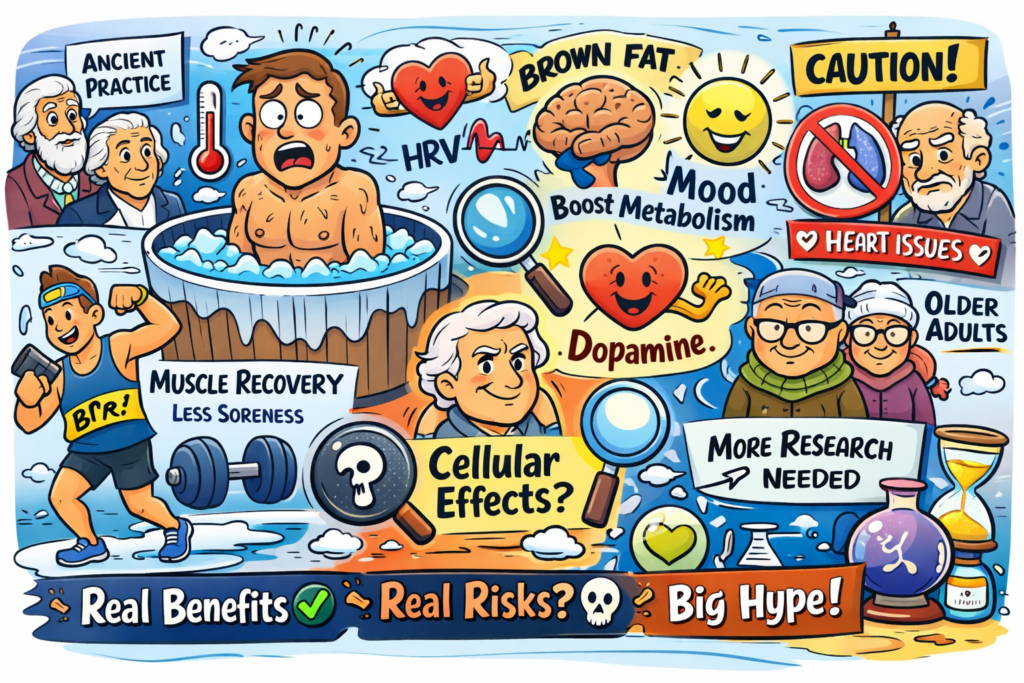
Long before cold plunging became a modern wellness trend, it existed as a long-standing human practice. References to cold water therapy appear in Egyptian medical texts dating back several thousand years. The Greek physician Hippocrates recommended cold water for pain relief and fatigue. Even Thomas Jefferson was said to have soaked his feet in cold water every morning for decades, believing it contributed to his health. The practice itself is not new but the attempt to study it systematically is.
For much of modern medical history, research on cold exposure focused primarily on its dangers—hypothermia, cardiac stress, and survival in extreme environments. Only in recent years has attention shifted toward possible benefits, driven largely by the explosion of public interest and researchers have acknowledged that the science is still catching up.
When it comes to physical effects, the strongest evidence relates to muscle recovery. Cold-water immersion has been shown to reduce soreness following intense exercise. The mechanism is relatively well understood. Exposure to cold causes blood vessels to constrict, which limits swelling and reduces inflammatory signaling. When normal circulation returns, metabolic byproducts are cleared more efficiently from muscle tissue. This is why athletes have relied on ice baths for decades.
However, this benefit comes with an important caveat. The same processes that reduce inflammation may also interfere with the body’s ability to adapt to strength training. Some studies suggest that regular cold exposure immediately after resistance exercise can blunt the molecular signals responsible for muscle growth. In practical terms, what helps you feel better in the short term may limit gains over the long term. For endurance athletes, this effect appears less pronounced, but for individuals focused on building strength and muscle mass, it is a meaningful consideration.
Cold exposure also has immediate and dramatic effects on the cardiovascular system. Immersion in cold water triggers what is often referred to as the “cold shock” response. Heart rate increases rapidly, blood pressure rises, and blood vessels in the skin constrict sharply, redirecting blood toward the body’s core. This is a powerful physiological stressor. Interestingly, once the body begins to recover, there is often a shift toward increased parasympathetic activity — the branch of the nervous system associated with rest and recovery. This shift is sometimes reflected in improved heart rate variability, a marker that correlates with cardiovascular resilience.
Observational studies of habitual cold-water swimmers suggest improvements in certain cardiovascular risk markers, including lipid profiles and oxidative stress. At the same time, it is important to recognize that even in well-adapted individuals, cold immersion still increases cardiac workload. The potential benefits and risks are not separate; they occur simultaneously. Whether long-term adaptation outweighs repeated short-term stress is still an open question.
Another frequently discussed area involves metabolism, particularly the activation of brown adipose tissue, or “brown fat.” Unlike white fat, which stores energy, brown fat burns energy to generate heat. Cold exposure stimulates this process, and some studies suggest it may improve insulin sensitivity and metabolic efficiency. A 2024 review published in GeroScience highlighted the possibility that cold exposure could reduce cardiometabolic risk. However, most of these studies are small and conducted under controlled conditions that may not reflect real-world behavior. While the findings are promising, they are not yet strong enough to support broad clinical recommendations.
More recently, researchers have begun exploring cellular-level effects. A 2025 study from the University of Ottawa found that repeated cold exposure influenced processes such as autophagy and apoptosis, which are involved in cellular repair and turnover. These mechanisms are often associated with aging and longevity. While the findings are intriguing, they were observed in a limited population and over a short time frame. At this stage, they represent an interesting possibility rather than a definitive conclusion.
The mental and emotional effects of cold plunging are perhaps the most widely discussed and the least clearly understood. Cold exposure triggers a surge in neurotransmitters, particularly norepinephrine and dopamine. These chemicals are associated with alertness, focus, and the experience of reward. Many individuals report feeling energized, clear-headed, and even euphoric after a cold plunge.
The key question, however, is whether these short-term effects translate into lasting improvements in mental health. Current evidence suggests that while immediate mood elevation is real, long-term benefits are less certain. Systematic reviews have found that the evidence for sustained reductions in anxiety or depression is inconclusive. It is also worth noting that some of the perceived benefit may reflect a placebo effect, which, while real, complicates interpretation.
There is somewhat stronger evidence supporting short-term stress reduction. Cold exposure acts as a controlled stressor, forcing the body to adapt. This concept, known as hormesis, suggests that small, manageable stressors can enhance resilience over time. Some studies have found that cold-water immersion is associated with reduced stress levels, improved sleep, and enhanced subjective well-being for several hours following exposure. However, these effects appear to be time-limited, and it is not yet clear whether they accumulate in a meaningful way over longer periods.
Claims regarding immune function are among the most popular and the least substantiated. A frequently cited study reported that individuals who took cold showers experienced fewer sick days. However, cold showers are not the same as full immersion, and reduced absenteeism is not a direct measure of immune performance. Studies examining cold-water immersion have produced inconsistent results. Some show changes in immune markers, while others do not. Most focus on laboratory measurements rather than actual illness outcomes. At present, the evidence for immune enhancement remains inconclusive.
For older adults, the picture becomes more complex. Aging affects the body’s ability to regulate temperature. The capacity to generate heat declines, sensitivity to cold may be reduced, and chronic conditions or medications can further impair thermoregulation. What might be an invigorating experience for a younger individual can pose a genuine risk for someone in their later decades.
This does not mean cold exposure is entirely off the table, but it does mean the approach must be modified. Milder temperatures, shorter durations, and greater caution are essential. The margin for error is smaller, and symptoms such as dizziness, confusion, or irregular heartbeat may be delayed. The risk-benefit balance shifts noticeably with age.
There are also groups for whom cold plunging is best avoided altogether. Individuals with cardiovascular disease, particularly those with arrhythmias or a history of heart attack, face increased risk due to the sudden cardiovascular stress. People with peripheral vascular disease or Raynaud’s phenomenon may experience harmful levels of vasoconstriction. Those with diabetes and neuropathy may have impaired sensation and circulation, increasing the risk of injury. Individuals with respiratory conditions such as severe asthma may be vulnerable to cold-induced bronchospasm. Additional caution applies to those with rare conditions such as cold urticaria or cryoglobulinemia, as well as anyone recovering from recent surgery.
It is important to acknowledge what the evidence does not support. Claims that cold plunging significantly slows aging are not backed by clinical data. The idea that it produces long-term immune enhancement remains unproven. Even the metabolic benefits, while biologically plausible, appear modest and context-dependent.
Another challenge is the lack of standardization in the research itself. Studies vary widely in water temperature, duration of exposure, frequency, and participant characteristics. This makes it difficult to compare results or draw firm conclusions. In many cases, researchers are effectively studying different interventions under the same label.
The bottom line is that cold plunging is neither a miracle cure nor pure nonsense. It produces real physiological effects, some of which are beneficial, particularly in the context of athletic recovery. For healthy individuals, it may offer short-term improvements in mood, stress, and perceived well-being. At the same time, its long-term benefits remain uncertain, and its risks are not trivial for certain populations.
For those who are curious and in good health, a gradual and cautious approach may be reasonable. Starting with cool water and progressing slowly allows the body to adapt while minimizing risk. A visit with a physician is still advised before starting any new regimen.
For individuals with underlying medical conditions, particularly cardiovascular disease, the prudent course is to consult a physician before attempting any cold water immersion.
Cold plunging clearly does something. The challenge is that we are still in the early stages of understanding exactly what that “something” is, how durable it may be, and for whom it is most appropriate. In medicine, that places it in a familiar category—an intervention that is interesting, potentially useful, possibly harmful in some cases, but not yet fully defined.
Illustration generated by author using ChatGPT.
Sources
2. Cold-water plunging health benefits — Mayo Clinic Health System (2024)
3. Cold plunges: Healthy or harmful for your heart? — Harvard Health (2025)
4. The untapped potential of cold water therapy for healthy aging — PMC / GeroScience (2024)
5. Health effects of voluntary exposure to cold water — PMC / Int J Circumpolar Health (2022)
6. Cold plunges actually change your cells — ScienceDaily / University of Ottawa (2025)
7. The health benefits (and risks) of cold plunges — Advisory Board (2025)
8. What are the health benefits of a cold plunge? Scientists vet the claims — NPR (2023)
9. The benefits of cold-water immersion therapy — UF Health Jacksonville (2024)
10. Cold and longevity: Can cold exposure counteract aging? — ScienceDirect (2025)
11. Ice bath for seniors: Safety and age-appropriate cold therapy — PlungeChill (2025)
12. What seniors should know before trying a cold plunge — SilverSneakers (2025)
13. Ice baths over 50, according to a geriatrician — Parade (2023)
14. Ice baths and saunas: Are the latest health trends bad for your lungs? — American Lung Association
15. Sauna and cold plunge for seniors 60+: Safe protocols guide 2026 — Calore Health
16. Cold plunge benefits, risks, and who should avoid — Dr. Axe (2024)
Medical Disclaimer
The information provided in this article is intended for general educational and informational purposes only and does not constitute medical advice. It should not be used as a substitute for professional medical advice, diagnosis, or treatment.
Always seek the guidance of a qualified healthcare provider with any questions you may have regarding a medical condition or treatment. Never disregard professional medical advice or delay seeking it because of something you have read here.
If you are experiencing a medical emergency, call 911 or your local emergency number immediately.
The author of this article is a licensed physician, but the views expressed here are solely those of the author and do not represent the official position of any hospital, health system, or medical organization with which the author may be affiliated.
Leave a Reply