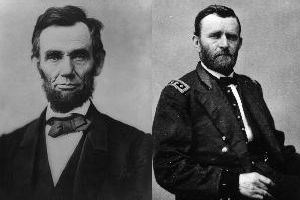
On January 12, 1864, President Lincoln went to Fort Stevens north of Washington, DC to observe military actions by the soldiers defending the capital against the Confederate cavalry of General Jubal Early. Lincoln became the only sitting United States President to come under direct fire from enemy troops. Reportedly, a young officer named Oliver Wendell Holmes (a future Supreme Court Justice) said to Lincoln “Get down you, damn fool”.
Ulysses S. Grant was the first army officer to hold the rank of Lieutenant General since George Washington.
One of General Grant’s ongoing problems was political generals. Because the army expanded so quickly, many people with little or no military experience were commissioned as officers because of political connections. Former senators, congressmen and governors frequently became generals. A number of these were placed in critical combat commands. Many of the early union setbacks can be partially attributed to the ineptitude of political generals who either were unable or unwilling to follow the orders of the professional army. (It must also be admitted that a few regular army generals were inept, but they were easier to set aside.) It wasn’t until late in the war that Grant finally had sufficient influence to be able to dismiss a number of these political generals.
Future Confederate General James Longstreet was a groomsman at the wedding of Ulysses and Julia Grant. He was a West Point friend of Grant’s and Julia’s cousin as well.
Lincoln first offered command of the Army of the Potomac to Robert E Lee. Lee refused, resigned his commission in the United States Army, and returned to Virginia where he swore allegiance to the Confederacy. The first official commander of the Army of the Potomac was General George B. McClellan. General Irwin McDowell commanded the union forces at the first battle of Bull Run, but those forces had not been designated as the Army of the Potomac at that time.
Lee was not the first choice for command of the army of Northern Virginia. The first commander of what would eventually become the army of Northern Virginia was General P. G. T. Beauregard. Interestingly, he also designed the Confederate battle flag which is today widely considered as the “Confederate flag”. It was designed because of the confusion between the Confederate national flag, the stars and bars, and the United States flag. General Beauregard relinquished command to General Joseph E. Johnston when his army was combined with Johnston’s larger army group. Lee did not become commander of the army of Northern Virginia until Johnston was wounded in battle and unable to continue.
The Civil War did not end with the surrender at Appomattox Courthouse on April 9, 1865. On April 26th, Joseph E. Johnston surrendered his larger army of 90,000 soldiers. On May 26th General Kirby Smith surrendered the Army of the Trans-Mississippi, the largest confederate force still operating on land. The last Confederate flag was lowered when the open ocean raider CSS Shenandoah surrendered to the British in Liverpool on November 6th. Interestingly, almost half of the Shenandoah ‘s victories over merchant ships occurred after the surrender at Appomattox.
The surrender at Appomattox Courthouse occurred in the home of Wilmer McLean. In one of those interesting coincidences of history, McLean originally lived near Manassas VA and his property was part of the battlefield of Bull Run. He moved to Appomattox Courthouse to try to get as far away from the fighting as he could.
At the beginning of the Civil War, Ulysses S. Grant was not even in the army. Initially, despite being a West Point graduate, he was refused a commission in the regular army and his first Civil War commission was in the militia.
Grant and wife were initially scheduled to be in the box with President and Mrs. Lincoln at Ford’s Theater on the night the President was assassinated. At the insistence of Julia, the Grants left Washington that afternoon. There’s been much speculation about why they did not attend the theater. Among the many reasons put forward are: Julia missed her children whom she had not seen for almost three months; Julia did not wish to spend time with Mrs. Lincoln whom she found disagreeable and with whom she had several contentious meetings; and one which seems most interesting, she was reported as being very worried about someone that she thought had been watching her all that day and she felt they needed to get away. The assassins did report that Grant had been one of their initial targets so this may be a true report.
Emancipation Proclamation only freed slaves in Confederate held territory. Slavery was not officially abolished in the entire United States until December 6, 1865, with the ratification of the 13th amendment.
Counting both northern and southern casualties, more Americans died in the Civil War than in all other American wars combined. The most recent estimate of the number of Civil War deaths on both sides is placed at about 750,000. Of that number, almost 2/3 died from disease.
At the end of the Civil War the United States had the largest army in the world. In 1860 the US Army had been about 16,000. At the end of the Civil War, it is estimated the army was slightly over one million. It is estimated that a total of about 2.6 million served in the US Army during the Civil War. There are no reliable estimates of the total number to have served in the Confederate Army.
Grant’s drinking was largely overstated. The stories of his dinking stem from a period, early in his career, when Grant was assigned to an isolated fort on the West Coast and his family remained on the East Coast. He suffered depression and loneliness. Throughout his life he had anxiety when separated from his family. While in the west, he began bouts of binge drinking. He missed his family to the point that he resigned from the army even though he had no job prospects at the time. There is very little report of any drinking by Grant’s following his return to the army during the Civil War, although rumors were plentiful. When given reports of supposed excessive drinking on Grant’s part, Lincoln is reported to have said “Find out what whiskey he drinks and send a case to all of my generals”.
Grant smoked up to 20 cigars a day and admirers from all over the country mailed him boxes of cigars. He eventually died of cancer of the throat and tongue.
The poet Walt Whitman worked as a volunteer in union hospitals.
Lew Wallace, author of Ben Hur, was a general in the Union Army. By most reports he was a better author than general.
The last verified Civil War veteran died in 1956. He was Albert Woolson who served in the Union Army as a drummer boy. There were three men who claimed to be Confederate veterans who lived longer than Woolson; however, one of those has been completely debunked and no confirmation of service of the other two has ever been found.


Things You May Not Know About George Washington
By John Turley
On June 18, 2023
In Appalachia, Commentary, History
We all know a lot about George Washington. Or do we really? And is everything we think we know true? We all know he was the first president, but was he really? He was the commander in chief of the Continental Army, and there is no question about that. He is often called the father of his country. But did you know that he never had any children?
The fanciful tales about George Washington began to circulate while he was still alive. Everyone has heard the story of the chopping down of the cherry tree and how the young George Washington could not tell a lie and that he did it with his little hatchet. Did you know that this story was created for one of the first biographies circulated about George Washington? It was a best seller written by Parson Mason Weems who was more interested in promoting morality than in historical accuracy. We also have the story of how Washington threw a silver dollar across the Potomac. Even though money went further in those days, it is unlikely since the river is about a mile wide at that point.
Presidential Dentures
We’ve all heard how Washington had wooden false teeth. It’s true that he had false teeth; he suffered with dental problems his entire life. But they weren’t made of wood. Washington began to lose his teeth in his early 20s. He had several sets of dentures made throughout his life, including one that incorporated hippopotamus ivory. He also had a set that incorporated human teeth. In the 18th century dentists were known to purchase healthy teeth from living donors who were in need of cash. The dentist would then incorporate these teeth into dentures for their clients. The dentures were cumbersome things that involved metal plates and gold wiring. Can you imagine having these in your mouth?
The First Entrepreneur
George Washington owned and operated one of the largest commercial distilleries in the early United States. Following his presidency, he began work on his distillery at Mount Vernon. He produced mostly rye whiskey, and it was quite profitable. So, not only was Washington first in war and first in peace but he was first in cocktails as well. (That makes him even more of a hero to me!) Margie and I visited Washington’s distillery as recreated at Mount Vernon. I even bought a bottle of his Mount Vernon whiskey that you can see below on my bookcase.
I haven’t yet tried it. The distiller told me it was considered to be very smooth for its day. When I asked him what we would consider it in our day, he said “Pretty rough.” Perhaps some year, on the anniversary of the Battle of Brooklyn Heights, I’ll use it to make a Mount Vernon Manhattan (or not).
Even though Washington owned a major distillery, rye whiskey was not his favorite drink. When at dinner or sitting around the fire with friends he enjoyed a glass of Madeira. It is a fortified wine made on the Portuguese island of Madeira. Washington began ordering Madeira from his London agents in 1759 and continued ordering throughout his life. He usually ordered wine in “pipes” of 150 gallons. He seldom traveled without a large supply of Madeira.
We’ve all been taught to think of George Washington as a planter. But now we know he was distiller as well. Will it surprise you to learn that he was also a commercial fisherman?
When tobacco prices started to fall, Washington looked for ways to diversify his income. He had almost 10 miles of shoreline on the Potomac River. He bought boats and nets and set his enslaved workers to the task of catching shad, herring, perch, and sturgeon. The fish were cleaned, packed in salt, and sold all over the colonies and even shipped to Europe. He went so far as to buy a sailing schooner that he used to ship his fish to such places as Portugal and Jamaica.
A Mountaineer?
Would you believe that George Washington was once a major landowner in what is now West Virginia? Washington received major land grants for his service in the French and Indian war and he also purchased grants from others who were not interested in developing their wilderness land. He owned land at the mouth of the Kanawha River in the area that is now Point Pleasant, West Virginia. He also owned land along the Kanawha River from the mouth of Coal River up to the area that now includes Charleston. So, we can honestly say George Washington was a West Virginian.
The Traveler?
George Washington only made one trip out of what would become the United States. He had been largely raised by his older half-brother Lawrence after his father died. Lawrence had been suffering from tuberculosis and was advised to spend the winter in the tropics. Nineteen-year-old George agreed to go with him on a trip to Barbados. Two important things happened while he was there. He had the opportunity to meet British Army officers and study fortifications and learn about British military armaments and drill. This was the beginning of his lifelong love of all things military.
But perhaps the most important and least well-known portion of this trip was that Washington contracted and recovered from smallpox, leaving him with lifelong immunity. Smallpox had ravaged the colonies for several years and was devastating many units of the Continental Army. Imagine the fate of the revolution had Washington died of smallpox in 1777.
As a result of the epidemic, he issued one of the first public health orders from the American government. He ordered that all recruits arriving in Philadelphia for the Continental Army be inoculated against smallpox. This practice was soon spread across all colonies and even veteran soldiers who had not yet had smallpox were inoculated.
There are many more fascinating things about George Washington, and I will include them in a future post entitled Even More Things You May Not Have Known About George Washington.
The First Question and Final Answer
In case you think I’ve forgotten my question about the first president, Washington was the first president, under the constitution. However, prior to the adoption of the Constitution, while under the Articles of Confederation there were eight men who held the title of President of the Congress and whom some historians consider to be Presidents of the United States. But, unless you’re a true history nerd, you’ve never heard of John Hanson, first president under the Articles of Confederation. It’s The Grumpy Doc’s opinion that his lack of accomplishments earned him his well deserved obscurity.
For even more interesting facts about Washington, see the website www.MountVernon.org.